
Wiring Electricity to a Pergola or Gazebo: Minnesota Guide
Key Takeaways
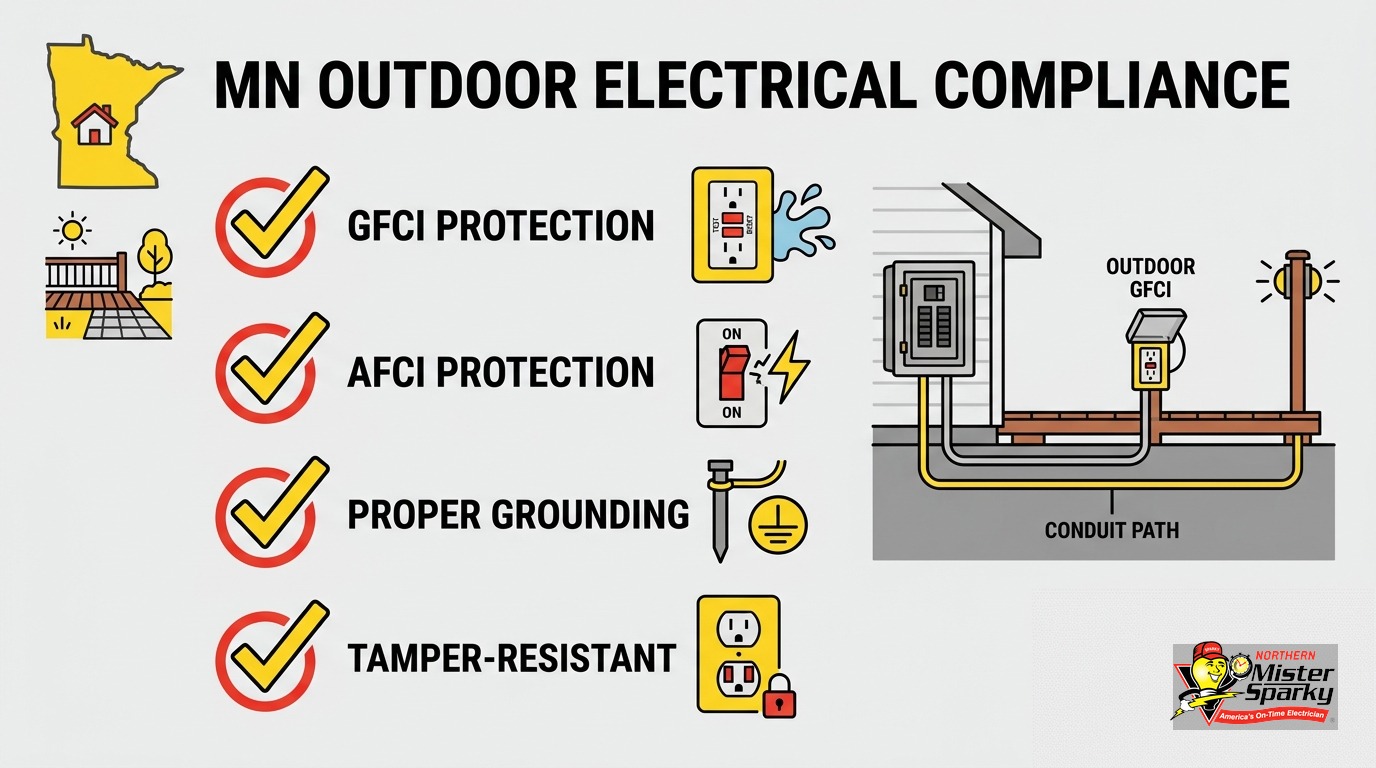
- An open pergola is a wet location under the NEC. A covered gazebo is a damp location. The distinction changes which outlet covers and fixture ratings are required.
- Minnesota adopted the 2026 NEC on August 17, 2026. Any electrical permit pulled today must comply with the new code.
- NEC 210.8(F) requires GFCI protection for all outdoor outlets, including hardwired ceiling fans and luminaires. A GFCI circuit breaker at the panel is the cleanest solution.
- Burial depth for buried conduit ranges from 6 inches for rigid metal conduit to 24 inches for direct-burial cable on a standard circuit.
- NEC Article 225 requires a disconnect at any detached structure that receives power. Most guides skip this requirement entirely.
- Minneapolis and St. Paul run their own permit offices. Most Twin Cities suburbs use the state DLI system.
- Call 763-200-5956 or book online to schedule an estimate.
Wiring electricity to a pergola or gazebo is a more involved project than most homeowners expect. The circuit crosses open ground in buried conduit. The structure needs a dedicated disconnect on-site. New GFCI rules now cover hardwired fixtures, not just receptacles. This guide covers all of it: burial depths, location classification, above-grade conduit, the disconnect requirement, and the Minnesota permit process. Minnesota adopted the 2026 NEC on August 17, 2026. Any permit pulled today is under the new code.
Why Wiring a Pergola or Gazebo Is More Involved Than a Deck Outlet
Adding an outlet to an attached deck is a short tap from the house panel. A pergola or gazebo sitting in the middle of the yard is a different job.
The circuit has to cross open ground in buried conduit. The structure is treated as a separate building under NEC Article 225. That means a disconnect at the structure, specific conduit choices above and below grade, and GFCI requirements that go beyond a single outdoor outlet.
Minnesota added another variable on August 17, 2026. That is when the state adopted the 2026 NEC. Any permit pulled today is under the new code. If your project straddles that date, the permit date determines which code applies.
This guide covers the complete job: location classification, burial depth, above-grade conduit, GFCI requirements, the disconnect, and the Minnesota permit process. For the simpler attached-deck scenario, that is covered in a separate article.
Does Your Pergola Count as a Wet Location or a Damp Location?
An open pergola with no solid overhead roof is a wet location under the NEC. A covered gazebo with a solid roof is a damp location. Wet locations require an in-use bubble cover that stays weatherproof even with a cord plugged in. Damp locations only need a cover that protects when nothing is connected.
This distinction comes from NEC 406.9. It determines which receptacles and covers are code-compliant on your structure.
An open pergola has no solid overhead protection. Rain falls directly on any outlet or fixture. Under NEC 406.9(B), that is a wet location. You need a weather-resistant (WR) receptacle and an in-use weatherproof cover rated for wet locations. The in-use cover stays sealed around a plugged-in cord. A standard flat-closure cover does not meet this requirement.
A covered gazebo with a solid roof keeps rain off the fixtures. Under NEC 406.9(A), that is a damp location. You still need a WR receptacle and a weatherproof enclosure. But the cover only has to protect when nothing is plugged in. A flat-closure cover is acceptable here.
Most pergolas sold in Minnesota have lattice tops, open slat roofs, or no roof panels at all. Most gazebos have solid roofs. Check your specific structure before ordering hardware.
Some partial-cover designs fall into a gray zone: a pergola with polycarbonate panels covering part of the roof, for example. When the classification is unclear, default to wet location requirements. Overspecifying hardware costs a little more. Underspecifying it fails inspection.
What Burial Depth Does the Trench Need to Be?
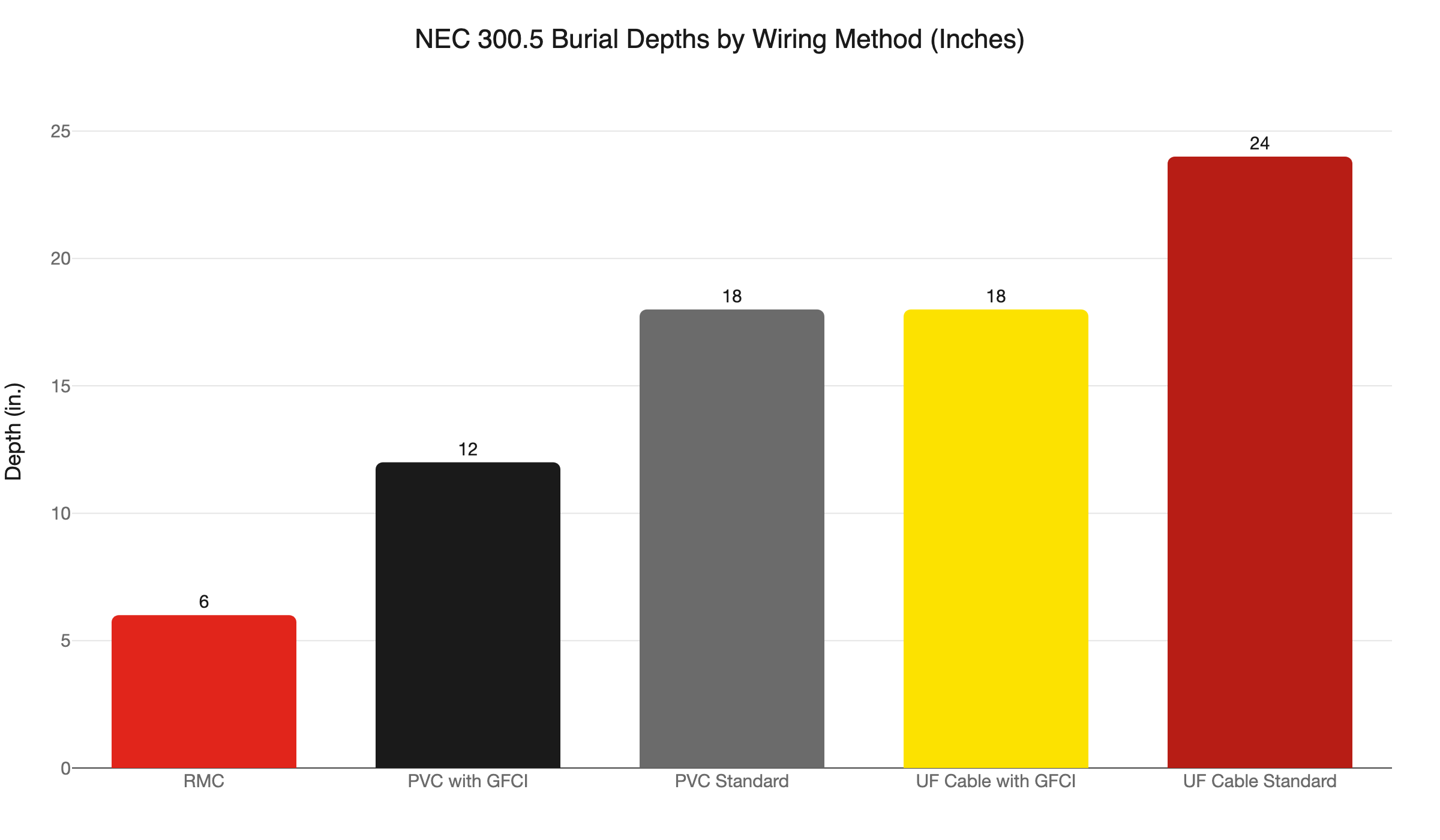
Minimum burial depth depends on the wiring method. Rigid metal conduit requires 6 inches. PVC conduit on a GFCI-protected 120V/20A circuit requires 12 inches, or 18 inches on a standard circuit. Direct-burial UF cable requires 18 inches with GFCI protection, or 24 inches without.
These minimums come from NEC Article 300.5. Depth is measured to the top of the conduit or cable.
Here is the breakdown by wiring method:
- Rigid metal conduit (RMC): 6 inches. The metal provides mechanical protection. The NEC rewards that with the shallowest burial depth allowed.
- PVC conduit, GFCI-protected 120V/20A circuit: 12 inches. GFCI protection earns a 6-inch reduction from the standard depth.
- PVC conduit, standard circuit: 18 inches.
- Direct-burial UF cable, GFCI-protected: 18 inches.
- Direct-burial UF cable, standard circuit: 24 inches.
A common point of confusion for Minnesota homeowners: frost depth and burial depth are two separate things. Minnesota’s frost line runs 42 to 60 inches, depending on location. NEC burial minimums are about mechanical protection of the wire. The trench does not need to reach frost depth.
There is one related issue worth knowing. If a post at the structure is set in concrete, that post needs to reach frost depth. A shallow post will shift over a Minnesota winter. Shifting can damage the conduit entering the post base.
For more on conduit type comparisons and burial requirements for other outdoor runs, see our underground electrical wire depth guide for Minnesota.
What Conduit Goes Above Grade on the Post and Beams?
Above-grade conduit on a pergola or gazebo must be rated for the location. PVC Schedule 40 or Schedule 80 works for long runs up posts and along beams. Liquid-tight flexible conduit handles short runs at junction boxes and fixture entries. All conduit must be strapped at code-required intervals.
This is the section most online guides skip. Everyone covers the underground run. Almost no guide covers what happens once the conduit comes up out of the ground and routes up the post.
Options for above-grade runs:
- PVC conduit (Schedule 40 or 80): Rated for outdoor use and wet locations. Use it for the post run from grade up to the first junction box and along overhead beams. Schedule 80 has thicker walls for spots with higher physical contact risk.
- Liquid-tight flexible metal conduit (LFMC): Correct for short connection runs at junction boxes, fixture entries, and tight bends that rigid conduit cannot navigate cleanly.
- Rigid metal conduit (RMC): Maximum mechanical protection. Costs more and takes more labor to route around decorative timber beams. Appropriate when the structure is in a high-traffic or high-impact area.
Conduit must be strapped at intervals per NEC Article 352 (for PVC) or Article 358 (for EMT). Under-strapping is a common mistake on DIY installs. Inspectors check strapping, and adding straps after the fact takes more time than doing it right during installation.
Wire gauge inside the conduit depends on circuit load and run length. A 20-amp circuit at 120V on a 75-foot run may need 10 AWG wire to stay within voltage-drop limits. Your electrician calculates this before pulling wire.
Does GFCI Protection Apply to Hardwired Fixtures, Not Just Receptacles?
Yes. NEC 210.8(F) requires GFCI protection for all outdoor outlets on single-phase circuits up to 150V and 50A. The word “outlets” includes hardwired ceiling fans, luminaires, and lighting controllers, not just plug-in receptacles. A pergola ceiling fan wired directly to a circuit still requires GFCI protection on that circuit.
This is the rule that catches most pergola electrical projects by surprise. Before the 2023 NEC, GFCI rules focused on receptacles. The 2023 code expanded coverage to all outdoor outlets. The 2026 NEC carries that rule forward. Minnesota adopted the 2026 NEC on August 17, 2026. The rule is in effect for any permit pulled today.
In practice, this means:
- A hardwired pergola ceiling fan circuit needs GFCI protection.
- Hardwired string light controllers on the structure need GFCI protection.
- Hardwired recessed or pendant fixtures on the pergola need GFCI protection.
An in-box GFCI outlet placed downstream does not protect hardwired loads upstream of it. A GFCI circuit breaker at the panel protects the entire circuit from source to load, including hardwired fixtures.
For a pergola with a mix of hardwired fixtures and plug-in receptacles, a GFCI breaker is the cleanest solution. It covers everything on that circuit with one device.
If the project is only a few outdoor receptacles with no hardwired loads, an in-box GFCI outlet can protect downstream receptacles through the load terminal. Our outdoor GFCI outlet installation guide explains the difference and when each approach is appropriate.
Do You Need a Disconnect at a Detached Pergola or Gazebo?
Yes. NEC Article 225 requires a disconnecting means at every detached structure that receives electrical power. The disconnect must be accessible at the structure and lockable in the open position. This applies regardless of how many circuits the structure receives.
Almost no online guide mentions this requirement. It comes up at inspection.
The disconnect lets you shut off power at the structure without going back to the main panel inside the house. That matters for service work, emergencies, and giving future homeowners a way to isolate the structure independently.
For most pergola projects, the disconnect is a 20-amp single-pole breaker in a small weatherproof disconnect box. It mounts on the post near grade level. The circuit from the house panel feeds the disconnect. Everything at the structure is fed from the disconnect.
If the project needs more than one circuit, a small sub-panel at the structure is a better choice than a single-circuit disconnect. A sub-panel gives you breaker slots to add circuits later without running new wire back to the house. Our detached garage sub-panel installation guide covers sizing and planning for detached outdoor structures.
The disconnect enclosure must be weatherproof and rated for the location. Open pergolas need wet-location rated enclosures. Covered gazebos need damp-location rated enclosures at minimum.
What Permits Do You Need for Pergola Electrical Work in Minnesota?
An electrical permit is required for all new wiring in Minnesota. Most Twin Cities suburbs pull permits through the state DLI. Minneapolis and St. Paul have separate city permit offices. A building permit for the structure may also be required, depending on the city.
Here is the full picture:
Electrical permit: Required statewide for any new circuit or wiring installation. Licensed electrical contractors pull permits through the Minnesota Department of Labor and Industry for most Twin Cities suburbs. Minneapolis and St. Paul are exceptions. Those cities run independent electrical permit departments. If your project is in either city, contact the city permit office directly.
Building permit for the structure: Varies by city. Maplewood, Minnesota, requires a building permit for outdoor structures over 200 square feet. Other suburbs set different thresholds. Some require permits for any accessory structure. Call your city building department before starting. Do not use any one city’s number as a universal rule.
Code timing: Minnesota adopted the 2026 NEC on August 17, 2026. Permits pulled on or after that date are under the 2026 code. Permits pulled before that date are under the 2023 code. The permit date determines which code applies.
Our Minnesota electrical permit guide walks through the DLI permit process, what inspectors check at rough-in, and how to coordinate the inspection schedule.
Can a Homeowner Wire Their Own Pergola Without a License?
Minnesota law allows homeowners to do electrical work on their own single-family home without a contractor license. An electrical permit is still required, and the work must pass inspection. The permit and inspection requirements cannot be waived under any circumstances.
The homeowner exemption is real. But it does not remove any other code requirement.
Scope is the practical constraint. Wiring electricity to a pergola or gazebo involves:
- Running a new circuit from the house panel
- Trenching and installing buried conduit
- Routing conduit up the structure post and through the overhead beams
- Installing a weatherproof disconnect box
- Wiring GFCI protection for all outdoor circuits and fixtures
- Coordinating a rough-in inspection before backfilling the trench
Each step has specific code requirements. A missed strap interval, wrong cover rating, or improper panel connection means a failed inspection and rework. Rework costs more time and money than getting it right during installation.
No malarky: most homeowners who start a pergola electrical project themselves call a licensed electrician before the job is complete. Starting with a pro is usually faster and less expensive than correcting a partial install.
If you want to dig the trench yourself and have us handle the electrical work, ask during your estimate call. We are straightforward about how the job can be divided.
What Does the Electrical Inspection Cover?
Inspectors verify burial depth with the trench open, conduit type and strapping above grade, wet- and damp-location ratings on all receptacles and covers, GFCI protection on all outdoor circuits including hardwired fixtures, the disconnect at the structure, and the panel connection at the house.
Minnesota inspectors use the 2026 NEC checklist for any permit pulled on or after August 17, 2026.
Items inspectors check on a pergola or gazebo electrical project:
- Burial depth and conduit type underground (the trench must be open at rough-in inspection)
- Conduit strapping and support above grade on the post and beams
- WR receptacles and correct cover type for the location classification
- GFCI protection on all outdoor outlets and hardwired fixtures
- Disconnect at the structure: accessible, weatherproof, and lockable
- Correct wire gauge for the circuit load and run length
- No double-tapped breakers or incorrect wire gauge at the panel
Schedule the rough-in inspection before backfilling the trench. Inspectors need to see the buried conduit. Backfilling before inspection is one of the most common mistakes on DIY projects. It forces a re-excavation.
What to Expect From Northern Mister Sparky on This Job
We are locally owned and operated in the Twin Cities. We pull permits across the metro and know which suburbs use DLI and which cities run their own permit offices.
The typical project sequence:
- On-site visit to look at the panel, measure the run from house to structure, and review the pergola or gazebo layout.
- Written estimate covering the permit, all materials, the underground run, above-grade conduit on the structure, the disconnect box, GFCI breaker, and fixtures.
- We pull the electrical permit. You do not manage the paperwork.
- We complete the work, keep the trench open for the rough-in inspection, and coordinate the inspection walkthrough.
- Final inspection sign-off.
Financing is available for larger projects. If your panel is already tight on slots and needs a new circuit for this job, ask about financing options when you call.
As America’s On-Time Electrician(R), we show up when we say we will. The UWIN(R) 100% satisfaction guarantee backs every job.
Call 763-200-5956 or book online to get your pergola or gazebo wired before the Minnesota cold arrives.
Frequently Asked Questions
Do I need a permit to wire electricity to my pergola or gazebo in Minnesota? +
Does my pergola ceiling fan circuit need GFCI protection? +
How deep does buried conduit need to be for a pergola wiring project? +
Can a Minnesota homeowner wire their own pergola? +
Need an electrician now?