
Permanent Outdoor String Lights Wiring Installation Guide
Key Takeaways
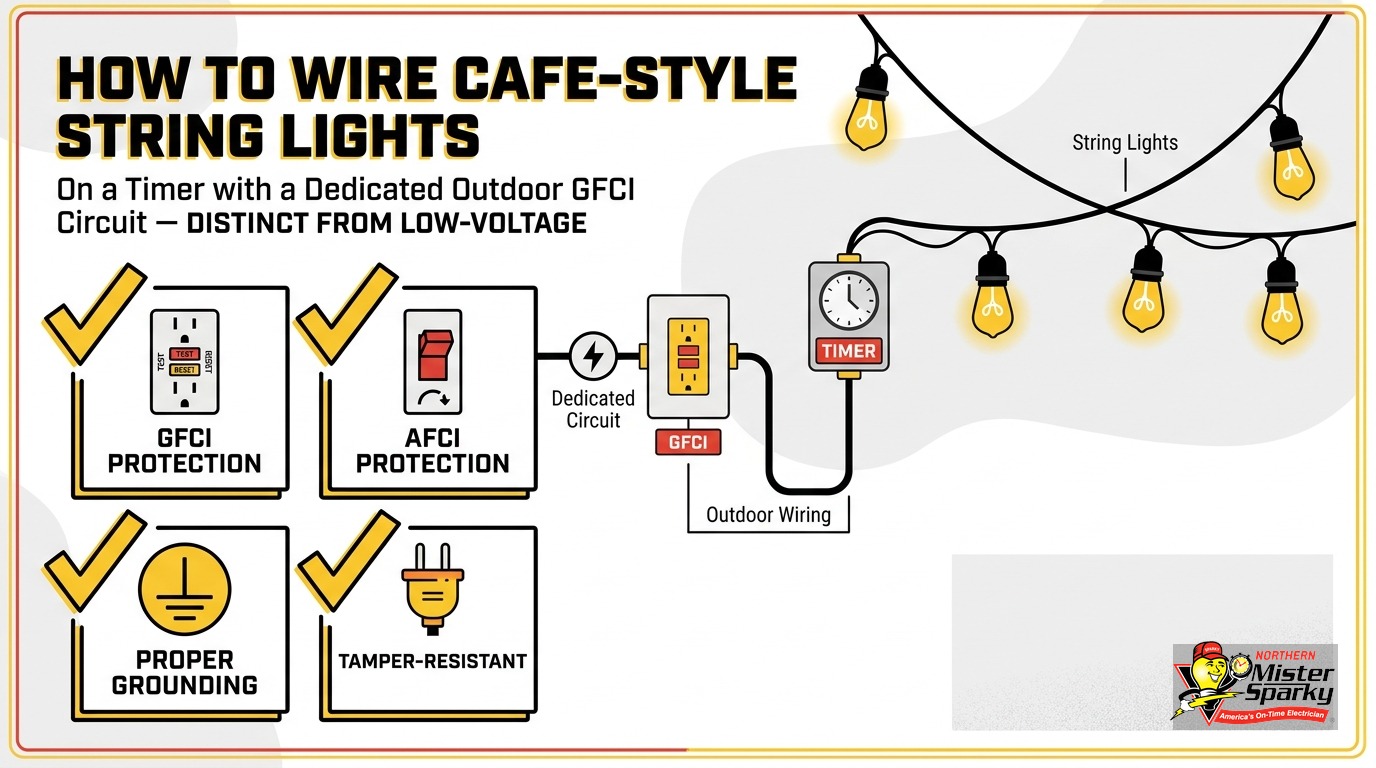
- Cafe-style 120V string lights and 12V low-voltage landscape path lights are completely different systems. They need different circuits, different hardware, and different timers.
- All outdoor receptacles require GFCI protection under NEC 210.8(A)(3). An extra-duty weatherproof in-use cover is also required by NEC 406.9(B).
- A dedicated circuit is not required by code, but it is strongly recommended. Sharing an outdoor circuit with tools or seasonal lighting causes nuisance trips at the GFCI breaker.
- A new outdoor circuit requires a permit in Minnesota before any work starts. Starting before a permit is pulled triggers an investigation fee on top of normal permit costs.
- Minnesota adopted the 2026 NEC on August 17, 2026. Permits filed on or after that date follow the expanded GFCI rules under NEC 210.8(F).
- LED cafe bulbs draw roughly 1W each. A 15A dedicated circuit handles 50-plus LED strands with ease. Incandescent S14 bulbs at 5W each fill the same circuit much faster.
- Our locally owned Northern Mister Sparky team handles permits, rough-in inspection scheduling, and final inspections. Call 763-200-5956 or book online to schedule your estimate.
Permanent outdoor string lights wiring installation is a real electrical project, not a plug-and-done swap. The right setup requires a dedicated GFCI-protected outdoor circuit, weatherproof hardware rated for Minnesota winters, and a permit pulled before any wire moves. Whether you are lighting a backyard pergola, a deck, or a covered patio, this guide walks through every step.
What Is the Difference Between Cafe String Lights and Low-Voltage Landscape Lighting?
Cafe string lights run at 120V and plug into a standard outdoor receptacle. Low-voltage path and accent lights run at 12V through a transformer. They are different products, different circuits, and different code requirements. Confusing the two leads to wrong hardware choices and a failed inspection.
This is the biggest gap in most online string-light guides. Many recommend a low-voltage transformer for outdoor string lights, which is the wrong approach for standard cafe or globe-style bulb strands.
If your string lights have a standard 2- or 3-prong plug, they are 120V line-voltage lights. They plug into a GFCI-protected outdoor receptacle and use a standard 15A or 20A circuit. Timers and smart switches for these lights must be rated for standard 15A or 20A line-voltage loads.
Low-voltage landscape lighting is a separate product category entirely. Those systems connect to a transformer that steps 120V down to 12V. Timers and dimmers for low-voltage systems sit on the transformer side, not at the wall outlet. If you are planning path lights alongside your string lights, our post on low-voltage landscape lighting transformer wiring covers the 12V side of that project.
For this guide, we are covering only 120V cafe-style string lights.
Why Do Permanent Outdoor String Lights Need a Dedicated GFCI Circuit?
All outdoor 120V receptacles require GFCI protection by code. A dedicated circuit adds reliability on top of that requirement: it prevents your string lights from tripping due to tools, holiday lighting, or other loads sharing the circuit.
The GFCI requirement is not optional
Under NEC 210.8(A)(3), all 125V, 15/20A outdoor receptacles must have GFCI protection. That applies whether the receptacle serves decorative lighting, a power tool, or a phone charger. If a string light plugs into an outdoor receptacle, that receptacle must be GFCI-protected. No exceptions.
Minnesota adopted the 2026 NEC on August 17, 2026. Under NEC 210.8(F) in the 2026 code, the GFCI requirement now covers all qualifying outdoor outlets rated 60A or less on single-phase branch circuits 150V or less to ground, expanded from the previous 50A threshold. Any permit filed in Minnesota on or after August 17, 2026 falls under these expanded rules.
If you add a plug-in timer at the outlet, the GFCI protection is still required on the receptacle regardless of where the timer sits in the circuit. A timer is not a substitute.
Why a dedicated circuit makes practical sense
Sharing an outdoor circuit with a refrigerator, power tools, or seasonal holiday lighting creates load competition. A 15A dedicated circuit handles roughly 1,440W of continuous load at the 80% rule. For LED cafe bulb strands, that is more capacity than most residential setups will ever use. Isolating the string-light circuit means a tripped breaker in the garage does not take out your patio lights, and a loaded outdoor run does not trip a breaker shared with something else.
Dedicated circuits are not code-mandated for string lights specifically. They are, however, the right call for a permanent installation you want to rely on year after year.
What Does a Permanent Outdoor String Lights Wiring Installation Actually Involve?
The project has four main parts: a panel assessment to confirm capacity, running the new circuit wire from panel to outlet location, installing a GFCI outlet with a weatherproof in-use cover, and optionally adding a timer or smart switch. A permit is required in Minnesota before any of this starts.
Here is what each step involves.
Panel assessment
Before adding any circuit, we verify your panel has an open breaker slot and sufficient remaining capacity. If the panel is already at its breaker limit, that conversation comes first. Options include a tandem breaker, a subpanel, or a full panel upgrade depending on how constrained the situation is.
Circuit wiring and wire sizing
A 15A outdoor circuit uses 14 AWG copper wire minimum. A 20A circuit requires 12 AWG copper. Per NEC 300.3, all conductors of the same circuit including the ground wire must run in the same raceway, cable, or trench.
For runs that go underground to reach a detached pergola or a far corner of the yard, UF cable is appropriate for direct burial. For exposed above-ground runs, THWN wire inside weatherproof conduit is the correct method. Standard indoor Romex (NM-B) is not rated for outdoor or wet locations. Using it outdoors is a code violation and a genuine hazard.
GFCI outlet and weatherproof in-use cover
The outdoor receptacle must be WR-rated (weather-resistant) and must use an extra-duty in-use weatherproof cover per NEC 406.9(B). An extra-duty cover keeps the outlet weatherproof with a cord plugged in. A standard flip-lid cover does not. This is not a detail inspectors overlook.
String lights that stay plugged in year-round need a cover that closes around the cord. If you mount the outlet on a post, pergola column, or exterior wall, the box must be rated for outdoor use and properly sealed. Our post on outdoor GFCI outlet installation covers outlet types and box options in detail.
Mechanical attachment points
The string lights themselves attach to eye hooks, turnbuckles, or cable guides anchored to the structure. Electrical code does not govern the mechanical side, but span length and attachment point spacing both affect how the lights hang. A span that is too long causes sag and puts strain on the outlet connection.
Do You Need a Permit for a New Outdoor Circuit in Minnesota?
Yes. Any new outdoor circuit or outlet requires a permit filed before work starts. Starting without a permit triggers an investigation fee added to your normal permit cost. In Minnesota, where you file depends on your city.
Who files the permit
Homeowners in owner-occupied single-family homes may pull their own permit and do the work themselves. If you rent the property, own a condo, or own a duplex, a licensed contractor must pull the permit and complete the work.
Roughly 66 Minnesota cities act as their own local authorities having jurisdiction and issue permits independently rather than through the state DLI. Minneapolis and several larger suburbs are in this group. Before filing, confirm whether your address falls under DLI or your city. Our guide on electrical permits in Minnesota walks through exactly how to check your address and which form to file.
Two inspections are required
Minnesota requires a rough-in inspection before walls, trenches, or concealed spaces are closed up. A final inspection follows after all devices are installed and the panel is energized. Plan the project timeline around both windows. If you backfill a trench before the rough-in inspection, you may be asked to re-open it.
The 2026 NEC transition matters for your permit date
Permits filed in Minnesota before August 17, 2026 use the 2023 NEC. Permits filed on or after that date use the 2026 NEC and its expanded GFCI requirements. Any project starting now is under 2026 code.
What Wire and Outlet Does an Outdoor String-Light Circuit Require?
14 AWG copper for a 15A circuit, 12 AWG for 20A. The outlet must be WR-rated with an extra-duty in-use weatherproof cover. UF cable for buried runs, THWN in conduit for exposed outdoor runs above grade.
This is the technical core of permanent outdoor string lights wiring installation. Here are the key specifications:
- Wire gauge: 14 AWG minimum for 15A, 12 AWG for 20A
- Wiring method (buried): UF cable, direct burial rated
- Wiring method (exposed above grade): THWN conductors in weatherproof conduit
- Outlet rating: WR (weather-resistant) rated receptacle
- Cover: Extra-duty in-use weatherproof cover (outlet stays protected with cord plugged in)
- GFCI protection: Required at the receptacle or upstream at the breaker
One thing that catches homeowners off guard at inspection: a standard outdoor box with a basic flip-lid cover does not meet the extra-duty in-use requirement. The cover must close around the plugged-in cord. Standard flip covers leave the outlet face exposed the moment a plug goes in. The fix is a $15 cover swap, but it must happen before the final inspection sign-off.
How Do You Add a Timer or Smart Switch to Outdoor String Lights?
Three placement options exist: a timer breaker at the panel, an in-wall timer or smart switch on the circuit, or a plug-in timer at the outlet. All three are code-compliant. GFCI protection on the receptacle is required regardless of which option you choose.
Timer breaker at the panel
A timer breaker replaces the standard breaker feeding the outdoor circuit and controls the entire run on a daily schedule. This is the cleanest install. There is no visible hardware outside. The tradeoff is that it requires panel access and uses a breaker slot.
In-wall timer or smart switch
An in-wall timer or smart switch mounted at the circuit’s load end gives you local manual control plus scheduling. A smart switch adds app and voice-assistant control without any extra outdoor hardware. This option works well for a covered porch where a wall box is practical and accessible. Confirm the switch is rated for resistive or LED loads at the wattage of your string lights.
Plug-in timer at the outlet
A plug-in mechanical or digital timer is the simplest option. It plugs into the GFCI outlet and the string lights plug into the timer. Confirm the timer is rated for outdoor use, or keep it housed inside a deep-cover weatherproof enclosure.
The GFCI protection requirement applies regardless of where the timer sits in the circuit. A timer does not substitute for GFCI protection at the receptacle. Also confirm any timer or smart switch you select is rated for standard 15A or 20A line-voltage loads, not for 12V transformer outputs.
How Many Strands Can One 15A Circuit Handle?
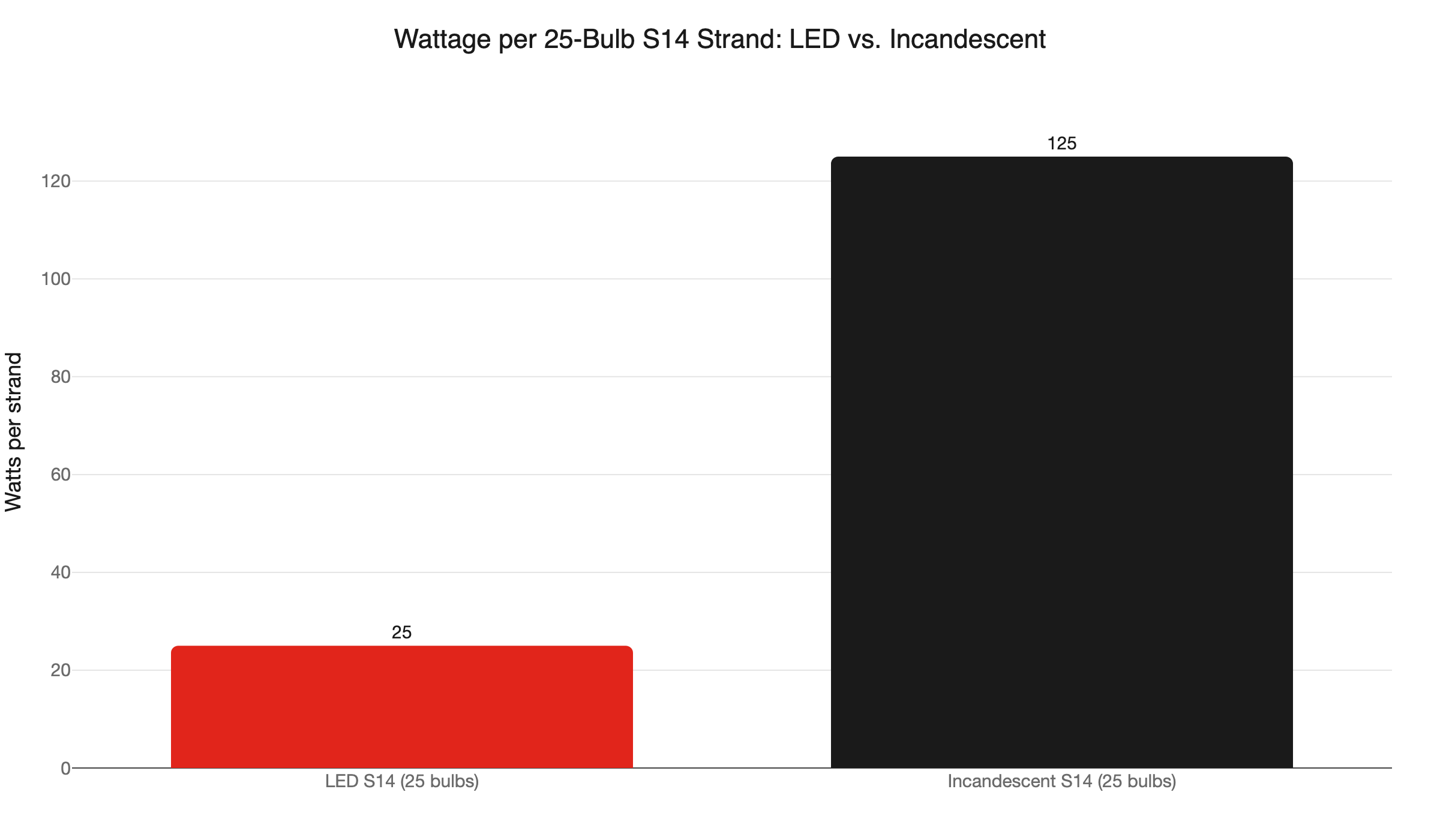
For LED cafe bulbs at roughly 1W per bulb, a 25-bulb strand draws about 25W. A 15A dedicated circuit handles roughly 1,440W continuous, so LED strands load it very lightly. Incandescent S14 strands at 5W per bulb fill the same circuit much faster.
Commercial-grade LED S14 bulbs draw approximately 1W each. Twenty-five bulbs per strand equals 25W. At the 80% continuous-load rule, a 15A circuit handles 1,440W, meaning roughly 57 LED strands before you approach the capacity limit.
Incandescent S14 bulbs draw approximately 5W each. A 25-bulb strand draws 125W. That same 15A circuit handles only about 11 incandescent strands at the 80% threshold.
Most residential pergola and deck setups use four to eight strands. LED cafe bulbs are the right choice for a permanent installation. The lower load means there is room to add more strands later without touching the circuit. LED bulbs also survive Minnesota freeze-thaw cycles significantly longer than incandescent.
If you are planning a large commercial-style installation or adding a second zone, a 20A circuit on 12 AWG wire gives meaningful headroom with either bulb type.
Should You DIY or Hire a Licensed Electrician?
If you have prior experience with panel work and understand NEC wiring methods, a homeowner can pull the permit and do the work on an owner-occupied single-family home in Minnesota. For most homeowners, the panel work, trenching, weatherproof hardware selection, and two-inspection process make hiring a licensed electrician the faster, lower-risk path.
No malarky: running a circuit from the panel, pulling wire through walls or underground, and passing two Minnesota inspections is real work. It is within reach for a homeowner who has done it before. If this is your first circuit project, the permit process provides a safety net, but it does not replace experience with box fill calculations, proper weatherproof wiring methods, or how to correctly land wires at the panel.
Errors that fail inspection include: wrong wire gauge, standard Romex used outdoors, a flip-lid cover instead of an extra-duty in-use cover, missing GFCI protection, or conductors that do not share the same raceway. Each of those requires opening walls or pulling wire a second time.
Northern Mister Sparky is locally owned and operated in the Twin Cities. We are America’s On-Time Electrician(R), and every job we complete is backed by the UWIN(R) 100% satisfaction guarantee. If something is not right, we make it right.
We pull the permit, schedule the rough-in and final inspections, and handle everything from panel to weatherproof outlet. Call 763-200-5956 or book your estimate online. We serve Minneapolis, St. Paul, Bloomington, Brooklyn Park, Woodbury, Blaine, Maple Grove, Plymouth, and surrounding Twin Cities communities.
Frequently Asked Questions
Do outdoor string lights need a GFCI outlet in Minnesota? +
Can a Minnesota homeowner pull their own electrical permit for a string-light circuit? +
What gauge wire is needed for an outdoor string-light circuit? +
Need an electrician now?