
Low Voltage Landscape Lighting Transformer Installation
Key Takeaways
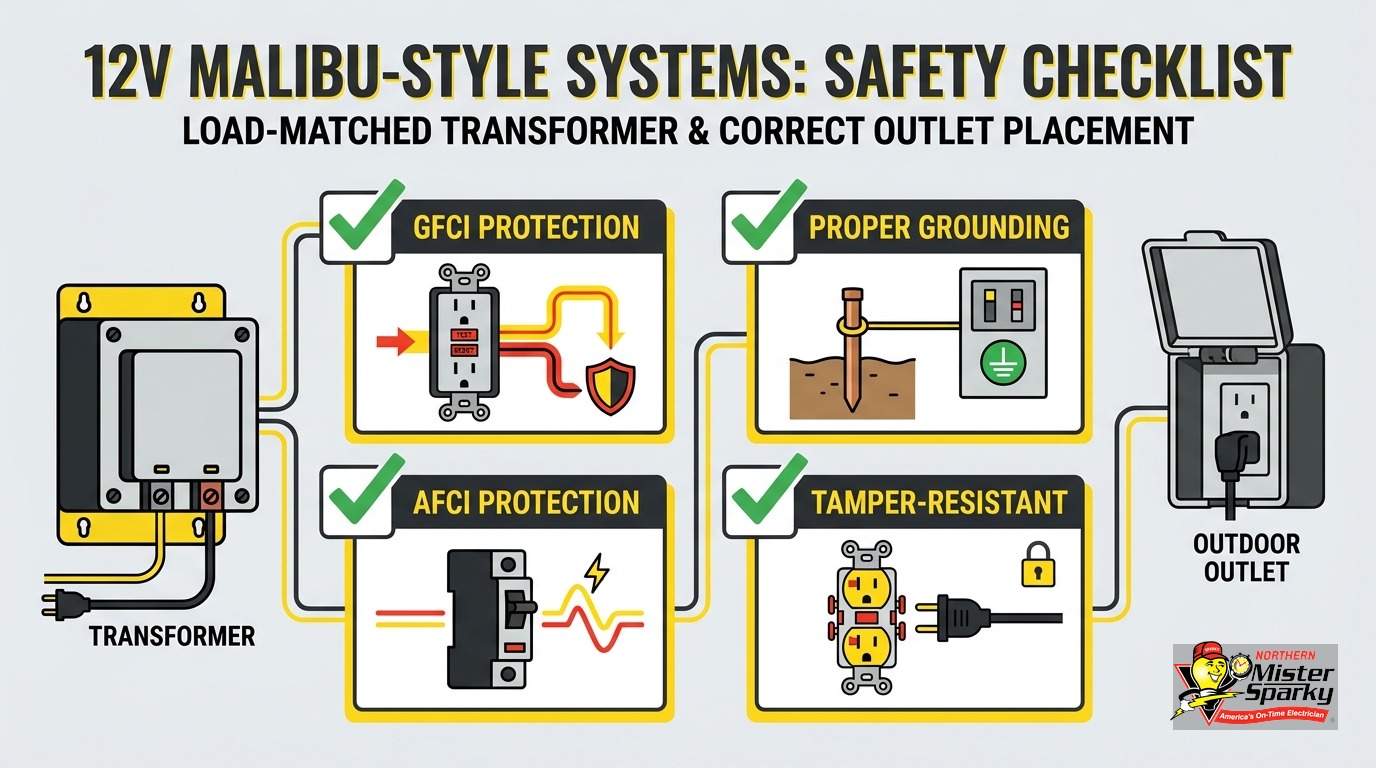
- A low voltage transformer plugs into a 120V outdoor outlet. That outlet must be GFCI-protected under NEC 210.8(A)(3), with no exceptions for low-voltage equipment.
- Most transformer power cords are 6 feet long. If no GFCI outlet exists within that reach of the mounting point, you need one installed before the transformer goes in.
- Standard flip-up outlet covers do not comply with NEC 406.9(B)(1) when a transformer is permanently plugged in. You need an in-use weatherproof cover designed to close around the cord.
- Size the transformer to the connected VA load, not just the wattage label. Keep the load at or below 80% of the nameplate VA rating.
- Adding a new outdoor outlet in Minnesota requires a permit and a licensed electrician under Minn. Stat. § 326B. The minimum DLI inspection fee is $55.
- Most Twin Cities homes built before the 1990s have no rear-yard outdoor outlet. Back-yard landscape lighting projects almost always require a new outlet run first.
What Do Most Low Voltage Landscape Lighting Transformer Installation Guides Get Wrong?
Most DIY guides tell you to “plug the transformer into a nearby GFCI outlet” and move on. They never ask whether that outlet exists, where it is, or whether it has the right in-use weatherproof cover. For older Twin Cities homes, the answer is often that no qualifying outlet exists near the installation spot.
That is the gap every other guide skips.
A large share of Twin Cities homes were built between the 1940s and 1980s. Outdoor outlet requirements changed dramatically over that span. Many of those homes have one exterior outlet, usually on the front soffit, installed decades ago to run holiday lights. That outlet is nowhere near the garden beds on the back or side of the house.
Most 12V landscape lighting kits sold at home centers assume an outdoor outlet already exists in the right spot. The instructions take it for granted. If no outlet exists, the box offers no guidance.
The result is predictable. Homeowners either run a temporary extension cord (not compliant for a permanent installation), discover the problem mid-project, or call an electrician after the transformer is already mounted. Getting the outlet right is the first step of any low voltage landscape lighting transformer installation. This post covers that step in full, along with transformer sizing, weatherproof cover requirements, Minnesota permit rules, and a planning sequence that puts the steps in the right order.
Does Your Home Have an Outdoor GFCI Outlet in the Right Place?
Probably not, especially on an older Twin Cities home. The transformer cord is typically 6 feet long. If no GFCI-protected outlet exists within 6 feet of the planned mounting point, you need a new outlet installed before anything else happens.
Homes built before 1978 were not required to have outdoor GFCI outlets at all. Homes built through the mid-1980s often had one or two exterior outlets, and those were typically installed at the front of the house for holiday decorating. The rear yard, where most landscape lighting actually goes, was left without power.
The transformer also mounts at a specific height: at least 12 inches above grade, positioned close to the cable runs, and within reach of the outlet. That combination means the outlet has to be placed with intention, in the right location on the right wall. You cannot solve a missing rear-yard outlet with an extension cord run from the front of the garage.
There is also a placement nuance specific to Minnesota winters. An outlet mounted in an unheated, north-facing location is exposed to deep cold. A GFCI in that position can nuisance-trip in January when impedance characteristics shift in low ambient temperatures. Positioning the new outlet on a sheltered or south-facing exterior surface, where practical, reduces that risk. Your electrician can advise on the best mounting point for both code compliance and cold-weather reliability.
Before you buy a transformer, walk around the back of your house. Note every outdoor outlet. Check whether each one has GFCI protection by pressing the “Test” and “Reset” buttons. A standard outlet without those buttons is not GFCI-protected. If outlets are absent on the rear or sides of the house, you have your answer: the outlet comes before the transformer.
Our page on outdoor GFCI outlet installation explains what that work involves and when it requires a permit. Our outdoor lighting service team can also assess your outlet situation in one visit.
What Does the NEC Require for the Outlet Serving Your Transformer?
The outlet must be GFCI-protected, weatherproof, and fitted with an in-use cover that closes around the cord while the transformer is plugged in. A standard flip-up cover does not qualify when a cord is permanently inserted. Two NEC sections apply here: 210.8(A)(3) and 406.9(B)(1).
NEC 210.8(A)(3) covers GFCI protection. Every outdoor receptacle on a residential dwelling must have ground-fault circuit interrupter protection. There are no exceptions for low-voltage equipment. The 12V output at the fixtures does not change what is required on the 120V primary side. Super Bright LEDs’ breakdown of NEC outdoor wiring requirements states this clearly: GFCI protection is required at the receptacle location, not conditioned by what is plugged into it.
NEC 406.9(B)(1) covers the outlet cover. A standard flip-up cover drops open when a plug is inserted. That leaves the receptacle exposed to rain, snow, and condensation. An in-use cover, sometimes called a bubble cover, stays closed around the cord while the transformer is plugged in. When the transformer is a permanent installation at that location, the standard cover is not compliant. You need the in-use style, rated for cord-connected equipment left in place.
NEC Article 411 governs the transformer itself. It limits landscape lighting secondary voltage to 30V AC. It also requires the transformer to be a listed unit with UL or equivalent certification. EC&M’s analysis of code rules for low-voltage lighting confirms that Article 411 adds no GFCI requirement on the primary side. That duty falls to NEC 210.8. The listing requirement matters for a separate reason: unlisted transformers leak small ground currents that cause nuisance GFCI trips, a problem covered in the section below.
Minnesota adopted the 2026 NEC as of August 17, 2026. Permits filed today must comply with the 2026 edition. Minneapolis and St. Paul run their own permit departments and do not use the DLI system, but both cities follow the same code cycle. Minnesota’s current electrical codes and standards are published at the DLI website.
How Do You Size a Low Voltage Landscape Lighting Transformer?
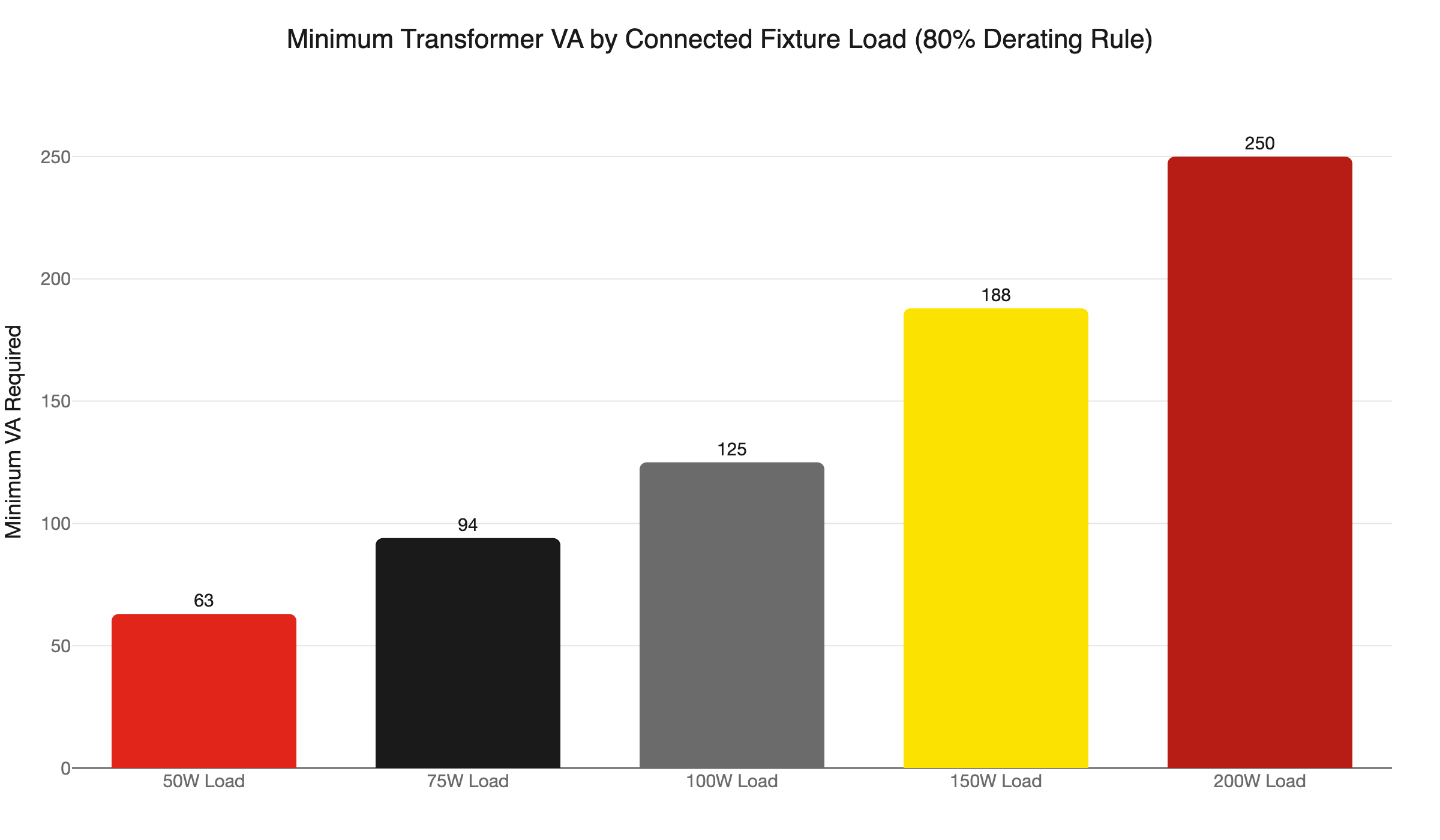
Add up the VA rating of every fixture, using manufacturer specs rather than the wattage label. Your total connected VA should be no more than 80% of the transformer’s nameplate VA rating. For a 75W load, that means a minimum 94VA transformer, so you choose the next standard size up.
Most homeowners think in watts. Transformer manufacturers rate capacity in volt-amperes. For LED landscape fixtures, those two numbers are not the same. LED drivers have a power factor below 1.0, which means VA demand can exceed the wattage label on the fixture package. Use the manufacturer’s listed VA spec when you total your system load. ExpertCE’s guide on low-voltage transformer theory covers this distinction in detail and explains why wattage alone undersizes the transformer.
The 80% rule is industry best practice. A landscape lighting system running from dusk to dawn is a continuous load. Running a transformer at or near 100% of nameplate VA causes it to run hot. That shortens its lifespan and can lead to early failure. Staying at 80% keeps the transformer in a safe thermal range for continuous operation.
The math is simple. Take your total connected VA and divide by 0.8. That gives your minimum transformer VA rating. Round up to the next standard size.
Voltage drop is the other sizing consideration. Low-voltage cable loses voltage over distance. On runs longer than 100 feet, fixtures at the far end appear dimmer than those near the transformer. Multi-tap transformers offer output terminals at 11V, 12V, and 13V. Long runs connect to the higher-voltage tap to compensate for the loss. This keeps brightness consistent across the whole system. ExpertCE’s landscape lighting installation guide covers both cable burial depth under NEC Table 300.5 and run-length math for multi-tap planning.
Why Does a GFCI Keep Tripping After You Plug In a Transformer?
Usually a cheap, unlisted transformer. Non-UL-listed transformers leak small ground currents that the GFCI reads as a fault and interrupts. The fix is a UL-listed, isolation-type transformer sized at no more than 80% of nameplate VA.
A GFCI compares current on the hot wire to current on the neutral wire. A mismatch of 5 milliamps or more triggers a trip. Nuisance trips, meaning trips that occur with no real ground fault, almost always trace back to leakage current in the connected equipment.
Budget landscape transformers sold through discount channels frequently lack a UL listing. Their internal insulation allows small amounts of current to bleed to ground. Those currents accumulate across all the fixtures and cable on the system. Even if each fixture’s contribution is tiny, the total can reach the trip threshold.
Minnesota winters add another layer. Cold temperatures change the impedance characteristics of GFCI devices and the equipment they protect. An outdoor GFCI in an unheated location can nuisance-trip in January or February. DLI has published guidance on breaker and GFCI behavior in low ambient temperatures, noting this effect. Cold-weather tripping is not a reason to remove GFCI protection. It is a reason to use a listed transformer, place the outlet in the most sheltered location practical, and have a licensed electrician review the circuit if nuisance trips continue after the hardware is correct.
If your GFCI trips repeatedly after a transformer installation, read our guide on GFCI outlet requirements explained before assuming the outlet is the problem. The transformer is the more likely cause.
Do You Need a Permit for Low Voltage Landscape Lighting in Minnesota?
Not for burying cable or mounting the transformer, if the right outlet already exists. Yes, if you need to add a new outdoor outlet. Any new outlet, circuit, or panel connection requires a permit and a licensed electrician under Minn. Stat. § 326B.
This is the distinction that surprises most homeowners. The low-voltage side of the system, meaning the transformer output, cable, and fixtures, does not require a permit. You can trench, lay cable, stake fixtures, and program your timer without pulling any permit.
The 120V outlet the transformer plugs into is a different matter entirely.
Minnesota requires a permit for any new outlet, new circuit, or panel connection under Minn. Stat. § 326B. This includes adding an exterior GFCI outlet on the back of your house where none existed before. The minimum DLI inspection fee is $55. Minneapolis and St. Paul route permits through their own departments rather than DLI, but the licensed-electrician requirement is the same in both cities.
The idea that a 12V system is permit-free in its entirety is a common and incorrect assumption. The transformer needs a 120V source. That source must meet code. Meeting code on a new outlet requires a permit, an inspection, and work by a licensed electrician.
Adding a single outdoor GFCI outlet is a straightforward job. It typically takes a few hours. The permit fee is low. Skipping the permit creates problems at home inspections. It can also complicate insurance claims in a way that costs far more to resolve than the permit itself. Our post on electrical permits in Minnesota walks through what the process involves.
Planning the Full Low Voltage Landscape Lighting Transformer Installation
When you plan the job in the right sequence, the project comes together cleanly. Here is how to approach it from start to finish.
Map the transformer location before buying anything.
Walk your yard and choose where the transformer will mount. It should sit close to your cable runs, at least 12 inches above grade, and accessible for timer adjustments and seasonal programming. Write down the specific location on the house.
Evaluate the outlet before buying the transformer.
Look at where the nearest outdoor GFCI outlet is relative to your chosen mounting point. Check three things: Is it within 6 feet? Is it GFCI-protected? Does it have an in-use weatherproof cover that closes around a plugged-in cord? If any answer is no, call an electrician before purchasing the transformer. The outlet work comes first.
Calculate your fixture load in VA.
List every fixture you plan to install. Pull the VA rating from the manufacturer specs, not the wattage label. Add them up. Divide by 0.8. That is your minimum transformer VA. Purchase the next standard size above that number.
Plan cable routes and measure real distances.
NEC Table 300.5 requires listed low-voltage cable to be buried at least 6 inches deep. In Minnesota, runs under driveways or sidewalks should go through conduit. Freeze-thaw cycles can heave and crack unprotected cable under paved surfaces. Measure actual trench distances, not straight-line estimates. Account for every direction change and fixture drop point.
Have the outlet work done before trenching.
If you need a new exterior GFCI outlet, have it permitted and completed before you start digging. The electrician may need access along the foundation or inside the house to run the new circuit. Completing that work first prevents the project from stalling mid-trench.
Mount, connect, bury, and test.
Mount the transformer at least 12 inches above grade. Connect cable runs to the appropriate output taps. Set fixture connections at each stake. Bury cable to the correct depth and backfill. Run a full test at dusk. Walk the entire system and check for brightness consistency. If end-of-run fixtures are noticeably dimmer than those near the transformer, move those runs to a higher-voltage tap.
Check the outlet cover before calling the job done.
Verify that the in-use weatherproof cover closes properly around the transformer cord. If it does not seat correctly with the cord inserted, replace it with a cover rated for permanently plugged-in cord-connected equipment. This is a $15 fix that keeps the installation code-compliant.
When to Call a Licensed Electrician
You can handle the transformer, cable, and fixtures on your own. Those parts of the project are legal for Minnesota homeowners without a permit.
Call a licensed electrician when:
- There is no GFCI-protected outdoor outlet within 6 feet of the transformer’s planned mounting point
- The existing outdoor outlet is missing an in-use weatherproof cover
- The existing outlet is not GFCI-protected
- The circuit serving the outlet already carries other outdoor equipment
- Your GFCI trips repeatedly after the transformer is plugged in and you have already confirmed you have a UL-listed, properly sized transformer
Northern Mister Sparky is locally owned and operated in the Twin Cities. No malarky about what your home actually needs or what the code actually requires. We are America’s On-Time Electrician(R), and every job is backed by our UWIN(R) 100% satisfaction guarantee.
Call us at 763-200-5956 or book online. We will assess your outlet situation, handle the permit work, and make sure your landscape lighting project starts on a foundation that is safe, code-compliant, and built to last through a Minnesota winter.
Frequently Asked Questions
Does a low voltage landscape lighting transformer need a GFCI outlet? +
Can I install a new outdoor outlet for landscape lighting myself in Minnesota? +
Need an electrician now?