
Portable Air Conditioner Circuit Requirements in Minnesota
Key Takeaways
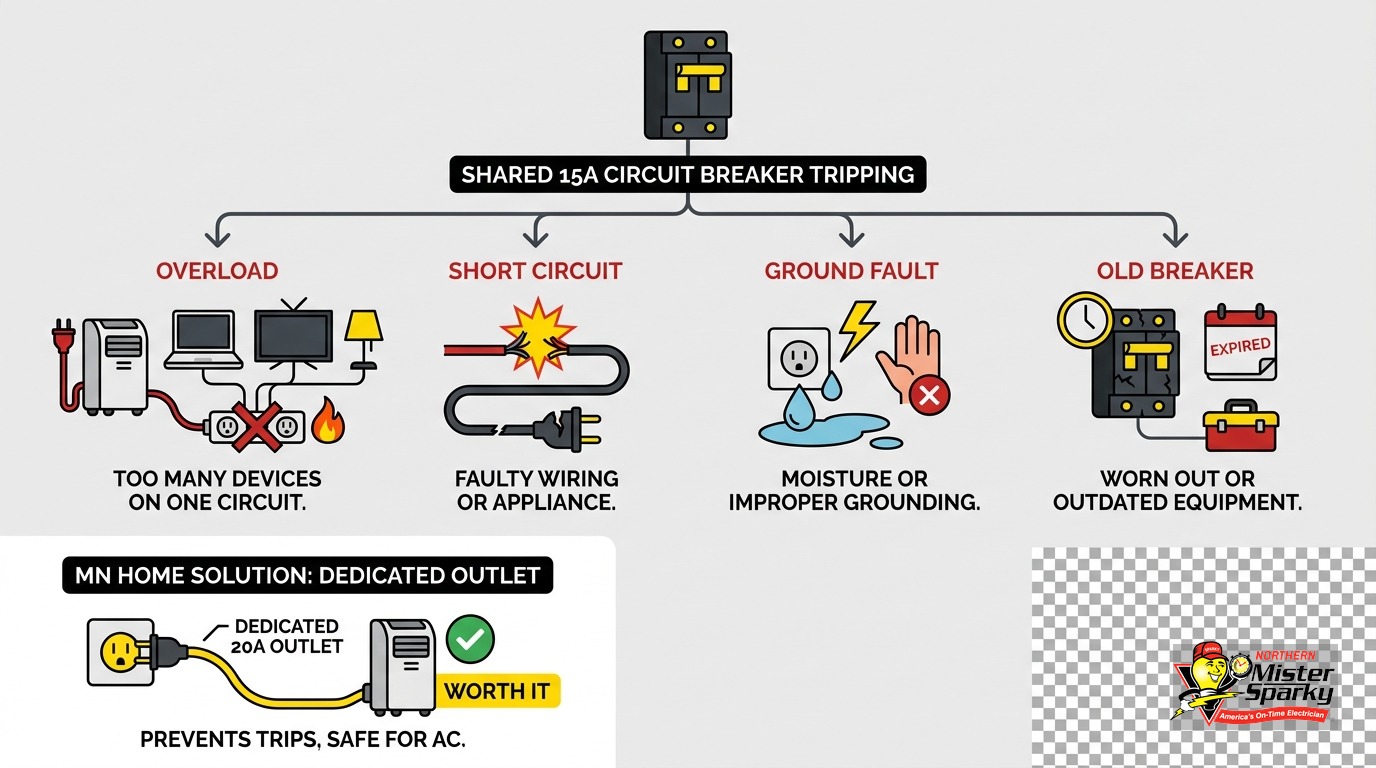
- Portable air conditioner circuit requirements center on one number: the unit’s running amp draw. Most portables pull 8-12 amps. A 12,000 BTU unit typically draws about 12 amps.
- NEC 210.23(A)(1) limits cord-and-plug appliances on a shared 15A or 20A multi-outlet circuit to 80% of circuit rating for continuous use. On a 15A circuit, that is 12 amps. A 12-amp portable fills the circuit to its legal limit alone.
- The compressor’s startup surge, not the steady running current, is what actually trips the breaker. Each compressor cycle sends a brief current spike through a circuit already carrying other bedroom loads.
- A 15-amp circuit holds 1,800 watts total. A 12-amp portable consumes 1,440 watts, leaving only 360 watts for everything else on that circuit.
- Minnesota adopted the 2026 NEC effective August 17, 2026. Any new outlet or circuit requires a permit and DLI inspection, no exceptions for small jobs.
- Homeowners in single-family homes may self-permit in Minnesota. Multi-family residents must use a licensed electrician.
- A dedicated circuit runs $150 to $400 and sets the room up for a mini-split that qualifies for up to $2,000 in Xcel rebates - something a portable AC will never earn.
What Are the Portable Air Conditioner Circuit Requirements?
Most portable ACs draw 8-12 amps under full load. A 12-amp unit on a standard shared 15-amp bedroom circuit hits the legal 80% continuous-load ceiling under NEC 210.23 with nothing else running. A safer setup is a dedicated 20-amp circuit that gives the compressor headroom to start without tripping the breaker.
The number printed on the box is BTUs. The number that matters to your wiring is the running amp draw on the unit’s nameplate or spec sheet. A 10,000 BTU portable typically draws 8-9 amps. A 12,000 BTU unit typically draws around 12 amps. On a 15-amp circuit, a 12-amp draw is already at the code limit before you factor in a single other device.
NEC 210.23(A)(1) covers how much load a cord-and-plug appliance may draw on a multi-outlet branch circuit for continuous use. The rule is 80% of circuit rating. Eighty percent of 15 amps is 12 amps. A 12-amp portable hits that ceiling alone. A television, a bedside lamp, and two phone chargers add another 2-3 amps. That combination overloads the circuit, and the breaker responds exactly as designed.
The difference between a 15-amp and a 20-amp circuit matters here. A 20-amp circuit uses 12-gauge wire and a 20-amp breaker. Its 80% continuous-load ceiling is 16 amps. A portable drawing 12 amps runs at 75% of a 20-amp circuit - safely within range, with room left for the startup surge. That difference shows up clearly on a hot August afternoon when the compressor has been cycling for six hours straight.
This is also why portable ACs cause more nuisance tripping than window units placed in the same rooms. A window unit is typically sized and installed on a circuit expected to carry that specific load. A portable moves to whatever room needs cooling and plugs into whatever outlet is convenient, regardless of what else is already running. The mismatch between appliance demand and available circuit capacity is built into how portables get used.
Why Does a Portable AC Keep Tripping a Shared Circuit?
The compressor’s startup surge is the culprit. Every time the compressor cycles on, it draws a brief current spike called locked-rotor amperage (LRA) that can reach two to three times its running draw. If the circuit is already loaded, that spike pushes the breaker past its trip point.
Running current (RLA) is the steady draw while the unit operates. Starting current (LRA) is the brief spike the compressor needs to spin up from rest. Manufacturers rate units by RLA, but LRA is what stresses the breaker. The compressor cycles every 10-20 minutes in hot weather. Each cycle sends that spike through the circuit. A circuit at 70% capacity during normal operation can briefly see 120% or more during a compressor startup.
That is why the breaker sometimes holds for an hour before tripping. The circuit warms under steady load. The compressor cycles. The combined thermal event tips the breaker. Resetting it and running the same setup repeats the cycle indefinitely.
The 15-amp circuit has a total capacity of 1,800 watts at 120 volts. A 12-amp portable consumes 1,440 watts while running. That leaves 360 watts for everything else on the circuit - roughly one small lamp and two phone chargers before steady-state load exceeds safe capacity. Add the startup surge and the circuit is well past its trip threshold.
Older Minneapolis and St. Paul homes make this worse. A 1955 bungalow in Longfellow was wired for its era: bedroom lights, a clock radio, maybe one small TV. Today that same 15-amp circuit carries a large television on standby, a game console, multiple phone chargers, and a 12-amp portable AC. Every addition was made without accounting for the circuit’s cumulative load.
For a broader look at why breakers trip and when repeated tripping signals a deeper problem, see our post on why your circuit breaker keeps tripping.
Does a Portable AC Need a Dedicated Circuit?
No code requires a dedicated circuit for portable ACs the way it mandates one for refrigerators or dishwashers. But a 12-amp unit on a shared 15A circuit already occupies that circuit’s legal continuous-load limit under NEC 210.23. A dedicated 20-amp circuit is not a code mandate for portables but is the correct technical fix for preventing trips.
A dedicated circuit is one circuit, one breaker, one outlet, nothing else. A 20-amp dedicated circuit can carry up to 16 amps continuously. A 12-amp portable draws 75% of that, safely inside the 80% threshold, and the startup surge has room to land without triggering the breaker. That is the difference between a portable that runs all summer and one that trips the breaker on the hottest night of the year.
The practical path in most Twin Cities homes is a new 20-amp circuit run from the panel to a single outlet in the room. The original 15-amp circuit stays in service for lights and general outlets. The portable gets its own breaker slot. For more on which appliances the code requires dedicated circuits for, and which ones benefit from one even when not required, see our post on dedicated circuits for appliances.
One shortcut that does not work: running a heavy-gauge extension cord to an outlet on a different circuit. Extension cords are not rated for continuous appliance loads. A long cord adds resistance, and that resistance generates heat at the connection points. Hours of continuous operation with a 12-amp appliance creates genuine fire risk at those points. If the outlet you need is not where the AC sits, the answer is a new outlet, not a longer cord.
What Does Minnesota Code Say About Adding a New Circuit or Outlet?
Minnesota requires an electrical permit and DLI inspection for any new circuit or outlet, including a single new bedroom receptacle. There are no small-job exceptions. Minnesota adopted the 2026 NEC effective August 17, 2026. Permits filed on or after that date must comply with 2026 code standards, not 2023.
This is the detail most online guides skip entirely. They say “hire an electrician” without explaining what the Minnesota permit process actually involves.
Per the Minnesota DLI, homeowners in owner-occupied single-family homes may self-permit and perform the electrical work themselves. The permit still requires a DLI inspection before the work is considered complete. Multi-family residents - apartments, condos, townhomes with shared construction - cannot self-permit. A licensed electrician must pull the permit and do the work.
The inspection covers wire gauge, breaker sizing, box fill, grounding, and connector use. In a 1960s Minneapolis home, the inspector may find aluminum branch wiring in the circuit path, or an older junction box that was never permitted. That does not halt the dedicated circuit project. It does add a conversation about what else is present. Better to know at the estimate stage than after the wall is open.
Minnesota’s 2026 NEC adoption also introduced updated GFCI device classifications, including high-frequency-tolerant types. If the new outlet is in a location that qualifies as a wet area under the updated code, the inspector may require a GFCI receptacle meeting the new standard. A licensed electrician will know this going in and spec the correct device from the start. For a complete walkthrough of how Minnesota electrical permits work, read our post on electrical permits in Minnesota.
What Do Older Twin Cities Homes Mean for Portable Air Conditioner Circuit Requirements?
Pre-1965 Minneapolis and St. Paul homes are the specific failure scenario here. They were built without central air, wired with 14-gauge 15-amp bedroom circuits, and never updated for today’s appliance loads. A portable AC in one of these homes runs at the code limit from the moment it turns on.
The neighborhoods most affected: Longfellow, Northeast Minneapolis, Como, Powderhorn, Nokomis, Prospect Park, the West Side of St. Paul, and most inner-ring suburbs built before 1965. These are well-built homes. The electrical systems were designed for their era. They were not designed for a 12-amp air conditioner on top of modern electronics.
The fix is a new 20-amp circuit from the panel. The existing 15-amp circuits stay in service for what they were designed to carry. The new circuit uses 12-gauge wire, terminates at a 20-amp T-slot receptacle, and gets its own breaker. An electrician can typically complete this run in two to four hours, depending on access and panel location.
Before work starts, the panel needs a look. An older panel in a pre-1965 home may have all slots occupied - a common condition when work has been added piecemeal over the decades. When that happens, an electrician has a few options: install a tandem breaker if the panel accepts them, relocate an existing circuit to free a slot, or recommend a panel upgrade. A 60-amp or 100-amp panel from the 1960s may already be approaching end of service life. The dedicated AC circuit is sometimes the job that surfaces that conversation. A reputable electrician tells you this at the estimate, not after the drywall is cut.
How Much Does It Cost to Add a Dedicated Circuit in the Twin Cities?
A dedicated 20-amp circuit for a portable AC typically costs $150 to $400 in the Twin Cities. That covers the wire run from the panel to the new outlet, the receptacle, permit fees, and inspection. Longer runs and finished walls push the number higher; open framing and a nearby panel keep it lower.
The industry-cited range of $150 to $400 assumes a straightforward installation with accessible panel space and a manageable run. A second-floor bedroom above a basement panel costs more than a main-floor room directly above it. Running wire through finished drywall takes longer than open framing, and that labor is a meaningful part of the total. Permit fees vary by municipality - typically $50 to $100 in Minneapolis and St. Paul for a single new circuit, added to materials and labor. Asking for an itemized estimate is reasonable, and a good electrician provides one without hesitation.
Compare that cost to the alternative. A breaker that trips repeatedly under thermal stress degrades faster than one operating in normal range. Repeated overcurrent events generate heat at wiring connections over time. A loose or corroded connection on a persistently overloaded circuit is the starting point for an arc fault - the kind that begins inside a wall with no visible warning. A $150 to $400 dedicated circuit is cheap insurance against that outcome.
The Xcel Rebate Gap - and the Smarter Long Game
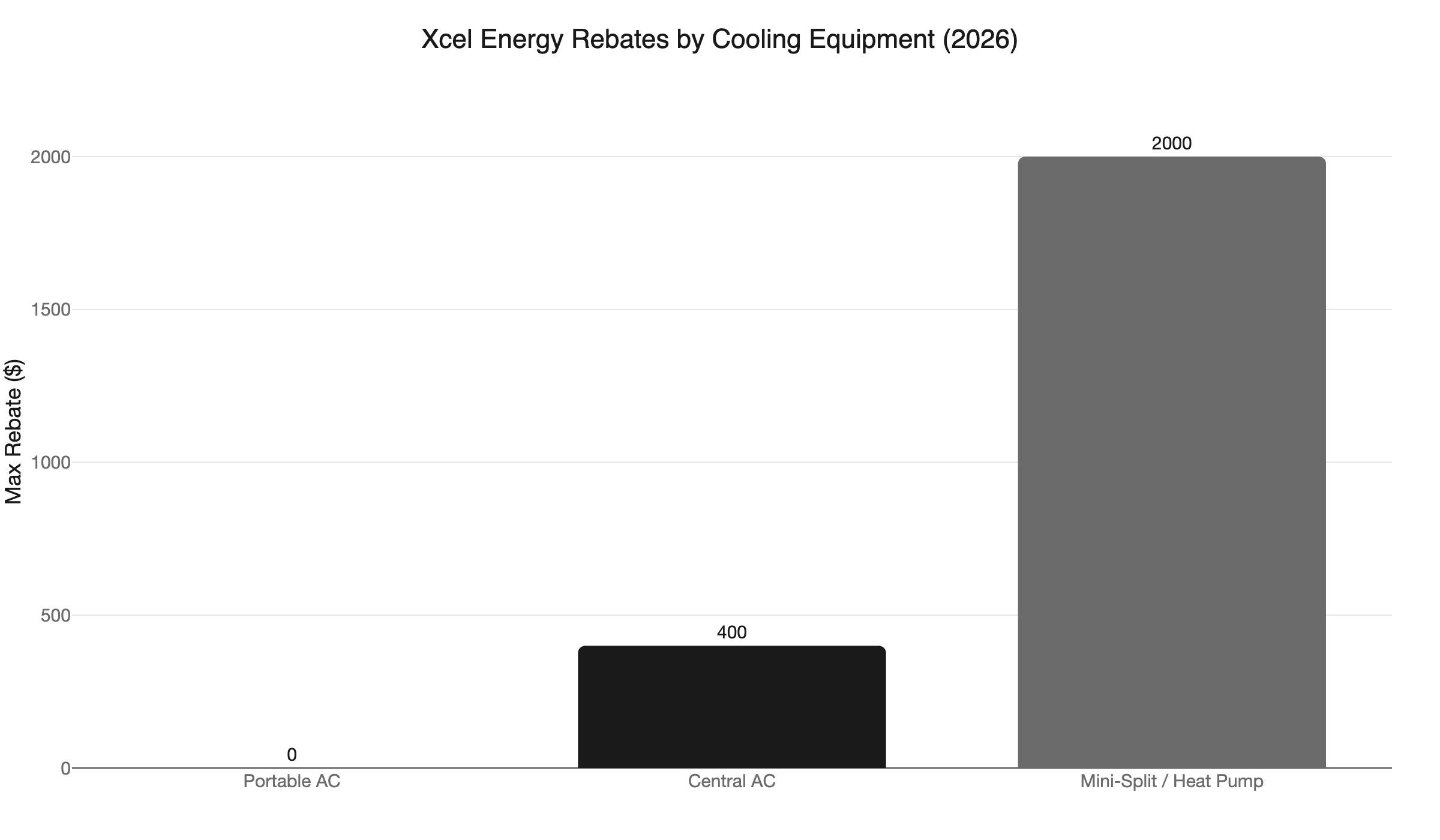
Xcel Energy offers no rebate for portable air conditioners. Buy any portable at any price and your utility will not contribute a dollar toward the purchase or installation. That is not a program gap. It is a deliberate exclusion based on efficiency standards. Xcel’s rebates are reserved for equipment that meaningfully reduces heating and cooling energy use.
Where the math shifts is the forward look. The dedicated 20-amp circuit you add for the portable is exactly the electrical infrastructure a ductless mini-split uses. Xcel’s current rebate program offers up to $2,000 for a qualifying mini-split heat pump. The federal 25C tax credit adds 30% of installation cost, up to $2,000 more. A portable AC qualifies for neither. A mini-split already does, and it uses the same dedicated circuit.
A mini-split cools in summer, heats in winter, handles the humidity that makes Twin Cities summers brutal, and does not require a window vent hose or a condensate bucket to empty. The electrical infrastructure is the same dedicated outlet you would install for the portable. If you are investing $150 to $400 in new wiring, ask what the long-term destination for that room is. If the answer is eventually a mini-split, the circuit you add today is not a stopgap. It is the foundation of a better solution.
For what a mini-split needs from your electrical system, see our post on mini-split circuit requirements. For the equipment side of a mini-split installation, that is Northern One Hour’s specialty. We handle the wiring; they handle the unit and refrigerant.
Should You Call a Licensed Electrician for This?
Homeowners in single-family Minnesota homes can legally self-permit and do this work. If you are in a multi-family building, are not comfortable working near a live panel, or do not know what the panel holds, hire a licensed electrician. The permit and inspection are required either way, and the work gets inspected regardless of who does it.
Panels are live even with the main breaker off. The service entrance conductors entering the top of the panel are not controlled by the main breaker. They are energized at all times. A mistake in that area is not a tripped breaker - it is a serious injury risk. For a single-circuit addition, the cost difference between hiring a professional and doing it yourself is smaller than most homeowners expect once materials, permit fees, and tool rental are factored in.
For homeowners who want to proceed themselves: the DLI’s online permit portal walks through the application. You will need to describe the scope (one new 20-amp branch circuit, one receptacle), list the panel location, and pay the permit fee. The inspection is scheduled after the work is complete. Inspectors check wire gauge, box fill, grounding, and the panel connection. A licensed electrician will be familiar with all of those checkpoints going in and typically completes the job with no re-inspection required.
Ready to Stop Resetting Breakers?
We are Northern Mister Sparky - locally owned and operated in the Twin Cities. As America’s On-Time Electrician(R), we show up when we say we will. We pull the permit, run the circuit, and stay through the DLI inspection. If the panel has no open slots or has conditions that affect the scope, you hear about it at the estimate, not after the work starts.
Call us at 763-200-5956 or book online. Every job is backed by the UWIN(R) 100% satisfaction guarantee. If the work does not meet your expectations, we make it right. No malarky.
Frequently Asked Questions
Does a portable air conditioner need a dedicated circuit? +
Why does my portable AC keep tripping the breaker? +
Do I need a permit to add an outlet for a portable AC in Minnesota? +
How much does a dedicated circuit for a portable AC cost in the Twin Cities? +
Need an electrician now?