
Radon Fan Dedicated Circuit Requirements: What MN Code Says
Key Takeaways
- No National Electrical Code provision requires a dedicated circuit breaker for a radon fan.
- Minnesota Rule 1303.2403 requires a switch-controlled light fixture AND a receptacle outlet near every active radon fan. Both are code-mandatory, not optional.
- Those two items rarely exist in a typical Twin Cities attic. An electrician runs a new circuit to supply them. A dedicated circuit is the cleanest way to do it.
- Any wiring routed through walls, ceilings, or floors is premises wiring under Minnesota law. A licensed Minnesota Electrical Contractor and an electrical permit are required.
- The radon contractor can handle wiring only under a narrow exception: factory-assembled fan, cord of six feet or less, plugging into an existing outlet the cord does not pass through any wall to reach.
- A system monitoring device, a manometer or audible alarm, is also code-required. It tells you when the fan has stopped.
- Call Northern Mister Sparky at 763-200-5956 to schedule the electrical side of your radon project.
Does a Radon Fan Require a Dedicated Circuit?
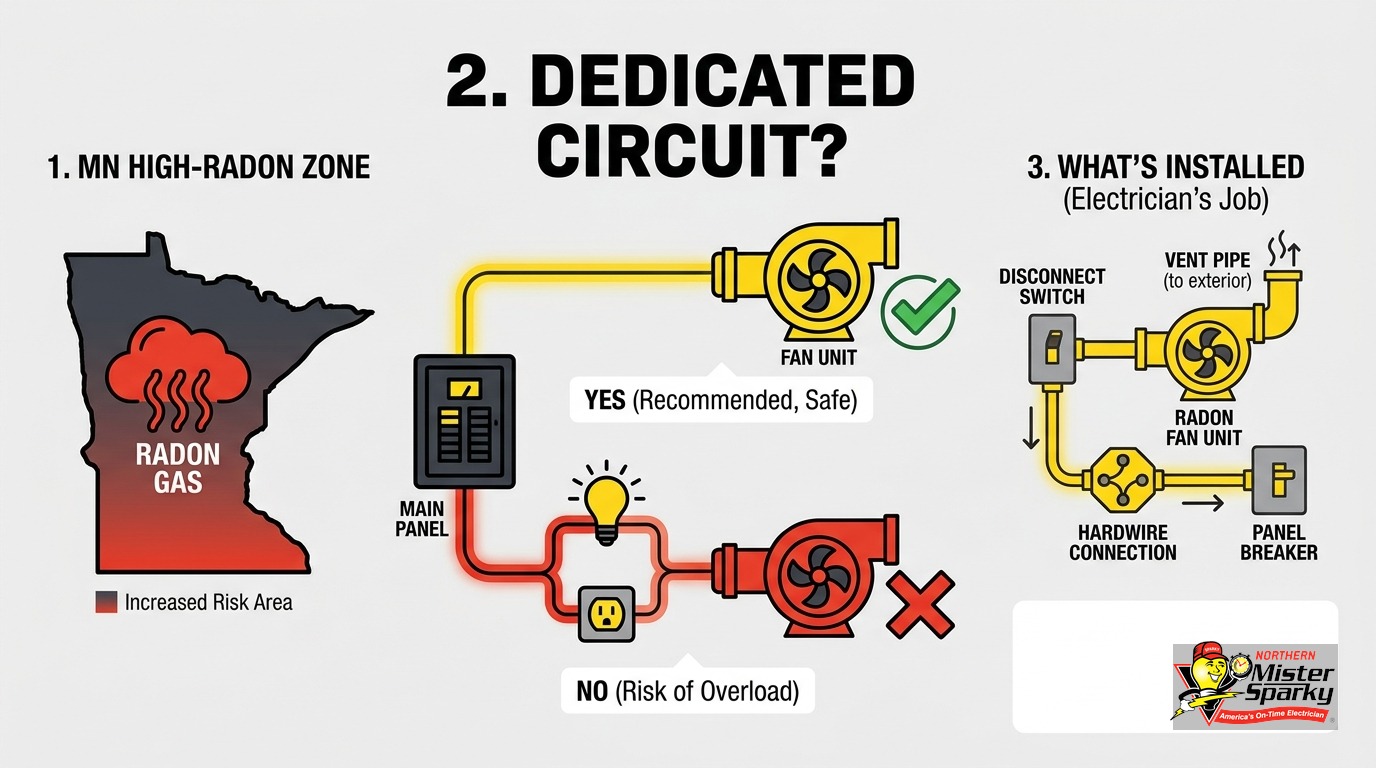
Short answer: No single NEC rule says the fan must have its own breaker. But Minnesota Rule 1303.2403 requires a switch-controlled light and a receptacle outlet near the fan. Those items need power, and they rarely exist in an attic. An electrician runs a new circuit to supply them. A dedicated circuit is the practical result.
The question sounds simple. The full answer takes a little explaining.
The fan itself draws very little power. Most residential radon fans pull under one amp at 120 volts. Sharing a circuit would not overload anything. But Minnesota code does not just regulate the fan. It regulates the entire active radon mitigation system.
That system requires two electrical items beyond the fan itself: a switch-controlled light fixture and a receptacle outlet, both installed near the fan. A typical Twin Cities attic has neither. There is no switched light above the fan mounting point. There is no outlet nearby for tools or test equipment. Those two items need a circuit. The electrician runs one.
A dedicated circuit for the whole assembly, fan, light, and outlet, is the clean way to wire it. That is the practical reality in nearly every attic installation, even though no single code line says “dedicated circuit required.”
Understanding why that circuit gets run is the key to understanding radon fan dedicated circuit requirements in Minnesota.
Why Minnesota Has a Radon Problem
Minnesota’s geology and climate create some of the highest average indoor radon levels in the country.
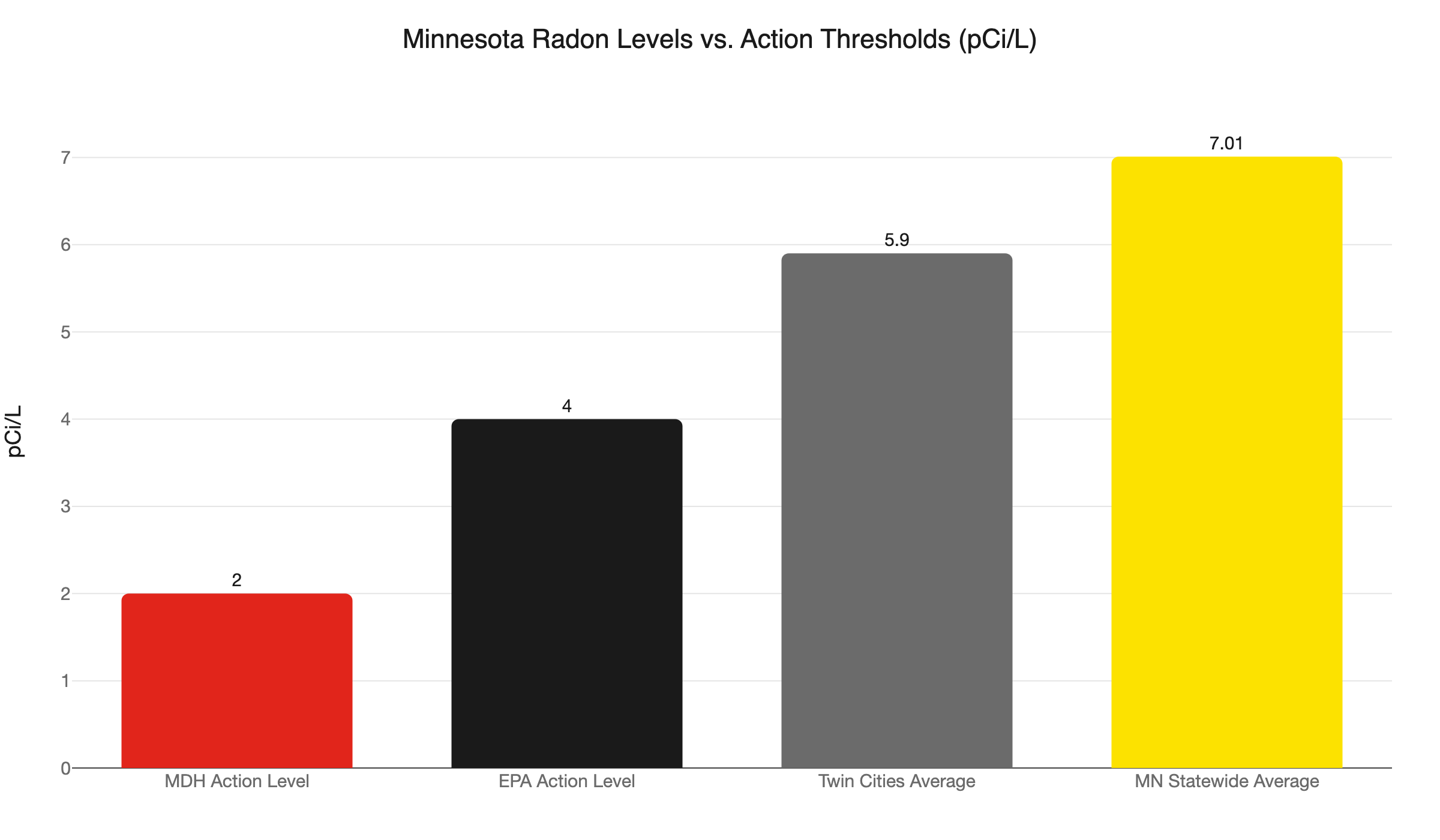
Sixty-eight of Minnesota’s 87 counties sit in the EPA’s Zone 1, the highest predicted average radon risk category. The entire Twin Cities metro is in Zone 1. Zone 1 means predicted average indoor levels above 4 pCi/L, which is the EPA’s recommended action threshold.
The numbers in Minnesota exceed that threshold by a wide margin. The statewide average indoor radon level is 7.01 pCi/L. The Twin Cities metro averages 5.9 pCi/L. Both are well above the EPA threshold.
The Minnesota Department of Health applies a stricter standard. MDH recommends action at 2 pCi/L, half the federal number. By that measure, even a home at the Twin Cities average is more than twice the recommended ceiling.
An estimated 40% of Minnesota homes test above the EPA’s 4 pCi/L level. Nationally, that figure is about 7%. The gap comes from Minnesota’s granite-rich soil geology and its long heating season. Homes seal tight against the cold for months. Soil gases, including radon, accumulate inside.
Radon is colorless and odorless. It is the second-leading cause of lung cancer in the United States. The mitigation system, the PVC pipe, the fan, the wiring, and the monitor, exists to pull that gas out before you breathe it. The electrical installation matters because a fan that stops running and goes unnoticed provides no protection at all.
What Does Minnesota Code Require for an Active Radon System?
Short answer: Minnesota Rule 1303.2403 requires the fan to be in an unconditioned space, rated for continuous operation, connected to a working monitoring device, and supplied with a switch-controlled light fixture and a receptacle outlet near the fan location. All four requirements apply the moment an active fan is installed.
Here is what each item means in practice.
Fan location. The fan must be installed outdoors, in an attic, or in a garage. It cannot be in conditioned living space, a basement, or a crawl space. This placement matters because radon fan housings can develop small leaks over time. Occupants should not be in the space where that air vents.
Fan rating. The fan must be rated for continuous operation at a minimum of 50 cubic feet per minute at one-half inch of water column pressure. An undersized fan fails to maintain adequate suction beneath the slab. Suction is what makes the system work.
Monitoring device. Rule 1303.2403(B) requires a system monitoring device installed in a visible location. A U-tube manometer, a digital pressure gauge, or an audible alarm all qualify. The device’s job is to alert you when the fan stops. Without a monitor, a dead fan can go unnoticed for months. The monitoring device is not optional.
The electrical items. Rule 1303.2403(C) requires a switch-controlled luminaire, meaning a light fixture wired to a switch, and a receptacle outlet installed near the fan. A technician servicing the fan in a dark attic needs light to work safely. The outlet gives service personnel a place to plug in tools and meters without running extension cords through the house.
When you add a fan to a passive system, the entire rule applies immediately. Installing the fan converts the system from passive to active. Every requirement in 1303.2403 kicks in at that point.
What Does an Electrician Actually Install on a Radon Fan Job?
Short answer: In a typical Twin Cities attic installation, the electrician installs a new circuit from the panel, a switch-controlled light fixture near the fan, and a receptacle outlet near the fan. Those three items satisfy both the electrical code and Minnesota Rule 1303.2403(C).
Here is what each piece involves.
A new circuit from the panel. The circuit runs from the main electrical panel to the attic. It supplies the light, the outlet, and in many cases a junction box or a direct wired connection for the fan. We almost always install this as a dedicated circuit: one breaker, one circuit, no other loads sharing it. That approach protects the fan from being tripped by something unrelated. It also makes the circuit easy to identify and label during future service calls.
If your home has a crowded panel or an older 100-amp service, adding a circuit may require addressing the panel first. Our post on signs you need an electrical panel upgrade walks through the indicators to watch for.
A switch-controlled light fixture. This is a code requirement under 1303.2403(C), not an upgrade. We mount a fixture near the fan and wire it to a switch placed at a logical entry point to the attic or fan area. A technician working in the attic should not need a headlamp because the homeowner skipped the required light.
A receptacle outlet. Also required under 1303.2403(C). We install a standard 15- or 20-amp outlet near the fan. It gives any service technician, ours or the radon contractor’s, a place to plug in test equipment and tools on future visits.
The fan connection itself varies by job. Some radon contractors hard-wire the fan directly to a junction box. Others use a cord-and-plug connection to the outlet. Both are acceptable when done correctly. In either case, the cable run from the panel through the ceiling and walls is premises wiring. That wiring always requires a licensed electrician and a permit.
When Does a Licensed Electrician Have to Do the Wiring?
Short answer: Whenever cable or cord is routed through a wall, ceiling, or floor, or terminated to a new circuit, Minnesota law requires a licensed Electrical Contractor. That covers nearly every attic radon fan installation.
The Minnesota Department of Labor and Industry published a bulletin specifically on this question: “Electrical Licensing and Inspections for Radon Fan Installations.” The language is direct. Routing or terminating cable through building structure is electrical work. It requires a licensed Minnesota Electrical Contractor. It requires an electrical permit. The work must be inspected by a state electrical inspector.
Radon mitigation contractors hold a Minnesota Department of Health license. That license covers the diagnostic work, the pipe routing, and the fan installation. It does not cover premises wiring. The two licenses are separate and cover different scopes.
A radon contractor who routes new cable from the panel to the attic without a licensed electrician is performing unlicensed electrical work. The homeowner may not learn this until a home inspection, a permit pull for a future remodel, or an insurance claim surfaces the issue.
If your radon contractor tells you no electrician is needed, ask them to point to the specific DLI bulletin language that covers your installation. The bulletin is public. The exemption is narrow. Most attic jobs do not qualify.
For more on what a Minnesota electrical permit involves and when one is required, see our post on electrical permits in Minnesota.
Is There a Plug-and-Play Exception?
Short answer: Yes, but it is narrow. The fan must be a completely factory-assembled, NRTL-listed appliance with a cord of six feet or less that plugs directly into an existing outlet. The cord cannot pass through any wall, ceiling, or floor. The light fixture and outlet required by 1303.2403(C) are not covered by this exception at all.
The DLI bulletin describes the exception precisely. When all three conditions are met, the radon contractor can make that connection without a licensed electrician. But most Twin Cities attic installations do not meet all three conditions.
Here is why the exception breaks down in practice:
- No existing outlet. The outlet must already exist near the fan location. In a typical attic, there is no outlet. Installing one is premises wiring. A licensed electrician must do it.
- Cord penetrations. If the cord passes through a ceiling, floor, or wall to reach an outlet in the conditioned space below, the exception does not apply. Most attic fan locations require exactly that kind of penetration.
- The required light. A switch-controlled luminaire hardwired to a switch is premises wiring. It is not a plug-in appliance. If 1303.2403(C) applies, a licensed electrician must install the light regardless of how the fan itself is connected.
The practical takeaway: if you have a standard unfinished attic in a Twin Cities home built before the 1990s, the plug-and-play exception almost certainly does not apply. A licensed electrician is the right call.
The same principle applies to other appliance circuits throughout the home. Our post on dedicated circuits for appliances covers how this pattern shows up across a residential electrical system.
What About New Construction?
Short answer: Minnesota requires a passive radon system and a roughed-in electrical circuit in all new residential construction. In a new home, you may not need to run a new circuit from the panel. But verify the rough-in is actually there before you schedule the fan installation.
All new Minnesota residential construction built under the Minnesota Residential Code must include a passive radon system: PVC pipe from beneath the slab, routed to the attic or exterior, capped and ready for a fan. The builder is also required to rough in an electrical circuit at the attic or highest floor, positioned at the anticipated fan location.
In a new home, this means the circuit wire may already be waiting. You add the fan, the light, the outlet, and the monitoring device. The run from the panel is done.
“May already be waiting” requires verification. Inspectors occasionally catch missing rough-ins during construction. Some builders complete the pipe but not the circuit. Confirm the rough-in is there and properly terminated before you schedule the radon contractor. We check during the estimate visit.
What If My Panel Is Already Full?
Short answer: If the panel has no open slots, adding the radon circuit means resolving that first. Options include a tandem breaker where the panel design allows, a small subpanel, or a full panel upgrade.
Some older Twin Cities homes, particularly those built before the 1980s, have 100-amp panels that are at or near capacity. A fully loaded panel cannot accept a new breaker without modification.
We assess the panel during our estimate visit. If there is room, we add the circuit directly. If there is not, we walk you through the options. No malarky, no upsell you do not need. The goal is a safe installation that passes inspection.
A panel upgrade alongside a radon circuit job is also an opportunity to address other deferred electrical work in an older home. If you are already paying for an electrician’s visit, adding other overdue items to the same visit often makes economic sense.
Should You Have the Radon Contractor and Electrician Coordinate?
Short answer: Yes. The fan location, pipe routing, and electrical path interact. Work done without coordination often results in one trade redoing something the other finished first.
The simplest approach is to schedule both contractors within the same week and have each talk to the other before either one starts. The key scope questions to resolve in advance:
- Where exactly is the fan going? The electrician needs to plan the circuit path from that point.
- Is the fan connection hard-wired to a junction box, or cord-and-plug to the outlet?
- Who is supplying the junction box, if one is needed?
- Who is pulling the electrical permit? (Answer: the licensed Electrical Contractor.)
- Is the monitoring device in the radon contractor’s scope, or does the homeowner source it separately?
Northern Mister Sparky is locally owned and operated in the Twin Cities. We coordinate with radon mitigation contractors on a regular basis. We can speak directly with your radon pro to align on scope before either of us enters the attic.
Questions to Get Answered Before the Job Starts
Confirm these items before any wiring begins:
- Is there an existing outlet in the attic near the planned fan location? (Usually no.)
- Is there an existing switched light near the fan? (Usually no.)
- What is the fan connection method: hard-wired junction box, or cord-and-plug to the outlet?
- Who is pulling the electrical permit?
- Does the main panel have an open slot for a new circuit breaker?
- Is the monitoring device included in the radon contractor’s scope, or is it a separate line item?
Getting answers before the job starts prevents a common problem: the radon contractor finishes, and the homeowner is left with a fan that has no code-required light, no outlet, and no electrical permit.
Ready to Get the Electrical Side Done Right?
Northern Mister Sparky is the Twin Cities’ locally owned and operated Mister Sparky franchise. As America’s On-Time Electrician(R), we pull the permit, run the circuit, install the required light and outlet, and schedule the state inspection. Our UWIN(R) 100% satisfaction guarantee covers every job.
We serve Minneapolis, St. Paul, Bloomington, Brooklyn Park, Woodbury, Blaine, Maple Grove, Plymouth, and the surrounding Twin Cities metro.
Call 763-200-5956 or book online to schedule your radon fan electrical installation.
Frequently Asked Questions
Does a radon fan need to be on a dedicated circuit in Minnesota? +
Can a radon contractor do the electrical wiring for the fan? +
Is an electrical permit required for a radon fan circuit? +
Need an electrician now?