
In-Wall Power Outlet Kit Behind Your Mounted TV
Key Takeaways
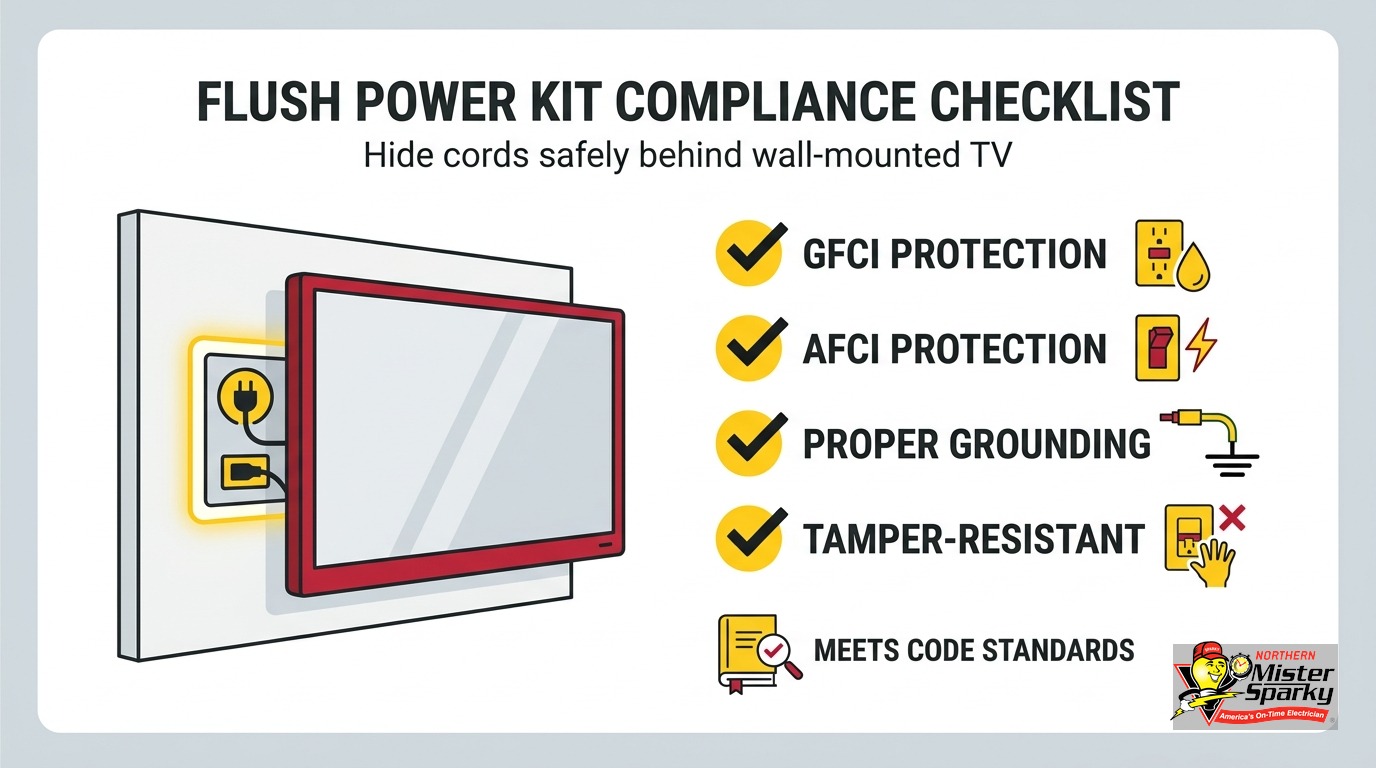
- An in-wall power outlet kit routes power from an existing lower outlet to a new recessed receptacle behind your TV. No cord is visible on the wall.
- NEC Article 400.12 prohibits running flexible cords - including TV power cords - through walls. A UL-listed relocation kit is the code-compliant path.
- Minnesota adopted the 2026 NEC effective August 17, 2026. Any permit pulled today falls under the new code.
- Single-family homeowners in Minnesota may self-permit this work if they personally perform it. Multi-family owners must hire a licensed electrician to pull the permit.
- Many Twin Cities bungalows and craftsman homes have horizontal fire-blocking lumber mid-stud-bay. A standard fish tape stops dead when it hits one.
- Unpermitted outlet work can surface at closing. Hennepin and Ramsey County title companies flag electrical disclosures. Pull the permit.
- Low-voltage cables (HDMI, Ethernet, coax) may legally run through walls when the cable is CL2 or CL3 rated.
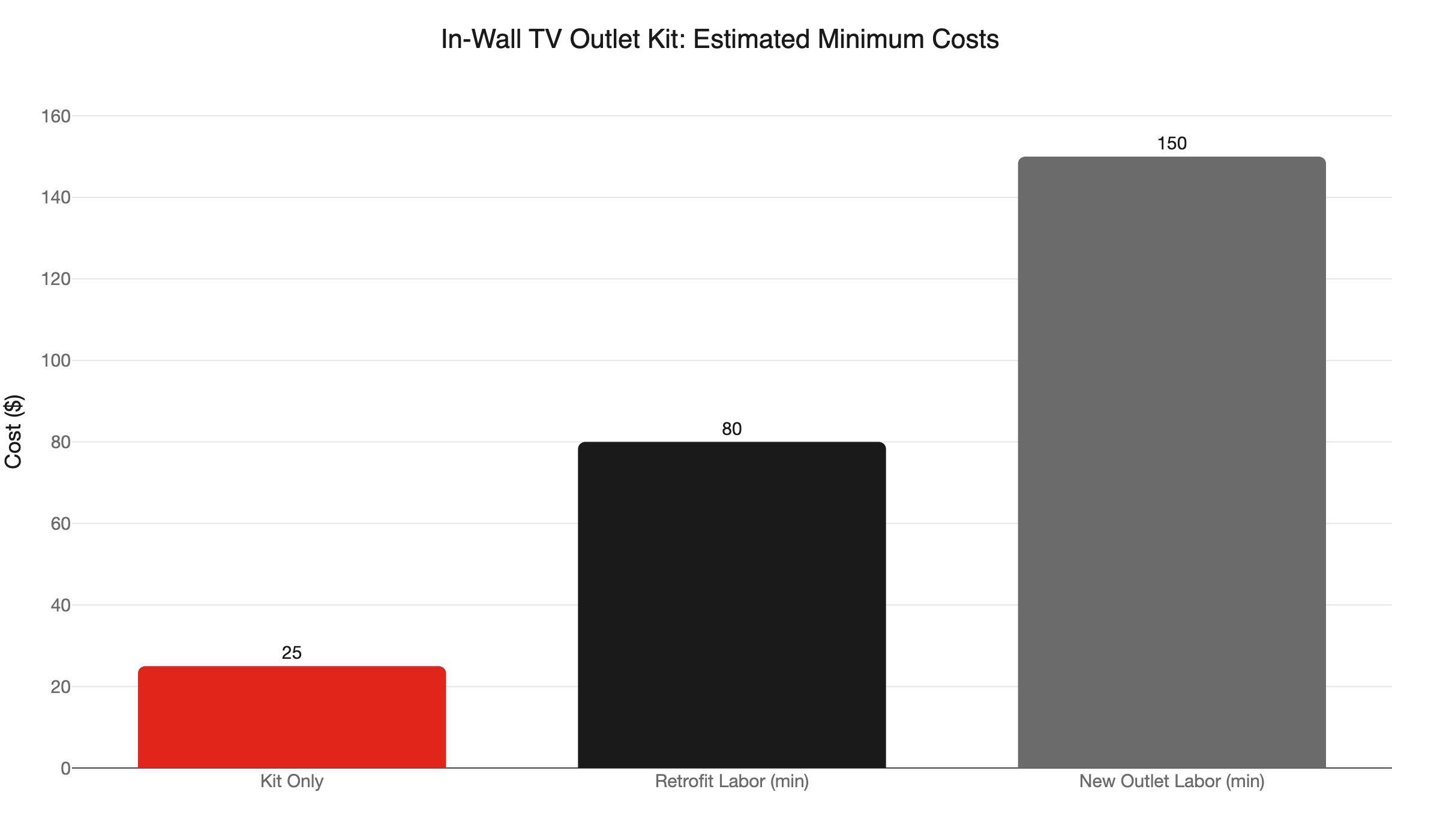
- Cost ranges: kit $25-$99, retrofit labor $80-$350, new outlet on existing circuit $150-$450.
What Is an In-Wall Power Outlet Kit for a Mounted TV?
A power relocation kit (also called a recessed outlet kit or in-wall power outlet kit) adds a new receptacle directly behind your mounted TV. That outlet draws power from an existing lower outlet on the same wall, connected by in-wall-rated cable hidden inside the stud cavity. The TV cord plugs into the upper outlet and never shows.
When you mount a TV on a wall, the power cord has nowhere clean to go. A power strip against the baseboard may manage the tangle, but the cord still dangles. An in-wall power outlet kit solves the problem at the source.
The kit typically includes three parts:
- An upper output plate with a recessed receptacle that sits flush with the drywall behind the TV
- A lower input plate that integrates with or replaces the face cover on the source outlet below
- In-wall-rated 14/2 NM-B cable to connect the two plates through the stud bay
UL-listed kits from brands like PowerBridge, Legrand, DataComm, and Sanus use snap-together connectors and pre-rated components. Because the kit is an extension of the existing outlet rather than new permanent wiring added to the panel, it is the standard DIY path for most jobs.
A licensed electrician can also hard-wire a new outlet at the upper location. That approach is cleaner and more permanent. Either path is code-compliant when done correctly.
One note up front: this post covers standard wall installations. Mounting a TV above a fireplace sits in a different code zone with different structural considerations. If that is your situation, our above-fireplace TV outlet guide covers that specific case.
Is It Legal to Run a TV Power Cord Through the Wall?
No. NEC Article 400.12 prohibits flexible cords - including TV power cords and extension cords - from being run through walls, ceilings, or floors as a substitute for fixed wiring. This applies whether you drill a hole for the cord directly or use any kind of sleeve or raceway inside the wall cavity.
The rule exists because flexible cords are not rated for concealment. Hidden in a wall, they cannot be inspected. A cord damaged by a drywall screw, a staple, or contact with insulation can overheat without any visible warning. The result is a fire hazard that nobody sees until it is too late.
Common workarounds homeowners try - and why each still violates code:
- Drilling a hole and threading the cord through. The cord is still a flexible cord. How it enters the wall does not change its classification under NEC 400.12.
- Using an extension cord inside the wall. Extension cords are also prohibited under the same article when used as a substitute for permanent wiring.
- Running the cord inside a metal conduit. Only an approved extension of fixed wiring, or a UL-listed relocation kit, qualifies. A cord inside conduit is still a flexible cord.
The two compliant options are a UL-listed power relocation kit or a licensed electrician installing a new outlet at the TV height.
What Does Minnesota Require for This Job?
Minnesota adopted the 2026 NEC effective August 17, 2026. Permits pulled today fall under that code. Adding a new hard-wired outlet requires a permit. A plug-in relocation kit occupies a gray area, but the safest path is to check with your local Authority Having Jurisdiction before starting.
For a hard-wired upper outlet, there is no ambiguity: a permit is required, and it triggers an inspection.
A plug-in relocation kit functions more like a heavy-duty appliance cord. Some inspectors treat it as not requiring a permit; others disagree. The answer depends on your municipality. In Minneapolis, the city runs its own electrical inspection department, independent from the state. In most other metro suburbs - Bloomington, Woodbury, Maple Grove, Plymouth, Brooklyn Park, Blaine - the Minnesota Department of Labor and Industry (DLI) is typically the inspection authority.
The DLI electrical inspector directory can help you identify the right agency for your address. The full permit process for Minnesota homeowners is covered in our Minnesota electrical permit guide.
The Multi-Family Trap That Catches Twin Cities Homeowners
Many Twin Cities homeowners assume they qualify for Minnesota’s homeowner self-permit exemption. Some of them are wrong - and the reason is often the property classification, not the work itself.
Minnesota law allows single-family homeowners to self-permit electrical work they personally perform on their own home. The exemption ends the moment the property is classified as multi-family. A licensed electrical contractor must pull the permit - even if the owner occupies a unit.
This is a real problem in South Minneapolis, Mac-Groveland, Longfellow, Seward, and several North Minneapolis neighborhoods. Many converted bungalows in these areas look single-family from the street. One front door. One driveway. But if the property was converted to a duplex at any point and is still recorded that way with the county, the self-permit exemption does not apply.
How to check your classification:
- Open your county’s online property records portal. (Hennepin County uses the Property Map; Ramsey County has Property Look Up.)
- Search your address and look for the use code or property classification field.
- If it reads “duplex,” “two-family,” “converted,” or any multi-family descriptor, you need a licensed electrician.
Getting this wrong is not a minor technicality. Unpermitted work by a non-licensed person in a multi-family building can be ordered removed and redone at the owner’s cost.
Do Twin Cities Homes with Fire Blocks Need a Different Approach?
Yes. Pre-1970 craftsman bungalows and foursquares common across Minneapolis and St. Paul often have horizontal fire-blocking lumber mid-stud-bay. A standard fish tape cannot pass through it. You need a right-angle flex drill bit to bore through the block before routing the kit cable. This is not covered in any national DIY guide - it is a genuine local gotcha.
Fire-blocking lumber sits at roughly mid-wall height inside the stud bay. Its purpose is to slow fire spread through wall cavities. It works well for that. It also stops a fish tape cold.
Here is how to handle it:
- Before cutting the upper outlet opening, probe the stud bay from the lower outlet with a long screwdriver or fish tape. Resistance at mid-height means a fire block is present.
- A right-angle flex drill bit, used from within the cavity, can bore through the center of the block. Use a spade bit or hole saw sized slightly larger than the cable diameter.
- Drill through the center of the block, not near the edges. Boring too close to the side of the block can weaken the stud bay structure.
Working inside a narrow stud bay with a flex bit is not beginner territory. If you open the wall and find a fire block - or any wiring, piping, or material you do not recognize - that is a reasonable stopping point. Call a licensed electrician to take over from there. Routing the cable incorrectly can damage existing wiring in the same cavity.
How Does a Power Relocation Kit Actually Work?
The kit is a pass-through: power flows from the panel to the lower outlet, then through the stud cavity to the new upper outlet. The TV plugs into the upper outlet. No cord runs through the wall itself.
Step-by-step installation overview:
- Turn off the circuit at the breaker panel. Verify it is off with a non-contact voltage tester before touching any wires.
- Mark and cut the upper outlet opening at the desired TV height. The opening must fall between two studs.
- Fish the 14/2 in-wall cable from the upper opening down to the lower outlet. (This is the step complicated by fire blocks in older homes.)
- Connect the cable at the lower outlet using the pigtail connectors and wire nuts included in the kit.
- Snap in the lower input plate and mount the upper output plate.
- Restore power at the breaker and test both outlets with a plug-in circuit tester.
One non-negotiable: do not conceal a surge protector or power strip inside the wall. Code requires surge protectors to remain accessible. The TV plugs directly into the recessed outlet. If you want surge protection, use an in-wall surge protector model rated for outlet-box installation, or add a whole-home surge device at the panel.
For a broader look at adding any new outlet in a finished wall, our finished-wall outlet guide covers the full process from start to finish.
Which Circuit Can the Kit Tap Into?
Tap a standard 15A or 20A general-purpose receptacle circuit. Do not extend from a kitchen small-appliance circuit, a bathroom circuit, a dedicated appliance circuit, or any circuit that is already labeled for a specific use. Extending the wrong circuit can cause nuisance trips and may introduce a code violation.
In practice, the source outlet is usually a living room or bedroom general-purpose outlet on the same wall or an adjacent wall, below the TV. A TV and its streaming devices draw modest current. The added load rarely causes problems on a circuit that was not already running near capacity.
Before connecting, check these items:
- Is the outlet feeding a labeled dedicated circuit? Do not extend it.
- Does the circuit trip frequently under its current load? Adding the TV will make that worse.
- Is the circuit 15A or 20A? A 15A circuit uses 14-gauge wire. A 20A circuit uses 12-gauge wire. The kit cable must match or exceed the source circuit’s gauge. You cannot use 14-gauge cable on a 20A circuit.
- Is the outlet in a kitchen, bathroom, or laundry room? Those circuits have code restrictions that make them off-limits as a source.
If no nearby outlet qualifies, the right answer is to add a new circuit rather than extend one that does not fit. Our outlet installation service page explains what that involves.
Can Low-Voltage Cables Like HDMI and Ethernet Run Through the Wall Too?
Yes, with the right cable. NEC 400.12 restricts 120V power cords, not low-voltage signal cables. HDMI, Ethernet (Cat6), coax, and speaker wire may legally run through interior walls - provided the cable jacket is rated CL2 or CL3 for in-wall use. Standard retail HDMI cables are not always in-wall rated. Check the jacket label before fishing any cable.
CL2 and CL3 ratings indicate that the cable jacket resists fire spread inside a wall cavity. CL3 is the higher rating and is acceptable wherever CL2 is required. When buying new cable for an in-wall run, CL3 is the safe default.
A few practical notes:
- Route signal cables in a separate pass from the power cable. The NEC requires that low-voltage cables maintain separation from power conductors sharing the same stud bay. Most relocation kits include a dedicated brush plate opening for low-voltage cables.
- Coax for cable or antenna is also a common in-wall run alongside a TV installation. CL3-rated RG6 coax is the standard for this use.
- Running HDMI and Ethernet at the same time as the power kit is efficient. Do the fishing for both runs before closing the wall.
What Does This Cost in the Twin Cities?
Kit cost runs $25-$99 depending on brand and features. Electrician labor for a straight retrofit on an accessible interior wall runs $80-$350. Adding a new outlet on an existing circuit - when no suitable outlet is nearby - runs $150-$450 for the electrical work alone.
What drives cost to the high end:
- Fire blocks in the stud bay requiring flex-bit drilling
- Long cable runs between the source outlet and the TV height
- The source outlet needing to be relocated before the kit install can start
- Multi-gang or specialty recessed outlet configurations
- Permit and inspection fees, typically $50-$100 in most Twin Cities municipalities
These ranges reflect licensed electrical work with a permit pulled. A quote that skips the permit will look cheaper upfront. That savings tends to reverse itself at closing.
What Happens to Unpermitted Outlet Work When You Sell?
Electrical disclosures come up at closing in both Hennepin and Ramsey County. If a seller cannot produce a permit for outlet work that a buyer’s inspector flags, the buyer can require retroactive permitting and inspection as a condition of sale. That process can delay or stall a closing.
This is not a hypothetical for Twin Cities homeowners. The resale market here is active, and buyers are asking more detailed questions about electrical work. A $60 kit installed without a permit can become an $800 problem at closing when retroactive permitting, reinspection, and potential remediation are added up.
There is also an insurance angle. If a fire starts near an unpermitted electrical modification, the insurer has grounds to investigate. An unpermitted outlet near the origin point gives an insurance company leverage to contest a claim.
The remediation cost for outlet work that was done correctly but never permitted is usually $300-$800 for the permit, inspection, and any required corrections. Modest - but it arrives at the worst possible moment in a transaction timeline.
When Should You Call a Licensed Electrician?
This job is within reach for a careful homeowner on the right property. But several situations call for a professional from the start. If any of the following apply, call rather than DIY.
Call us if:
- Your home was built before 1970 and you suspect fire blocks in the stud bay
- The nearest suitable outlet is on a circuit you cannot confidently identify
- Your property is recorded as multi-family, including converted bungalows
- You open the wall and find aluminum wiring, cloth-wrapped wiring, or anything unfamiliar
- You want a hard-wired outlet instead of a plug-in kit for a cleaner result
- The routing requires passing through more than one stud bay
Reasonable DIY territory:
- Post-1980 single-family home with an accessible interior wall and a clear stud bay
- Comfortable using a non-contact tester and working safely around electrical circuits
- The source outlet is on an identifiable general-purpose circuit
- Willing to pull the permit yourself and schedule the inspection
We are locally owned and operated in the Twin Cities. As America’s On-Time Electrician(R), we show up when we say we will, and we back every job with the UWIN(R) 100% satisfaction guarantee.
Call 763-200-5956 or book online. No malarky.
Frequently Asked Questions
Can I run a TV power cord through the wall without a kit? +
Do I need a permit to install an in-wall power outlet kit in Minnesota? +
Can a homeowner do this work themselves in Minnesota? +
What happens if I sell my house and the outlet work was never permitted? +
Need an electrician now?