
Smart Doorbell Installation No Existing Wiring: MN Guide
Key Takeaways
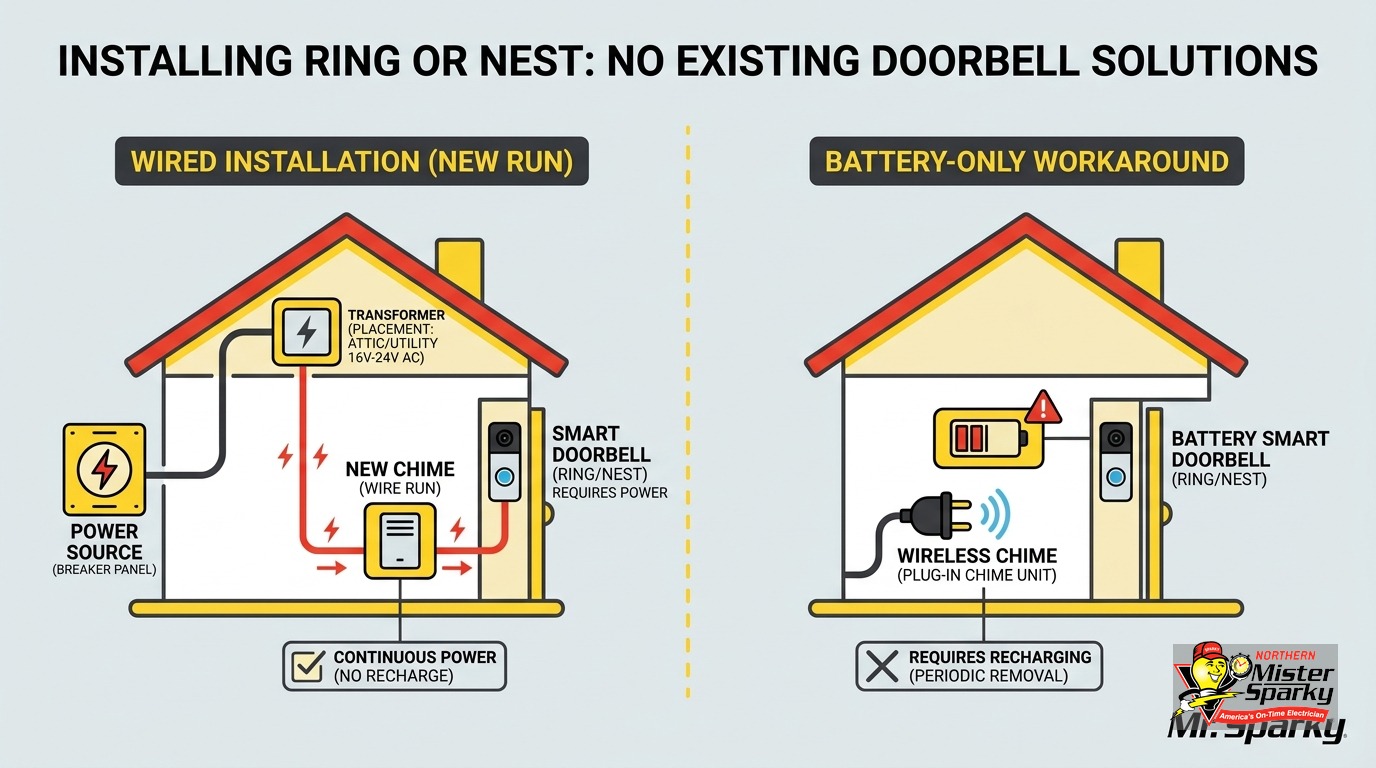
- Smart doorbell installation with no existing wiring requires three new components: a code-compliant transformer in an accessible junction box, a low-voltage wire run to the door, and a 120V supply connection from your panel.
- Battery-only doorbells stop charging below 32°F and lose more than 50% capacity below 40°F. In a Minnesota winter, they drain without recovering until temperatures rise again.
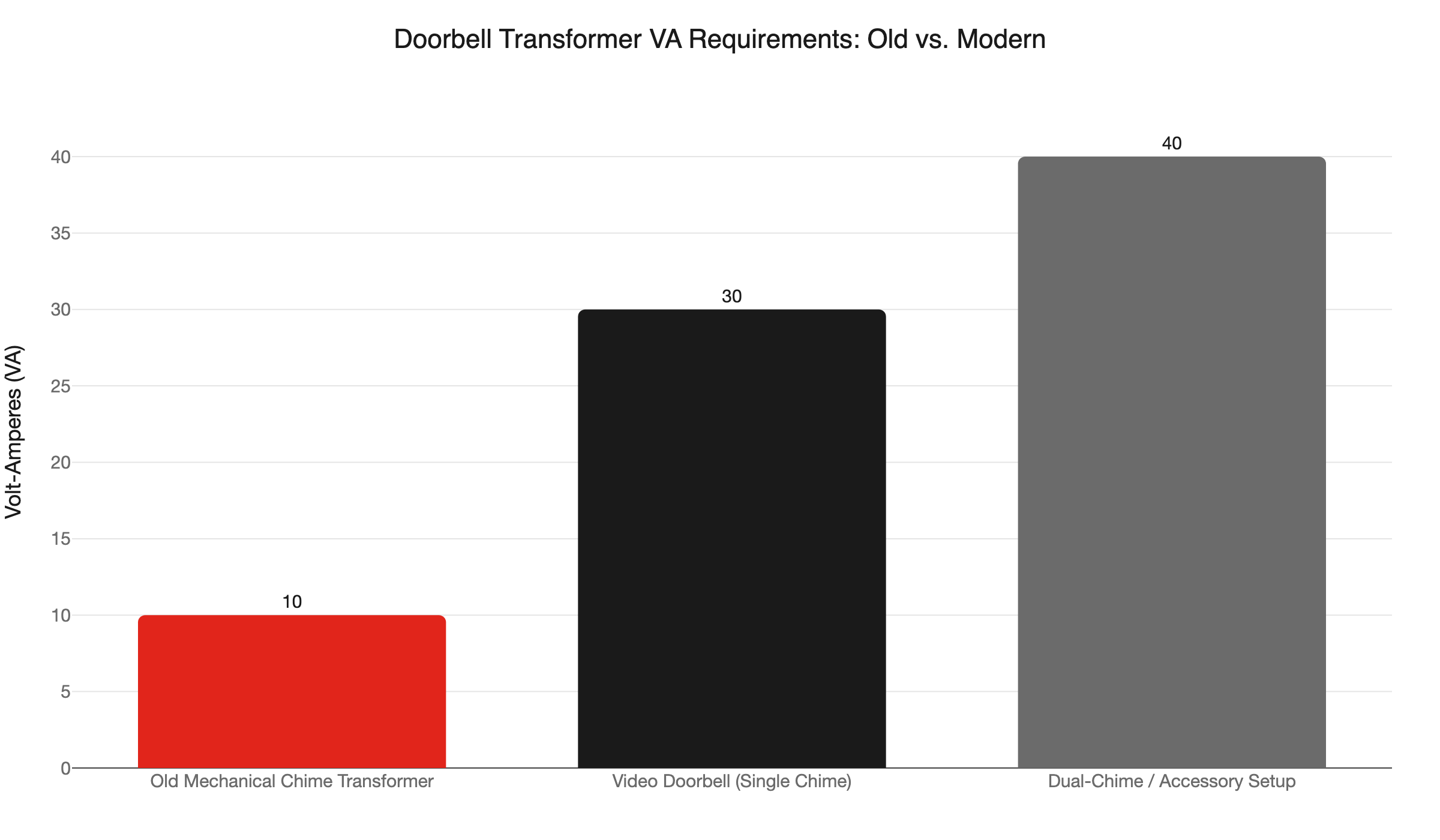
- Older mechanical-chime transformers are rated at 10VA. Modern video doorbells require 30-40VA at 16-24V AC. Undersizing causes flickering, disconnects, and voided warranties.
- Minnesota requires a Power Limited Technician (PLT) license for the low-voltage wire run. A licensed electrician handles the 120V transformer hookup. DIY on either side is unlicensed electrical work under Minn. Stat. 326B.
- Any permit pulled after August 17, 2026 must comply with the 2026 NEC, now adopted in Minnesota.
- One properly hardwired install lasts indefinitely. Call 763-200-5956 to schedule.
What Does Smart Doorbell Installation With No Existing Wiring Actually Require?
Short answer: Three components are missing from your home: a new transformer mounted in an accessible junction box, low-voltage Class 2 wire run from the transformer to the door, and a licensed electrician to connect the 120V supply side. Each piece is a distinct scope of work. Getting all three right is a legitimate electrical project, not a quick afternoon job.
Here is what each component involves:
A properly sized transformer. Old mechanical doorbell transformers were rated at 10VA. That is far below what any video doorbell on the market requires today. A standard Ring or Nest video doorbell installation calls for 16-24V AC at a minimum of 30VA. Dual-chime setups or units with active accessory ports call for 40VA. Undersizing causes the device to flicker, disconnect intermittently, and eventually stop working reliably.
An accessible junction box. NEC 300.15 requires transformer connections to live in an accessible junction box. “Accessible” means you can open the box without cutting into a finished wall. In most Twin Cities homes, that is the basement mechanical room or utility area. The box location gets inspected. There is no workaround.
Low-voltage bell wire. The run from the transformer to the door uses 18 AWG Class 2 rated wire for runs under 100 feet. Longer runs step up to 16 AWG to keep voltage drop under 3%. This wire must stay physically separated from line-voltage conductors per NEC 725.136. Bell wire and standard Romex do not share conduit.
The 120V supply connection. The transformer steps down 120V from your home’s wiring to the low-voltage the doorbell needs. Connecting the 120V supply side is licensed electrician work under Minnesota statute.
Why Battery-Only Is the Wrong Default for Minnesota
Ring’s documentation states it directly: battery charging stops below 32°F. Battery capacity drops more than 50% below 40°F. The device continues to operate down to -4°F, but it cannot recharge in place once temperatures fall below freezing.
Translate that to a Twin Cities calendar. Temperatures in Minneapolis stay below 32°F from November through March in a typical year. During those months, a battery doorbell mounted outside drains without recovering. Normal battery cycles of six to 12 months compress to roughly monthly intervals when temperatures stay below 40°F.
Monthly battery swaps in a Minnesota winter mean this: pull the battery from the door in subzero or near-zero temperatures, bring it inside to warm to room temperature, charge it fully, reinstall it. Skip the warm-up step and you damage the cells. Repeat the whole cycle every month from November through March, year after year.
There is also a reliability dimension beyond the maintenance burden. A battery doorbell running at reduced capacity in cold weather may miss motion events or delay real-time alerts. For a device that doubles as a security tool, reduced performance through the five darkest months of the year is not a minor drawback.
A hardwired doorbell eliminates both problems. The transformer provides constant low-voltage power. The camera, motion detection, and chime work the same in January as in July.
Battery-only makes sense only when running wire is physically impossible. In that case, a plug-in adapter near an outdoor outlet is a better bridge than battery alone. But when wire is possible, hardwired is the correct long-term answer for any Minnesota home.
What Size Transformer Does a Video Doorbell Actually Need?
Short answer: The professional standard for Ring and Nest video doorbell installs is 16-24V AC at 30VA minimum for a single-chime setup. Dual-chime or accessory-connected configurations call for 40VA. Old mechanical-chime transformers at 10VA are universally insufficient. Undersizing is the leading cause of video doorbell flickering and repeated disconnects from the first day of operation.
The VA rating tells you the transformer’s power capacity. Old doorbell systems needed almost none. A mechanical chime draws power for a fraction of a second when you press the button. A video doorbell runs continuously: camera processor, Wi-Fi radio, motion sensor, night vision LEDs. The power demand is fundamentally different.
Transformer requirements by setup:
- Standard single-chime video doorbell: 16-24V at 30VA
- Dual-chime setup: 40VA minimum
- Models with powered accessory ports: 40VA
Size to the recommended rating, not the stated minimum. The cost difference between a 30VA and a 40VA transformer is negligible at purchase. Repeated service calls because of an undersized transformer are not.
Confirm any transformer you specify is UL-listed. NEC 725 mandates UL-listed transformers on all Class 2 circuits. A generic imported unit without UL listing fails inspection outright.
Where Does the Transformer Go in a Minnesota Home?
Short answer: The basement mechanical room is the standard placement for Twin Cities homes. It keeps the junction box accessible for inspection, puts the transformer close to your panel, and keeps the wire run to the front door manageable. Attic placement is allowed but adds run length and may require a wire gauge upgrade.
NEC 300.15 requires the transformer connection in an accessible junction box. That rules out burying a transformer inside finished wall framing. “Accessible” in code terms means you can reach the box for inspection and maintenance without demolishing finished surfaces. A junction box behind a removable panel in a utility room qualifies. One encased in drywall does not. This matters at inspection and again when you sell the house.
Practical reasons favor the basement in most Minnesota homes:
- Most Twin Cities homes built after 1960 have the electrical panel in or near the basement. A short conduit run from the transformer junction box to the panel is straightforward and clean.
- Basement mechanical rooms stay in conditioned space. Cold does not affect transformer electronics the way it affects batteries, but keeping hardware in a climate-stable environment is sound practice.
- A basement-to-main-floor wire run in a typical Twin Cities home is 40-70 feet. That is well within the 18 AWG range without voltage-drop concerns.
If the panel is in an attached garage, the interior wall between the garage and the house is often the second-best option. The criteria are the same regardless of location: accessible junction box, short conduit to the panel, and a manageable wire distance to the doorbell mount point.
Homes with attic panels or unusual floor plans should measure the full wire run before specifying gauge. Any run over 100 feet requires a step up to 16 AWG.
Does Minnesota Require a Licensed Electrician for Smart Doorbell Installation With No Existing Wiring?
Short answer: Yes, and the work splits across two licensed scopes. The 120V supply connection to the transformer requires a licensed electrician under Minn. Stat. 326B. The Class 2 low-voltage wire run from transformer to door requires a Power Limited Technician (PLT) license. Both sides are licensed work. Neither is legal for a homeowner to perform without those credentials in Minnesota.
Minnesota is one of the strictest low-voltage licensing states in the country. A PLT license covers Class 2 systems operating at 100V or less. The doorbell wire run from transformer output to the door button falls entirely within that scope. Businesses performing this work must also hold a Technology Systems Contractor (TSC) license.
Ring’s own installation documentation acknowledges this: “Installation by a qualified electrician may be required in your area. Refer to your local laws and building codes before performing electrical work; permits and/or professional installation may be required by law.”
In Minnesota, “may be required” resolves to “is required.” The statute does not carve out homeowner exemptions for Class 2 low-voltage circuits the way some other states do.
The permit side follows the same logic. A new transformer circuit requires a permit and inspection. The 2026 NEC took effect in Minnesota on August 17, 2026. Any permit pulled today references the 2026 edition. Confirm your contractor is current on the 2026 requirements before work begins.
Unlicensed electrical work in Minnesota can result in fines, failed inspections, and homeowners insurance complications if a claim arises from the work. The permit record also follows the property. At resale, an uninspected install surfaces as a disclosure item and a potential negotiating point for the buyer. For a full walkthrough of the Minnesota permit process, see our post on electrical permits in Minnesota.
What About Older Ring Models Wired Directly to a Transformer?
Short answer: First-generation Ring doorbells and the Ring Video Doorbell 2 require a wirewound resistor when connected directly to a transformer with no chime in the circuit. Ring identifies the omission as a fire hazard in its own documentation. Newer models (Ring 3, 4, Pro, Pro 2, Ultra) do not require the resistor.
Here is why. A mechanical chime in the circuit acts as a load-balancing element. When there is no chime, the circuit loses that ballast. In older Ring models, the missing ballast leads to overheating at the circuit level. The resistor substitutes for the missing load. Without it, the device overheats.
No malarky: that callout in Ring’s documentation is not generic boilerplate. It exists because overheating in the circuit is a real and documented consequence of skipping the resistor on affected models.
If you are unsure which Ring model you have, check the back of the device or open the Ring app under Device Health. The model and hardware generation display there. If you inherited a Ring from a previous owner, verify the model before completing any direct-transformer hookup.
This is the kind of detail a general handyman or a DIY tutorial video may skip. A licensed electrician who installs doorbells professionally catches it in the design phase, before any wire is run.
For transformer replacement on existing doorbell infrastructure, see our post on doorbell transformer replacement. If your home already has a chime and you are upgrading to a video doorbell, the video doorbell wiring guide for existing chime systems covers that distinct scenario instead.
The NEC Code Points That Govern This Work
Doorbell wiring is classified under NEC Article 725 as a Class 2 circuit. Four code requirements shape every no-existing-wiring install:
NEC 300.15: Accessible junction box. Transformer connections must be in an accessible box. No concealing connections inside finished wall cavities without a proper access panel.
NEC 725.121: Supply-side breaker. The 120V supply to the transformer must connect to a 15A or 20A breaker. This is a code requirement, not a contractor preference.
NEC 725.136: Physical separation. Class 2 wiring must stay physically separated from line-voltage conductors. Bell wire and standard household Romex do not share conduit.
UL-listed transformer. NEC 725 mandates a UL-listed transformer on every Class 2 circuit. A generic imported unit without UL listing fails inspection.
Minnesota adopted the 2026 NEC effective August 17, 2026. All permits now reference the 2026 edition. If your contractor cites 2023 NEC requirements without flagging the transition, ask why.
An inspected permit record also protects you at resale. Home buyers and their agents run permit searches on new electrical work. An uninspected doorbell circuit becomes a disclosure item and a line in the negotiation.
Is Smart Doorbell Installation With No Existing Wiring a DIY Project?
Short answer: Not in Minnesota. The 120V transformer hookup is licensed electrician work under state law. The low-voltage wire run to the door requires a PLT license. Both scopes require credentials. Attempting either without a license carries fines and can void homeowners insurance for any claim connected to the unpermitted work.
Beyond licensing, the design decisions carry real consequences if they go wrong. Transformer VA sizing, wire gauge for the run length, junction box placement, and resistor requirements for older device models all need to be correct before a single wire is cut. A licensed professional resolves each of those in a single assessment visit, not as a series of callbacks.
This is not a statement about general competence. It is a description of what Minnesota law requires and what can go wrong without proper credentials. Our post on DIY electrical dangers covers the insurance and code implications in more detail.
What Northern Mister Sparky Does for Your Smart Doorbell Install
We are locally owned and operated in the Twin Cities. Our team holds the credentials this work requires: licensed electricians for the 120V scope, PLT-licensed technicians for the Class 2 low-voltage wire run, and a Technology Systems Contractor license for the business.
A typical no-existing-wiring smart doorbell install with our team moves through five stages:
Assessment. We identify the right transformer placement, measure the full wire run from the mechanical room to the door, confirm the correct VA rating for your device model and chime configuration, and flag any older-model resistor considerations upfront.
Transformer installation. A licensed electrician mounts the transformer, installs the accessible junction box per NEC 300.15, and connects the 120V supply to a properly sized breaker at the panel.
Low-voltage wire run. We route Class 2 wire from the transformer to the door location. Wire gauge is selected based on run length and voltage-drop calculations, not a one-size assumption.
Doorbell mount and commissioning. We mount the doorbell unit, connect the chime if applicable, and test video feed, motion alerts, and app connectivity before we leave the job.
Permit and inspection. We pull the required permit and coordinate the inspection. The permit record stays with the property.
The result is a hardwired video doorbell that functions reliably through every Minnesota winter. No monthly battery swaps. No cold-weather dead zones. No callbacks.
Installs that include running a new branch circuit from the panel, or that pair the doorbell with additional camera work at the same visit, can qualify for financing. Ask when you call.
Every job is backed by the UWIN(R) 100% satisfaction guarantee. If something is not right, we make it right.
Call 763-200-5956 or book online to schedule. We serve Minneapolis, St. Paul, Bloomington, Brooklyn Park, Woodbury, Blaine, Maple Grove, Plymouth, and communities across the Twin Cities. Northern Mister Sparky is America’s On-Time Electrician(R), locally owned and operated, and ready to get this done right.
Frequently Asked Questions
Can I install a Ring or Nest doorbell if my house has no existing doorbell wiring? +
Do I need a licensed electrician to install a smart doorbell in Minnesota? +
What size transformer do I need for a Ring or Nest video doorbell? +
Need an electrician now?