
Under Cabinet Lighting Installation Cost: Twin Cities Guide
Key Takeaways
- Hardwired under-cabinet lighting costs $500 to $1,200 installed, including labor, materials, and permit.
- Plug-in puck strips cost $150 to $400 in materials but do not count as a permanent improvement at appraisal.
- Minnesota law requires a permit and inspection for any hardwired lighting that involves new wiring.
- You cannot tap your countertop outlets for lighting. The applicable kitchen circuit code dedicates those circuits to appliances only.
- The biggest cost variable in Twin Cities kitchens is whether the electrician can fish wire above the cabinet line or must route through tile.
- Xcel Energy offers residential LED lighting rebates for Twin Cities customers. Check program funding before you schedule.
- Unpermitted hardwired work is a known defect under Minnesota seller disclosure law. It can hurt your home sale.
What Does Under Cabinet Lighting Installation Cost?
A professionally installed hardwired system runs $500 to $1,200, all-in. That covers labor, materials, and permit. A DIY plug-in setup costs $150 to $400 in materials only. The gap is not markup. It reflects labor, code compliance, and the permanent value that hardwired adds to your home.
Under-cabinet lighting comes in two types: plug-in and hardwired.
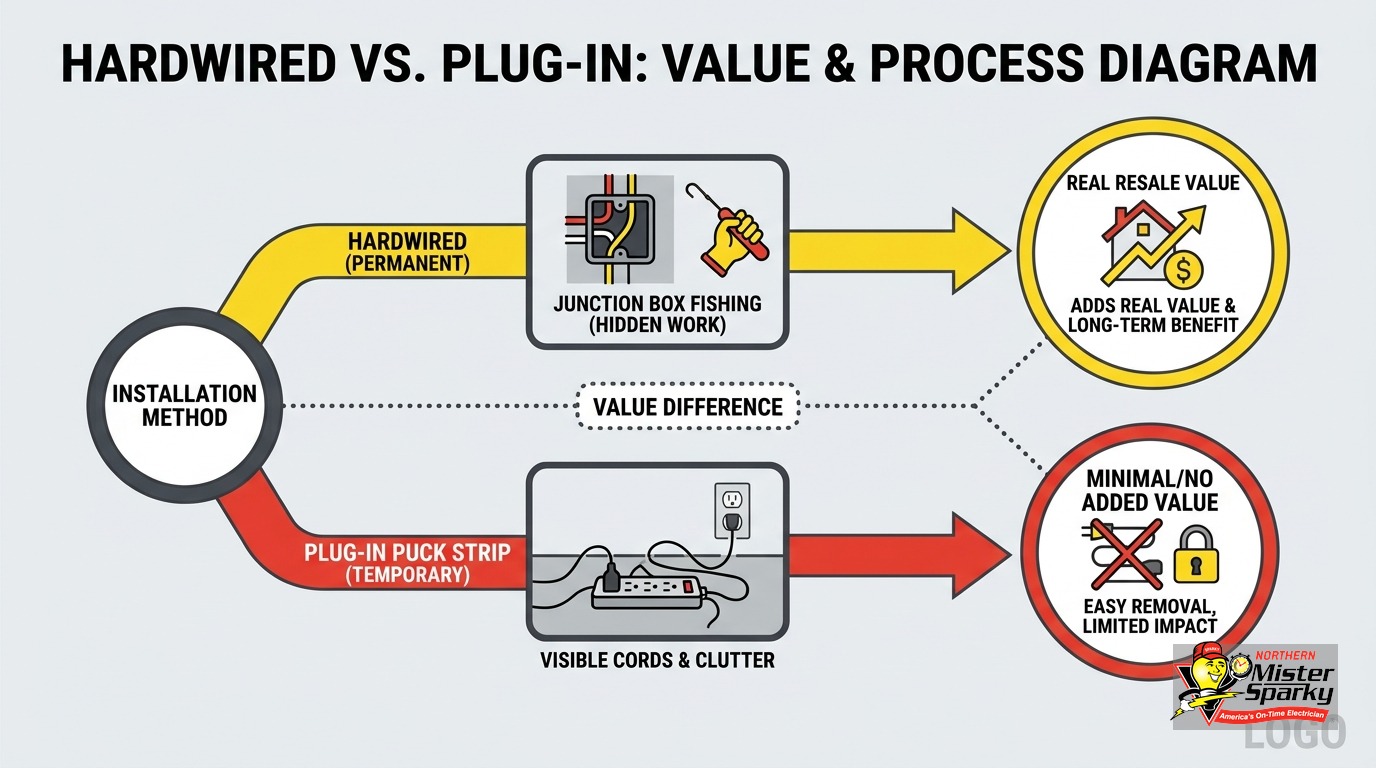
Plug-in strips run from a standard outlet. They are simple to install yourself and cost little upfront. They also have limits on what they can do for your home. They cannot count as a permitted improvement at resale.
Hardwired systems connect directly to your home’s wiring. They run from a wall switch, look clean on the wall, and count as permanent electrical infrastructure.
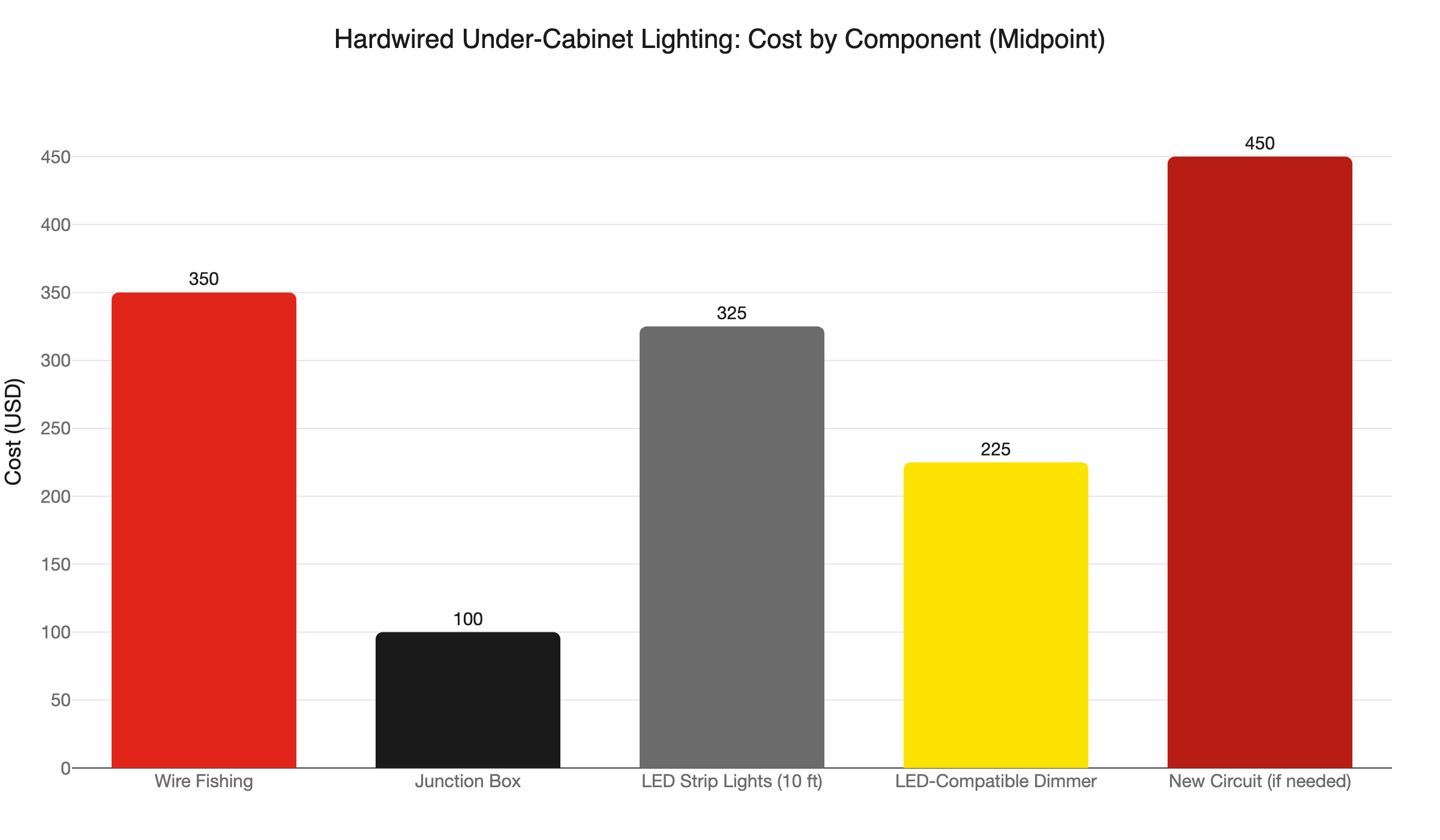
The numbers behind the range are straightforward. LED strip lights vary in price per linear foot in materials. An electrician’s labor is charged by the hour. A standard hardwired install takes two to six hours. Add the junction box, permit, and an LED-compatible dimmer. The total lands between $500 and $1,200 for most kitchens.
If your existing switch layout is close and the wall path is clear, you land near $500. If the run is long or the wall path is blocked, you push toward the top. A new circuit adds another $300 to $600 to the project.
The sections below explain each cost driver in plain terms.
Hardwired vs. Plug-In: Which Under-Cabinet Lighting Installation Adds Value?
Hardwired does. A permitted, inspected hardwired system counts as permanent electrical infrastructure and contributes to your home’s appraised value. A plug-in strip does not. Buyers rank kitchen lighting among their top three priorities during home tours. Plug-in strips cannot make that case at closing.
The performance case for hardwired is straightforward. It turns on from a wall switch. It can be dimmed. It draws from the right circuit.
The code case matters more than most homeowners expect.
Under NEC 400.8, flexible cords cannot serve as permanent wiring. A plug-in strip that stays in place for years is not a code-compliant permanent installation. Minnesota’s DLI has addressed this issue directly in guidance on flexible cords used for connecting luminaires. Electrical inspectors know what to look for, and they find these situations during pre-sale inspections.
Hardwired lighting, installed with a permit and inspected by the state, becomes part of the house’s record. It does not create a disclosure problem at sale. It shows up correctly on an appraisal. And the light is controlled by a wall switch, not a cord.
The price difference between plug-in and hardwired is $500 to $700 for most Twin Cities kitchens. For homeowners planning to stay more than a few years, hardwired is the right call.
How Does the Wire Actually Get to the Fixture?
Your electrician taps a switch leg inside the wall, runs wire up through the wall cavity above the cabinet line, and connects it to a junction box hidden above the cabinets. From that box, shorter runs feed each fixture. This route keeps everything inside finished walls, out of sight, and up to code.
This is the step every national cost guide skips, and it is the main driver of labor time.
Here is the sequence. The electrician identifies a switch box near the kitchen: often a light switch that controls a nearby fixture. They access that box and identify a usable switch leg. Then they feed wire up through the wall cavity, above the top of the cabinet run, and into the soffit space or the open framing above the cabinet tops.
A junction box mounts to the framing in that space. The box is a code requirement, not optional. It costs $50 to $150 and must remain accessible after the installation is complete. All the wire splices happen inside it. That is what the inspector verifies.
From the junction box, shorter wire runs drop down to each fixture location. The connections at each fixture are protected and clean.
Fishing wire through a finished wall runs $200 to $500 in labor, depending on the route length and what the electrician encounters inside the wall. That labor line is the main cost driver for hardwired installs.
If you want dimmer control, add an LED-compatible dimmer switch to the scope. That adds $150 to $300 to the total. Not every dimmer works with every LED strip. Our post on LED dimmer switch compatibility explains how to match them correctly and what to avoid.
Why You Cannot Tap the Countertop Outlets
This is the first question most homeowners ask. The outlets above your kitchen counter look like the obvious power source. They are not available for this job.
The applicable code requires two or more dedicated small-appliance branch circuits for kitchen countertops. Those circuits serve appliances only. Lighting loads are not permitted on them.
Minnesota adopted the 2023 NEC on July 1, 2023. Work permitted after that date must comply. The reasoning is practical: countertop circuits need headroom. A refrigerator, toaster oven, microwave, and coffee maker can all draw current at the same time. Adding a lighting load on top creates real overload risk.
Your electrician’s job is to find a switch leg with available capacity or to pull a new circuit from the panel. Those are the two code-compliant paths. There is no shortcut around the countertop restriction.
If the existing circuits are already running near capacity, a new circuit adds $300 to $600 and moves the project toward the top of the price range. Our post on kitchen electrical circuits and code requirements explains why countertop circuits fill up fast and what adding a circuit actually involves.
What Does Minnesota Code Require for Hardwired Under-Cabinet Lighting?
A permit and inspection are required any time a hardwired lighting project involves new wiring. Minnesota DLI enforces this statewide. AFCI protection is required on any kitchen branch circuit you modify. A licensed electrical contractor must pull the permit. An inspector must sign off before the work counts as a permanent improvement.
Minnesota’s requirements are specific and apply to every community in the state.
Permits. The Minnesota DLI requires a permit for hardwired lighting that involves new wiring. This is not a rule that varies by city or county. It applies in Minneapolis, Bloomington, Woodbury, Blaine, Plymouth, and every other Twin Cities suburb. The permit becomes part of your home’s official record.
AFCI protection. The Minnesota electrical code, as adopted in 2023, requires arc-fault circuit interrupter protection on kitchen branch circuits. Any modification, extension, or replacement of a kitchen circuit triggers this requirement. Your electrician confirms the panel has the right breaker. If it does not, an AFCI breaker is added to the scope.
Licensed contractor. A licensed electrical contractor must pull the permit and perform the work. Homeowners cannot pull permits for most hardwired circuit work. For the full detail, see our guide to electrical permits in Minnesota.
Inspection. A state electrical inspector reviews the completed work. That sign-off makes the installation a permanent, permitted improvement. Without it, you have hardwired lighting with no paper trail and a potential disclosure problem at resale.
One timing note: Minnesota has already adopted the 2026 NEC, with an effective date of August 3, 2026. Projects starting after that date should confirm which code cycle applies with your contractor.
How Your Kitchen Layout Affects Under Cabinet Lighting Installation Cost
Here is the detail national cost guides never mention. It is the main reason local quotes can run $200 to $300 above what an online calculator estimates.
Most Twin Cities homes built between 1958 and 1985 have a consistent kitchen layout. The tile backsplash stops partway up the wall. The cabinet run ends 18 inches or so below the ceiling. A framing cavity sits above the cabinet tops, often accessible through the soffit or from the open space above.
When that cavity is accessible, the electrician fishes wire above the cabinet line. The tile stays untouched. The wall surface stays untouched. Installation lands toward the lower end of the labor range.
When a 1970s kitchen remodel ran tile all the way to the soffit, that cavity is sealed. The electrician must route wire through the wall instead. That route takes longer. Labor climbs.
This is not a markup. It is geometry. And it is why a walk-through before quoting matters. An electrician who looks at your specific kitchen gives you a real number. An online calculator gives you a national average that may have nothing to do with your walls, your soffit, or your tile line.
Older Twin Cities homes sometimes pair a tight wall cavity with an undersized panel. If your panel is already running close to full, that changes the conversation before the first fixture goes up. Our post on signs you need an electrical panel upgrade covers the indicators that a panel is running out of room.
Does Unpermitted Work Hurt Your Home Sale?
Yes. Minnesota requires sellers to disclose known defects. Unpermitted hardwired electrical work is a known defect. It can reduce your negotiating position and, in some cases, void homeowner’s insurance coverage for electrical losses. Doing the work right costs less than fixing it before a sale.
Above the Code Electrical states this directly: unpermitted electrical work can void homeowner’s insurance and surface as a defect on a pre-sale inspection.
Buyers’ inspectors are trained to identify hardwired fixtures with no permit record. They test circuits, check junction box accessibility, and look for AFCI compliance. When they find a problem, it goes into the inspection report. The buyer’s attorney reads that report.
At that point, the cost of remediation typically comes out of the sale price. You also lose the ability to represent the work as a permitted improvement when justifying your asking price to an appraiser or a buyer.
Permitted work leaves a clean paper trail. It contributes to the home’s appraised value as a permanent improvement. It gives buyers and their lenders confidence. And it satisfies the seller disclosure requirement without a conversation.
If you are buying a Twin Cities home and want to understand what past electrical work should look like, our guide to electrical inspections when buying a home explains what to request and what red flags to watch for.
Can an Xcel Energy Rebate Offset the Cost?
Sometimes. Xcel Energy offers residential LED lighting rebates for Twin Cities customers. Current amounts and program availability are at mn.my.xcelenergy.com/s/residential/home-rebates. These programs run while funding lasts. Check before you schedule your installation.
LED lighting uses significantly less energy than incandescent or halogen, according to the U.S. Department of Energy. LED strip lights also carry rated lifespans of 50,000 hours or more. The energy savings are real over the life of the installation.
Xcel’s rebates do not cover installation labor, but they can offset part of your fixture and strip light costs. The rebate check typically arrives within a few weeks of submission. The program is first-come, first-served. Funding can close before the calendar year ends, so check the program page early.
If you are doing a broader kitchen lighting project, we can often combine under-cabinet strips with other fixture work in a single visit. Our indoor lighting installation service covers the full scope of what we handle in one trip.
Ready to Book an Under-Cabinet Lighting Install?
Here is what the project looks like from your end.
You call us or book online. We schedule a walk-through, usually within a day or two. Our electrician checks the cabinet run, the wall path above it, the nearest switch box, and your panel. You get a quote before any work starts. No surprises, no malarky.
On install day, we fish the wire, mount the junction box, run the fixture wires, and install a dimmer if you want one. We pull the permit and schedule the state inspection. When the inspector signs off, you have a permanent improvement that belongs to the house.
We are locally owned and operated in the Twin Cities. We are also America’s On-Time Electrician(R). We show up when we say we will. If something is not right after the job, the UWIN(R) 100% satisfaction guarantee covers it.
For larger kitchens or older homes where a new circuit is likely, financing options are available to spread the cost across time.
Call 763-200-5956 or book online to get your walk-through on the calendar.
Frequently Asked Questions
How much does under cabinet lighting installation cost in Minnesota? +
Do I need a permit for hardwired under-cabinet lighting in Minnesota? +
Can I tap my kitchen countertop outlets for under-cabinet lighting? +
Does hardwired under-cabinet lighting add home value? +
Need an electrician now?