
Pendant Light Installation Kitchen Island: Code and Circuits
Key Takeaways
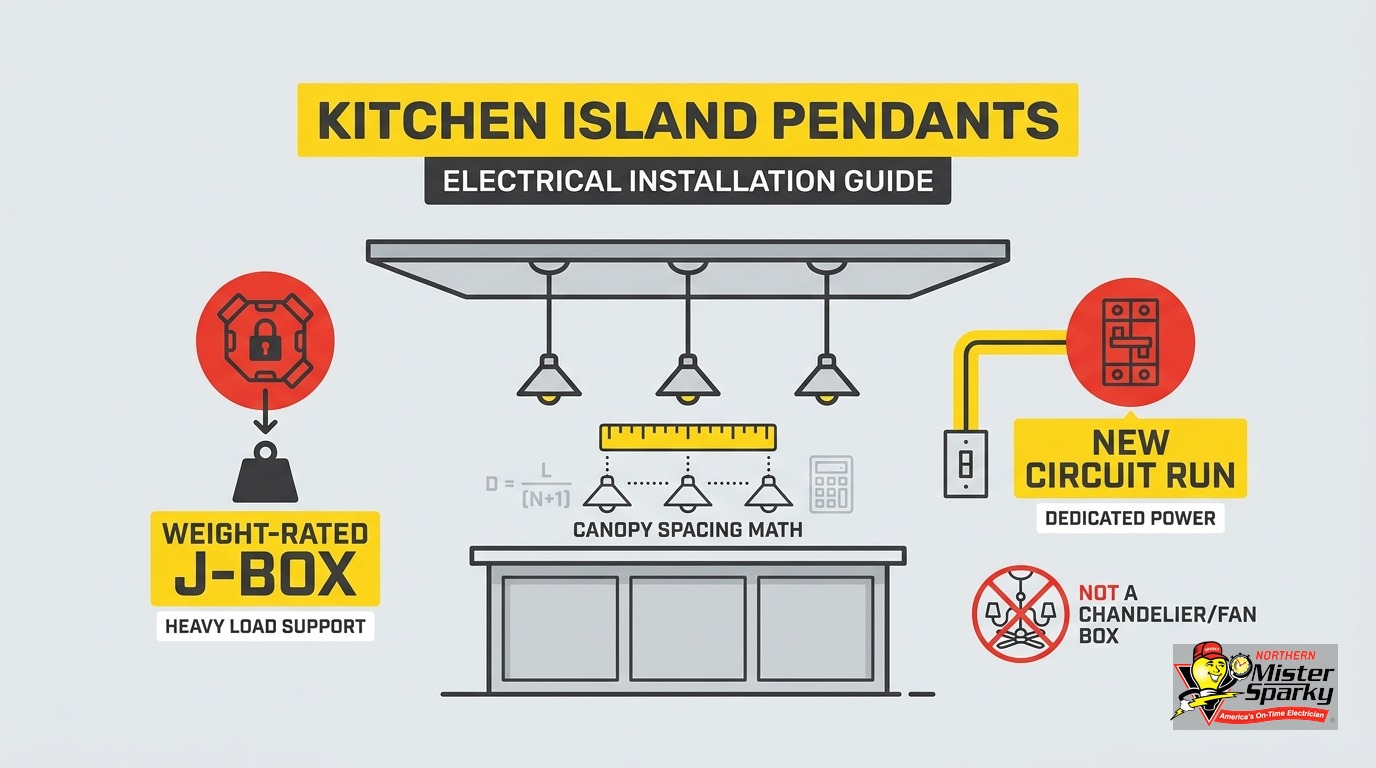
- Pendant light installation over a kitchen island usually means running a new circuit from the panel. Assume no junction box exists until an electrician confirms otherwise.
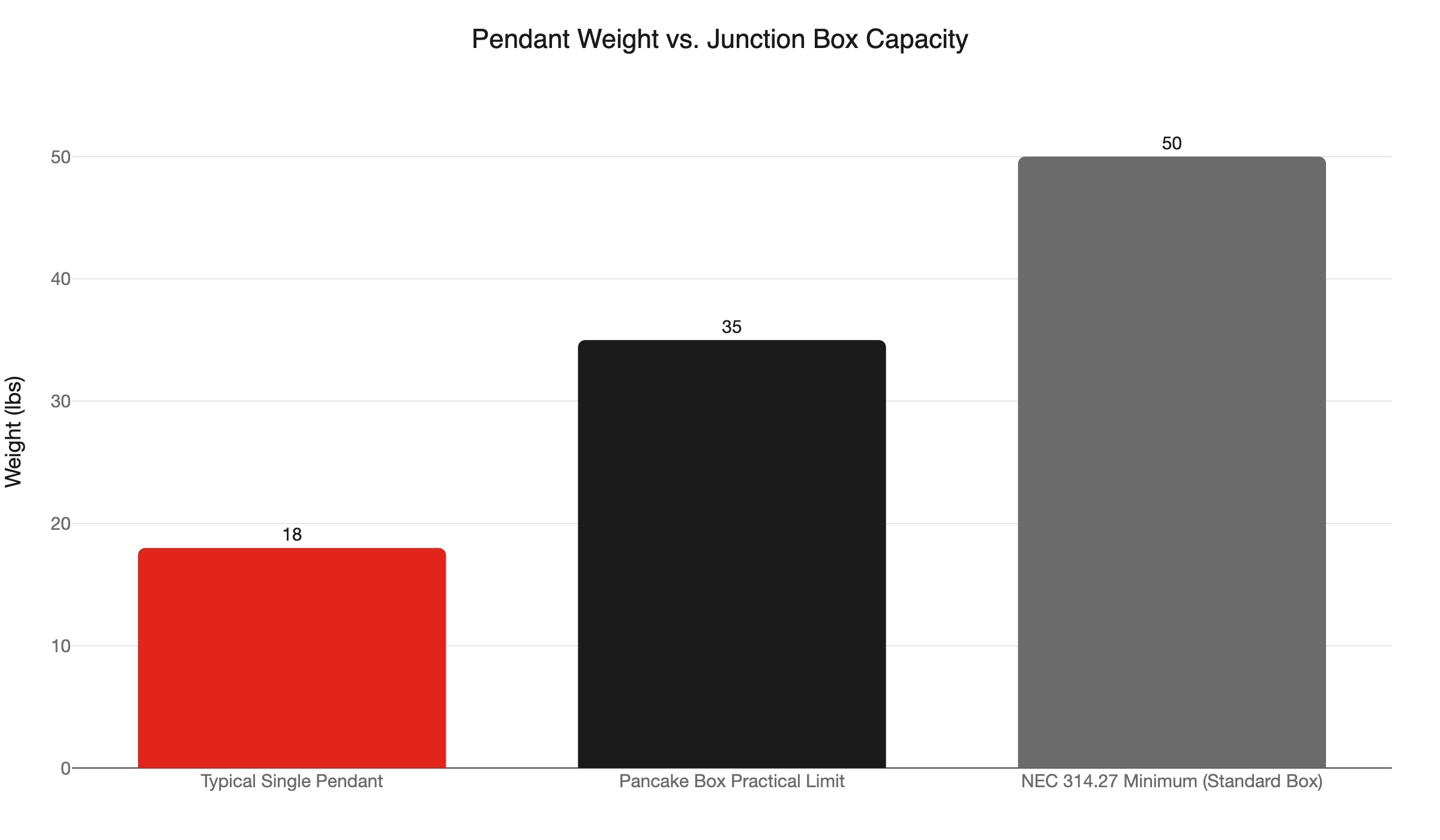
- NEC 314.27(A)(2) requires ceiling outlet boxes for lighting to support at least 50 lbs. A standard pancake box screwed into a single joist may only hold about 35 lbs in practice.
- Island pendant lighting must be on its own general illumination circuit. It cannot share the kitchen’s Small Appliance Branch Circuit (SABC). Wiring it to an existing countertop outlet circuit is a code violation and a guaranteed inspection failure.
- Minnesota adopted the 2026 NEC on August 17, 2026. Permits filed on or after that date must comply with the 2026 code.
- A permit and final inspection are required for any new circuit in Minnesota.
- Call 763-200-5956 or book online to schedule. We handle the permit, the circuit run, the box, and the install.
Why Pendant Light Installation Over a Kitchen Island Is Not a Fixture Swap
Pendant light installation over a kitchen island is one of the most searched lighting upgrades for Twin Cities homeowners. The top results tell you how to pick a hanging height, how many pendants to order, and which finishes look best over white quartz. What none of them tell you is the part that actually requires an electrician.
Most kitchen island ceilings have no junction box, no wiring, and no circuit. You are looking at plain drywall and insulation above a space that was never roughed in for pendant lighting. The project is not a fixture swap. It is a new circuit run from the panel, a new box installation, a permit, and a final inspection.
The three things that make pendant light installation over a kitchen island a licensed electrical job are the junction box weight rating, the circuit separation requirement, and the permit process. This guide covers all three in plain language, then finishes with the hanging height and spacing math that the decorating articles do get right.
One local detail worth knowing before you file anything: Minnesota adopted the 2026 NEC on August 17, 2026. Every permit filed in the state on or after that date follows the new code. That means this article is publishing one week into a fresh code cycle - and no national content covers it.
Does a Junction Box Already Exist Above Your Kitchen Island?
Most likely no. Most kitchen island ceilings are plain drywall with no box, no wiring, and no circuit. A licensed electrician needs to confirm what is above the ceiling before any fixture is ordered or installed.
When a kitchen was originally wired, the electrician focused on countertop receptacles and perimeter recessed lighting. The ceiling directly above the island was rarely part of that scope. In most mid-century and modern homes across the Twin Cities - Minneapolis, St. Paul, Bloomington, Brooklyn Park, Woodbury - there is nothing above that drywall but insulation and joists.
Older homes occasionally have a legacy pull-chain socket fixture above the kitchen table area, which may or may not align with the island’s centerline. If that socket exists, it may have wiring - but it was almost certainly placed on an overhead general lighting circuit from an era before dedicated island circuits were standard practice. That does not automatically make it the right circuit for pendant lighting. An electrician still needs to confirm what it is wired to.
The entire project branches based on what is up there.
If no box exists, the job is a new-circuit run from the panel. An electrician pulls wire through the attic or ceiling cavity, routes it to the correct position above the island’s centerline, and installs a properly rated box. That is a permit job with a required final inspection.
If a box already exists, the next question is box type and weight rating relative to your chosen fixture. A box that held a 3-pound surface-mount fixture is not automatically cleared for a 30-pound pendant cluster.
If a box exists and there is an existing circuit, your electrician still confirms whether that circuit is a general illumination circuit or a branch off an SABC. That distinction is the subject of the next section.
The practical move: call before you shop for fixtures. Knowing the ceiling situation changes fixture selection, cord length, and canopy diameter.
What Is the Junction Box Weight Rating for Pendant Lights?
NEC 314.27(A)(2) requires ceiling outlet boxes used for lighting to support at least 50 lbs. That is a minimum floor, not a design target. A standard pancake box mounted with coarse-thread screws into a single joist may only handle about 35 lbs in practice, even if its label reads “50 lb rated.”
This is the code rule that most pendant guides skip. It is also the rule whose failure shows up as a fixture on the floor.
Here is how the weight math works in practice.
A typical 8-inch cylinder pendant, assembled with cord, canopy, and shade, weighs 15 to 20 lbs. That sits comfortably under the NEC minimum. A single lightweight pendant over a short island is generally fine with a properly installed standard box.
The problem starts with heavier configurations. Multi-pendant linear bars, large brass globe arrays, long-rod lantern pendants, and blown-glass clusters can push past 35 to 50 lbs once the full system is assembled. At that point, the box type becomes the limiting factor - not the fixture’s aesthetic.
For fixtures between 50 and 70 lbs, a fan-rated box is the minimum acceptable installation. Fan-rated boxes are engineered for dynamic and static loads. They transfer weight into ceiling framing rather than relying on drywall anchors or a single screw into one joist.
For installations where the existing box type is unknown, or where the fixture is particularly heavy, a retrofit brace is the reliable solution. A retrofit brace expands between two joists and carries a 50 to 75 lb rating. It installs without opening the ceiling and transfers the load directly into the structure.
NEC 314.23(H)(1) covers another layer of this: pendant-supported enclosures must use a listed cord grip fitting that protects conductors against strain and connects to the box’s threaded hub in an approved manner. The canopy assembly you choose needs to be compatible with the box you install. Not every pendant fixture ships with a cord grip rated for a commercial-grade threaded hub.
The practical checklist before you order:
- Weigh the assembled fixture - rod, canopy, cord, and shade together.
- Identify the existing box type before purchasing. Pancake boxes on a single joist are the most common weak point.
- If the fixture exceeds 35 lbs and a pancake box is present, plan for a retrofit brace or a new fan-rated box.
- If the fixture exceeds 50 lbs, a fan-rated box or structural blocking into the joists is required under the code, regardless of what is already in the ceiling.
Your electrician assesses all of this on the first visit. A fixture that drops because the box was undersized is not something you recover from cleanly.
Can Pendant Lights Share the Kitchen’s Existing Circuit?
No. Island pendant lighting must be on a separate general illumination circuit and cannot share the kitchen’s Small Appliance Branch Circuits (SABCs). Under NEC 210.11(C)(1), SABCs are dedicated to countertop receptacles. Adding a lighting load to an SABC is a code violation and a guaranteed inspection failure.
This is the rule that makes most “just tap the nearest outlet circuit” DIY pendant installs code-violating before the first pendant goes up.
Here is why the circuits are separated. Kitchen SABCs are sized for high-draw appliances - toasters, coffee makers, microwaves, stand mixers. Those circuits run at or near capacity during typical morning use. Adding a consistent lighting load on top of that demand reduces available ampacity and creates a tripping risk. The code does not allow it, and an inspector will catch it.
A general illumination circuit is a separate home run to the panel. The standard options are 14/2 NM-B cable on a 15A breaker, or 12/2 NM-B cable on a 20A breaker. The circuit is dedicated to lighting only.
In new construction or a full kitchen remodel, the circuit is roughed in before drywall: a wire drop positioned so pendant locations will center on the island’s long axis, without exposed wire crossing the ceiling. In a retrofit, the electrician routes the new wire through the attic or ceiling cavity to the new box location. That routing is what separates a rough-in job from a simple fixture swap.
One related code change worth knowing: NEC 210.52(C)(5) in the 2023 and 2026 editions made island receptacles optional in new construction. Pendant drops and floor boxes are now the preferred power delivery alternatives at islands. That shift does not eliminate the separate-circuit requirement for pendant lighting - it reinforces why the lighting circuit is planned independently from the island outlet question. For a full breakdown of how those rules interact, see our guide to kitchen island outlet requirements.
For a broader look at how kitchen circuits are organized under the code, the guide to kitchen electrical circuit requirements covers the SABC count rules, GFCI requirements, and dedicated appliance circuits in one place.
The one-line version: island pendant lights need their own circuit home run. There is no shortcut the inspector will pass.
How to Space and Hang Pendant Lights Over a Kitchen Island
Once the electrical rough-in is confirmed and the box is set, fixture selection and placement become the primary decisions. Here is the measurement framework that lighting designers consistently apply.
Hanging height
The standard hanging range is 30 to 36 inches above the countertop surface. At 30 inches, the pendant provides focused task lighting and a closer, more intimate feel. At 36 inches, the fixture sits above typical sightlines and keeps the view across the island open.
At a standard 8-foot ceiling, the pendant body should hang 12 to 20 inches below the ceiling. Cord or rod length at purchase needs to account for the full drop from the canopy mounting point to the bottom of the shade - not just the cord itself. Measure from the actual box location to the countertop to confirm clearance before ordering.
For ceilings above 8 feet, add approximately 3 inches of additional hang for every extra foot of ceiling height. A 10-foot ceiling calls for pendants hanging 36 to 42 inches above the counter.
Number of pendants
A common starting rule: one pendant per 2 linear feet of island. A 4-foot island takes two pendants. A 6-foot island takes three. Adjust for fixture diameter - a large-shade pendant may call for two over a 6-foot island rather than three crowded in.
Spacing
Center the pendant grouping on the island’s long axis. Space individual pendants 24 to 30 inches center-to-center. Keep the outermost pendant centerlines at least 6 inches from the island’s short edges. This prevents the outer pendants from reading as pushed to the corners.
Vaulted and cathedral ceilings
A sloped ceiling changes the installation in ways the height math does not capture. The junction box must mount on a sloped-ceiling adapter, and cord or rod length must account for the mounting angle rather than a straight vertical drop. Get the rough-in confirmed before ordering any fixture with a fixed-rod suspension. For structural and code requirements specific to sloped-ceiling box installations, the guide to ceiling fan installation on vaulted and cathedral ceilings covers the applicable rules in detail.
Do You Need a Permit for Pendant Light Installation in Minnesota?
Yes, if the job involves a new circuit. Minnesota requires a permit for any new circuit installation, and island pendant lighting almost always requires a new circuit. A final inspection is mandatory. Apply online at ims.dli.mn.gov.
Here is who can pull the permit and do the work.
Owner-occupants may pull their own permit and perform the electrical work on their own residence. This is a real option for homeowners who are qualified and willing to do the rough-in themselves. The permit still requires a final inspection - that step is not optional regardless of who does the work.
If the property is a rental, non-owner-occupied, or if the work is being done on behalf of someone else, a licensed electrical contractor must pull the permit and complete the work. There is no DIY path for rental property electrical.
Skipping the permit is not a low-risk shortcut. An uninspected circuit can void your homeowner’s insurance coverage for damage that traces back to that work. And when the house sells, the unpermitted circuit becomes a disclosure issue or a renegotiation point.
The inspection authority varies across the Twin Cities. Some suburbs use state DLI inspectors. Others use local city or township inspectors. Bloomington, Brooklyn Park, Woodbury, Blaine, Maple Grove, and Plymouth each may operate under different AHJs. The DLI inspector lookup identifies which AHJ governs your specific address before you file. That lookup matters - filing under the wrong jurisdiction delays the inspection.
When Northern Mister Sparky pulls the permit for a homeowner, the AHJ lookup, the filing, and the inspector coordination are included. You do not need to learn how to navigate the difference between a state inspector and a local one. For more on the permit process in Minnesota, see our guide to electrical permits in Minnesota.
What Does the 2026 NEC Adoption Mean for Twin Cities Pendant Installations?
Minnesota adopted the 2026 NEC on August 17, 2026. Permits filed on or after that date must comply with the 2026 code. Permits filed before August 17 follow the 2023 NEC. The code version that governs your project is determined by the permit filing date, not the quote date or the job start date.
This timing detail matters if you received a quote before August 17 and have not yet filed the permit. Confirm with your electrician which code applies before the permit goes in.
For pendant light installation specifically, the junction box weight rating rules and the circuit separation requirement exist in both the 2023 and 2026 NEC editions. The core technical requirements discussed in this article apply under either code cycle. This job type is not one where the 2026 transition changes the scope or approach.
Minnesota adopts the NEC without state-specific amendments. The code applies as written, without carve-outs for residential lighting circuit work.
The 2026 NEC changes with the broadest residential impact involve AFCI expansion, energy storage systems, and EV charging infrastructure - not standard lighting circuit work. If your project is being quoted now and the permit has not been filed, it is a 2026 NEC project, full stop. Ask your electrician to confirm.
When Should You Call an Electrician for Pendant Light Installation?
Call before you buy the fixtures. The box type, circuit situation, and permit requirements all affect which fixtures will work in your ceiling. Choosing a fixture first and then discovering the ceiling has no box - or a pancake box rated below the fixture’s assembled weight - wastes time and sometimes money on non-refundable orders.
Here is the right sequence for a kitchen island pendant project:
- Have an electrician confirm the ceiling situation. Box present or not? What type? Where are the joists?
- Confirm the circuit. Is a general illumination circuit already roughed in above the island? If not, a new run is required.
- File the permit. New circuit equals a required permit in Minnesota.
- Select fixtures with real numbers in hand - weight, cord length, and canopy diameter based on the actual rough-in location and box type.
- Complete the rough-in and any required rough-in inspection from the AHJ.
- Install the fixtures and schedule the final inspection.
Steps 1 through 3 and 5 through 6 belong to the electrician. Step 4 is yours, made with real information instead of assumptions.
Northern Mister Sparky is locally owned and operated in the Twin Cities. As America’s On-Time Electrician(R), we show up when we say we will, pull the permit, run the circuit, and hang the fixture right the first time. The UWIN(R) 100% satisfaction guarantee backs every job - if something is not right, we make it right.
We serve Minneapolis, St. Paul, Bloomington, Brooklyn Park, Woodbury, Blaine, Maple Grove, Plymouth, and the broader Twin Cities area. Call 763-200-5956 or book online to get the project started the right way.
Frequently Asked Questions
Can I add pendant lights over my kitchen island without an electrician? +
What junction box do I need for kitchen island pendant lights? +
Do pendant lights over a kitchen island need their own circuit? +
Is a permit required for pendant light installation in Minnesota? +
Need an electrician now?