
Kitchen Island Popup Outlet Installation: 2026 NEC
Key Takeaways
- Minnesota adopted the 2026 NEC on August 17, 2026. Any permit pulled in the Twin Cities today falls under the 2026 edition, not the 2023 edition.
- Kitchen island and peninsula outlets are no longer required by code. But if you install one, the rules for where it can go are strict.
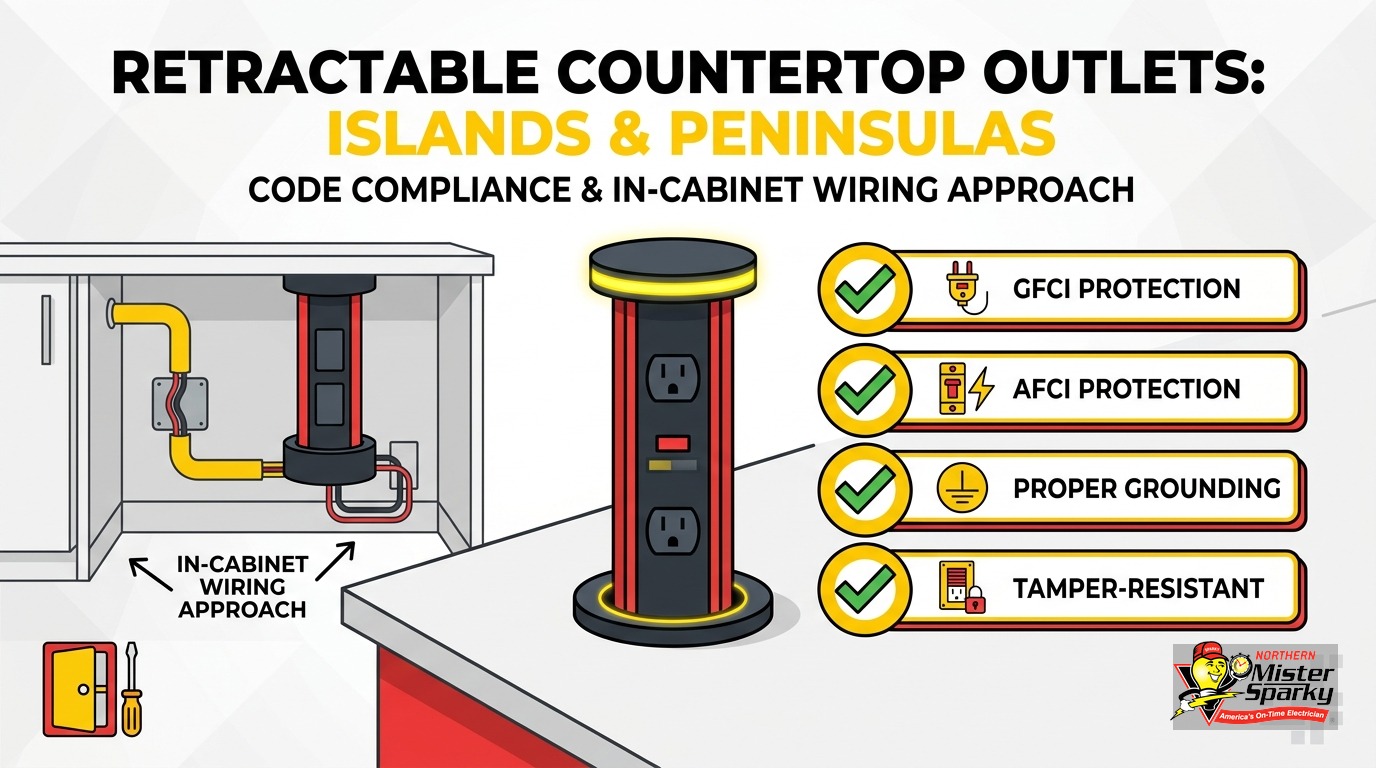
- The entire popup assembly must carry a listing for countertop use under NEC 406.5(E). An assembly where only the receptacle inside has a UL mark is a code violation, even if that outlet is high quality.
- NEC 210.52(C)(4), added in the 2026 edition, explicitly prohibits receptacles on cabinet sides or wall surfaces within approximately 24 inches below the countertop surface. The side-panel workaround is gone.
- GFCI protection and tamper-resistant receptacles are mandatory for all island countertop outlets.
- A listed, hard-wired assembly on a dedicated 20-amp GFCI circuit is the installation path that passes inspection reliably.
- A Minnesota electrical permit is required before work starts. The minimum fee is $26.
What Is a Kitchen Island Popup Outlet?
A popup outlet is a retractable countertop assembly. It sits flush with the surface when closed and rises to expose outlets when opened. It puts power right at the counter without running a cord from a wall outlet across the island.
Most assemblies hold two or three standard receptacles. Some include USB-A or USB-C ports for charging without an adapter block. The housing drops into a cutout in the countertop, usually a round or rectangular hole, and sits flush when the unit is at rest. A light push pops the top open and lifts the outlet housing a few inches above the surface.
The appeal is obvious. Kitchen islands are prep surfaces, charging stations, and gathering points. Running a cord from a wall outlet across an island to reach a stand mixer or a laptop is awkward and creates a hazard. A popup outlet in the surface solves that problem cleanly.
The risk is less obvious. Most popup outlet products sold online and at home-improvement stores are not listed for the application the National Electrical Code actually requires. Homeowners buy them, install them, and either fail the final inspection or skip the permit entirely and live with a product that would not have passed.
The listing problem is the core story here. The sections below explain it, cover the 2026 NEC changes that matter most for Twin Cities homeowners, and describe what a properly permitted and inspected kitchen island popup outlet installation looks like.
Is a Kitchen Island Outlet Required by Code?
No. Since the 2023 NEC, island and peninsula outlets are not required. If you skip the outlet, you must still provide electrical provisions: a junction box or conduit stub inside the cabinet so a receptacle can be added later without cutting into the finished cabinet structure.
Structure Tech, a Twin Cities home inspection firm, called the removal of the required island outlet “the most notable and surprising change” in the 2023 NEC. It caught contractors and inspectors off guard throughout Minnesota when the edition took effect on July 1, 2023.
The practical meaning: you can design and build a kitchen island with no outlet at all. It will pass inspection. That is a real design option. Many homeowners choose it because they would rather have an uninterrupted countertop surface than a popup housing cut into the middle of it.
But a finished island with no electrical path for the future does not pass inspection. NEC 210.52(C)(2) requires electrical provisions if no receptacle is installed. That means a properly installed junction box inside the cabinet, covered with a blank plate, or a conduit stub with a pull string. A closed-up cabinet with no junction box and no conduit stub fails this requirement under both the 2023 and 2026 NEC.
The rough-in for electrical provisions is a small, inexpensive step at the right stage of the build. If you are already opening walls and running wire for a kitchen remodel, adding a junction box inside the island cabinet takes an hour. Adding it after the cabinet is finished, the countertop is in, and the walls are closed can mean cutting into tile, granite, or finished millwork.
Why Doesn’t the UL Mark on the Box Always Mean the Outlet Is Compliant?
Under NEC 406.5(E), the entire countertop assembly must be listed for countertop use. A UL mark on the outlet alone does not cover the housing, the wiring compartment, or the assembly’s spill resistance as a complete unit.
This is the listing trap, and it is the source of more failed inspections on popup outlets than any other single issue.
When you buy a popup outlet online or at a home-improvement store, the packaging will almost certainly display “UL Listed.” What that listing covers is the question. It may apply to the receptacle inside the housing. It may apply to the housing as a work-surface or furniture-power-strip assembly. It does not automatically extend to the complete unit as a kitchen countertop installation.
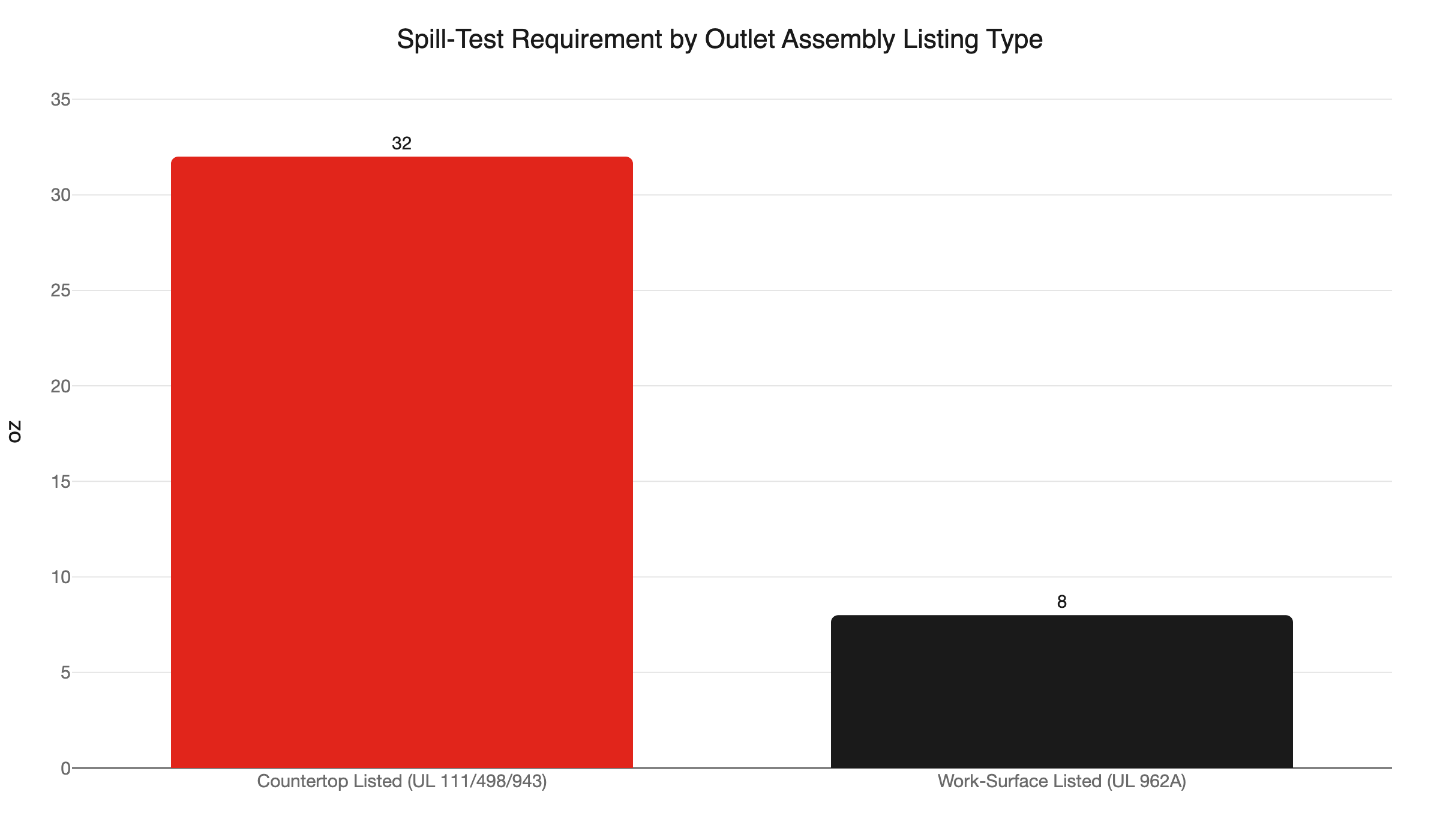
The NEC requires the complete countertop assembly to pass a spill test. The countertop listing requires the assembly to handle a 1/2-gallon (32 oz) spill per UL 111, UL 498, and UL 943. Work-surface-only assemblies, classified under UL 962A and used for furniture power strips and conference table outlets, must pass only an 8 oz spill test. An assembly with a UL 962A listing is not qualified for kitchen countertop installation. Installing it in a countertop is a code violation regardless of how many UL marks appear on the product.
Tamper-resistant receptacles are a separate requirement. Look for “TR” marked on the face of the outlets inside the assembly before purchase. Many lower-cost popup products omit tamper-resistant devices and fail on that point alone.
The fix is to ask for the UL category code before any countertop gets cut. If the product carries a KCXS category listing from UL, it is countertop-rated. If the seller cannot point you to a countertop listing, the product is probably not one.
Where Can a Kitchen Island Outlet Be Located Under the 2026 NEC?
NEC 210.52(C)(3) permits countertop outlets in three locations only: above the countertop surface no more than 20 inches up, in the countertop itself using a listed countertop assembly, or in a work surface using a listed assembly. Side-mounted below-counter outlets are not permitted under any of those options.
Before the 2023 NEC, a common installer approach was to mount an outlet on the side panel of the island cabinet, below the countertop edge. The homeowner would run the appliance cord up over the counter to reach the toaster or stand mixer. That was legal under the old code. It saved the installer the work of running wire into the countertop.
The Consumer Product Safety Commission tracked 9,700 U.S. emergency department visits between 1991 and 2020 for burns and similar injuries caused by appliance cords draped over counter edges from below-counter island outlets. The cord could contact a hot burner or catch the edge and pull an appliance off the counter. In a busy kitchen, it was also a trip hazard. That data drove the 2023 NEC to remove side-mounted below-counter outlets as a permitted location.
The 2026 NEC added section 210.52(C)(4) to close the door explicitly. Receptacles on cabinet sides or wall surfaces within approximately 24 inches below the countertop surface are now prohibited. A drawer-mounted outlet is a named exception to this prohibition. It can sit inside a cabinet drawer and serve the countertop surface without exposing a cord over the edge.
The Hubbell NEC explainer summarizes the three compliant location options clearly:
- On or above the countertop, mounted in a wall or riser, no more than 20 inches above the surface
- In the countertop itself, using a listed countertop assembly
- In a work surface, using a listed assembly
If a contractor bids a side-mounted outlet for a permit pulled in the Twin Cities today, push back.
What Did Minnesota’s 2026 NEC Adoption Change for Island Outlets?
Minnesota adopted the 2026 NEC on August 17, 2026. Every permit filed on or after that date must comply with the 2026 edition. That means 210.52(C)(4) is now current law in Minnesota, and the side-panel workaround is explicitly prohibited.
Permits filed before August 17, 2026, used the 2023 NEC. Electrician licensing exams transitioned to the 2026 edition on September 8, 2026. Both editions prohibit side-mounted below-counter outlets. What the 2026 edition adds is a codified prohibition zone with a specific measurement and a named exception for drawer-mounted units.
For Twin Cities homeowners who had a side-mounted island outlet installed before July 1, 2023, that outlet was legal under the code in effect at installation. A buyer’s inspector cannot cite it as a current code violation. But the moment you pull a new permit to replace, move, or add to that island wiring, the 2026 NEC governs the new work.
This timing matters for remodels. Every electrical permit pulled in Minnesota today is under the 2026 NEC. That means the popup or above-counter option only, a countertop-listed assembly, and a dedicated GFCI circuit below.
How Should a Kitchen Island Popup Outlet Be Wired?
The compliant path is a listed, hard-wired countertop assembly connected to a dedicated 20-amp circuit with GFCI protection. Popup products that use a cord-and-plug connection to a junction box hidden inside the cabinet may fail inspection under NEC Article 400, which restricts flexible cord use in permanent wiring.
There are two wiring approaches common in the field. They have very different outcomes at inspection.
Hard-wired to a dedicated circuit
The assembly is permanently connected to its own 20-amp circuit. The circuit runs from the panel, through the cabinet structure, and terminates inside the assembly’s wiring compartment. The wire is 12 AWG copper, appropriate for a 20-amp circuit. GFCI protection is either built into the assembly (look for a KCXS listing) or provided by a GFCI circuit breaker at the panel.
This is the approach that passes inspection without discussion. It also protects you at resale. See our post on kitchen electrical circuit requirements for how a dedicated island circuit fits into a kitchen rough-in and the rest of the kitchen’s circuit load.
Cord-and-plug to a hidden junction box
Some popup products ship with a flexible power cord and a standard plug. The instruction tells you to run the cord inside the cabinet to a junction box or receptacle mounted inside. Plug it in, screw on the cover, and the homeowner sees a flush countertop unit.
NEC Article 400 is the problem. The code limits flexible cords to specific uses: connecting movable appliances to an outlet, pendant light fixtures, extension cords, and similar portable-device applications. A popup outlet permanently mounted in a countertop, connected by flexible cord to an in-cabinet receptacle, falls outside that list. The unit is not portable. It is not an appliance in the movable sense. Some Minnesota inspectors pass this assembly if the upstream receptacle is properly installed and GFCI-protected. Others flag it.
For a permanent installation in a countertop you just paid to have installed, that uncertainty is not worth taking on. Hard-wire it.
Does a Kitchen Island Popup Outlet Need GFCI Protection?
Yes. NEC 210.8(A) requires GFCI protection for all receptacles serving kitchen countertop surfaces, including island and peninsula surfaces. Protection can be integral to the listed assembly or provided upstream by a GFCI circuit breaker.
GFCI stands for ground-fault circuit interrupter. It measures the current flowing out on the hot wire and returning on the neutral. If those values differ, the GFCI trips the circuit in milliseconds. That difference occurs when current finds a path through a person or through water on the counter surface.
Kitchen countertops see water constantly. A popup outlet that rises out of a surface where produce gets rinsed, coffee gets spilled, and wet hands land regularly needs that protection. The GFCI requirement is not a formality.
The Docking Drawer NEC guide notes that assemblies carrying the KCXS UL category listing include integral GFCI protection. A GFCI circuit breaker at the panel is the other compliant option when the assembly does not include its own GFCI device.
For a full overview of where GFCI protection is required throughout a home, see our post on GFCI outlet requirements explained.
What If You Skip the Island Outlet Entirely?
That is allowed. NEC 210.52(C)(2) removed the requirement for island outlets. But the code still requires electrical provisions: a junction box or conduit stub inside the cabinet so a receptacle can be added later without cutting into the finished structure.
You do not have to install a popup outlet on a new or remodeled kitchen island. If you would rather have an unbroken countertop surface, that is a legitimate design choice and it passes inspection.
What the code does not allow is a finished cabinet with no electrical path for the future. The provisions requirement means a properly installed junction box inside the island cabinet with a blank cover plate, accessible without opening the structure. Or a conduit stub with a pull string ready for a future wire pull. Either one satisfies the code.
This is a meaningful distinction when it comes to resale. A future owner who wants to add a popup outlet runs wire to the existing box and cuts the countertop hole. If there is no box and no conduit path, they have to open the cabinet structure to run wire. That is a bigger job and a bigger bill.
Do You Need a Permit for Kitchen Island Popup Outlet Installation in Minnesota?
Yes. Minnesota requires an electrical permit before work starts. The minimum fee is $26 ($25 permit plus a $1 surcharge). A final inspection is required, and the permit expires 12 months from filing if the work is not inspected.
The Minnesota Department of Labor and Industry confirms that homeowners who own and occupy the property may self-permit and do the work themselves. You do not need a licensed contractor to pull the permit. But the work must pass a final inspection before the permit closes.
A permit creates a paper trail that the work was done to code. That record matters at resale. Pre-sale electrical inspections regularly surface unpermitted work, and buyers routinely ask for price reductions or require a licensed electrician to redo the work before close. Skipping the permit to save $26 is not a good trade.
If you hire us, we pull the permit, schedule the inspection, and walk you through what the inspector will look for. No surprises, no malarky.
For a full walkthrough of how the Minnesota electrical permit process works, see our post on electrical permits in Minnesota.
Ready to Get It Done Right?
A kitchen island popup outlet looks like a small project. Cut a hole, wire it up, test it. But the gap between “it powers up” and “it passes inspection, meets the 2026 NEC, and holds up for 20 years” is wider than most homeowners expect.
The listing trap catches people who bought a product with a UL mark and did not know it covered the wrong listing category. The 210.52(C)(4) prohibition zone catches contractors who default to a side-panel mount because it is faster. The cord-and-plug shortcut catches DIYers who followed the product instructions without knowing about Article 400.
Northern Mister Sparky is locally owned and operated in the Twin Cities. We are America’s On-Time Electrician(R), and we back every job with the UWIN(R) 100% satisfaction guarantee. We specify the right listed assembly, pull the permit, wire it to a dedicated GFCI circuit, and schedule the inspection.
Call 763-200-5956 or book online to schedule. We serve Minneapolis, St. Paul, Bloomington, Brooklyn Park, Woodbury, Blaine, Maple Grove, Plymouth, and the surrounding Twin Cities area.
For the broader picture on island and peninsula outlet rules, see our post on kitchen island outlet requirements.
Frequently Asked Questions
Do I need a permit to install a kitchen island popup outlet in Minnesota? +
Is a side-mounted outlet under a kitchen island still legal in Minnesota? +
Does a kitchen island popup outlet need GFCI protection? +
What is the listing trap for kitchen island popup outlets? +
Need an electrician now?