
How Deep to Bury Electrical Wire in Minnesota (2026)
Key Takeaways
- Minnesota adopts the NEC without additional burial-depth amendments. NEC Table 300.5 is the law.
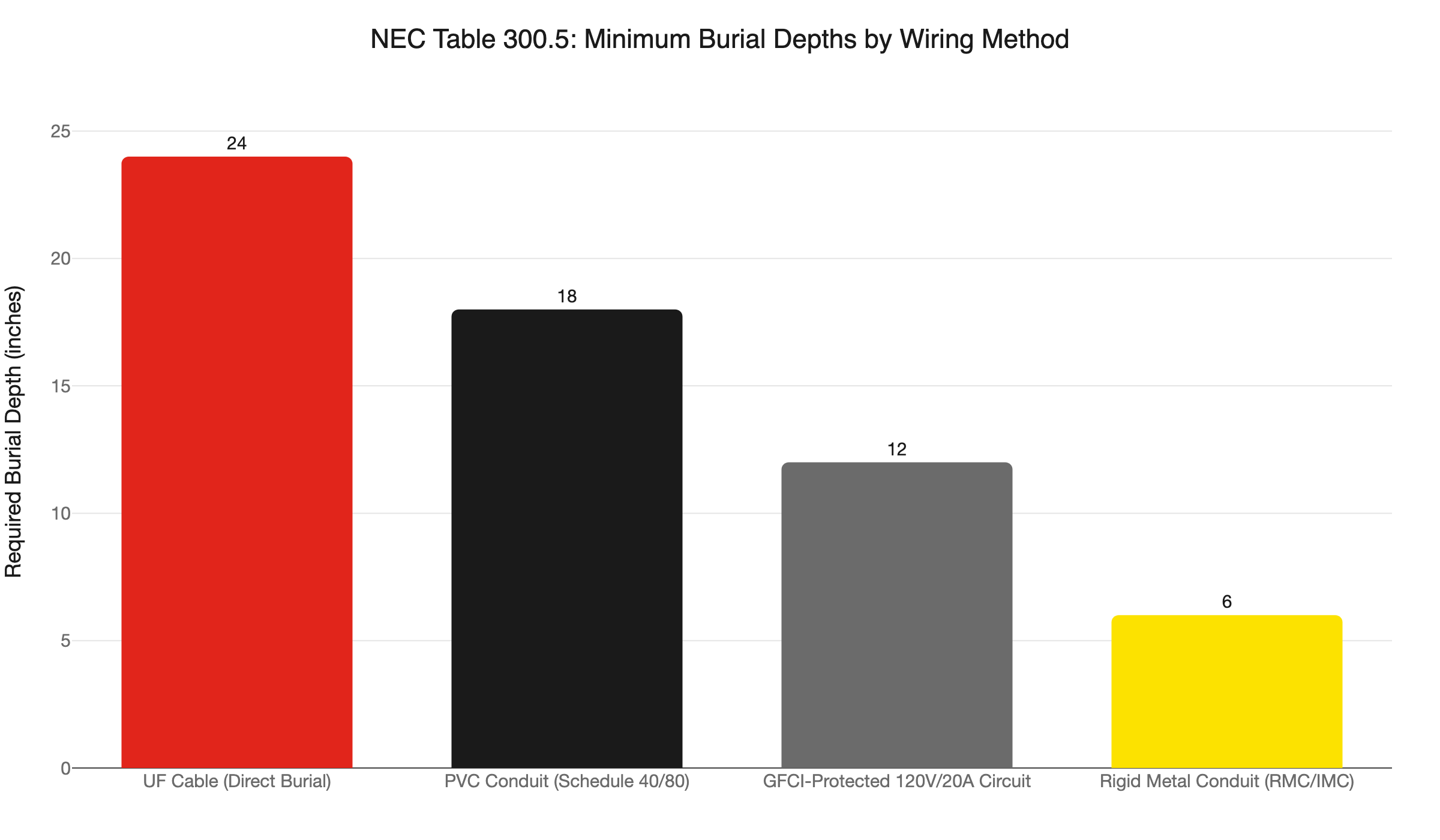
- Required minimums: 24 inches for UF direct-burial cable, 18 inches for PVC conduit, 12 inches for GFCI-protected 120V/20A circuits, 6 inches for RMC or IMC.
- Twin Cities frost reaches 42-48 inches. Burial minimums are not frost-protection depths. Freeze damage in underground electrical work happens at risers, not in the buried run.
- You must call for a rough-in inspection before backfilling the trench. Cover it first and you pay to re-dig.
- Minneapolis, St. Paul, Plymouth, and Maple Grove operate their own electrical permit programs. Most other Twin Cities suburbs file with the state Department of Labor and Industry (DLI).
- Schedule 80 PVC or rigid metal conduit is required from 18 inches below grade up to the termination above grade wherever conduit exits the ground.
- The 2026 NEC takes effect in Minnesota on August 17, 2026. Permits filed before that date use the 2023 NEC.
Search for how deep to bury electrical wire in Minnesota and you get a table. Six, twelve, eighteen, or twenty-four inches, depending on wire type and method. That table is real. It is the legal minimum here. What those national guides almost never explain is the gap between that number and reality. Twin Cities frost reaches 42-48 inches. The NEC minimum tops out at 24. There are code-specific reasons for that gap, and local inspection rules are where compliance actually costs homeowners money. This post covers both.
How Deep to Bury Electrical Wire in Minnesota: The NEC Minimums
The short answer: NEC Table 300.5 sets four key depths. UF direct-burial cable requires 24 inches. PVC conduit requires 18 inches. GFCI-protected 120V/20A residential circuits can be as shallow as 12 inches. Rigid metal conduit (RMC or IMC) requires just 6 inches.
NEC Table 300.5 is the national baseline for underground wiring. The four categories that apply to most residential projects in the Twin Cities are:
UF cable (direct burial): 24 inches. Underground feeder (UF) cable is the gray, sunlight-resistant cable rated for burial without conduit. It requires the deepest minimum on the table. UF is common for shorter runs to outbuildings or garages where pulling wire through conduit is not practical.
PVC conduit: 18 inches. Schedule 40 or Schedule 80 PVC conduit in open ground requires 18 inches of cover. This is the most common method for longer runs and for anything that may need to be replaced later. Conduit lets you pull new wire without digging.
Rigid metal conduit (RMC) or intermediate metal conduit (IMC): 6 inches. Metal conduit is significantly stronger than PVC. Its physical durability justifies the shallower burial depth. RMC and IMC appear mainly in commercial work or in high-impact areas on residential projects.
GFCI-protected residential branch circuit, 120V, 20A maximum: 12 inches. This exception has significant fine print. See the GFCI section below before you rely on it.
There is also a driveway exception. Circuits under residential driveways can be reduced to 12 inches in PVC conduit for one- and two-family dwellings. Confirm this with your inspector before reducing depth.
A practical note: many experienced Twin Cities electricians run direct-burial cable at 24 inches and conduit at 20-24 inches, even when 18 is the code floor. Extra depth costs almost nothing once the trench is open. It protects against future digging by the next owner or a utility crew.
Does Minnesota Have Its Own Rules for Burying Electrical Wire?
The short answer: No. Minnesota adopts the NEC wholesale, with no state-level amendment to burial depths. NEC Table 300.5 is Minnesota law. There are no extra inches required at the state level.
This surprises many homeowners. Minnesota has some of the deepest frost in the continental U.S., and the electrical code does not add a single inch to the national minimums. That is intentional. The frost-damage problem is handled through installation details at the riser, not through burial depth.
What Minnesota does add is a strict inspection requirement before backfill and a Schedule 80 stub-up rule. Those are the local compliance requirements where people actually get stuck. Both are covered in detail below.
How Deep Is the Frost Line in the Twin Cities?
The short answer: Twin Cities frost typically reaches 42-48 inches below grade. Northern Minnesota can see 60-80 inches. The NEC burial minimums of 18-24 inches sit well above the frost line. Buried conductors are not damaged by freezing. This is not a code gap.
MnDOT tracks frost and thaw penetration weekly across the state for road load-limit purposes. In a typical Twin Cities winter, frost reaches full depth by January or February and holds through March. A conduit buried at 18 inches is fully inside the frozen zone for several months each year.
The conductors inside that conduit are fine. Copper wire does not crack or fail from freezing. Electrical insulation is not harmed by the freeze-thaw cycle. The problem is mechanical, and it happens at the riser. NEC 300.5(J) handles it separately.
The practical takeaway: run at the NEC minimums and you are in full legal compliance in Minnesota. Many electricians target 24 inches for all runs anyway. Extra depth costs a few minutes of digging and removes questions during inspection.
Why Doesn’t the Code Require Burial Below the Frost Line?
The short answer: Because buried conductors are not damaged by freezing. The real freeze risk in underground electrical work is at the riser, where rigid conduit anchored to a fixed structure can be heaved and cracked by frost movement. NEC 300.5(J) addresses that through expansion fittings and S-loops, not deeper burial.
When frozen ground heaves upward, a rigid conduit anchored at the top (to a meter socket, panel, or piece of equipment) and buried below is pushed. Without a place to flex, the joint at the connection point cracks. The buried run is unaffected. The riser is where the damage happens.
NEC 300.5(J) requires that underground conductors and raceways subject to movement by frost be arranged to prevent damage. The two accepted solutions are:
- Expansion fittings on rigid conduit risers. These allow the conduit to slide slightly inside the coupling, absorbing vertical movement without cracking the joint. They are rated for four to six inches of travel.
- S-loops in direct-burial cable at the emergence point. An S-curve in the cable gives it slack to move with the soil without stressing the termination above grade.
In Minnesota, expansion fittings on risers are not optional. A conduit riser anchored to a garage wall with no expansion fitting is a common source of damage that does not show up for two or three winters. By then, the original installer is long gone and you are paying the repair bill.
What Is the Schedule 80 Stub-Up Requirement?
The short answer: Wherever buried conduit or cable exits the ground, the riser must use RMC, IMC, or Schedule 80 PVC from 18 inches below grade up to the termination above grade. Schedule 40 PVC is not acceptable for the transition zone or the above-grade section.
NEC 300.5(D)(1) requires protection for conductors emerging from grade. The surface is where physical damage is most likely: future digging, lawn equipment, vehicle contact. The heavier conduit handles that exposure.
For a typical residential run in the Twin Cities, the installation sequence looks like this:
- Run PVC Schedule 40 through the buried section at 18 inches or deeper.
- At 18 inches below grade, transition to Schedule 80 PVC or rigid metal conduit.
- Continue the heavier conduit from that transition point up through grade to the termination above ground.
Schedule 80 and Schedule 40 PVC share the same outside diameter. Standard fittings connect them. The difference is wall thickness: Schedule 80 is thicker and rated for the impact resistance the code requires at the surface.
Installing Schedule 40 all the way to the surface is one of the most common inspection failures on residential underground electrical projects. Bring the right material before you open the trench.
The Inspection Gotcha That Costs Twin Cities Homeowners Real Money
MN Rule 3801.3770 is direct: all wiring in a trench must be inspected before it is covered. The rule assigns all costs of uncovering to whoever backfilled without an inspection. There is no appeal process. Fill the trench before the inspector arrives and you pay to re-dig, every inch of it.
The standard inspection sequence for underground electrical in Minnesota:
- Pull the permit before any digging begins.
- Install the conduit or cable in the open trench.
- Call for the rough-in inspection. Leave the trench open.
- The inspector checks depth, conduit type, stub-up construction, and warning ribbon placement.
- After written approval, backfill.
- Call for a final inspection once all equipment is connected and work is complete.
The gap between step 2 and step 4 is where projects go sideways. Booking an inspector in the Twin Cities metro during busy season can take several days to two weeks. Plan for that delay before you break ground. Do not dig on a Friday expecting an inspector Monday.
Warning ribbon is required and it is part of the rough-in inspection. NEC 300.5(D)(3) requires a warning ribbon at least 12 inches above underground service laterals. This is the red or orange tape labeled “Caution: Electric Line Below.” It goes in the trench before backfill and must be visible to the inspector.
For a full breakdown of how the permit process works, see our post on pulling an electrical permit in Minnesota.
Which Minnesota Cities Handle Their Own Electrical Permits?
The short answer: Minneapolis, St. Paul, Plymouth, and Maple Grove each operate their own electrical permit and inspection programs. If your project is in any of those cities, file with the city, not the state DLI system. Most other Twin Cities suburbs file with DLI.
This split catches contractors who work across the metro without checking each time. Filing a permit with DLI for a Minneapolis job does not produce a Minneapolis inspection. The city programs run their own scheduling, their own inspectors, and their own approval timelines.
Before filing any permit, confirm the authority having jurisdiction (AHJ) for your specific address. DLI maintains an AHJ lookup directory on its website. For Minneapolis, contact Minneapolis Inspections. For St. Paul, contact the city’s Division of Safety and Inspections. Plymouth and Maple Grove both have their own building and electrical inspection departments.
Do not assume AHJ based on geography alone. Plymouth and Golden Valley share a border. Golden Valley files with DLI. Plymouth does not. Confirm before you pull.
What About the GFCI 12-Inch Depth Exception?
The short answer: The 12-inch burial minimum applies only when the entire branch circuit is GFCI-protected from the panel outward, not just the endpoint receptacle. A GFCI outlet installed at the end of the run does not qualify the buried cable for 12 inches. The protection must cover the full circuit.
This is one of the most common failures on residential outdoor electrical projects in the Twin Cities. The NEC Table 300.5 exception requires GFCI protection starting at the source, typically a GFCI circuit breaker in the panel. A GFCI receptacle at the far end of the run protects users at that outlet. It does not protect the buried cable upstream of it.
Inspectors know this distinction well. A cable buried at 12 inches with only a GFCI outlet at the endpoint will fail the rough-in inspection.
If you plan to use the 12-inch exception, have a licensed electrician confirm how the circuit is protected before you dig. If there is any ambiguity, run at 18 inches in conduit. The extra six inches costs a few minutes of digging and removes any inspection risk.
Frost Heave Protection: What NEC 300.5(J) Requires in Minnesota
The buried run itself survives Minnesota winters without damage. The failure point is the connection between the buried conduit and the fixed structure above grade. That joint is what gets pushed.
NEC 300.5(J) requires that underground conductors and raceways subject to movement by frost be arranged to prevent damage to the conductors or raceways. For residential work in the Twin Cities, the two recognized methods are:
Expansion fittings on rigid conduit risers. These look like standard conduit couplings with a sliding sleeve inside. They absorb vertical soil movement without cracking the joint. Every electrical supply house in the Twin Cities carries them in standard trade sizes.
S-loops in direct-burial cable. An S-curve in the cable at the emergence point gives it slack to move with the soil without pulling on the termination above grade.
If your underground run connects to a meter socket, outdoor subpanel, or any equipment fixed to a building, expansion fittings belong in the riser. They are inexpensive and straightforward to install. Missing them is one of the easier code violations to prevent, and one of the more expensive to fix three winters after the fact.
What Changes on August 17, 2026?
The short answer: The 2026 NEC takes effect in Minnesota on August 17, 2026. Permits filed before that date use the 2023 NEC. Licensing exams shift to the 2026 NEC on September 8, 2026.
If you are planning an underground electrical project this summer, the code governing your permit depends on your filing date. Pull before August 17 and the 2023 NEC applies. File on or after August 17 and the inspector checks against the 2026 code.
The 2026 NEC does not dramatically change burial depths for standard residential applications. However, GFCI and arc-fault protection requirements do change, and those affect circuits tied to underground feeders. Ask your electrician which code version governs before the permit is filed.
Minnesota’s DLI electrical code page is the authoritative source for effective dates, exam schedules, and transition guidance.
When to Call a Licensed Electrician for Underground Electrical Work
Underground electrical in Minnesota involves trench timing, conduit selection, Schedule 80 stub-ups, expansion fittings, inspection scheduling, and AHJ confirmation before a single permit is filed. A missed step does not just mean a failed inspection. It can mean re-digging a trench you already filled.
These projects call for a licensed electrician:
- Running power to a detached garage or outbuilding. Our post on running electricity to a shed or outbuilding covers what that job involves.
- Installing a buried feeder to a detached garage subpanel.
- Adding an EV charger with an underground circuit. Our EV charger installation guide for the Twin Cities covers load requirements and the permit process.
- Any run that crosses under a driveway, paved surface, or near other utilities. Call 811 before digging.
- Projects in Minneapolis, St. Paul, Plymouth, or Maple Grove, where the local AHJ process differs from the DLI system.
Northern Mister Sparky is locally owned and operated in the Twin Cities. We pull permits, coordinate inspections, and install underground electrical runs correctly the first time. As America’s On-Time Electrician(R), we show up when we say we will, no malarky.
Call us at 763-200-5956 or book online. We serve Minneapolis, St. Paul, Bloomington, Brooklyn Park, Woodbury, Blaine, Maple Grove, Plymouth, and the surrounding Twin Cities metro.
Frequently Asked Questions
How deep do you have to bury electrical wire in Minnesota? +
Does Minnesota require burying wire below the frost line? +
Do I need an inspection before backfilling an electrical trench in Minnesota? +
Do Minneapolis and St. Paul use the state DLI electrical permit system? +
Need an electrician now?