
Ungrounded Electrical Outlets in an Older Home: What to Do
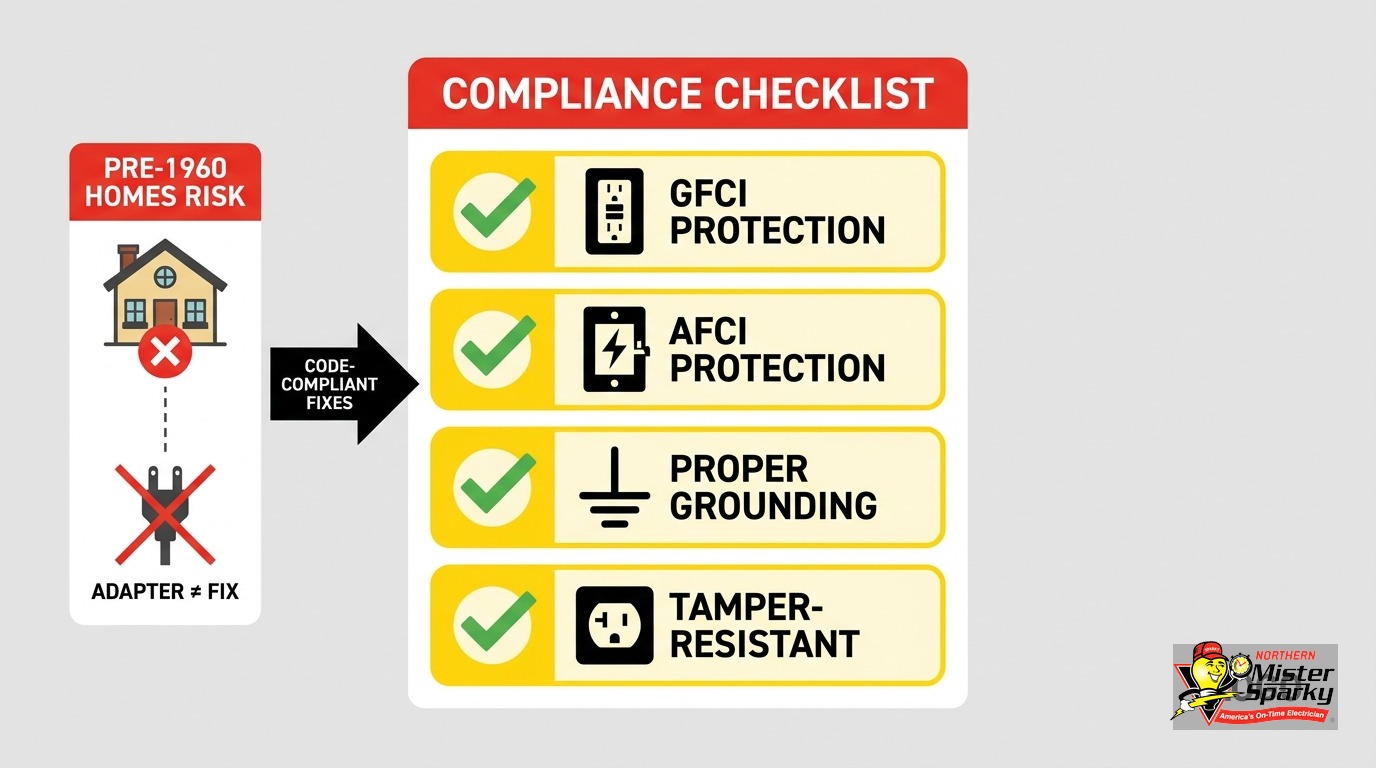
Key Takeaways
- Homes built before 1962 in the Twin Cities almost certainly have ungrounded electrical outlets. In South Minneapolis, Northeast, Mac-Groveland, and Highland Park, this is the rule, not the exception.
- A three-prong adapter does not fix an ungrounded outlet. It changes the plug shape and adds no ground path.
- Surge protectors on ungrounded outlets provide false confidence. The Metal Oxide Varistors inside them need a ground wire to work. Without one, your electronics remain exposed to voltage spikes.
- Minnesota code gives you four options for ungrounded outlets. Only running a new ground wire back to the panel actually grounds the outlet.
- A GFCI outlet is the most common middle path. It must be labeled “No Equipment Ground” by code. That label is not optional, and inspectors check for it.
- In Minnesota, apartments, condos, and multi-family buildings require a licensed contractor for this work. Single-family homeowners can self-permit but must personally perform the work.
- Pre-1960 Twin Cities homes often have layered wiring - knob-and-tube behind partial later rewires. What looks like a simple outlet swap can be more complicated than it appears.
What Does “Ungrounded” Mean in an Older Home?
In short: An ungrounded outlet has only two conductors - a hot wire and a neutral wire. The ground wire is missing. The bottom slot on a three-prong outlet is supposed to connect to that ground wire. In an ungrounded outlet, it connects to nothing.
The ground wire is a safety path for fault current. Imagine a wiring failure inside a washing machine causes its metal casing to become energized. The ground wire gives that fault current a fast, low-resistance path back to the panel. The breaker trips. Without a ground, that fault current looks for another path. It may find you.
Three-prong outlets have been required since the 1962 NEC. But requiring the outlet shape is not the same as requiring a ground wire behind it. In older homes, contractors sometimes installed three-prong outlets on two-wire circuits. The outlet looks right from the front. The wiring behind it is not. A basic outlet tester with a GFCI function is the only reliable way to confirm what you have.
Under NEC 406.4(D)(1), if a ground path already exists to the outlet box, you must use it. An ungrounded outlet in a home built after 1962 usually means someone made an error at some point. That is worth investigating, not ignoring.
Why Are So Many Twin Cities Homes Affected?
In short: Because the Twin Cities housing stock is old. A large share of homes in core Minneapolis and St. Paul neighborhoods were built before grounding was required. In the bungalow belt, ungrounded outlets are the starting condition, not an unusual defect.
About 18% of Twin Cities-area homes predate 1950, and core Hennepin and Ramsey County neighborhoods carry median home ages of 49 to 56 years. Statewide, half of all Minnesota homes were built before 1979. The Midwest has among the oldest housing stocks in the country.
The bungalow belt running from South Minneapolis through Mac-Groveland and Highland Park in St. Paul is especially affected. These homes were built in the 1920s through the 1950s with two-wire knob-and-tube wiring. No ground conductor was installed because none was required. Some homes have been partially updated since - a kitchen rewired here, a bedroom circuit there. But they have not been rewired end to end.
The result is a house with mixed circuits. Some outlets are grounded. Others are not. The outlet covers look identical from the front. One Twin Cities home inspector calls ungrounded three-prong outlets among the most common defects found on inspections of older houses. If you own a pre-1960 home and have not tested your outlets, assume you have ungrounded circuits. Confirm with testing before assuming otherwise.
Why a Three-Prong Adapter Is Not a Fix
A three-prong adapter - sometimes called a cheater plug - lets you plug a three-prong cord into a two-prong outlet. People reach for them because the problem seems solved. It is not.
The adapter changes the plug shape. It does not create a ground path. The small green tab or pigtail wire on the adapter is designed to attach to the cover plate screw on the outlet. If the outlet box is grounded through properly bonded metal conduit back to the panel, that screw connection does something useful. In most older Twin Cities homes, the box is not grounded through conduit. The pigtail screws to nothing.
An adapter is safe only when the outlet box itself is grounded through metal conduit back to the panel. That condition is rare in pre-1960 homes. If you do not know whether your boxes are grounded through conduit, assume the adapter provides no protection.
The adapter also sends a false signal to equipment that checks for a ground before operating. Some sensitive devices confirm a ground connection before running at full power. An adapter that mimics a ground without providing one can fool that check. The equipment proceeds, and the safety mechanism is bypassed without any visible indication.
What Happens to Your Surge Protector on an Ungrounded Outlet?
In short: It provides less protection than you think - possibly none at all. The protection mechanism inside most surge protectors depends on a ground wire to work. Without one, the strip may light up green and pass power normally while providing no actual spike protection.
Here is the mechanism. Most surge protectors use components called Metal Oxide Varistors (MOVs). When a voltage spike hits the circuit, the MOV clamps it by diverting the excess energy to the ground conductor. The ground conductor carries it safely back to the panel. Remove the ground path, and the MOV has nowhere to route that energy. It may attempt to divert through the neutral wire - which can damage equipment differently - or the spike passes through to your device unchanged.
Nothing on the power strip tells you this is happening. The green indicator light glows. Power flows normally. The strip functions as a power distribution device. It does not function as a surge protection device.
This is why an ungrounded outlet with a surge protector can be more problematic than one without. The strip removes the motivation to fix the actual problem. Real surge protection starts with grounded circuits. Our guide to whole-home surge protection explains how panel-level protection works and why it covers every circuit in the house regardless of what sits at the outlet.
What Are the Code-Compliant Options for Ungrounded Outlets?
In short: Minnesota adopted the 2023 NEC effective July 1, 2023. Under NEC 406.4(D), four options exist when an outlet has no ground path. They range from acknowledging the limitation honestly to correcting it completely.
Here are the four options in plain language:
Option 1: Replace with a two-prong outlet. Legal under NEC 406.4(D)(1). It is honest - the outlet now matches what the circuit can actually support. The practical problem is that most modern appliances and electronics use three-prong plugs. Homeowners immediately reach for an adapter, and the cycle starts over.
Option 2: Replace with a GFCI outlet, labeled “No Equipment Ground.” The most common middle path, permitted under NEC 406.4(D)(2)(b). A GFCI protects people from shock by tripping when current leaks through a body. It does not create a ground wire. It does not protect electronics from voltage spikes. The “No Equipment Ground” label is required by code - not a suggestion. Inspectors check for it at every outlet where this fix was applied.
Option 3: Install a grounded-style receptacle downstream of a GFCI, with both required labels. A variation of Option 2 under NEC 406.4(D)(2)(c). This allows a standard three-prong outlet where the GFCI device itself sits upstream - at the head of the circuit, for example. Both “GFCI Protected” and “No Equipment Ground” labels are required at the downstream outlet. The protection level is identical to Option 2: shock protection, not equipment protection.
Option 4: Run a new equipment grounding conductor back to the panel. The only option that actually grounds the outlet, per NEC 250.130(C). A new ground wire runs from the outlet back to the panel. In a home with finished walls and no accessible wire paths, that means fishing wire through walls. It is more labor-intensive than swapping a receptacle. But it is the only fix that actually does what most homeowners assume Options 2 and 3 do.
For a house with many ungrounded circuits, fixing outlets one by one often costs more than addressing multiple circuits together. That conversation starts with an assessment of the full scope.
A note on older panels and AFCI requirements. If your panel is old enough that Arc-Fault Circuit Interrupter (AFCI) breakers are not available for it, NEC 406.4(D)(4) provides a limited exemption from the AFCI upgrade requirement when converting to GFCI. That exception has conditions, however. A panel that cannot accept AFCI breakers is usually a panel that needs evaluation in its own right.
Does This Work Require a Permit in Minnesota?
In short: Yes, in most cases. Minnesota requires an electrical permit for outlet work. Who can pull that permit depends on whether the building is a single-family home or a multi-family property.
The rules:
- Single-family homeowners may self-permit electrical work on their own home, provided they personally perform the work. “Personally” means you - not a handyman, not a neighbor, not an unlicensed contractor doing you a favor.
- Apartments, condos, and multi-family buildings require a licensed, bonded, and insured electrical contractor. The contractor pulls the permit. The property owner or tenant may not self-permit.
This matters in the Twin Cities context. Many pre-1960 bungalows in South Minneapolis and Mac-Groveland have been converted to duplexes or small multi-family buildings. An owner who occupies one unit still lives in a multi-family building for permitting purposes. The self-permit option does not apply, even if the owner does the physical work.
Permits also matter for insurance and resale. Unpermitted electrical work can complicate a homeowner’s insurance claim and create disclosure issues at closing. Our post on electrical permits in Minnesota walks through what the permit process involves and what happens at inspection.
Can a Homeowner Do This Work in Minnesota?
In short: If you own and personally occupy a single-family home, Minnesota law allows you to self-permit and perform the work. But pre-1960 Twin Cities homes often hide complications that make a straightforward outlet swap more involved than expected.
Replacing a standard outlet with a GFCI receptacle on a confirmed dead circuit is within reach for a careful, experienced DIYer. The complication is that you often do not know what is behind the plate until the outlet is out of the wall.
Common complications in older Twin Cities homes:
- Layered wiring. Original knob-and-tube may run some circuits while newer two-wire cable runs others. Both can arrive at the same box. Without a proper circuit tester, you are guessing about what you have.
- Box fill. GFCI outlets are physically deeper than standard receptacles. A small older box may not have the volume code requires once a GFCI is installed.
- Deteriorated insulation. Knob-and-tube insulation - cloth or rubber - degrades over decades. Disturbing it during a swap can expose bare conductors.
- Aluminum wiring. Homes built roughly between 1965 and 1973 may have aluminum branch circuit wiring. Aluminum requires CO/ALR-rated devices at every outlet. A standard GFCI at an aluminum-wired outlet is not code-compliant.
If any of these conditions exist in your home, a licensed electrician’s assessment prevents a simple outlet replacement from turning into a larger problem. We are happy to do that assessment and give you a straight answer about what you have before any work begins.
What If Your Home Has Knob-and-Tube Wiring?
In short: Knob-and-tube wiring is ungrounded by definition - no ground conductor was ever installed. Any outlet on a live knob-and-tube circuit is ungrounded. The four options above all apply, but the broader wiring situation warrants a closer look before you start swapping receptacles.
Knob-and-tube was standard in homes built through roughly the 1940s. It runs separate hot and neutral conductors through ceramic knobs and tubes in the framing, with no ground wire. The insulation is cloth or rubber. In a home approaching 80 or more years old, that insulation may be brittle, cracked, or compromised by heat, pests, or past blown-in insulation that buried the conductors and trapped heat.
Here is the specific risk with knob-and-tube and outlet upgrades. Some past contractors spliced modern Romex cable onto knob-and-tube circuits to add three-prong outlets downstream. If the original circuit has no ground conductor, the downstream outlet has no ground either. This is true regardless of what the outlet plate looks like. A neon lamp tester will not catch it. A three-light outlet tester or a dedicated GFCI tester will.
Our post on knob-and-tube wiring replacement in Twin Cities homes covers the scope of a partial or full replacement, what insurance carriers typically require, and what the conversation with a licensed electrician looks like for these properties.
A Note on Minnesota’s Pending Code Update
Minnesota adopted the 2023 NEC on July 1, 2023. Any electrical permit filed on or after that date must comply with the 2023 NEC.
Minnesota’s Board of Electricity is actively reviewing the 2026 NEC for adoption. The target effective date is July 1, 2026, with an October 13, 2026 fallback if a formal hearing is required. As of this writing, no adoption has been finalized. Permits filed before any new adoption date follow the 2023 NEC. We will update this post when the timeline is confirmed.
Get a Straight Answer About What You Have
Ungrounded electrical outlets in an older Twin Cities home are common. They are not always an emergency. But they are worth understanding - and worth addressing before a fault, a home inspection, or an insurance claim puts them under scrutiny.
Our team is locally owned and operated in the Twin Cities. We are licensed, bonded, and insured. As America’s On-Time Electrician(R), we show up when we say we will. And with the UWIN(R) 100% satisfaction guarantee behind every job, there is no malarky involved - the work gets done right or we make it right.
We can test your outlets, assess your wiring, and walk you through your options under current Minnesota code. Call us at 763-200-5956 or book an appointment online. We serve Minneapolis, St. Paul, Bloomington, Brooklyn Park, Woodbury, Blaine, Maple Grove, Plymouth, and the surrounding Twin Cities metro.
If your situation points toward a panel upgrade or a larger rewire, ask about financing options when you call.
Frequently Asked Questions
Are ungrounded outlets dangerous? +
Can I install a three-prong outlet on an ungrounded circuit? +
Does a GFCI outlet create a ground? +
Do I need a permit to replace outlets in Minnesota? +
Need an electrician now?