
Video Doorbell Wiring With Your Existing Chime: The Real Fix
Key Takeaways
- Video doorbells need a transformer rated for 16-24V AC at 10-40 VA minimum. Most transformers in Twin Cities homes built between 1950 and 1980 output only 8-10 VA, which is not enough.
- Three symptoms point to an underpowered transformer: constant rebooting, a buzzing chime that won’t stop, and a blinking yellow light on Nest wired devices.
- Removing the mechanical chime without adding a load resistor can push an unregulated 24V transformer’s output to 34V. That overvoltage can destroy your doorbell.
- Homes with no existing doorbell wiring need a full hardwired install: a new transformer at the panel, plus an 18 AWG low-voltage wire run to the front door.
- Replacing a doorbell transformer in Minnesota requires a permit and a licensed electrician. The transformer is hardwired to a 120V branch circuit.
- Permits filed before August 3, 2026 comply with the 2023 NEC. Permits filed on or after that date comply with the 2026 NEC.
Video Doorbell Wiring With an Existing Chime: What Most Guides Miss
Most installation guides walk you through mounting the device and connecting two wires. They skip the part that actually stops homeowners: the transformer behind the wall that powers those wires, and what happens when that transformer is too weak for the job.
Your Ring or Nest video doorbell runs a camera chip and a WiFi radio every second of every day. The transformer that powered your mechanical chime was built to push a brief current spike through a coil when someone pressed the button. Those are not the same job.
The doorbell is low voltage. The upgrade path is not.
If your video doorbell keeps rebooting, your chime buzzes constantly, or a blinking yellow light appeared on your Nest device, this guide explains the root cause, what fixing it looks like, and why replacing the transformer in a Minnesota home means a permit and a licensed electrician.
Why Does My Video Doorbell Keep Rebooting, Buzzing, or Showing a Yellow Light?
All three symptoms share one root cause: an underpowered transformer. A video doorbell runs a camera processor and WiFi radio continuously. A traditional chime transformer was built for a fraction-of-a-second pulse. When it cannot supply enough continuous power, the doorbell reboots, the chime buzzes without stopping, or the device signals a problem with a warning light.
Here is what each symptom means in plain terms.
Constant rebooting. The doorbell is losing power and restarting on a loop. This is not a firmware issue or a WiFi problem. Google’s own support documentation lists continuous rebooting as a sign of insufficient transformer power. Resetting the device or updating the app will not fix it.
Chime buzzing all day. When the transformer delivers a weak, continuous signal instead of the clean pulse the chime needs, the plunger vibrates but never completes the strike. You hear a low hum or buzz that does not stop until someone cuts power to the circuit. This is the transformer struggling to meet demand, not a problem with the chime itself.
Yellow blinking light on Nest Doorbell. Google specifies that a blinking yellow front light on the Nest Doorbell (wired, 2nd gen or 3rd gen) means the device is not receiving enough power from the transformer. Google’s published guidance recommends calling a licensed electrician to find and replace the transformer.
None of these symptoms resolve with a factory reset, a firmware update, or a new router. The hardware is working as designed. The problem is the transformer upstream. That is also the reason we focus on the transformer first before touching anything else.
What Voltage and VA Does a Ring or Nest Video Doorbell Actually Need?
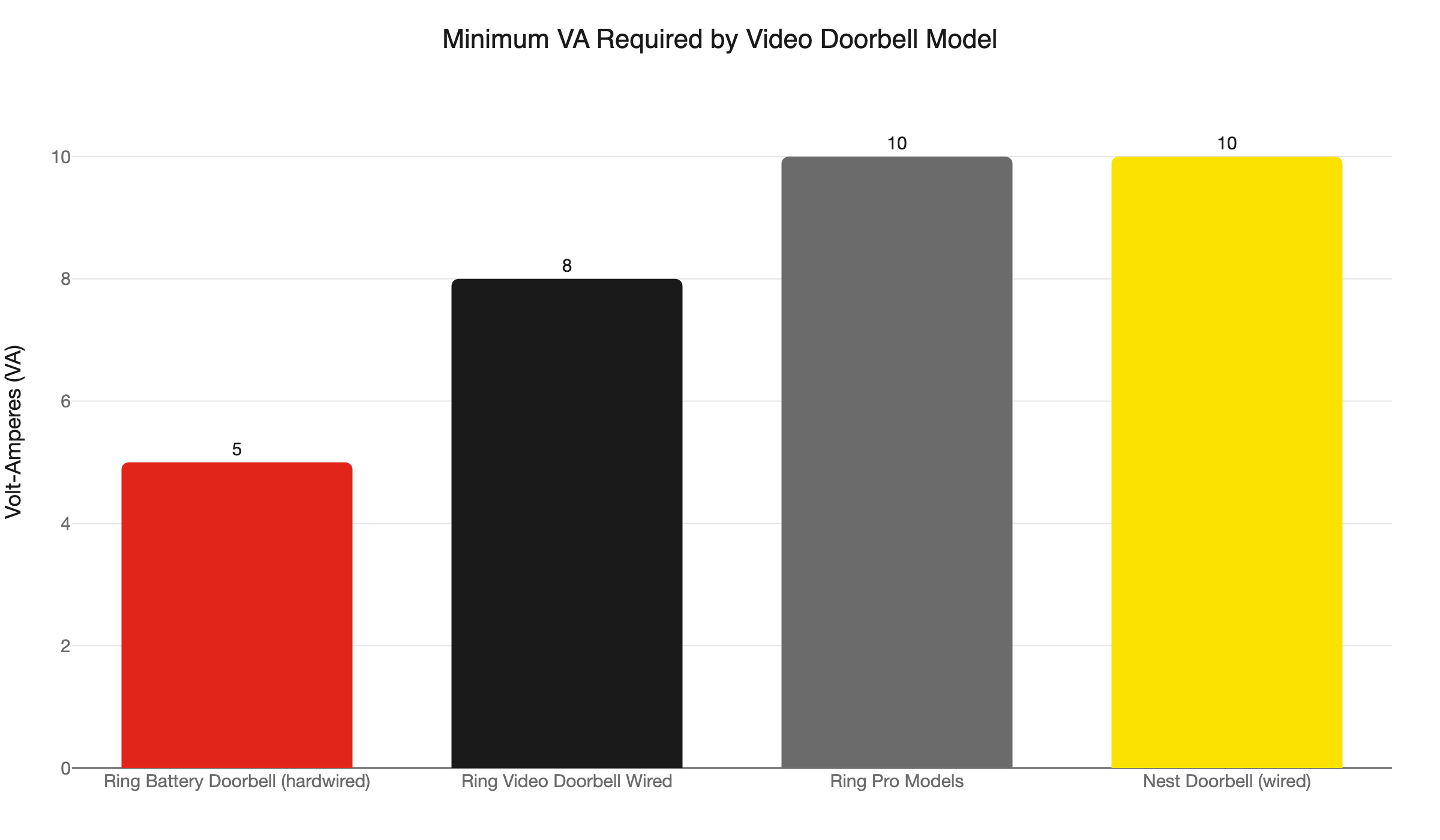
Ring Pro models and the Nest Doorbell (wired) both require 16-24 VAC at a minimum of 10-40 VA. Ring Video Doorbell Wired requires 8-24 VAC at 8-40 VA minimum. Most transformers in older Twin Cities homes are rated at 8-10 VA, which puts them at or below the minimum threshold for every wired video doorbell on the market.
Here are the specs by model, from manufacturer documentation:
- Ring Video Doorbell Wired: 8-24 VAC, 8-40 VA minimum
- Ring Video Doorbell Pro models: 16-24 VAC, 10-40 VA minimum
- Ring battery doorbells (hardwired): 8-24 VAC, 5-40 VA minimum
- Nest Doorbell (wired, 2nd and 3rd gen): 16-24V AC, 10-40 VA minimum
Those figures are the floor, not the target. A transformer running at its rated minimum has no headroom. When the camera detects motion and the processor load spikes, the device draws more than the transformer can supply and the failure symptoms start.
Many Minneapolis and St. Paul bungalows and ramblers built in the 1950s through 1970s have transformers rated at 8 volts or 10 VA. That is the bottom of the acceptable range for even the least demanding wired video doorbell. It has no margin for the continuous load a camera and WiFi chip demand.
To find your transformer: look near the furnace, on the utility room wall, inside a basement closet, or near the electrical panel. The label shows the input voltage (120V), output voltage (8V, 16V, or 24V), and the VA rating. A VA rating below 10 needs to be replaced. A rating at 10 is marginal. A rating of 16 or above is where most video doorbells run reliably.
One important note: do not measure transformer output voltage with the chime disconnected. The reading will not reflect real-world conditions. The next section explains why.
What Happens When You Remove the Mechanical Chime?
Removing the mechanical chime creates an unloaded circuit. On an unregulated transformer, which covers most residential doorbell units, no load allows the output voltage to climb well above the rated value. Documented testing shows a 24V/1A unregulated transformer measuring 34V with no load attached. That overvoltage can damage or destroy your video doorbell.
The mechanical chime does two things. It rings when someone presses the button. It also acts as a resistive load that holds the transformer’s output voltage in a safe range. Remove the chime without replacing that load and the output voltage rises. This is not a defect in the transformer. It is how unregulated transformers work.
If you are installing a battery video doorbell that bypasses the chime, or removing the mechanical chime and replacing it with a digital chime kit, you need to add a resistor across the terminals. The specified value is a 25-ohm, 50-watt wirewound resistor. This resistor takes the place of the chime as a stabilizing load on the circuit.
This is also why measuring your transformer’s output voltage with the chime disconnected gives a misleading result. The unloaded reading will be higher than what the doorbell will see during normal operation. Measure with the circuit in its normal state, chime connected, for an accurate picture of what you are working with.
Chime compatibility is a separate issue from transformer capacity. Some older mechanical chimes in Twin Cities homes were designed for specific transformer voltages and do not respond correctly to the digital bypass kits that come with Ring and Nest devices. If your chime rings when it should not, or does not ring at all after install, the bypass kit wiring and chime model compatibility are where to look first.
What If My Home Has No Existing Doorbell Wiring?
You need a full hardwired install: a new transformer wired to a 120V branch circuit at your panel, plus a run of 18 AWG low-voltage wire from the transformer to the front door. The transformer connection is licensed electrician work in Minnesota and requires a permit.
Some Twin Cities homes never had a wired doorbell. This is common in homes that relied on electric baseboard heat with no furnace-mounted chime, in homes where a previous owner removed the system and never replaced it, and in some older construction where a battery-powered wireless doorbell was added and then removed.
For these homes, a video doorbell installation is not a doorbell project. It is a small electrical project that begins at the panel and ends at the front door.
The full scope includes:
Transformer installation. A new 16-24V transformer rated at 16-30 VA is wired to an available 120V branch circuit. This is the step that requires a permit and licensed electrical work under MN statute 326B.35.
Low-voltage wire run. 18 AWG is the minimum wire gauge for longer runs to prevent voltage drop. 20-22 AWG is acceptable for short runs. The wire runs from the transformer through walls or a ceiling chase to the doorbell mounting point at the door.
Exterior wall air sealing. Any wire penetration through an exterior wall needs to be sealed after the run. Minnesota winters are hard on unsealed penetrations. Air sealing is not an NEC item for a doorbell install, but it is the right call when a hole through an insulated wall is already open.
Licensing for the low-voltage work. Running low-voltage wire for hire in Minnesota requires a Power Limited Technician (PLT) license from DLI. Operating a business that performs this work requires a Technology Systems Contractor (TSC) license. The 120V transformer connection requires a licensed master or journeyman electrician.
When our team handles a no-wiring install, we cover both the 120V connection and the low-voltage run as a single coordinated job. One call, one permit, one visit.
Does Video Doorbell Wiring Require a Permit in Minnesota?
If you are replacing the transformer, yes. Minnesota requires a permit for any installation, alteration, or replacement of an electrical system element under MN statute 326B.35. A doorbell transformer is hardwired to a 120V branch circuit. Replacing it triggers the permit requirement.
This is where most DIY guides stop being useful for Minnesota homeowners. The guides correctly describe the low-voltage connections at the doorbell and chime. They do not mention that the transformer powering those connections is wired into 120V household current, and that opening that connection is regulated electrical work.
Here is what the permit process looks like in practice:
- A licensed electrician pulls the permit before any 120V work begins.
- The electrician replaces the transformer and makes the 120V connection.
- A DLI electrical inspector signs off on the completed work.
Minnesota does not have a blanket homeowner exemption for low-voltage-only work the way some other states do. When the transformer-to-panel connection is part of the scope, the permit requirement applies regardless of how small the project feels.
Some municipalities in the Twin Cities metro add requirements above the state baseline. The City of Blaine, for example, confirms that low-voltage permits are required for certain residential work. If you are in Maple Grove, Woodbury, Brooklyn Park, or Plymouth, check with your municipality for any local additions to the state standard. Our team handles permit filing as part of the job. For a fuller picture of what permits cover and how the process works in Minnesota, see our guide to electrical permits in Minnesota.
The August 3, 2026 NEC transition.
For a transformer replacement, the practical code difference between the two editions is minor. But if you have been putting off other electrical work alongside this project, the transition date is a real reason to call now. Any project permitted before August 3 locks in the current code edition. If your panel has been on your list too, see our guide on signs you need an electrical panel upgrade before you schedule.
What Does an Electrician Check During a Video Doorbell Wiring Install?
We confirm transformer rating vs. doorbell specs, wire gauge on the low-voltage run, chime compatibility, and whether a load resistor is needed if the mechanical chime is removed. Every check matters: the wrong transformer voltage can damage the doorbell, and a missing load resistor on a no-chime setup can push a 24V circuit well above safe limits.
Here is what each check covers.
Transformer rating vs. doorbell specs. The replacement transformer needs to output the correct voltage and VA for your specific device. For most Ring Pro and Nest wired installs, that means 16V or 24V at 16 VA minimum. We size up from the minimum to leave room for the camera’s variable load.
Wire gauge on the low-voltage run. Most existing doorbell wire in Twin Cities homes is 18 or 20 AWG, which handles normal run lengths without significant voltage drop. Very long runs, typically over 100 feet, may need heavier gauge wire.
Chime compatibility. If you are keeping the mechanical chime, its rated input voltage needs to match the new transformer. Many chimes in 1960s-70s Twin Cities homes are rated for 16V. A mismatch means the chime rings weakly, does not ring, or rings when it should not.
No-chime load resistor. If the mechanical chime is removed or bypassed, a 25-ohm, 50-watt wirewound resistor goes across the terminals to stabilize transformer output. Skipping this step leaves the doorbell exposed to overvoltage.
Existing wire condition. Older homes sometimes have doorbell wire that is brittle, kinked, or spliced in ways that add resistance and reduce voltage at the device. We replace wire that is not fit for the job.
If this project is part of a broader smart home upgrade, see our guide to smart home pre-wiring for what to plan before walls close.
Call Northern Mister Sparky for Video Doorbell Wiring in the Twin Cities
We are locally owned and operated in the Twin Cities. Our electricians know the Minnesota permit process, the DLI inspection timeline, and what both the 2023 and 2026 NEC mean for your project.
When you call us for video doorbell wiring or a transformer upgrade:
- We assess your existing transformer, wire gauge, and chime compatibility.
- We pull the permit and handle the licensed 120V transformer connection.
- We wire the low-voltage side, mount the doorbell, and test the full circuit end to end.
- We back the work with our UWIN(R) 100% satisfaction guarantee.
As America’s On-Time Electrician(R), we show up when we say we will. No malarky.
Call 763-200-5956 or book online. We serve Minneapolis, St. Paul, Bloomington, Brooklyn Park, Woodbury, Blaine, Maple Grove, Plymouth, and the surrounding Twin Cities metro.
Frequently Asked Questions
Does replacing a doorbell transformer require a permit in Minnesota? +
Why does my video doorbell keep rebooting? +
What voltage does a Ring or Nest video doorbell require? +
Can I install a video doorbell if my home has no existing doorbell wiring? +
Need an electrician now?