
Outlet Warm to Touch? Normal Heat vs. Real Danger Signs
Key Takeaways
- Mild warmth near a charger or adapter is often normal. Heat in the outlet itself, with nothing plugged in, is not.
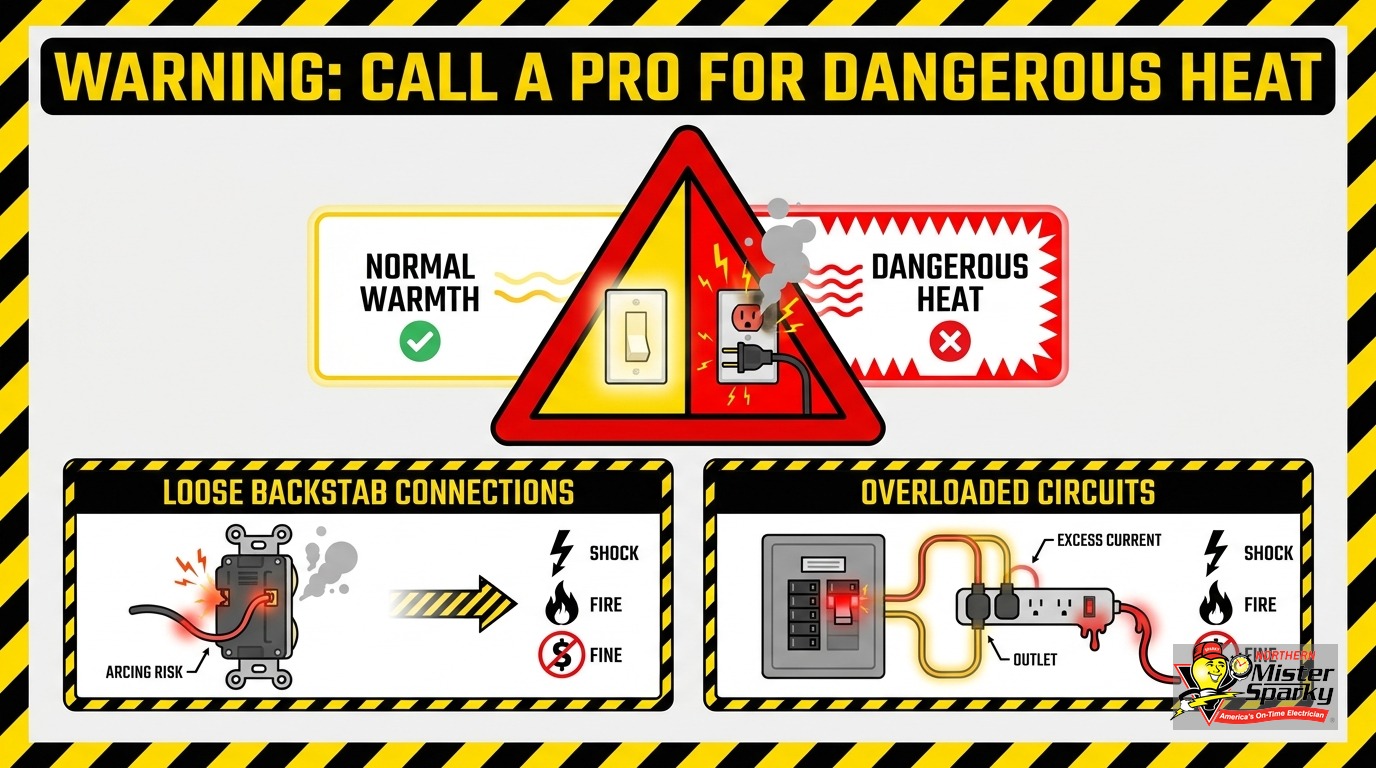
- Use the pull-away rule. If you want to take your hand off the cover plate, the outlet is too hot.
- UL’s standard treats an outlet as too hot when it runs more than 54 degrees Fahrenheit above its normal temperature.
- Loose push-in (backstab) connections, overloaded circuits, worn outlets, and damaged cords are the usual causes.
- A breaker may not trip on a hot outlet, so don’t count on it to warn you.
- A hot outlet is not a DIY job. Turn off the breaker and call a licensed electrician.
Is an Outlet Warm to Touch Normal?
A slightly warm outlet face can be normal after a charger or appliance has run for a while. An outlet that is hot, discolored, or too hot to keep your hand on is not normal. Stop using it until an electrician checks it.
You noticed an outlet that feels warm, and you want to know if it’s a problem. Twin Cities homeowners ask us this all the time. Most of the time the answer is simple. Sometimes it isn’t.
We are Northern Mister Sparky, a locally owned and operated electrician. We serve Minneapolis, St. Paul, Bloomington, Plymouth, Woodbury, and the suburbs around them.
Warmth that matches a load and fades after you unplug is usually fine. Heat that builds, smells, or leaves marks needs a repair.
What Does It Mean When an Electrical Outlet Is Hot?
A hot outlet means electricity is meeting resistance somewhere in the path, and that resistance turns energy into heat. Common causes are a loose wire connection, a circuit carrying too much load, a worn outlet, or a damaged cord or plug. The heat is a symptom. The source still has to be found.
Think of a wire as a hallway. When the path is clean and tight, electricity moves through freely. A loose joint, a worn contact, or too much traffic narrows the hallway. The energy that can’t get through becomes heat.
A home-repair guide lists four common causes of hot outlets:
- A 15-amp receptacle on a 20-amp circuit
- Devices drawing too much current
- Loose terminal connections
- Long circuits or extension cords
An electrical service company notes that most standard household circuits are rated for 15 or 20 amps. Push past that rating long enough and the wiring heats up. The same source warns that loose connections can cause arcing. Arcing is electricity jumping a tiny gap, and it makes intense local heat.
The same home-repair guide lists these warning signs that often travel with a hot outlet:
- Scorching
- Discoloration
- Burning smells
- Flickering lights
- Frequent breaker trips
Any one of these, plus a warm outlet, moves the problem from “watch it” to “fix it.”
How Can You Tell Normal Warmth From Dangerous Heat?
Normal warmth is mild, matches a load, and fades after you unplug. Dangerous heat keeps rising, feels too hot to hold your hand on, or comes with a smell, discoloration, or buzzing. UL’s standard treats an outlet as too hot when it exceeds its normal temperature by more than 54 degrees Fahrenheit.
Start with what’s plugged in. Phone chargers, laptop bricks, and wall adapters make their own heat. The plug can feel warm even when the outlet is fine. So can the plug on a hair dryer or a heater that has run for a while.
Here is what is usually normal:
- Mild, even warmth on a charger or power adapter
- Slight warmth on the cover plate after a high-draw appliance has run for a while
- Warmth that fades within minutes of unplugging
Here is what is not normal:
- Heat you can feel with nothing plugged in
- A cover plate too hot to keep your hand on
- Brown or yellow stains, melting, or scorch marks
- A burning, hot-plastic, or fishy smell
- Buzzing, crackling, or sizzling sounds
- Lights that flicker or a breaker that trips
Use the pull-away rule
Hold the back of your hand near the cover plate. Touch the plastic only, never the screws or the slots. If you want to pull away, the outlet is too hot. Don’t wait to be sure.
Then compare it to a nearby outlet on a different wall. If the suspect outlet is clearly hotter, tell your electrician what you felt and when.
Why a thermometer is not the whole answer
The 54-degree figure is hard to judge by feel. The same guide suggests an infrared thermometer or a thermal camera. Those tools help, but they show only surface heat.
The hottest spot is often behind the outlet, inside the wall box. By the time the face feels hot, the wiring behind it may be hotter. Trust your senses and lean toward caution.
Why Do Backstab Connections Run Hot?
A backstab connection is a small hole in the back of an outlet where you push a wire straight in, and a spring clip holds it. Over time that grip can loosen. A loose grip raises resistance at that spot, and resistance makes heat. Screw terminals clamp the wire more firmly.
Backstab outlets are fast to install, which is why builders and remodelers use them. They aren’t always a problem. But a small contact area carries heavy current poorly, and it has to hold on for decades.
Here is how the trouble builds:
- The wire sits in a small spring clip, not under a screw.
- Heating and cooling, plus the pull of plugs, can loosen the grip a little.
- A looser grip means higher resistance at the contact.
- Higher resistance means more heat at that spot, right when the load is highest.
- Heat can weaken the clip further, and the cycle repeats.
We have no hard number for how often this happens. We can tell you what it looks like on the job. We often find browned plastic and darkened wire ends behind outlets that felt only “a little warm.” The face of the outlet hides what the back is doing.
A failing backstab can also act up in other ways:
- Lights or devices on the same circuit flicker
- Outlets downstream stop working
- The outlet crackles or sparks when you plug in
Remember the arcing warning from earlier. A loose connection can arc, and that heat sits inside the wall box, next to wire insulation.
You can’t see this without opening the box. Don’t open it yourself while the circuit is live. A licensed electrician can turn off power, inspect the connection, and rebuild it the right way.
Can an Overloaded Circuit Make an Outlet Hot?
Yes. When too many devices share a circuit, or one device pulls close to the circuit’s limit, the wires and outlet carry heavy current for hours. That makes heat. A breaker guards against dangerous overload, but it may not trip on a loose connection or a load just under its limit.
This part surprises people. A breaker trips when current climbs past its rating. A loose connection makes heat without raising current much. A steady load just under the limit can also run for hours without a trip. The wiring stays hot and the breaker stays quiet.
Common overload setups include:
- A power strip feeding several high-draw devices
- An extension cord running a heater, a freezer, or a tool
- A kitchen or garage circuit shared by too many appliances
- A long run of wire that adds resistance on top of the load
Receptacle size matters too. Standard outlets come in 15-amp and 20-amp styles, and the circuit wire and breaker must match the plan. Our guide on the difference between 15-amp and 20-amp outlets shows how to read the markings. As noted above, a 15-amp receptacle on a 20-amp circuit is one of the causes the home-repair guide lists. If one heavy appliance leans on a mismatched outlet, the weak link heats up.
Extension cords add their own trouble. Thin cords heat up under load, and long cords add resistance. If you keep reaching for a cord, you likely need another outlet in that spot. That’s a simple, safe fix.
Why Is My Outlet Getting Hot When I Plug In a Space Heater?
A space heater is one of the heaviest loads you can plug into a wall outlet. A typical 1,500-watt model draws about 12.5 amps, which is most of a 15-amp circuit. That steady draw heats the plug, the outlet, and the wires. Plug it directly into the wall, never into a power strip.
The math is simple. Watts divided by volts gives amps. At 120 volts, 1,500 watts is 12.5 amps. That leaves little room on a 15-amp circuit. Add a lamp, a TV, or a phone charger on the same circuit and you may cross the line.
Heaters also run for hours, and long-running loads need more margin than short ones. A hair dryer runs for ten minutes. A heater runs all evening. That sustained draw is what warms the outlet.
Check these points if your heater outlet runs warm:
- Is the heater plugged straight into the wall, not a strip or cord?
- Is anything else running on that circuit?
- Is the plug blade loose in the outlet, or does the plug wiggle?
- Is the plug or cord discolored, soft, or bent?
If the plug or the outlet looks scorched, stop using both. Don’t just swap the heater. A heat-damaged outlet can grip plugs poorly, which makes the next plug run hotter.
In Minnesota, the usual story is a heater in a bedroom, basement, or home office. If you rely on one, ask about a dedicated circuit for a space heater. A circuit built for that load keeps the heat out of your outlet.
Can a Bad Outlet Start a Fire?
Yes. A failing outlet can overheat wire insulation and nearby material, and loose connections can arc. Most outlet problems don’t end in fire, but electrical wiring problems do cause real fires. Treat heat, scorch marks, or a burning smell as urgent.
We want to give you real numbers and label them honestly. These figures are older, so read them as history, not as this year’s count.
An older Consumer Product Safety Commission page says more than 40,000 fires are caused each year by problems with home electrical wiring. It adds that wiring was the leading cause of electrical-equipment fire deaths over the prior 10 years, at nearly 350 deaths per year.
A fire-research summary of NFPA data gives a second view. It estimates 20,900 reported U.S. non-confined home structure fires in 2005 involved electrical distribution or lighting equipment. Those fires caused 500 civilian deaths, 1,100 civilian injuries, and $862 million in direct property damage.
These numbers are dated, and they don’t tell you the risk at your outlet today. They do show that home wiring fires are real and costly.
A hot outlet is an early warning. You can act before a fire starts.
Other Causes of Hot Outlets
Loose backstabs and overloads are the big two, but they aren’t the only causes. Here are the others we see in Twin Cities homes.
Worn outlets. Outlets have internal contacts that grip plug blades. Years of plugging and unplugging loosen that grip, and poor contact means heat. If plugs fall out or wiggle, the outlet is worn.
Damaged cords and plugs. The electrical service company mentioned earlier lists aging cords, plugs, and outlets as causes. A frayed cord or a bent plug blade can heat up. The warm spot may be the plug, not the wall.
High-power appliances on shared circuits. Space heaters, air fryers, microwaves, and toasters pull a lot of power. Put two on one circuit and the wiring works hard.
Older wiring. Homes with older wiring may have brittle insulation, ungrounded outlets, or tired connections. If your home has two-prong outlets, read our guide on ungrounded outlets in older homes. Heat is one more reason to have the wiring checked.
Poor workmanship. Wires stripped too short, wires bent around a screw the wrong way, or box fill that is too tight can all cause hot spots. These faults hide until the load gets heavy.
Each cause has a different fix, which is why guessing doesn’t work. Replacing the outlet cures a worn one. It does not cure an overloaded circuit.
What Should You Do Right Now If an Outlet Is Hot?
Stop using the outlet and unplug what you can safely reach. Turn off its breaker at the panel. If you see smoke, sparks, or flames, leave the house and call 911. Otherwise, keep the circuit off and call a licensed electrician to inspect it.
Follow these steps in order:
- Stop using the outlet. Don’t plug anything else in.
- Unplug safely. Only do this if the plug is not scorched and you see no sparks.
- Turn off the breaker. Flip the breaker for that circuit at your panel. If you aren’t sure which one, turn off the main breaker.
- Leave if there is smoke or fire. Get everyone out and call 911.
- Note what you saw. Write down what was plugged in, how long it ran, and any smell or sound.
- Call a licensed electrician. Keep the circuit off until it is inspected.
Here is what not to do:
- Do not just replace the outlet and hope for the best.
- Do not open the box with the power on.
- Do not rely on the breaker to protect you.
- Do not cover the outlet or push furniture against it.
A quick swap is tempting. A new outlet may fix a worn one. But if the cause is a loose wire, an overloaded circuit, or damaged insulation, the new outlet will run hot too. The inspection is where the answer lives.
If a burning smell is part of your story, our post on electrical outlet repair explains how we handle it.
What Will an Electrician Do About a Hot Outlet?
We find the heat source before we fix anything. That means checking the load on the circuit, inspecting the outlet and its connections, and testing the wiring. Then we repair the cause, which may be a new outlet, remade connections, or a fix to the circuit itself.
Here is how a typical visit goes:
- We ask questions. What was plugged in? When did you notice the heat? Did anything smell or flicker?
- We check the load. We look at what shares the circuit and how much it draws.
- We cut power and open the box. We inspect the wire ends, the terminals, and the insulation.
- We look for heat damage. Browned plastic, darkened copper, and brittle insulation tell the story.
- We repair the real cause. That may mean a quality outlet with screw terminals, fresh wire ends, or a better circuit layout.
- We test the result. We confirm the outlet and the neighbors on that circuit work as they should.
Sometimes the fix is small. A single loose connection, rebuilt properly, can end the problem. Other times the circuit needs more, like added outlets so you can retire the extension cord. If the answer grows into a bigger job, like a new circuit or panel work, ask us about financing.
We also check the neighbors. If one backstab outlet ran hot, others in the same room may share the same weakness, and we can look at those while we’re there.
Why Minnesota Homes Need Extra Attention in Winter
Cold months raise the load on your home’s wiring. Space heaters run for hours. Holiday lights go up. Block heaters and heated blankets join the usual mix. Basements and garages that are cold all year get supplemental heat.
So an outlet that was fine in July can run hot in January. A connection that was a little loose in summer now carries a heavier load. If you notice warmth in winter, don’t shrug it off.
Code matters here too. Minnesota’s Board of Electricity has adopted the 2026 National Electrical Code, effective Aug. 17, 2026. Permits filed before that date follow the 2023 NEC. Permits filed on or after it follow the 2026 NEC. The state page lists no Minnesota amendments.
For you, that means any repair that needs a permit now falls under the 2026 NEC. We keep up with the code so your repair is done to the current standard.
A hot outlet is not a project to learn on. Wiring faults hide inside walls, and mistakes can stay hidden until they cause damage. Call a licensed electrician. No malarky, just a safe fix.
Call Northern Mister Sparky Before a Warm Outlet Becomes a Bigger Problem
A warm outlet doesn’t call for panic, but it does call for a check.
We are Northern Mister Sparky, a locally owned and operated team in the Twin Cities. We are America’s On-Time Electrician(R), so we show up when we say we will. Our work is backed by the UWIN(R) 100% satisfaction guarantee. If something isn’t right, we make it right.
Here is what to do next:
- If the outlet is hot, smells, or shows marks, turn off the breaker now.
- Call 763-200-5956 or book online. We will schedule you fast.
- Tell us what you felt, what was plugged in, and how long it ran.
We will find the cause, fix it right, and leave your home safer than we found it.
Frequently Asked Questions
How can I fix a reversed hot and neutral outlet? +
Is it normal for a phone charger outlet to feel warm? +
Should I turn off the breaker for a hot outlet? +
Need an electrician now?