
Dedicated Circuit for Space Heater: When Code Requires It
Key Takeaways
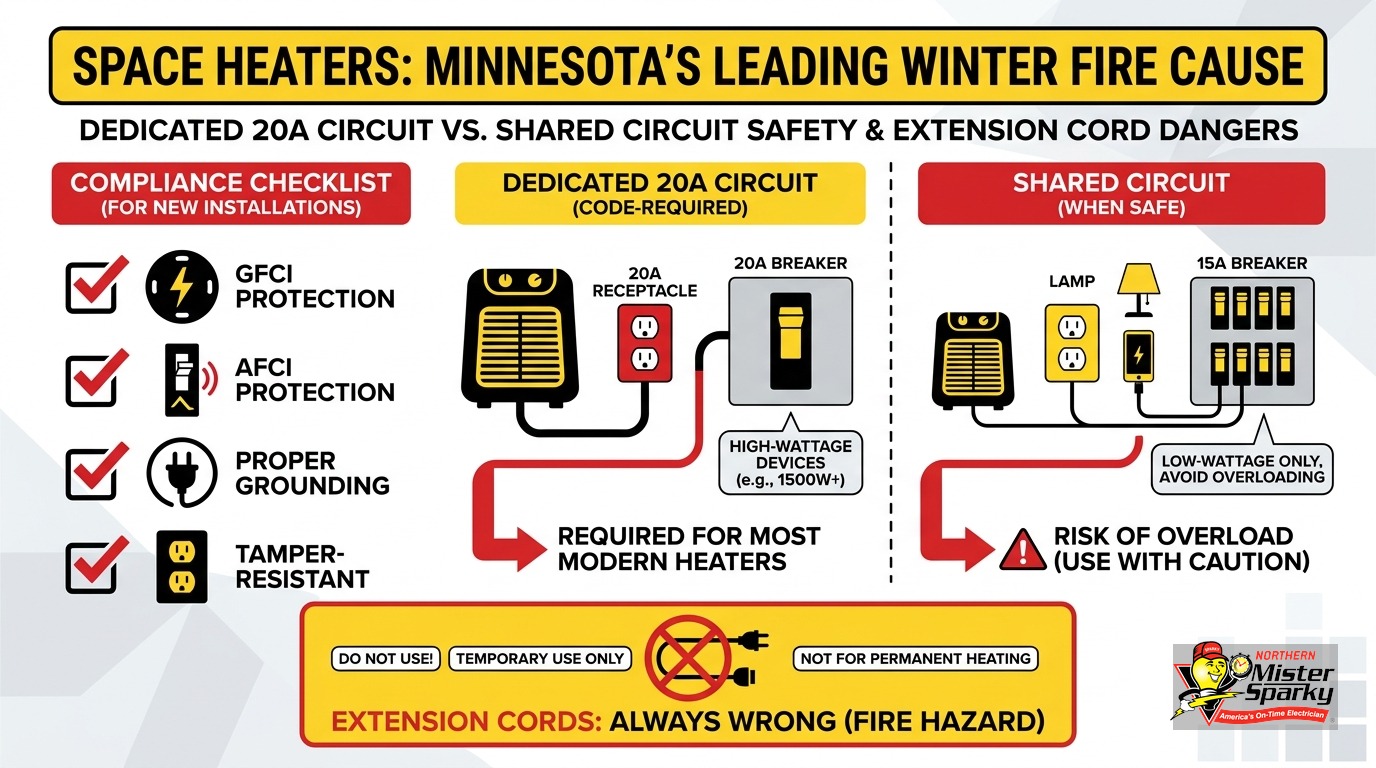
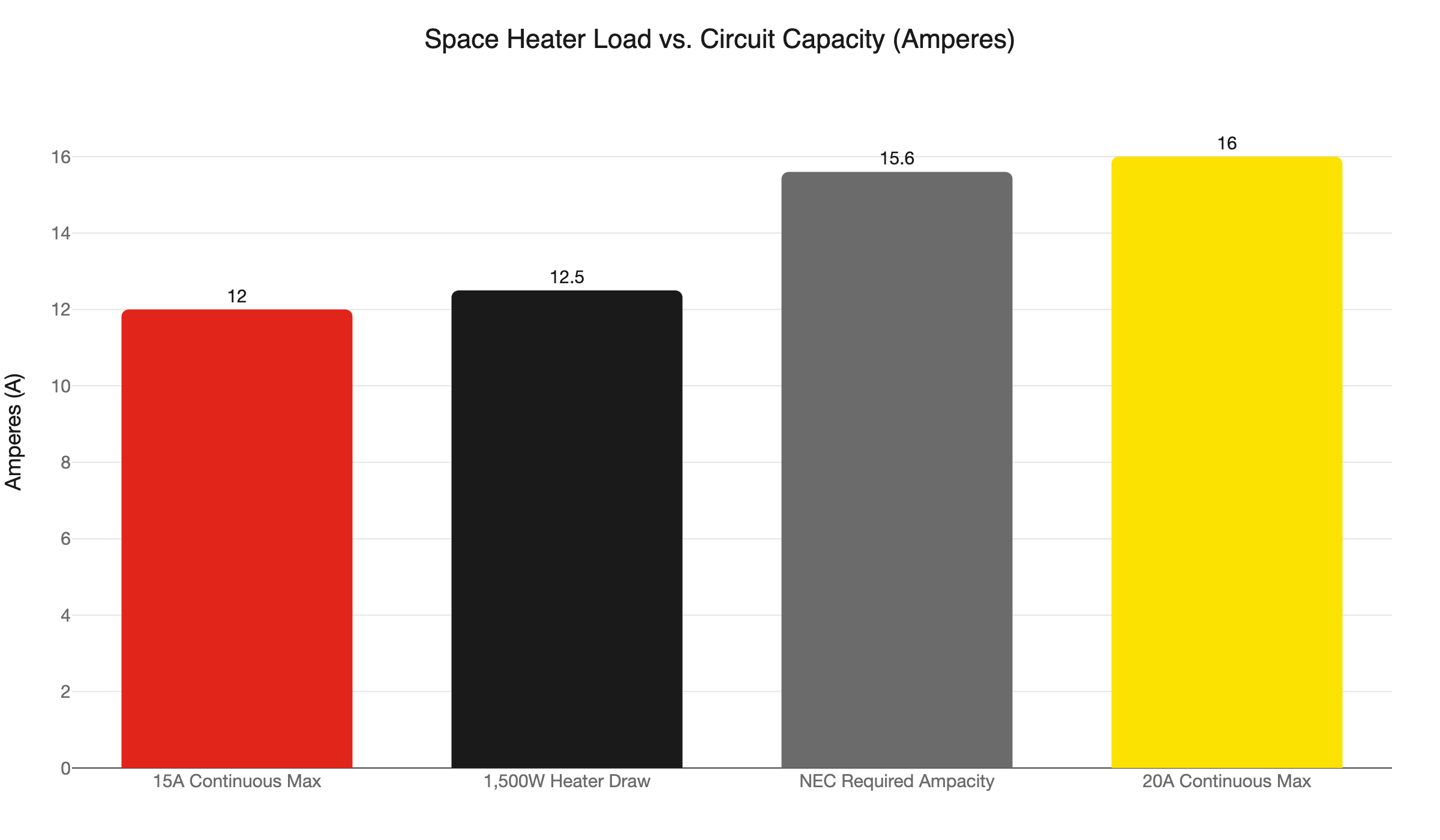
- A 1,500-watt space heater draws 12.5 amps at 120 volts. Running it for three or more hours makes it a continuous load under the NEC.
- A 15A circuit’s legal continuous load ceiling is 12 amps. The heater draw of 12.5 amps already exceeds it.
- The NEC’s 125% ampacity rule pushes the required conductor rating to 15.6 amps. A 15A circuit cannot meet that threshold. A dedicated 20A circuit can.
- Permanently installed electric heaters - baseboard, wall units, ceiling units - have no gray area: NEC Article 424.3(B) explicitly requires individual branch circuits.
- Using an extension cord with a space heater is a code violation under NEC 400.12(2), not just a safety warning.
- Minnesota adopted the 2026 NEC effective August 17, 2026. Any new dedicated circuit installed now must comply with the current code.
- Adding a dedicated circuit in Minnesota requires an electrical permit. Northern Mister Sparky pulls the permit and handles the inspection.
Are Space Heaters a Real Fire Risk?
Space heaters account for roughly one-third of home heating fires in the U.S. but about 86% of home heating fire deaths, according to NFPA research on home heating fires. That gap - a modest share of fires, an outsized share of deaths - is what makes space heaters different from every other type of heating equipment.
Heating equipment ranks as the second leading cause of home fires in the United States. Space heaters are the standout danger within that category, and the risk concentrates heavily in December, January, and February.
The U.S. Consumer Product Safety Commission estimates space heaters are involved in roughly 1,700 residential fires per year, with about 80 deaths and 160 injuries annually. Their guidance is explicit: never use an extension cord with a space heater. That warning has a specific legal basis in the National Electrical Code, which we cover below.
For homeowners in the Twin Cities, these numbers are not abstract. The average January low in Minneapolis is around -2°F (NOAA MSP climate normals). Most households here run space heaters for hours every day from October through April. That is not occasional use. That is sustained, daily, high-draw operation - the exact usage pattern that puts wiring under continuous stress.
Most space heater fires trace back to electrical failures: overloaded circuits, deteriorated cords, and undersized wiring that was never designed to carry a continuous 12.5-amp load. All of those are problems a licensed electrician can prevent.
Does a Space Heater Need a Dedicated Circuit?
Yes, for any 1,500W heater running three or more hours at a stretch. That usage pattern meets the NEC definition of a continuous load. A 15A shared circuit cannot legally carry it due to the 80% continuous load cap and the 125% ampacity rule. Whether code demands a dedicated circuit depends on whether the heater is portable or permanently installed - but both paths arrive at the same answer.
Portable space heaters do not have a named product mandate in the NEC. The requirement comes from load math applied to how they are actually used. Permanently installed electric heaters have an explicit mandate under NEC Article 424, with no gray area and no load-math workaround.
Our post on dedicated circuits for home appliances covers the broader question of which loads always require their own circuit. Space heaters are one of the clearer cases once you work through the arithmetic.
The Code Math: Why a 15A Circuit Falls Short
The numbers here are not opinions. They come directly from the rules in the National Electrical Code (NFPA 70) that govern how circuits must be sized for continuous loads.
Start with the basic load calculation:
1,500W divided by 120V equals 12.5 amps.
That 12.5A draw is 83.3% of a 15A circuit’s rated capacity. NEC 210.23(A)(1) limits continuous loads on a multi-outlet branch circuit to 80% of the circuit’s rating. On a 15A circuit, the legal continuous load ceiling is 12 amps. A standard 1,500W heater at 12.5 amps is already over the line.
Now apply the conductor ampacity rule. NEC 210.19(A)(1) requires branch circuit conductors to be rated at 125% of the continuous load current. For a 12.5A heater:
12.5A multiplied by 1.25 equals 15.6 amps of required conductor ampacity.
A 15A circuit uses 14-gauge wire, rated at 15 amps. It cannot deliver 15.6 amps of ampacity. The math does not work.
A 20A circuit uses 12-gauge wire, rated at 20 amps. Check both tests:
- 12.5A is 62.5% of the 20A rating - well under the 80% continuous load cap.
- 20A conductor ampacity (20A) exceeds the required 15.6A.
A dedicated 20A circuit passes both tests cleanly. A shared 15A circuit fails both. This is not an upsell - it is what the code arithmetic compels.
For a plain-language breakdown of how 15A and 20A circuits differ in everyday practice, see our post on the difference between 15A and 20A outlets and circuits.
What’s the Difference Between Fixed and Portable Heaters Under the Code?
Fixed electric heaters have a direct code mandate. Portable heaters get there through load math. The legal basis differs, but the result is the same: a dedicated circuit is required in both cases.
Portable heaters fall under NEC Article 210. The continuous load analysis above applies. A 1,500W portable heater running three or more hours on a shared 15A circuit violates both the 80% cap and the 125% ampacity rule. A dedicated 20A circuit is the compliant answer.
Fixed heaters - electric baseboard, wall heaters, ceiling radiant units - fall under NEC Article 424. Section 424.3(B) states that fixed electric space heating equipment shall be supplied by individual branch circuits. This mandate is not load-dependent. It applies regardless of the heater’s wattage. Each permanently installed unit gets its own circuit, full stop.
This distinction matters in practice. A homeowner who runs a portable heater for short periods occupies a gray zone depending on actual duration. A homeowner who installs baseboard heaters is under an explicit mandate with no ambiguity. In Minnesota, that installation also requires a permit and a licensed electrician.
Why Extension Cords Are a Code Violation, Not Just a Safety Tip
Every safety publication says to keep extension cords away from space heaters. Most explain the hazard in general terms. Few explain that the prohibition has a specific legal basis in the code.
NEC 400.12(2) prohibits flexible cords and cables from being used as a substitute for the fixed wiring of a structure. When you plug a space heater into an extension cord and treat that cord as the heater’s permanent power supply, you are using flexible cord as a substitute for fixed wiring. That is a code violation - the same category as an ungrounded outlet or an undersized breaker.
Extension cords are not rated for continuous high-amperage loads. A standard household extension cord is typically rated for 13 amps. A 1,500W heater draws 12.5 amps - nearly at the cord’s limit, sustained for hours at a time. The cord heats up. The insulation degrades over repeated use. At worst, the cord ignites the carpet, rug, or wall material it runs under or beside.
“Heavy duty” extension cords do not fix this. The NEC prohibition is categorical, not load-dependent. No gauge of extension cord makes this use legal. If you need a permanent outlet in that location, the code-compliant answer is a permanent outlet installed by a licensed electrician.
Our post on extension cord dangers and when to add a permanent outlet covers the full hazard picture and what a proper outlet installation involves.
What About Older Twin Cities Homes?
Pre-1980 homes in the Twin Cities were typically wired with 15A circuits throughout. A bedroom in one of these houses may have a single 15A circuit serving every outlet and the lighting on that wall. The space heater, the bedside lamp, the phone charger, and the clock radio all share it. Adding a 12.5A heater to that circuit puts the total load over the wire’s capacity before the continuous load rules even enter the picture.
Many older homes also have aluminum branch circuit wiring or cloth-insulated wiring from original construction. These materials are not inherently unsafe when they are in good condition, but connections loosen over decades and insulation cracks over time. Sustained high loads accelerate that degradation.
There is also a Minnesota-specific factor worth knowing. The MN DLI has published a bulletin on circuit breakers in low ambient temperatures. Breakers installed in cold spaces - unheated garages, utility rooms on exterior walls, or panels in cold basements - can trip at lower loads than their stamped amperage rating. If your panel sits in a cold space and you have noticed breakers tripping on loads that seem within limit, that bulletin explains the physics behind it. It is a real phenomenon in Minnesota homes, and it is worth mentioning to our team during an assessment.
For homeowners in older Twin Cities homes, adding a dedicated circuit for a space heater often opens a broader conversation about the panel. If the panel has no available slots, or if it carries known issues, that becomes part of the project scope. Our team walks through everything on the assessment call. We will not schedule work you do not need, and we will not skip recommending work you do.
Does Adding a Dedicated Circuit Require a Permit in Minnesota?
Yes. Any new branch circuit in Minnesota requires an electrical permit from the Minnesota Department of Labor and Industry or your local authority having jurisdiction. The permit is not a formality. It is what triggers the inspection that verifies the work was done to code - and what protects you if there is ever an insurance claim tied to the electrical work.
Work done without a permit is a code violation. It can surface as a problem during a pre-sale home inspection if no permit is on record. In some cases, it can affect insurance coverage if a fire is traced to unpermitted wiring.
When you hire Northern Mister Sparky, permit pulling is part of the job. We are licensed and insured in Minnesota. We pull the permit before work begins and schedule the inspection after the work is complete. You do not have to track down paperwork, follow up with the state, or figure out which authority has jurisdiction in your municipality.
For more on what the Minnesota electrical permit process looks like from a homeowner’s perspective - including what triggers a permit, what inspectors check, and what to do about open permits on a home you are purchasing - see our post on electrical permits in Minnesota.
What Is Minnesota’s Current Electrical Code for New Circuits?
Minnesota adopted the 2026 NEC with an effective date of August 17, 2026. Permits filed on or after that date must comply with the 2026 NEC. Permits filed before that date used the 2023 NEC. If you are adding a dedicated circuit now, the 2026 NEC governs the work.
The load math that requires a 20A dedicated circuit for a 1,500W heater is unchanged from prior editions - the continuous load rules and 125% ampacity requirement have been in the code for many years. But code updates do affect related requirements. AFCI breaker protection requirements have expanded under the 2026 NEC, and new circuits in bedroom and living area locations may require AFCI protection depending on the specific circuit location and jurisdiction.
The Minnesota DLI 2026 NEC residential inspection checklist is publicly available if you want to see exactly what inspectors verify on a new circuit installation. It covers conductor sizing, breaker ratings, AFCI and GFCI requirements, grounding, and labeling - all of which our team addresses as part of a dedicated circuit install.
Minnesota’s electrical code is the NFPA 70 National Electrical Code as adopted by the state. The DLI does not issue separate amendments to the core load calculation rules. What the NEC requires, Minnesota requires.
What Does a Dedicated 20A Circuit Installation Actually Look Like?
Most dedicated circuit installations for a single space heater take two to four hours when the panel is accessible and the wire run is straightforward. Here is what the process looks like so you know what to expect before we arrive.
Panel assessment. We start at the breaker panel. We check for open slots, look at the panel’s age and condition, and confirm the service has the capacity to support the new circuit. For most Twin Cities homes adding one heater circuit, the panel assessment is routine. When it is not - crowded panel, aging equipment, or a known-problematic panel brand - we tell you what we found and what the options are before any work starts.
Wire routing. A 20A, 120V circuit uses 12-gauge NM-B cable (12/2 with ground). The wire runs from the panel to the outlet location. In finished living spaces we route through wall cavities, attic space, or crawl space to keep the work clean and minimize drywall repair. In unfinished spaces like a utility room or basement we may run conduit where exposed wiring requires protection.
Outlet installation. A dedicated 20A circuit gets a 20A receptacle, identified by the T-shaped slot on one side. The heater plugs directly into this outlet. No extension cord, no power strip, no adapter - the heater is the only load on the circuit.
Breaker installation. A new 20A breaker goes in the panel for this circuit. Under the 2026 NEC in Minnesota, AFCI protection requirements apply to many bedroom, hallway, and living area circuits. We confirm the requirement for your specific circuit location and install the appropriate breaker.
Labeling. Every circuit gets a clear label at the panel. “Space heater - master bedroom” or equivalent. Good panel labeling matters when a breaker trips at midnight and someone needs to find it fast.
Permit and inspection. We pull the permit before the first wire is run. After the installation is complete, a DLI inspector or local inspector verifies the work. You receive the stamped permit card, and the circuit is on record.
Schedule Before Winter Demand Hits
Space heater season in the Twin Cities runs from October through April - six months of daily use. A circuit that handles occasional loads in September becomes a liability by January when the heater runs eight hours a day and temperatures have dropped below zero.
Scheduling a dedicated circuit in early fall means easier permit timelines, more calendar availability, and no competing with the rush of homeowners who waited until December. It also means the work is done and inspected before you actually need the heater running all day.
If you are not sure whether your current setup is safe, call us. We will assess it and tell you straight: shared circuit that is borderline but usable short-term, or a dedicated circuit install you should schedule now. No malarky, no pressure.
Call 763-200-5956 or book online to schedule. Northern Mister Sparky is America’s On-Time Electrician(R), locally owned and operated in the Twin Cities. Every job is backed by our UWIN(R) 100% satisfaction guarantee.
Frequently Asked Questions
Can I plug a 1,500W space heater into a regular shared outlet? +
What size circuit does a 1,500-watt space heater need? +
Do I need a permit to add a dedicated circuit in Minnesota? +
Is using an extension cord with a space heater against code? +
Need an electrician now?