
Whole Home Surge Protector vs Plug-In Strips in MN
Key Takeaways
- A whole home surge protector mounts at your electrical panel and guards every circuit at once.
- Since July 1, 2023, Minnesota’s adopted code requires a surge-protective device on any service or panel replacement (Minnesota DLI).
- Plug-in strips only protect the one device plugged into them, so your hardwired gear stays exposed.
- The Twin Cities region sees roughly 30 to 40 thunderstorm days each warm season (Climate of Minnesota).
- Best practice pairs a panel-level unit with point-of-use strips for sensitive electronics (Today’s Homeowner).
- Panel installs are permitted and inspected in Minnesota. Plug-in strips are not.
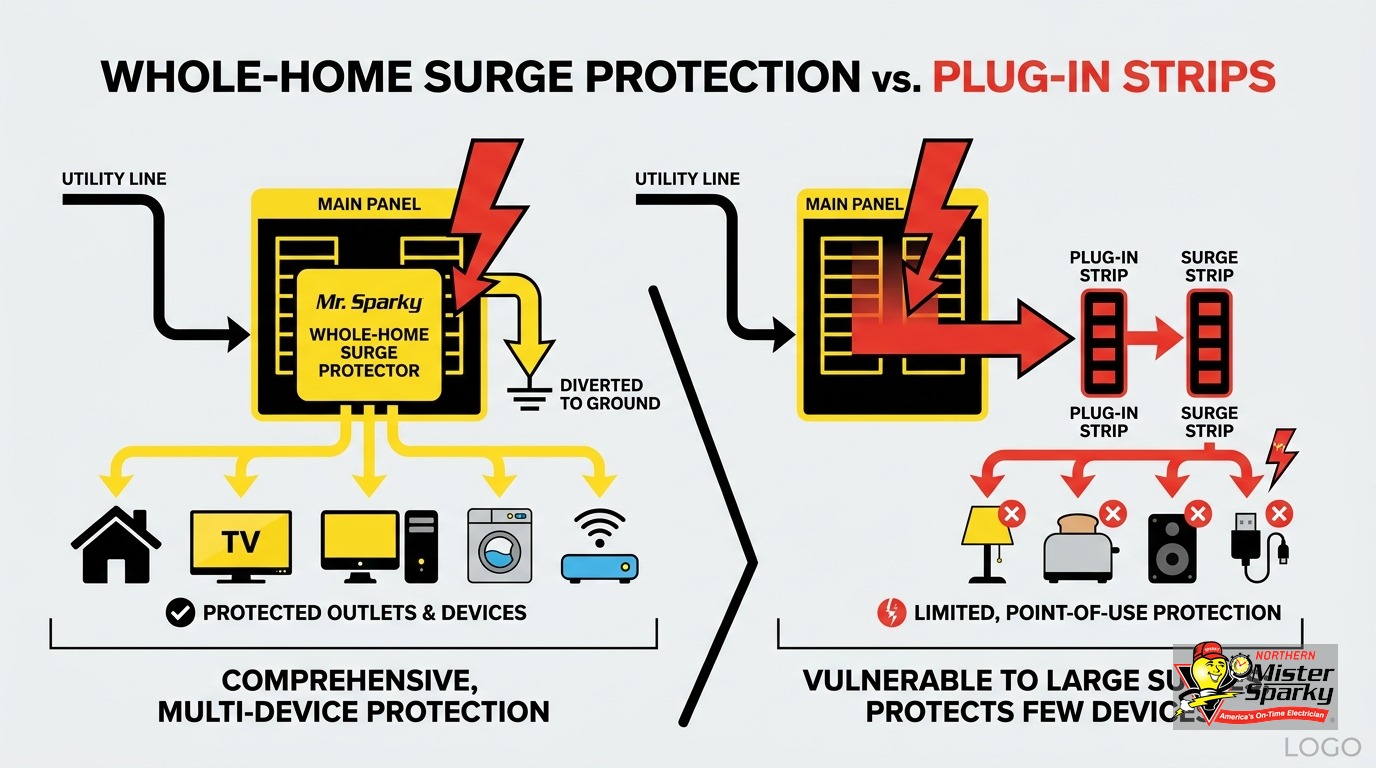
A whole home surge protector is the single best defense against the voltage spikes our Minnesota storms send down the line. When lightning strikes near your street, that surge can reach your panel in less than a heartbeat. It then races into every outlet, appliance, and hardwired system you own. Most homeowners think a power strip has them covered. It does not. This guide compares whole home surge protection against plug-in strips in plain terms. We will also explain a 2023 code change that now touches almost every panel job in the Twin Cities.
We are locally owned and operated, and we install this gear across the metro every week. Here is the honest breakdown.
What is a whole home surge protector?
A whole home surge protector is a device wired at or beside your main electrical panel. It watches the incoming power for voltage spikes. When a spike arrives, it diverts the extra energy safely to ground. Your circuits never feel the full hit. Electricians label it a Type 1 or Type 2 surge-protective device, or SPD.
Think of it as a pressure valve for electricity. Normal household voltage stays near 120 volts. A surge can push thousands of volts in a fraction of a second. That spike is what fries circuit boards and burns out motors. The SPD clamps the voltage down before it spreads through your home. National code now recognizes this device as basic protection, not a luxury add-on (NEC 230.67).
The key word is “whole.” One unit at the panel stands guard over your entire home. It does not care which outlet or circuit the surge is headed for. It stops the spike at the source, before the energy fans out to your rooms.
Whole home surge protector vs plug-in strips: what is the real difference?
A whole home surge protector sits at your panel and shields every circuit, including hardwired appliances. A plug-in strip only protects the single device connected to it. One guards the whole house at the source. The other guards one gadget at the outlet. They work best together, not as substitutes.
The gap shows up fast when you list what you own. Your refrigerator, furnace blower, air conditioner, water heater, and EV charger are all hardwired or on dedicated circuits. A power strip cannot reach any of them. The average U.S. household carries around $15,000 in electronics and appliances, and hardwired loads cannot be protected by a plug-in strip at all (Today’s Homeowner).
A plug-in strip also sits at the end of the line. By the time a surge reaches that outlet, it has already traveled through your panel and your wiring. A panel-level unit stops the spike at the front door instead. That is why we treat it as the foundation of any home’s protection. If you are weighing a bigger project, our electrical panel upgrade service is the natural time to add one.
Is a whole home surge protector required by code in Minnesota?
Yes, in many cases. The National Electrical Code section 230.67 requires a Type 1 or Type 2 surge-protective device on services that feed dwelling units. Minnesota adopted the 2023 code on July 1, 2023. So any panel or service replacement permitted after that date must include whole-home surge protection.
This is the piece most online guides skip. The requirement lives in NEC 230.67. It states that all services supplying dwelling units must include a surge-protective device, and it must be a Type 1 or Type 2 SPD (NEC 230.67). The code also says that when service equipment is replaced, the rule applies, and the SPD must sit inside or right next to the service equipment (NEC 230.67).
Minnesota’s Board of Electricity adopted the 2023 NEC with an effective date of July 1, 2023. Permits filed on or after that date must comply (Minnesota DLI). In plain terms: if we swap your panel or upgrade your service today, code says the surge protector comes with it. It is not an upsell. It is part of a compliant job.
Why did the code add this rule? Modern homes now run on sensitive electronics and life-safety devices. AFCI breakers, GFCI outlets, and smoke and carbon monoxide detectors all contain circuit boards. The SPD requirement exists to protect that gear (Electrical License Renewal). If you are seeing warning signs, our guide on the signs you need an electrical panel upgrade covers what to watch for.
What is the difference between a Type 1 and a Type 2 SPD?
A Type 1 surge protector installs on the line side of your main breaker, before power reaches the panel. A Type 2 installs on the load side, inside or next to the panel. Both meet the code requirement for dwellings. Your electrician picks the right type for your service layout.
Type 1 units handle the largest external surges, like the transient from a nearby lightning event. They sit ahead of the main breaker, so they meet the spike first. Type 2 units are the most common choice for existing homes. They mount inside the panel and protect everything downstream. NEC 230.67 accepts either type for a dwelling service (NEC 230.67).
During our visit, we look at your panel, your service entrance, and your budget. Then we recommend the type that fits your home. Some houses benefit from both, stacked for extra headroom. You do not have to sort this out on your own. That is our job.
Why does Minnesota’s storm season make a whole home surge protector worth it?
Minnesota’s warm season brings frequent thunderstorms and lightning. The Twin Cities region sees roughly 30 to 40 thunderstorm days a year. Lightning does not need to hit your house to cause a surge. A strike up to 10 miles away, or routine grid switching, can send a damaging spike down the line.
Our severe season runs from roughly May through August. It peaks in June and July. During that stretch, the region records about 30 to 40 thunderstorm days (Climate of Minnesota). That is a lot of chances for a spike to find your home.
Here is the part homeowners miss. A surge does not require a direct hit. Lightning can strike as far as 10 miles from any rainfall, and a typical thunderstorm spans about 15 miles across (National Weather Service). A strike near an overhead line miles away can still push a transient into your panel. Add the everyday grid switching from utilities, and small surges happen year round.
Much of the Twin Cities metro still runs on overhead utility lines. Those lines carry surges straight to your service entrance. A panel-level device is the one product that meets that energy at the source, before it reaches your family’s electronics.
What does a whole home surge protector cost?
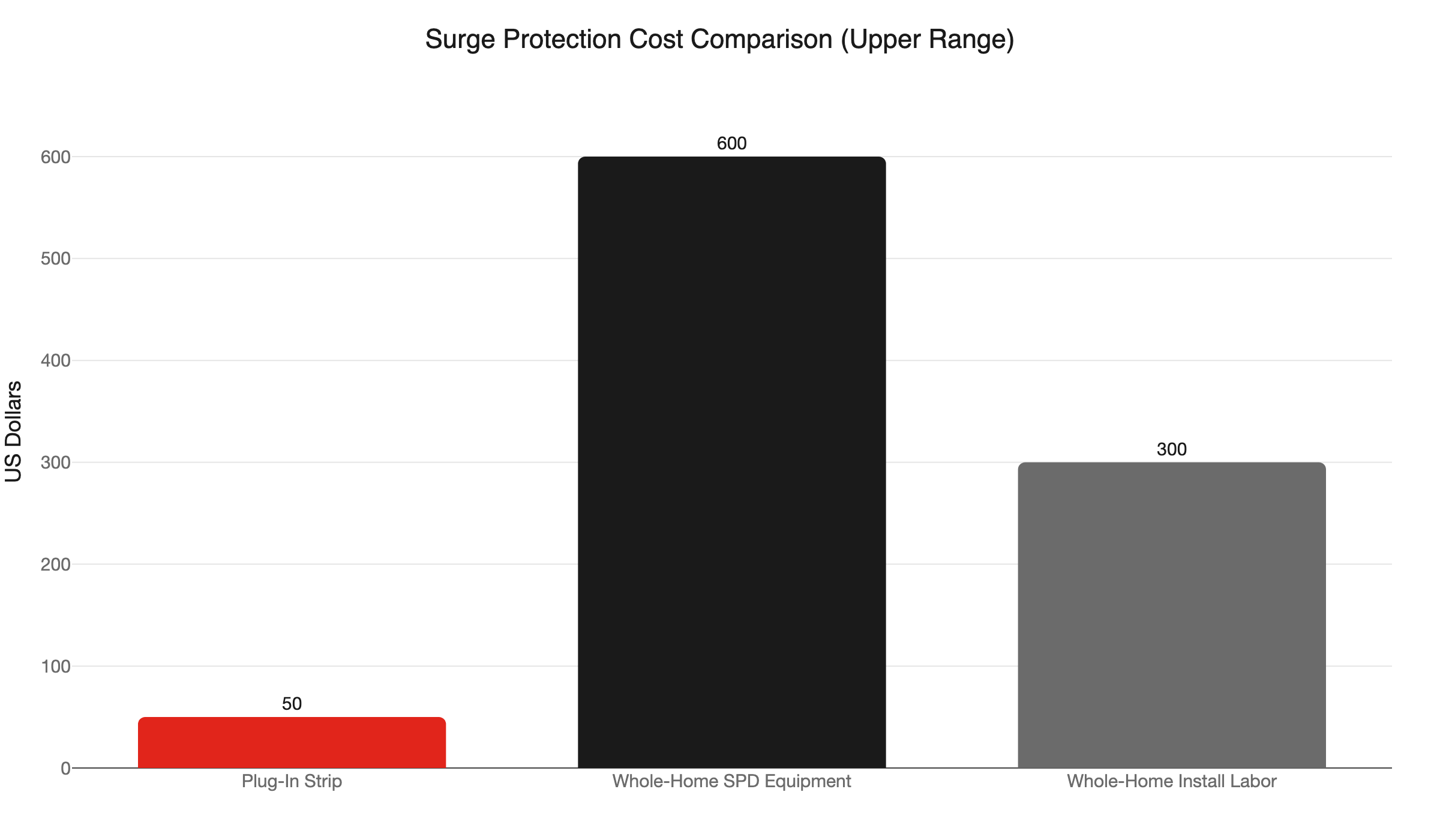
A whole home surge protector runs roughly $300 to $600 for the equipment, plus about $100 to $300 for professional installation. Plug-in strips cost $15 to $50 each. But a strip only covers one device, so protecting a whole house with strips is neither practical nor complete.
Let me give you the numbers. The unit itself typically costs $300 to $600. Professional installation adds roughly $100 to $300 (cost breakdown). A plug-in strip runs $15 to $50, but it guards only what you plug into it (same source).
The chart below compares the upper-range figures side by side.
Now do the math on strips. To match the coverage of one panel unit, you would need a strip on every outlet. And you still could not protect the furnace, water heater, or EV charger. That is the false economy. A single well-placed unit does what a drawer full of strips cannot. If you are already planning an EV charger installation, the surge protector belongs in that same visit.
What can a power surge actually damage?
A surge does not always announce itself with a bang. Sometimes it degrades electronics slowly over months. Other times it kills a circuit board instantly. The targets include your HVAC control board, refrigerator compressor, washer and dryer electronics, garage door opener, and smart-home hubs. Your computers, televisions, and gaming consoles are all vulnerable too.
The hardwired loads are the expensive ones. A furnace control board or a central air unit can cost thousands to replace. None of those sit behind a plug-in strip. This is exactly why code now ties surge protection to the panel. Protecting the source protects the whole list at once. One event can otherwise total several appliances in the same instant.
Do you still need plug-in strips too?
Yes. The best setup uses layered protection. The whole home surge protector at the panel handles large spikes and shields hardwired loads. Point-of-use strips add a second layer at your most sensitive electronics, like computers and home theater gear. The two work together, and neither fully replaces the other.
Electricians call this cascaded or layered protection (Today’s Homeowner). The panel unit takes the big hit and knocks the voltage down. A quality strip at your desk or media center trims the smaller remainder. For a home office or a theater room, that second layer is cheap insurance. So the answer is not one or the other. It is both, in the right order.
Is a whole home surge protector install permitted work in Minnesota?
Yes. Installing a surge protector at your panel is electrical work that requires a permit and a state inspection in Minnesota. A homeowner can pull a permit for a homesteaded single-family home, but the work is still inspected. A plug-in strip needs no permit because you simply plug it in.
This is another decision factor the national guides ignore. Panel-level work is permitted and inspected in our state. A homeowner can pull an electrical permit for a homesteaded single-family home, but a state electrical inspector still checks the work (Minnesota DLI). Most homeowners hire a licensed contractor to handle both the install and the paperwork.
A plug-in strip, by contrast, needs no permit. You buy it and plug it in. That difference explains why a strip cannot satisfy code or protect hardwired systems. It never touches your panel. Our whole-home surge protector installation service handles the permit, the install, and the inspection in one visit.
How Northern Mister Sparky protects your home
We are locally owned and operated, and we live with these same storms. When our team installs a whole home surge protector, we size it to your panel and your loads. We pull the permit, mount the unit, and stand behind the work. Our service reflects the America’s On-Time Electrician(R) promise and the UWIN(R) 100 percent satisfaction guarantee.
If you are booking a panel upgrade, a service change, or an EV charger, this is the moment to add protection. Code may already require it. Your electronics already deserve it. A few hundred dollars at the panel guards tens of thousands in gear inside your walls.
Ready to protect your home before the next storm rolls through? Call us at 763-200-5956 or book online today. We will get you scheduled fast, no malarky.
Frequently Asked Questions
Does a whole home surge protector stop a direct lightning strike? +
Is a whole home surge protector required in Minnesota? +
Can I install a whole home surge protector myself? +
How long does a whole home surge protector last? +
Need an electrician now?