
Whole House Dehumidifier Electrical Requirements in MN
Key Takeaways
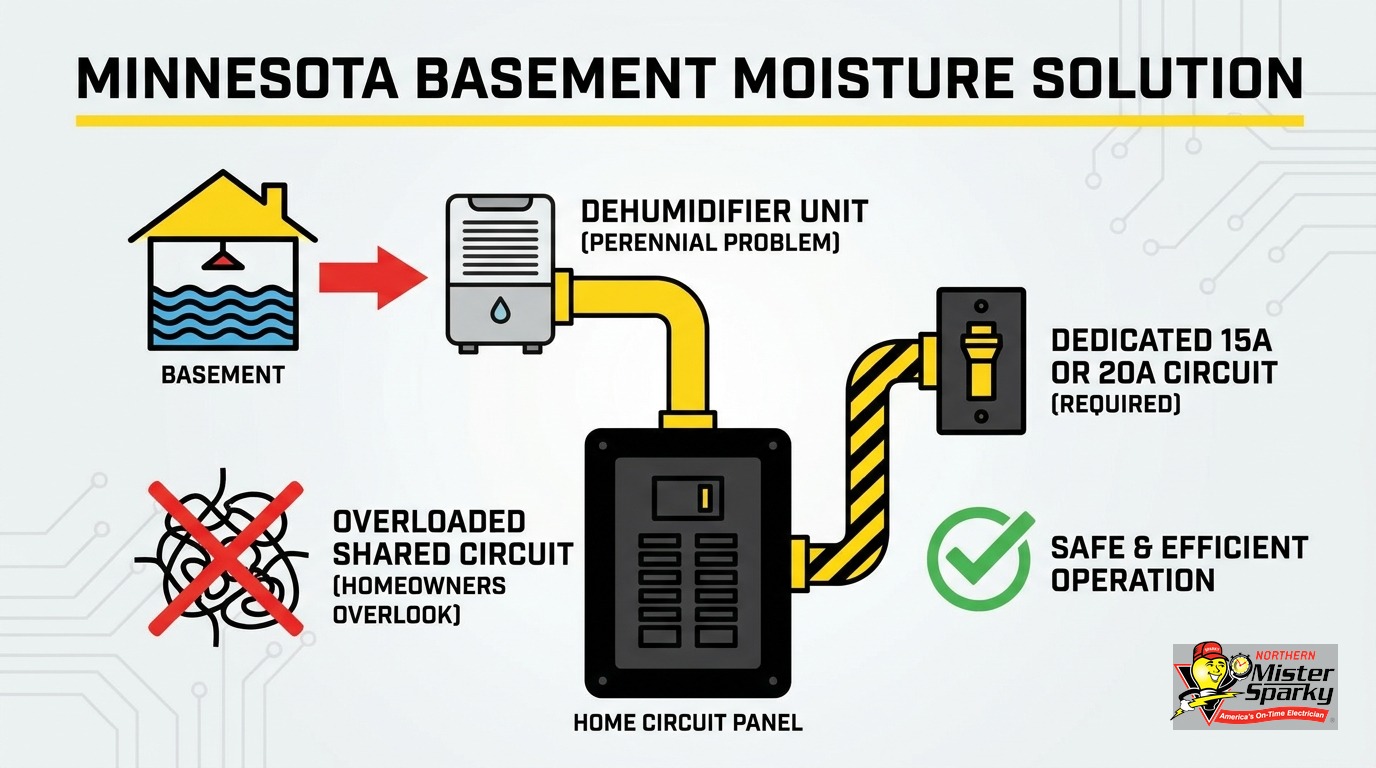
- Most whole-house dehumidifiers need a dedicated 15A circuit on 14-gauge wire. Larger units or those the manufacturer specifies need a 20A circuit on 12-gauge wire.
- All basement outlets now require GFCI protection under the 2026 NEC, which became Minnesota’s code on August 17, 2026.
- Adding a new circuit in Minnesota requires an electrical permit through the DLI. Skipping the permit is a misdemeanor under Minnesota Statute 16B.69 and will surface when you sell.
- Older Minneapolis and St. Paul homes often have full panels. A dehumidifier install can turn into a panel upgrade conversation fast.
- Xcel Energy does not currently offer a dehumidifier rebate. ENERGY STAR units use about 15% less energy and may qualify for municipal utility rebates.
- Set your basement dehumidifier to 55% relative humidity to prevent mold without running the unit harder than it needs to run.
Why Minnesota Basements Are Different
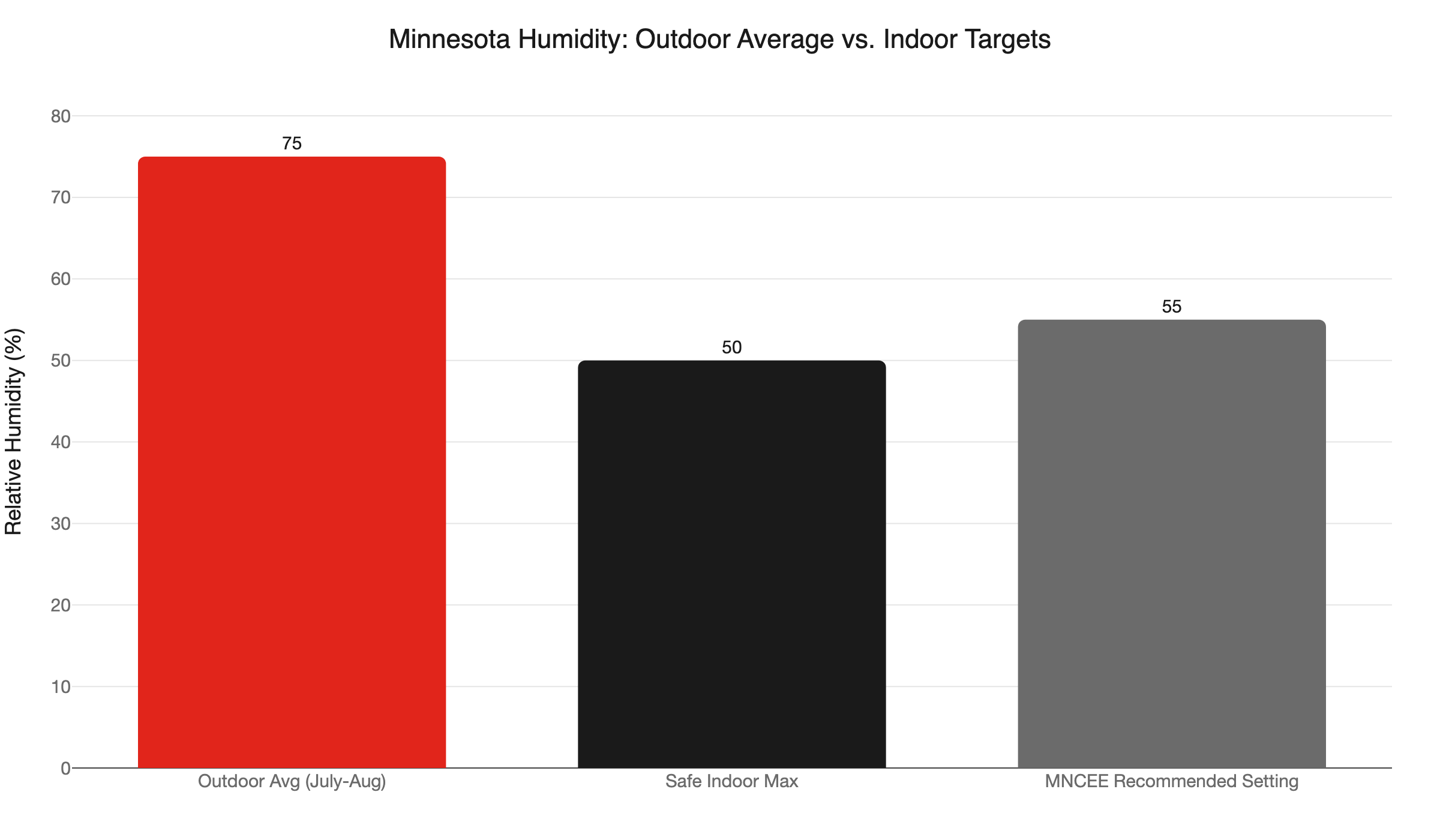
Twin Cities summers average 70-80% relative humidity in July and August. That moisture does not stop at your foundation wall. It migrates through concrete, window wells, and every air gap into your basement.
The safe indoor maximum is 50% relative humidity. When your basement sits at 70%, mold is not a future risk. It is already a present one.
Active dehumidification is standard maintenance in Minnesota. It is not a luxury upgrade.
And when a dehumidifier runs through a Twin Cities summer, it runs constantly. A well-sized unit can pull 10-20 gallons of water per day during peak weeks. That sustained electrical load matters. It is why the whole house dehumidifier electrical requirements deserve attention before you carry the unit home from the store, not after you plug it in.
The three competitor articles that dominate search results right now treat dehumidifiers like generic appliances. None of them mention Minnesota humidity data. None mention the 2026 NEC transition that took effect nine days ago. None walk through what an unpermitted basement circuit means when you go to sell your home. This post fills those gaps.
What Are the Whole House Dehumidifier Electrical Requirements?
Most whole-house and basement dehumidifiers need a dedicated 15A circuit on 14-gauge wire. Larger units require a 20A circuit on 12-gauge wire. The basement outlet must have GFCI protection. In Minnesota, adding the circuit requires a permit and a licensed inspection.
Every dehumidifier has a nameplate and an installation manual. Those documents list the circuit requirements. Always match the wiring to what the manufacturer specifies. If the manual says 20A and you install 15A, you have an undersized circuit. Breakers trip. Wire can overheat.
Standard basement and whole-house dehumidifiers draw roughly 6-7 amps on 120 volts. That fits on a 15A circuit with headroom. But dehumidifiers run continuously during peak season. A shared circuit - one also powering a chest freezer, a sump pump, or a washing machine - risks nuisance tripping and slow heat buildup in the wire.
A dedicated circuit means one breaker, one wire run, one outlet. Nothing else on that circuit.
The whole house dehumidifier electrical requirements are not complicated. But they are specific, and Minnesota enforces them through permit and inspection. That is not optional paperwork - it is the process that protects you when you sell.
Do I Need a Dedicated Circuit for a Whole House Dehumidifier?
Yes. A whole-house dehumidifier needs its own dedicated circuit. Sharing with other loads risks tripped breakers and overheated wiring. It also means the dehumidifier can shut off mid-cycle without you noticing until the humidity has climbed back to problem levels.
The dehumidifier nameplate or manual will confirm the circuit requirements. If you are replacing an older unit, do not assume the existing outlet is on a dedicated circuit. Pull the panel schedule and verify before plugging in the new unit.
Our post on dedicated circuits for appliances explains how to tell whether an existing outlet is dedicated or shared without opening the panel yourself.
A dehumidifier with a continuous drain line can run all day without your involvement. That is the point. You may not realize it has been tripping the breaker until you come downstairs and find the humidity back at 70%. A dedicated circuit removes that failure mode entirely. It is the correct starting point for any whole-house dehumidifier installation.
What Size Circuit Does a Whole House Dehumidifier Need?
A 15A circuit on 14-gauge wire covers most residential units. If your unit’s nameplate or manual calls for 20A, you need 12-gauge wire and a 20A breaker. Never install a smaller wire than the breaker size requires.
Wire gauge and breaker size must match. Running 14-gauge wire on a 20A breaker is a fire hazard. The breaker will not trip before the wire overheats. This is one of the primary reasons to have a licensed electrician run the circuit instead of relying on whoever previously owned the home.
Here is the quick sizing reference:
- Most residential units (6-7A draw): 15A breaker, 14-gauge wire, standard 120V outlet
- Larger or higher-capacity units: 20A breaker, 12-gauge wire, 20A outlet (the T-slot style)
- All basement locations: GFCI protection required in addition to the circuit sizing above
If the unit came from a home improvement store and the packaging is silent on circuit requirements, assume 15A and verify against the manufacturer’s spec sheet. When the situation is unclear, stepping up to 20A is the safer option.
One detail that surprises homeowners: longer wire runs from the panel to the basement outlet can cause voltage drop. An electrician accounts for that when choosing wire gauge. You do not need to calculate it yourself. But it is another reason the professional assessment matters here.
Does a Basement Dehumidifier Circuit Need GFCI Protection?
Yes, always. Under NEC 210.8(A)(5), all 125-volt receptacles in dwelling-unit basements require GFCI protection - finished or unfinished. Minnesota adopted the 2026 NEC on August 17, 2026. That requirement is now Minnesota’s current electrical code.
GFCI protection takes one of two forms: a GFCI breaker at the panel, or a GFCI receptacle (the one with TEST and RESET buttons) at the outlet location. Either satisfies code. Your electrician will choose the approach that fits your panel and the circuit run.
Basements are damp environments. Minnesota basements are damp by nature and by season. GFCI protection exists because water intrusion and live current are a lethal combination. The code requirement is not overcautious.
NEC 210.8(A)(5) has required GFCI protection for basement receptacles since the 2020 code cycle. Minnesota lagged one code edition for years. The August 17 adoption closes that gap permanently.
If a standard, non-GFCI outlet has been in your basement for 20 years, it may have been compliant when installed. Any new circuit you add today cannot be held to the old standard. New work must meet the 2026 NEC.
The GFCI requirement also applies if you are replacing an existing outlet to serve a new dehumidifier. Swapping only the outlet without upgrading to GFCI protection skips a required step.
Do I Need a Permit to Add a Dehumidifier Circuit in Minnesota?
Yes. Minnesota requires an electrical permit for any new circuit. The permit is filed with the Minnesota Department of Labor and Industry. A licensed inspector verifies the work. Homeowners can pull their own permits, but the work must still pass inspection.
The DLI homeowner permit process protects you in two concrete ways. First, an inspector catches wiring mistakes before they become fires or shock hazards. Second, the permit creates a paper trail proving the work was done to code.
Skipping the permit is a misdemeanor under Minnesota Statute 16B.69. That consequence feels distant until you sell your home. A buyer’s inspector finds an unpermitted circuit in your basement. Now you have a disclosure issue, a potential credit request, and a delayed closing. The permit is inexpensive. The absence of one surfaces at the worst possible time.
Northern Mister Sparky pulls the permit as part of every job. You do not navigate DLI paperwork yourself. If you want to understand the process before you call, our post on electrical permits in Minnesota covers the DLI steps in detail.
The 2026 NEC Is Now Minnesota’s Electrical Code
Minnesota adopted the 2026 National Electrical Code effective August 17, 2026. Any permit filed on or after that date falls under the 2026 NEC. Licensing exams transition to the new code on September 8, 2026.
This is not a hypothetical future change. It is already in effect. Any quote you receive today from an electrician is priced to the 2026 NEC. Any permit filed this week is reviewed against it.
The 2026 NEC carries forward the GFCI basement requirements and dedicated-circuit standards already established in the 2020 cycle. If you found advice online that predates 2020, that advice is now two code cycles old. Treat it as background reading, not installation guidance.
For Twin Cities homeowners pulling a permit right now, this transition is a live detail. Your installation will be inspected against the newest version of the code. You want the work done to that standard, not the one from six years ago.
What If My Panel Does Not Have an Open Slot?
If your panel is full, options include tandem breakers where the panel permits them, a small subpanel fed from the main, or a full service upgrade. We assess your panel during the quote visit and present each option with pricing before any work begins.
Older Minneapolis and St. Paul homes skew pre-1960. Many started life with 60A or original 100A service. Some were upgraded over the decades but still have panels with every slot occupied. A dehumidifier install that starts as a simple circuit addition sometimes becomes a larger conversation.
Here are the typical paths:
Tandem breakers. Some panels accept tandem (double-stuff) breakers that fit two circuits in a single slot. Not every panel qualifies, and not all circuit types can use them. An electrician reads the panel label and inspects the interior bus bar before recommending this route.
A subpanel. If the main panel is genuinely full, a small subpanel fed from the main adds capacity without replacing the entire service. This is a cost-effective solution when a finished basement has several new circuit needs: a dehumidifier, a home gym circuit, and a chest freezer all landing at once.
A service upgrade. If the panel is obsolete - a split-bus panel, an old Federal Pacific unit, or 60A service that is genuinely at capacity - the right answer is a full upgrade. Our post on signs you need an electrical panel upgrade covers the warning flags in detail.
Financing is available for panel upgrade projects. Ask when you call.
The Home Sale Consequence Most Buyers Miss
Most people buy a dehumidifier at the store, carry it home, and plug it into the nearest basement outlet. It works. They forget about it.
Months or years later, they list the house. The buyer’s inspector does a thorough basement walkthrough. The inspector cross-references the panel schedule against what is in the basement. The circuit serving the dehumidifier has no permit on file. It gets flagged.
Now there is a material defect disclosure. The buyer requests the circuit be brought up to code or asks for a price credit. Deals have fallen through over exactly this situation.
The cost of a permit and proper installation is predictable and modest. The cost of no permit surfaces during a home sale at the worst possible time, under the most pressure.
If you bought an older Minneapolis or St. Paul home with a basement dehumidifier already in place, it is worth having the electrical situation inspected before you assume it is code-compliant. Our post on what to expect from a pre-sale electrical inspection explains what gets reviewed and when to schedule one.
Will Xcel Energy Rebate My New Dehumidifier?
No current rebate from Xcel. Xcel Energy’s residential rebate program does not include dehumidifiers. Some Minnesota municipal utilities offer a small mail-in rebate for ENERGY STAR-certified models. The federal HOMES Act program has not launched as of August 2026 - DOE approval is still pending.
The honest answer is that the rebate picture for dehumidifiers in the Twin Cities is thin right now. You are not going to recover significant cost through utility programs on this purchase.
The practical alternative: buy an ENERGY STAR-certified unit. ENERGY STAR dehumidifiers use about 15% less energy than standard models. The ENERGY STAR rebate finder lets you enter your ZIP code to search for utility-specific incentives in your area. Some municipal utilities in Minnesota do offer a small mail-in rebate for qualifying units.
Look for a unit with an energy factor of at least 2.0. The Minnesota Center for Energy and Environment recommends this efficiency threshold and pairs it with a 55% humidity target setting.
The bigger financial protection is not a rebate - it is a properly installed, permitted circuit that does not become a disclosure item when you sell.
What Humidity Level Should I Set for a Minnesota Basement?
Set your dehumidifier to 55% relative humidity. The Minnesota Center for Energy and Environment recommends this level to prevent mold and bacterial growth. It keeps you safely below the 50% indoor maximum without running the unit harder than it needs to run.
The logic behind 55% instead of 50%: basements run cooler than the rest of the house. Cooler air holds less moisture at any given humidity percentage. A reading of 55% in a cool basement is doing its job well.
During July and August, a properly sized Minnesota basement dehumidifier pulling 10-20 gallons per day is working normally. That sustained output is exactly why the circuit matters. An undersized or shared circuit under that load is a slow-building problem. It may not fail immediately. It may fail during the hottest week of the year.
Setting your unit too low - say, 40% - forces it to run harder than necessary and cycles it more frequently. Setting it too high - say, 65% - means mold is already ahead of it. Set to 55% and leave it.
When to Call Northern Mister Sparky
Call before you plug in the new unit if any of these apply to your situation:
- Your basement has no dedicated outlet for the dehumidifier.
- The outlet is ungrounded, two-prong, or lacks GFCI protection.
- You do not know whether the outlet is on a dedicated or shared circuit.
- Your panel appears full or already has breaker issues.
- You bought an older Minneapolis or St. Paul home and have never had the electrical system inspected.
- You are preparing to sell and want the basement documented and code-compliant.
We are locally owned and operated in the Twin Cities. As America’s On-Time Electrician(R), we show up when we say we will. The UWIN(R) 100% satisfaction guarantee backs every job.
We will assess your panel, run the circuit to the 2026 NEC standard, pull the DLI permit, and schedule the inspection. The job is done right and documented for the life of your home. No malarky.
Call 763-200-5956 or book online to schedule your visit.
Frequently Asked Questions
Does a whole house dehumidifier need a dedicated circuit? +
Do I need a permit to add a dehumidifier circuit in Minnesota? +
Does a basement dehumidifier outlet need GFCI protection? +
Need an electrician now?