
Arc Fault Circuit Interrupter Breaker Requirements Explained
Key Takeaways
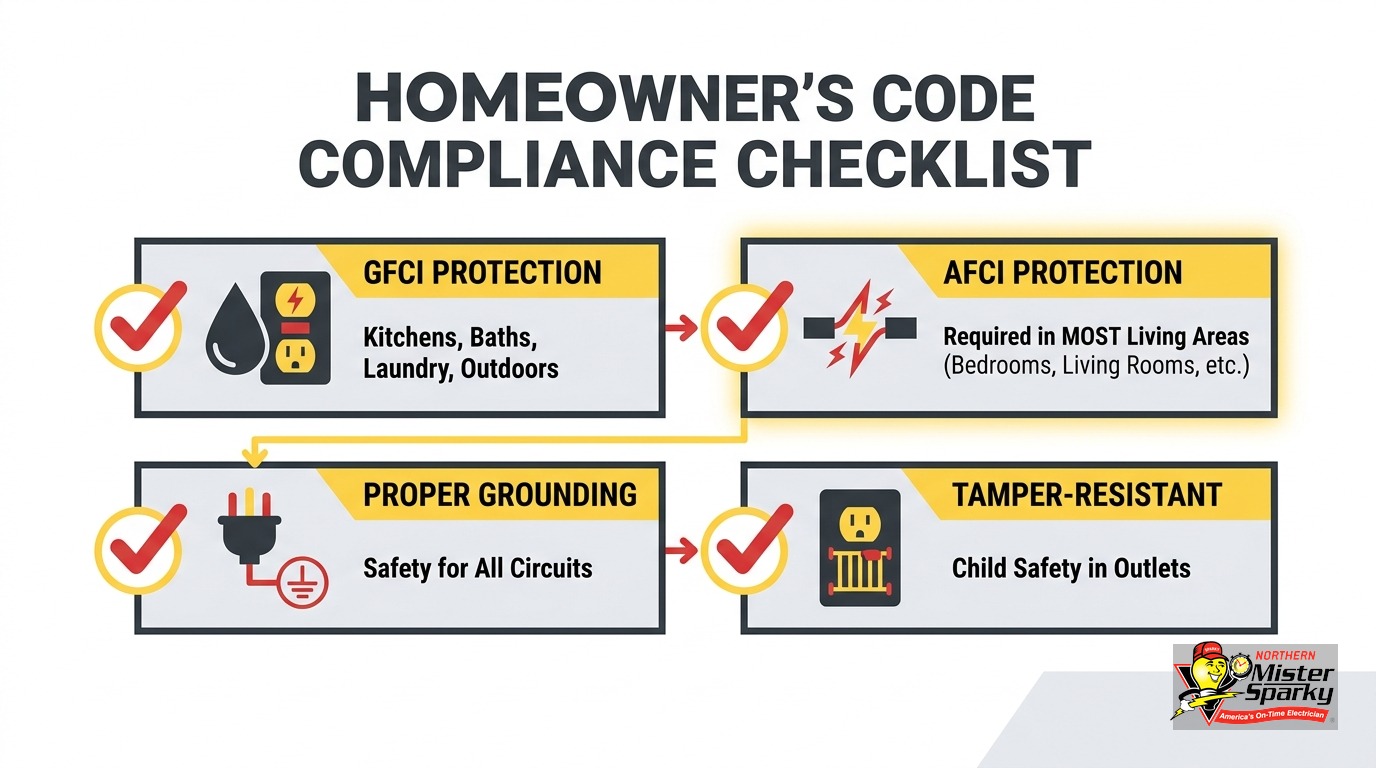
- Arc fault circuit interrupter breaker requirements under NEC 210.12 cover most finished living spaces: bedrooms, living rooms, family rooms, dining rooms, kitchens, hallways, and laundry areas.
- Modifying, replacing, or extending a circuit in a covered area triggers the AFCI requirement, even in homes built before AFCIs existed. This rule has applied since the 2011 NEC.
- Minnesota follows the NEC with no state AFCI exemptions. Permits filed before August 17, 2026 fall under the 2023 NEC. Permits filed on or after that date fall under the 2026 NEC.
- A failed AFCI inspection stops your project cold. It can also void a fire insurance claim and block a home sale.
- AFCI combination breakers cost $25 to $50 each. A typical basement finish adds 2 to 4 circuits.
- Call Northern Mister Sparky at 763-200-5956 or book online before you pull your permit.
What Is an Arc Fault Circuit Interrupter Breaker?
Standard circuit breakers protect against two things: overloads and short circuits. They respond when too much current flows at once. They miss the arc fault, and that is the problem.
An arc fault is a type of electrical discharge that jumps across a gap in damaged or degraded wiring. It smolders inside a wall. It generates heat without drawing enough current to trip a standard breaker. Left unchecked, it starts a fire.
Arc faults cause approximately 42,000 home fires in the US each year. Between 2010 and 2014, US electrical home fires averaged 45,210 per year, resulting in 420 deaths, 1,370 injuries, and $1.4 billion in property damage annually. That is a recurring, preventable toll.
An AFCI breaker monitors the current signature on the circuit. It detects the irregular pattern of an arcing fault, whether the source is a loose wire connection at an outlet, a staple driven through a cable during a past renovation, or insulation worn thin over decades of use. When it detects that signature, it trips. The fire never starts.
The AFCI breaker installs at the electrical panel in place of a standard breaker on the circuits that code requires it to protect. A homeowner does not interact with it day to day. It works silently in the background.
What Rooms Require AFCI Protection?
Under NEC 210.12(B), AFCI protection is required on all 120-volt, 15- and 20-amp branch circuits serving bedrooms, living rooms, family rooms, dining rooms, kitchens, sunrooms, recreation rooms, closets, hallways, and laundry areas. The code’s “similar rooms or areas” language captures most finished living spaces in a home.
The list is intentionally broad. If a room is finished, conditioned, and used by people, it almost certainly needs AFCI protection on every circuit serving it. That includes the basement bedroom you are adding, the family room you are framing out below grade, and the home office you are carving out of a spare room.
A few spaces fall outside the standard requirement. Unfinished utility areas, dedicated circuits for some specific equipment, and a handful of other narrow exceptions are not covered by the 2023 NEC. But those exceptions are exactly that: narrow. They do not apply to the typical basement bedroom or rec room finish.
The 2026 NEC tightens the standard even further. Starting with permits filed on or after August 17, 2026 in Minnesota, the updated code expands AFCI to cover every general-purpose 15A and 20A circuit in new construction, closing remaining gaps around some dedicated appliance circuits that the 2023 edition left unaddressed.
Outdoor circuits, garage circuits, and bathroom circuits fall under different protection requirements, primarily GFCI protection. Our post on GFCI outlet requirements explains where GFCI applies and how the two technologies protect against different hazards.
Does Extending an Old Circuit Trigger the AFCI Requirement?
Yes. NEC 210.12(D) requires AFCI protection whenever a branch circuit is modified, replaced, or extended in a covered area, regardless of when the home was built. This provision has been in force since the 2011 NEC. A house built in 1958 is not exempt once you touch its wiring.
This is the provision that surprises most Twin Cities homeowners. The assumption is: “My house predates AFCI, so I’m grandfathered in.” That assumption is wrong.
Here is the scenario that trips people up. You are finishing a basement. Your plan is to run a few outlets and a couple of light switches off an existing circuit, rather than pulling brand-new wire back to the panel. Reasonable approach. Lower material cost. And it triggers 210.12(D) the moment you extend that wire into the finished space.
Your electrician must install an AFCI breaker at the panel on that circuit. Not optional. Not a recommendation. A code requirement that your rough-in inspector will check.
There is one narrow exception. An extension of 6 feet or less with no new outlets or devices added does not require AFCI. That might cover a short reroute of a junction box. It does not cover running wire across a basement ceiling to a new outlet in a bedroom wall.
If your renovation adds outlets, switches, fixtures, or any new device on an existing circuit in a covered room, plan for AFCI on that circuit.
The Basement Finishing Scenario, Step by Step
Here is what the AFCI requirement looks like in a real Twin Cities project. You are adding a bedroom and a rec room to an unfinished basement in a 1972 Minneapolis rambler. The house has a 200-amp panel with several open slots. Good news: no panel upgrade needed.
What the code requires for this project:
- Every new circuit you run to the bedroom and rec room needs an AFCI breaker at the panel.
- Every existing circuit you extend into those finished spaces needs an AFCI breaker added at the panel.
- The bathroom you are adding needs GFCI protection at the outlets and any wet-location points.
- If a rec room wet bar shares a circuit with the general rec room outlets, you may need combination AFCI/GFCI protection.
What happens at the rough-in inspection:
Your electrician runs the circuits, installs the AFCI breakers, and schedules the rough-in before any drywall goes up. The inspector checks each circuit. A missing AFCI breaker on a covered circuit fails the inspection. You correct it, schedule a re-inspection, and close the walls only after you pass. No exceptions.
What the permit date controls:
Your permit date determines which NEC edition the inspector references. Permits filed before August 17, 2026 use the 2023 NEC. Permits filed on or after use the 2026 NEC. For this project, both editions require AFCI in the bedroom and rec room. The practical difference is minor. But the permit date is the official reference point.
Our post on basement finishing electrical costs has a complete breakdown of what this type of project typically runs from permit to final inspection, including circuit counts and panel considerations.
Minnesota’s Code Timeline: Which Rules Apply to Your Permit?
Minnesota’s electrical code is Chapter 1315 of the State Building Code. It adopts the NEC as published by NFPA. Minnesota made no significant AFCI-specific amendments. The NEC applies as written. There are no Minnesota carve-outs or AFCI exemptions unique to this state.
The code transition happening right now matters if you are planning a project:
- Permits filed before August 17, 2026 fall under the 2023 NEC.
- Permits filed on or after August 17, 2026 fall under the 2026 NEC.
For a standard residential basement finish or bedroom addition, the covered rooms are identical under both editions. The 2026 NEC adds coverage for some circuits the 2023 edition left unaddressed, but those additions are unlikely to affect a typical remodel in a meaningful way. The rooms you are finishing require AFCI under either edition.
What your permit date controls is the specific inspector checklist. If you are starting a project this week, pull your permit now and you are locked into the 2023 NEC. If your project kicks off in late August, you fall under the 2026 NEC. Ask us which one is cleaner for your scope if you have flexibility on timing.
St. Paul’s Department of Safety and Inspections confirmed in a June 2023 guidance document that the modification and extension trigger under 210.12(D) applies locally. Minneapolis and suburban Twin Cities jurisdictions follow the same state code. There is no municipality in the metro with a local AFCI exemption.
What Happens If Your Inspection Fails for Missing AFCI?
A failed rough-in inspection means the walls cannot close. You correct the deficiency, schedule a re-inspection, and pass before the project moves forward. Missing AFCI where code requires it is a clear fail item, not a gray area the inspector might overlook.
That is the immediate problem. Two longer-term consequences carry more weight for most homeowners.
First, missing AFCI protection where code requires it can void a homeowner’s fire insurance claim. If a fire starts in a wall served by a circuit that should have had AFCI protection, your insurance company will investigate whether the work was permitted and code-compliant. Unpermitted work or a failed inspection shifts that liability onto you at exactly the wrong moment.
Second, a failed or unpermitted inspection can block a home sale. Open permit records surface in title searches. Buyers, lenders, and home inspectors check for them. An unpermitted basement finish, or a basement finish where the inspection record shows a failure with no subsequent pass, is a negotiation problem at best. At worst, it kills the deal or requires a retroactive permit and inspection before closing, which can take weeks.
The permit and inspection process protects you. It creates a documented record that the work was done to code. That record has real monetary value at resale and real protective value for your insurance coverage.
How Much Do AFCI Breakers Cost?
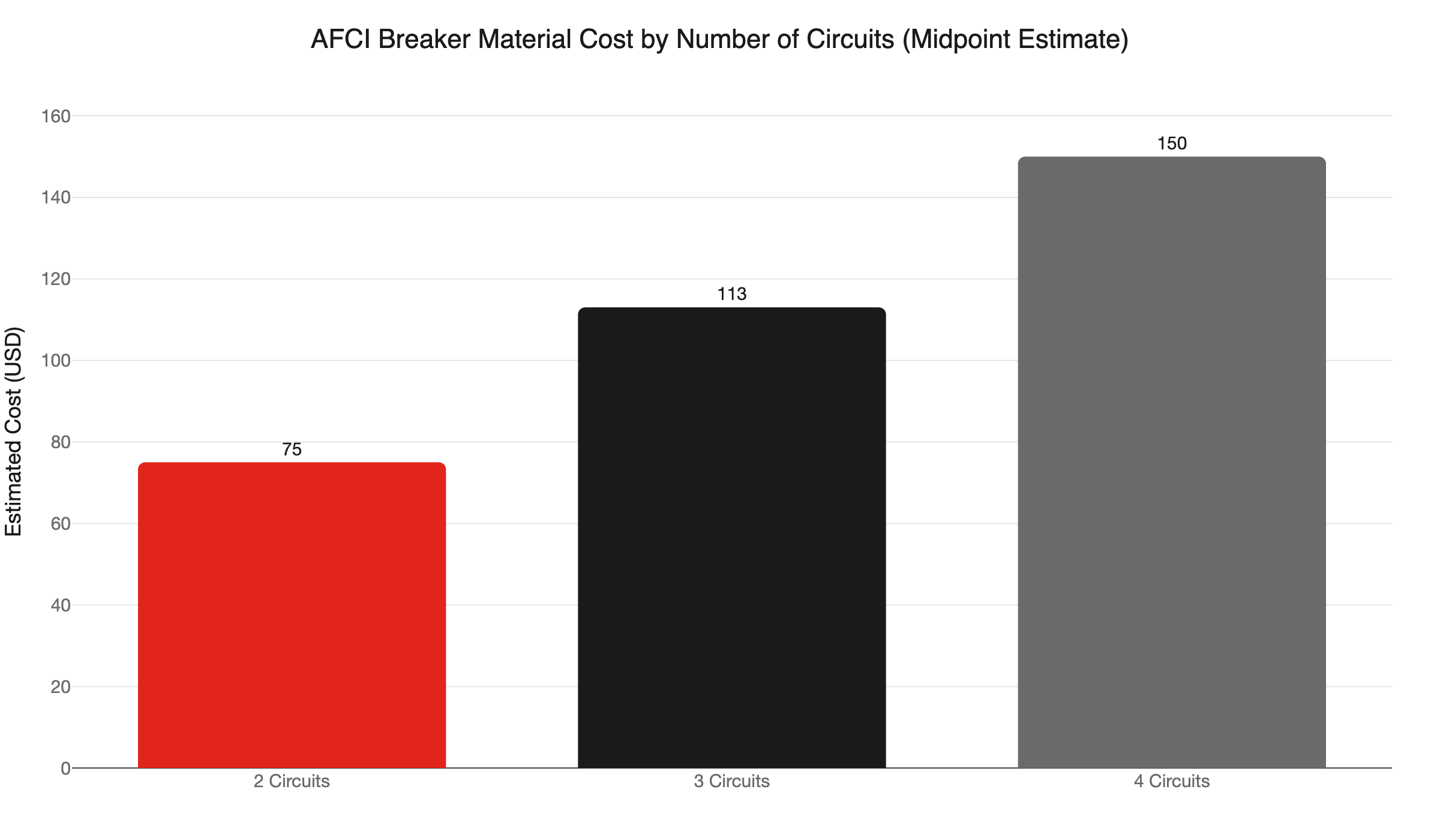
AFCI combination-type breakers cost $25 to $50 each in materials. A typical basement finish adds 2 to 4 new circuits, putting material cost for the breakers at $50 to $200. Labor and any panel work to add circuit slots are separate line items.
The breakers themselves are usually a small fraction of a basement finishing project’s total electrical budget. The bigger variables are how many circuits your project scope requires, whether your panel has open slots, and whether any existing wiring needs to change.
If your panel is at capacity, adding circuits means either a panel upgrade or a subpanel installation. Both add cost beyond the AFCI breakers. If your panel is an older brand with known reliability problems, it may need to come out regardless of slot count. Those are separate conversations from the AFCI requirement, but they often surface during the same project.
Financing is available for larger panel or circuit work. Mention it when you book and we will walk you through the options.
AFCI vs. GFCI: What’s the Difference?
Homeowners regularly confuse these two technologies. Both involve upgraded protection at the breaker or outlet level. They protect against entirely different hazards.
GFCI (ground fault circuit interrupter) detects current leaking to ground. It protects against electrocution in wet or damp locations: bathrooms, kitchens near sinks, garages, outdoor circuits, and similar areas. When it detects a ground fault, it trips in milliseconds.
AFCI (arc fault circuit interrupter) detects the electrical signature of an arcing fault inside the wiring. It protects against fire, not electrocution. It is required in finished living spaces, not in wet locations.
The two systems do not overlap much. But some locations need both. A basement wet bar that sits inside a finished rec room might need AFCI on the room’s general circuits and GFCI at the wet bar outlets. Combination AFCI/GFCI breakers exist for exactly those cases. They satisfy both requirements from a single slot in your panel.
When you are planning a basement finish, your electrician should map both protection requirements at the design stage. Getting one right and missing the other still means a failed inspection and a delayed project. Our post on GFCI outlet requirements covers where GFCI is required and how it pairs with AFCI in a full renovation.
Is a Permit Required for Basement Finishing in the Twin Cities?
Yes. Any project that adds or modifies electrical circuits in Minneapolis, St. Paul, or the suburban Twin Cities requires an electrical permit. AFCI compliance is a line item on the rough-in inspection checklist, and there is no pathway around it.
Your electrician pulls the permit as part of the job. It is not an optional add-on. A contractor who suggests skipping the permit, or who assures you the inspector will not look closely, is a contractor you should pass on.
The permit cost is real but modest relative to what it protects. A permitted, inspected installation is documented proof that the work meets code. That proof matters for insurance. It matters at resale. And it matters if you ever want to pull a subsequent permit for work in the same space.
Our post on electrical permits in Minnesota walks through the full process: what information you need, how long the permit takes to issue, and what to expect at the rough-in and final inspection stages.
Old Wiring and the Modification Trap
Most Twin Cities housing stock was built before 1980. Many of these homes have never had a significant electrical renovation. The wiring has been in the walls for forty, fifty, sixty years.
The modification trap is simple. Homeowners assume that because the house predates AFCI requirements, the old wiring is grandfathered. It is not.
The moment you modify, extend, or replace wiring in a covered room in that older home, you are subject to current code on the work you are doing. The rest of the house does not suddenly need AFCI retrofitted throughout. But the circuits you touch do.
A 1962 St. Paul house that has never had a permit pulled becomes a different story the moment you add a bedroom in the basement. The new circuits need AFCI breakers. Any existing circuits extended into that bedroom need AFCI breakers. The old panel is not exempt because it predates the requirement. If the panel does not support AFCI-compatible breakers, which is true of some very old panels, the panel has to change.
This surprises homeowners who received a bid that did not include AFCI breakers. It is not your electrician inventing a problem. It is code, and your inspector will check for it.
If your home has aluminum wiring from the 1960s or 1970s, the wiring type can affect which AFCI breakers are compatible and how the work needs to be structured. If you are not sure what type of wiring runs through your walls, have us take a look before the project starts. Knowing upfront avoids mid-project surprises.
Getting AFCI Right the First Time
We are locally owned and operated in the Twin Cities. We know Minnesota’s code adoption schedule, we know how Minneapolis and St. Paul inspectors read the AFCI requirements, and we pull permits on every job that needs one.
As America’s On-Time Electrician(R), we show up when we say we will. When our quote includes AFCI breakers, we are pricing the job to pass rough-in inspection the first time and keep your project moving without delays.
The UWIN(R) 100% satisfaction guarantee backs every job. If something is not right, we come back and make it right.
If you are planning a basement finish, bedroom addition, or any renovation that involves adding or modifying circuits in your home, call us at 763-200-5956 or book online. We will walk through your project scope, advise on permit and AFCI requirements, and give you a straight price before any work begins. Financing is available for larger panel and circuit projects.
Frequently Asked Questions
What rooms require AFCI breakers under current code? +
Does extending an existing circuit require AFCI protection? +
How much do AFCI breakers cost for a typical basement finish? +
Need an electrician now?