
Aging in Place Electrical Upgrades for Your Twin Cities Home
Key Takeaways
- Older adults die from falls at a high rate each year. The age-adjusted fall death rate rose 21% between 2018 and 2024.
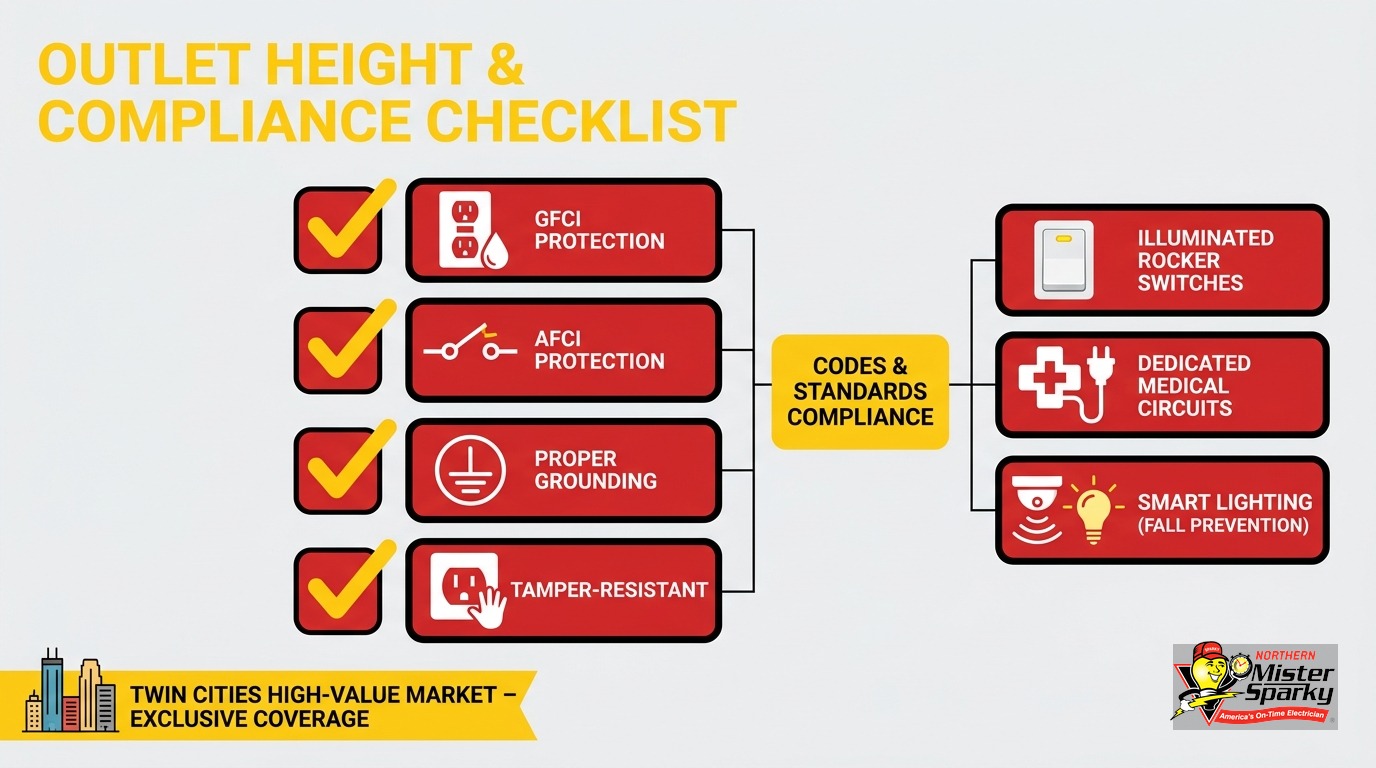
- NEC Article 210.52 governs outlet spacing, not height. ADA standards set the outlet minimum height and the switch maximum height. Best practice for aging in place is 18 to 24 inches for outlets and 44 inches or below for switches.
- Toggle switches technically fail ADA operability standards. Illuminated rocker switches activate with a palm, fist, or elbow.
- GFCI outlets are the wrong choice for CPAP machines and oxygen concentrators. Small leakage current from those devices can trip a GFCI and cut power.
- A dedicated 20-amp circuit with a clearly labeled breaker is the right setup for home medical equipment.
- Minnesota adopted the 2026 NEC effective August 17, 2026. Permits filed today fall under the new code.
- Xcel Energy offers LED lighting rebates through its Conservation Improvement Program. Confirm current residential availability directly with Xcel before budgeting.
Why Do Aging in Place Electrical Upgrades at Home Matter in the Twin Cities?
Short answer: Poor lighting, inaccessible outlets, and circuits shared with medical equipment are proven environmental fall risk factors. For the 611,000 Baby Boomers in the Twin Cities metro, upgrading the electrical system before a health event forces the issue is the most cost-effective window available.
One in five Minnesotans will be 65 or older within the next decade. That shift is already underway. Minnesota’s 65-plus population grew from 683,000 in 2010 to 950,000 in 2020, reaching 17% of the state. The Twin Cities metro is carrying a significant share of that load.
That demographic reality has a direct electrical dimension.
More than 1 in 4 adults 65 and older falls each year. Falling once doubles the chance of falling again. Nearly 3.85 million older adults were treated in emergency departments for fall injuries in 2024. The CDC names poor lighting, clutter, and lack of supports as named environmental fall risk factors. All three have electrical solutions.
Most Twin Cities homes were built for a standing adult in their 30s at full health. Outlets sit 12 to 14 inches off the floor. Toggle switches are mounted at 48 inches. Hallways go dark between a wall switch and the next room. Bedroom circuits serve six or eight devices without a dedicated path for the oxygen concentrator running through the night.
These are not cosmetic issues. They are safety infrastructure gaps.
Targeted electrical upgrades done right the first time cost far less than a single emergency room visit. For homeowners planning ahead for themselves or a parent, the window to act before a health event is open now. Waiting until the home needs accessibility modifications under pressure means paying for drywall repair on top of the electrical work.
What Outlet Height Is Right for Aging in Place Electrical Upgrades at Home?
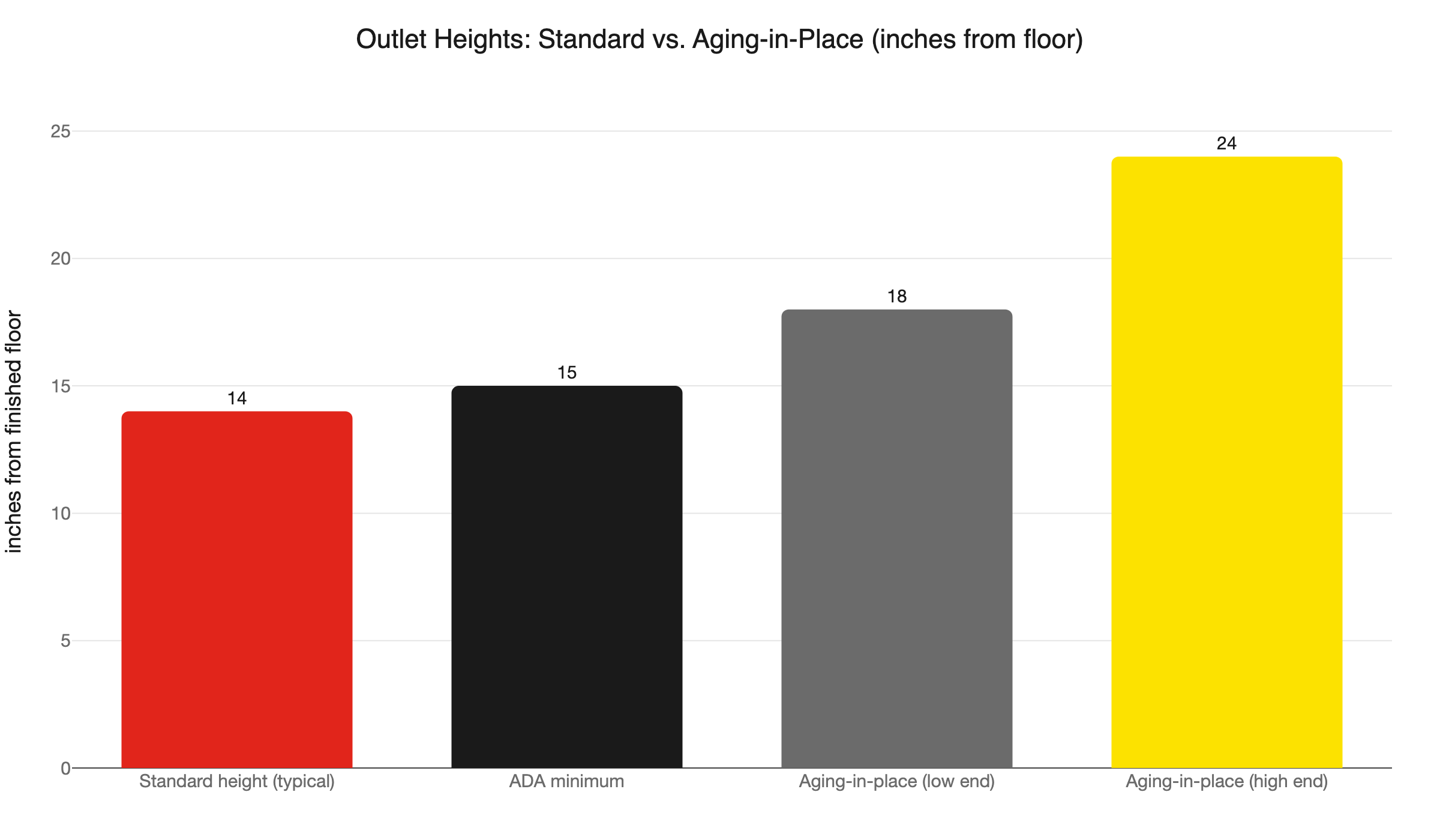
Short answer: ADA standards require a minimum outlet height of 15 inches and a maximum of 48 inches. Aging-in-place best practice raises outlets to 18 to 24 inches and lowers switches to 44 inches or below. Those numbers work for standing adults, seated users, and walker users equally well.
Here is where most homeowners get confused. NEC code governs outlet placement along walls: no point along a wall can be more than 6 feet from a receptacle. It says nothing about how high off the floor. Height defaults to industry practice, typically 12 to 16 inches in Minnesota homes built before 2000.
That standard height was designed for healthy adults standing at full height. Reaching a 12-inch outlet requires bending at the waist. For someone with arthritis, a herniated disc, or limited range of motion, that is a daily strain. For a homeowner using a walker or wheelchair, it is a genuine hazard.
ADA Standards for Accessible Design address this directly:
- Minimum outlet height: 15 inches from finished floor
- Maximum outlet height, unobstructed forward reach: 48 inches
- Obstructed reach over a counter up to 20 inches deep: maximum drops to 44 inches
- Switch maximum: 48 inches, with aging-in-place best practice at 44 inches or below
California added a residential code requirement specifically for “Aging-In-Place Design and Fall Prevention,” mandating outlets no lower than 15 inches and switches no higher than 48 inches. Minnesota has not adopted that specific provision yet, but the ADA standard is the right planning target regardless of whether state code requires it.
In practice, relocating an outlet from 12 inches to 22 inches is a straightforward job when combined with other circuit work in the room. Doing it during a remodel or alongside a dedicated circuit installation keeps the cost proportional. Doing it later, after walls are finished and other trades are gone, costs more.
When we walk a home for an aging-in-place assessment, we flag every outlet and switch that falls outside the accessible range and bundle the relocations into the same visit as the circuit work. That is the efficient path.
Why Do Toggle Switches Fall Short of ADA Standards?
Short answer: ADA-compliant controls must be operable without tight grasping, pinching, or wrist-twisting. A toggle switch requires all three. Rocker switches activate with the flat of a hand, the back of a knuckle, or an elbow. That single difference makes rocker switches the correct choice for accessible design.
For anyone with arthritis, limited grip strength, or reduced motor control after a stroke or injury, the toggle-flip motion ranges from uncomfortable to impossible. The failure is not dramatic. It is the cumulative friction of a switch that does not cooperate every time you walk into a room.
Wallware notes that ADA requires controls operable without tight grasping, and toggle switches technically fail that standard. Rockers pass it. For an aging-in-place upgrade, swapping toggles for rockers is a no-brainer.
Illuminated rockers add a second layer of safety. The face of the switch glows when the light is off, making it visible in a dark hallway at 2 a.m. without first turning on another light. Quick and Easy Lighting describes illuminated rockers as especially valuable for seniors with low vision: the glow confirms circuit state without requiring touch or memory.
We prioritize the nighttime travel routes when swapping switches: bedroom to bathroom, stairway tops and bottoms, kitchen entry, and any hallway longer than 10 feet. Those are the corridors where a hard-to-operate switch in the dark creates the most risk. A full home switch swap is a single-visit job. Illuminated rockers cost a few dollars more per switch than standard toggles. That cost difference has no proportional relationship to the safety gain.
Should You Use GFCI Outlets for Medical Equipment?
Short answer: No. CPAP machines and oxygen concentrators produce small amounts of leakage current during normal operation. A GFCI outlet can misread that signal as a fault and trip, cutting power to life-sustaining equipment. The correct answer is a dedicated 20-amp circuit without GFCI protection at the receptacle.
This surprises most homeowners. GFCI outlets are the right answer in kitchens, bathrooms, garages, and anywhere water is present. They protect against electric shock. But they are sensitive by design, and that sensitivity creates a serious problem when the “fault” signal is a medical device operating exactly as intended.
Stationary oxygen concentrators draw 150 to 300 watts of power continuously. Device manufacturers prohibit extension cord use and require a grounded 3-prong outlet. Many manufacturers and healthcare providers specifically caution against GFCI receptacles for life-sustaining equipment: a nuisance trip in the middle of the night is not a nuisance when the device is keeping someone breathing.
NEC Article 210.23 caps continuous loads at 80% of a circuit’s rated ampacity. A standard 15-amp circuit safely carries only 12 amps of continuous load. A 20-amp circuit caps at 16 amps. Medical equipment running 8 to 12 hours overnight is a continuous load by code definition. A shared bedroom circuit with other devices plugged in does not leave consistent headroom for that load.
The right setup for a bedroom with home medical equipment:
- A dedicated 20-amp circuit run directly from the panel to the bedroom receptacle
- A clearly labeled breaker at the panel, so emergency responders know which circuit serves that equipment
- A pure sine wave UPS rated at least 1,500VA to handle compressor inrush and bridge brief power interruptions without alarming the equipment’s internal monitor
For the full wiring and code breakdown, see our guide on home medical equipment dedicated circuits.
How Does Smart Lighting Reduce Falls at Home?
Short answer: Smart and motion-activated lighting eliminates one of the most common fall triggers: navigating a dark space to reach a switch. A motion sensor turns the light on the moment you enter. Automated schedules keep key paths lit when people actually move through them. Both remove darkness as a variable in the fall-risk equation.
The CDC names poor lighting as a direct environmental fall risk factor. The scale behind that designation is significant. The fall death rate for older adults more than doubled over recent years. Lighting does not eliminate every fall risk. It removes one of the most preventable contributors.
Smart lighting for aging in place works in three layers.
Motion-activated switches on high-traffic routes
Hallways, the bedroom-to-bathroom path, stairways, and kitchen entries are the highest-risk corridors in the home. Motion sensor light switches activate the moment you step into the space and switch off once the area clears. There is no reaching for a switch in the dark and no returning to turn off a light you forgot.
Low-level accent and under-cabinet lighting
Continuous low-level illumination in bathrooms and kitchens means a 2 a.m. walk does not start in full darkness. Hardwired under-cabinet LED strips and recessed night-light circuits do not occupy the outlets needed for medical equipment, phone chargers, or CPAP machines. That matters when outlet count is part of the planning problem.
Scheduled smart-bulb routines
If the kitchen light is already on when someone wakes at 6 a.m., a dark kitchen entry is never a hazard that morning. Smart routines keyed to the homeowner’s daily schedule cost nothing to run once the hardware is installed. The upfront cost is a switch and a bulb.
One installation note worth knowing: smart switches require a neutral wire at the switch box. Many older Twin Cities homes have switch loops without one. We run the neutral and install the switch in the same visit, so the smart features work from day one without a callback.
What Does Minnesota’s 2026 NEC Mean for Your Aging in Place Upgrade?
Short answer: Minnesota adopted the 2026 NEC with an effective date of August 17, 2026. Any permit filed today falls under the new code. A licensed electrician handles code compliance and permit filing on your behalf, but you should know that uninspected work skips the protection that a permit record provides.
The Minnesota Department of Labor and Industry made the 2026 NEC the governing standard for all permits filed on or after August 17, 2026. Permits filed before that date comply with the 2023 NEC. If a project started before the cutoff and is still in progress, confirm with your electrician which code cycle governs the open inspection.
All electrical work in Minnesota requires a permit filed with DLI or the local authority having jurisdiction. Minneapolis and approximately 66 other cities route certain projects through local inspection offices. We file the permit as part of every job. You end up with a record of inspected, code-compliant work. That record is valuable when you sell the home, file a homeowner’s insurance claim, or need to document a dedicated medical equipment circuit for a health insurer.
Homeowners may self-permit and self-perform electrical work on a single-family home they own and occupy. For the upgrades in this post, a licensed electrician is the right call. The permit filing is handled for you. The code compliance on a dedicated medical equipment circuit is not something to figure out mid-project.
Are There Rebates for Aging in Place Electrical Work in Minnesota?
Short answer: Yes, for the lighting component. Xcel Energy’s Conservation Improvement Program includes LED lighting upgrades as a qualifying category. Confirm current residential program terms directly with Xcel before building a budget, because program eligibility and amounts change annually.
Xcel Energy’s Conservation Improvement Program is a state-required efficiency investment. If your aging-in-place plan includes replacing fluorescent or incandescent fixtures with hardwired LED lighting, a rebate on fixture cost may apply. Enhanced LED rebates have been available for commercial customers with significant bonus amounts through the One-Stop Efficiency Shop. Residential customers should call Xcel directly to confirm current availability and terms.
Rebate programs reset annually and eligibility criteria shift. Before committing LED fixture selections to a budget, verify what is active. Our post on Xcel Energy electrical rebates in Minnesota tracks the current program details.
On the federal side, the Inflation Reduction Act includes tax credits for certain home energy efficiency improvements. A qualifying panel upgrade, which often accompanies aging-in-place rewiring work, may be eligible. A tax professional familiar with IRA residential credits is the right resource for that specific question.
What Should a Full Aging in Place Electrical Plan Include?
Short answer: A room-by-room walkthrough that maps outlet and switch heights against ADA standards, identifies circuits serving medical equipment, and places motion-activated or smart lighting on all nighttime travel routes. Most Twin Cities single-family homes complete the core upgrades in one to two visits.
A complete aging-in-place plan is not a product catalog. It is a structured assessment of where the home falls short for the people who live in it. Here is what that looks like room by room.
Bedroom
- Dedicated 20-amp circuit for medical equipment, labeled at the panel
- Outlets at 18 to 24 inches on each side of the bed
- Illuminated rocker switches at 44 inches or below
- Motion sensor or smart switch on the overhead light
Bathroom
- GFCI protection remains required on all bathroom outlets by NEC: this is one room where GFCI is the right answer
- Outlet height at 18 to 24 inches from the finished floor
- Illuminated switch for the overhead, visible from the doorway in the dark
Hallways and stairways
- Motion-activated lighting covering the full path from bedroom to bathroom
- Three-way switch setups so both ends of a hallway or stairway control the same fixture
- Illuminated rocker switches at both the top and bottom of every stairway
Kitchen
- Under-cabinet LED strips to eliminate shadows at the work surface
- Dedicated circuits for major appliances to prevent nuisance tripping that can mask a real circuit problem
- Outlets verified at an accessible forward-reach height
Whole home
- Tamper-resistant, clearly labeled outlets throughout
- Whole-home surge protection on the panel to protect sensitive medical and electronic equipment from voltage spikes
- Panel labeling reviewed and updated so every circuit is identifiable by anyone who opens the door
Most aging-in-place jobs in standard Twin Cities single-family homes fit within the existing panel capacity with careful circuit planning. A panel upgrade is warranted when the dedicated medical circuit and smart lighting additions push the load calculation past available capacity. We run that calculation before we quote.
Ready to Plan Your Aging in Place Electrical Upgrade?
Northern Mister Sparky is locally owned and operated in the Twin Cities. We serve Minneapolis, St. Paul, Bloomington, Brooklyn Park, Woodbury, Blaine, Maple Grove, Plymouth, and the surrounding metro.
As America’s On-Time Electrician(R), we show up on schedule, pull the permit, do the work to code, and back every job with the UWIN(R) 100% satisfaction guarantee. No malarky.
Call 763-200-5956 or book online to schedule your aging in place electrical assessment.
Frequently Asked Questions
Do I need a permit for aging in place electrical upgrades in Minnesota? +
Can I plug my oxygen concentrator or CPAP machine into a GFCI outlet? +
What outlet height is recommended for aging in place? +
Need an electrician now?