
Home Medical Equipment Electrical Requirements Explained
Key Takeaways
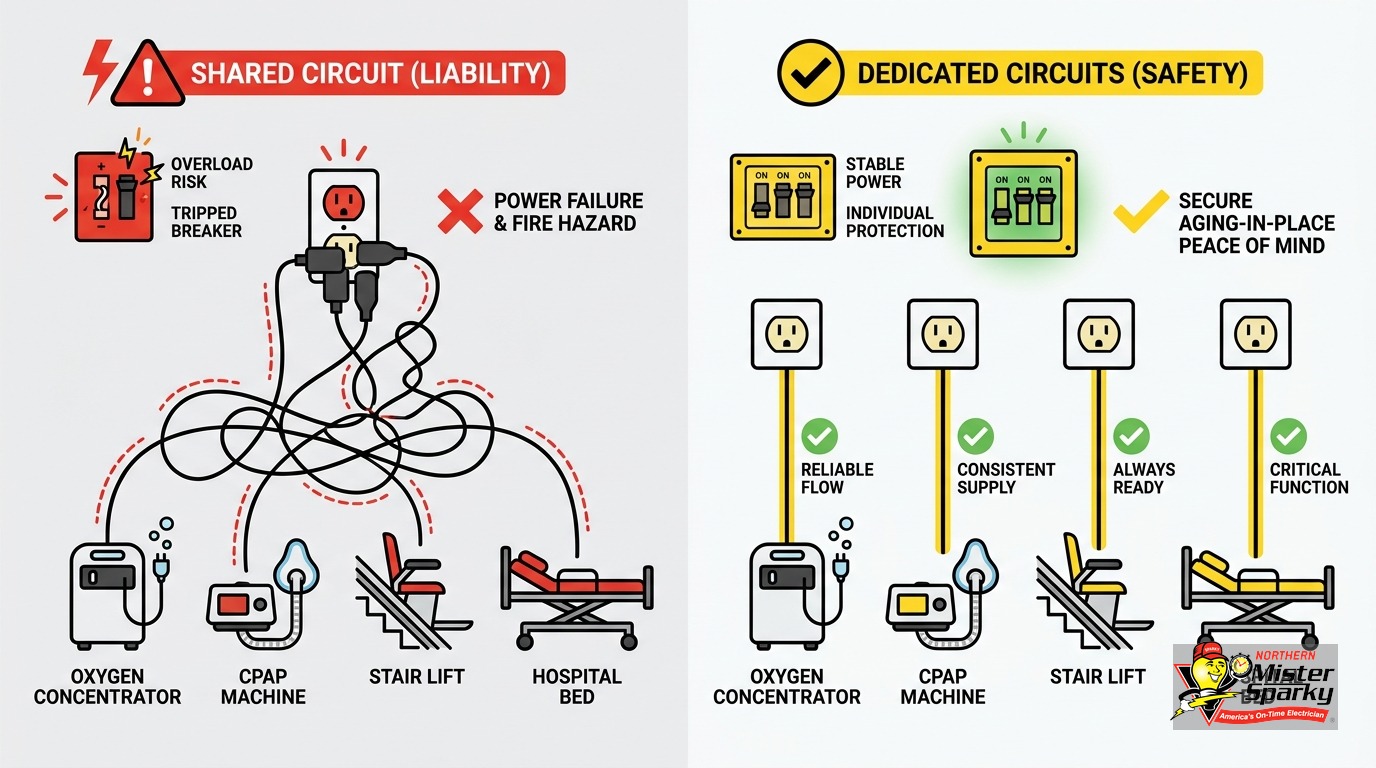
- Stationary oxygen concentrators draw 150-300 watts continuously. On a shared 15A circuit, they compete with lights, phone chargers, and space heaters.
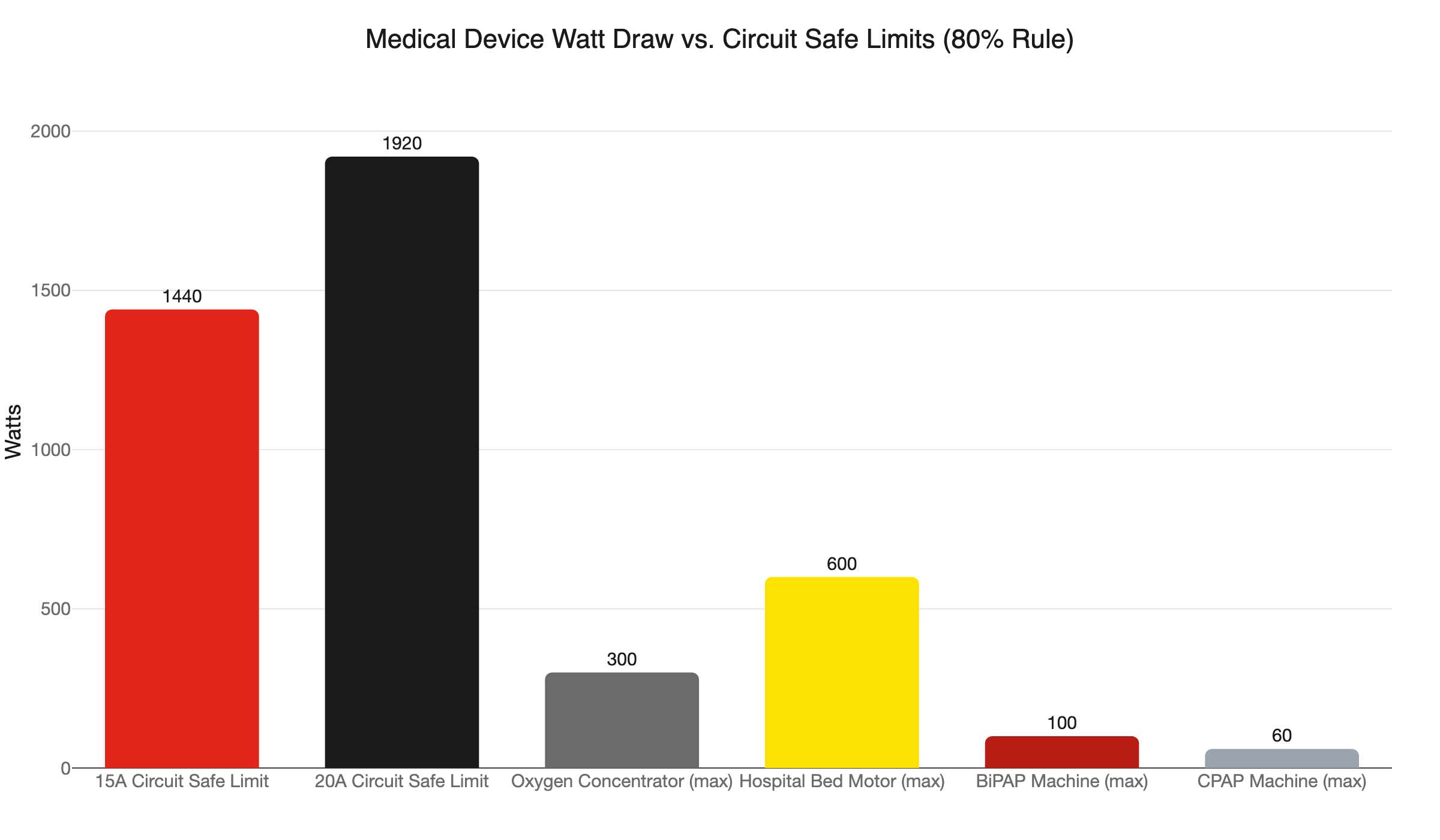
- NEC Article 210.23 limits continuous loads to 80% of a circuit’s rated ampacity. A 15A circuit can safely carry only 12 amps of sustained draw.
- Stair lift motors pull startup surge current up to the full 15A breaker limit. On a shared circuit, they trip the breaker and can strand someone mid-stair.
- Hospital bed motors draw 3-5 amps during position adjustment. That load, combined with other devices on a shared circuit, can push the total past the safe limit.
- Minnesota adopted the 2026 National Electrical Code on August 17, 2026. Any new electrical work permitted now must comply with updated AFCI and GFCI standards.
- Adding a dedicated circuit in Minnesota requires a permit through the Department of Labor and Industry, even for homeowners doing their own work on their primary residence.
- A tripped circuit at 2 a.m. in a Minnesota January is an emergency, not an inconvenience.
If your household is aging in place, the electrical picture changes over time. One oxygen concentrator arrives. Then a CPAP machine. Then a stair lift. Then an adjustable hospital-style bed. Each device plugs into whatever outlet is closest. Each one competes for power on a circuit that was sized for a 1960s living room.
That is where the risk builds.
Home medical equipment electrical requirements rarely appear in aging-in-place guides. Medical supply retailers say to plug the device into a standard outlet. AARP checklists cover grab bars, ramp widths, and doorway clearances. Nobody explains what happens when four high-draw or motor-driven devices land on circuits never designed for continuous medical loads.
The compounding problem is real. It is common in older Twin Cities homes. And it is entirely solvable with the right circuits in the right places.
We are locally owned and operated in the Twin Cities. We serve Minneapolis, St. Paul, Bloomington, Woodbury, Brooklyn Park, and the surrounding metro. We see this situation often: a household managing complex medical needs, running devices on shared circuits, hoping the breaker holds.
This post explains what the electrical code requires, what each device actually draws, why shared circuits create risk, and what it takes to fix the problem permanently.
What Are Home Medical Equipment Electrical Requirements?
Most stationary home medical devices are rated for a standard 120V, 60Hz, grounded outlet. But “standard outlet” does not mean a shared circuit is safe. The proper approach for any continuous-draw or motor-driven device is a dedicated circuit: one breaker, one circuit, serving only that device or outlet.
A dedicated circuit means a single breaker in your electrical panel feeds only the outlet (or outlets) serving that specific device. Nothing else runs on that circuit. No bedroom lighting. No phone chargers. No bedside clock or space heater.
The concept is well-established for high-draw household appliances. Refrigerators, dishwashers, microwave ovens, and laundry equipment all benefit from dedicated circuits, and many are required by code to have them. See our post on dedicated circuits for appliances for how those requirements work in practice.
For home medical equipment, the dedicated circuit recommendation is less consistently communicated. Device retailers focus on the product, not the outlet. Installation technicians focus on the lift mechanism or the concentrator settings, not the circuit. Homeowners assume the existing outlet is adequate.
Often it is not, and the difference matters. For someone dependent on continuous oxygen delivery or a stair lift as their only way between floors, an unplanned circuit trip is not a minor inconvenience.
Why Is Adding Multiple Medical Devices to One Circuit a Problem?
Each device adds to the circuit’s total ampere draw. The National Electrical Code, Article 210.23 limits continuous loads to 80% of a circuit’s rated ampacity. A standard 15A circuit can safely carry only 12 amps of continuous draw. A 20A circuit caps at 16 amps. An aging-in-place household can reach that limit faster than most people expect.
Here is the math in a typical bedroom. A 15A general-purpose circuit might serve several outlets and the overhead light. An oxygen concentrator drawing 200 watts uses about 1.67 amps. A modest 750-watt space heater adds 6.25 amps. A bedside lamp and a phone charger add another amp or more. That total is already past 9 amps of sustained load, with no room left for anything else.
Now the person’s spouse turns on a hair dryer in the same room, or the CPAP humidifier cycles on. The circuit hits its limit and the breaker trips.
General-purpose circuits are designed for varied, occasional loads. They were not designed for devices that draw continuously for hours, or that pull a motor startup surge at unpredictable moments. That is the mismatch home medical equipment creates in an older home.
The NFPA reports approximately 51,000 home electrical fires annually in the U.S., with overloaded circuits and extension cords among the leading causes. The aggregate load problem across shared circuits is a real fire risk, not a theoretical one. For help with a circuit that is already showing signs of strain, our overloaded circuits repair service is a starting point.
The fix is straightforward: give each high-draw or motor-driven medical device its own circuit. Remove it from the shared pool of loads. The circuit has room to breathe, and the device runs without competition.
Does My Oxygen Concentrator Need a Dedicated Circuit?
Yes. Stationary oxygen concentrators draw 150-300 watts of continuous power at 120V. Philips Respironics and other manufacturers require a grounded 3-prong outlet and explicitly prohibit extension cord use. A dedicated circuit is the most reliable way to meet those requirements and eliminate the risk of a shared-circuit trip cutting off oxygen flow.
Oxygen concentrators are the clearest case in the home medical equipment category. They run continuously, sometimes around the clock. Even a brief voltage dip or a breaker trip interrupts oxygen delivery for a person who may not be physically able to reset the breaker quickly.
Most stationary concentrators draw 1.25-2.5 amps in normal operation. That looks small on paper. But continuous draw is different from the occasional draw of a lamp or a charger. The 80% rule exists precisely because sustained loads generate heat in wire and connections over time. A concentrator running on a shared circuit that is already loaded applies that heat continuously.
Extension cords add a second risk layer. A cord run introduces resistance that generates additional heat. Long extension cords, or cords used with adapters, can overheat. Manufacturers prohibit them for this reason, and the NFPA electrical fires data bears it out. If the outlet is not close enough, the correct answer is a new outlet on a dedicated circuit, not a longer cord.
Some concentrators also draw a brief startup surge when the compressor motor cycles. On a shared circuit, that surge can trip the breaker even when the sustained load seems manageable. A dedicated circuit eliminates that variable entirely.
What About CPAP and BiPAP Machines?
Standard CPAP machines draw 30-60 watts. BiPAP and auto-titrating units with heated humidifiers draw 50-100 watts. The draw is lower than an oxygen concentrator, but CPAPs run every night and benefit from a stable, dedicated outlet, especially when sharing a bedroom circuit with other devices.
CPAP machines are often overlooked in the electrical planning conversation because their draw is relatively modest. Most modern units use a universal power supply rated for 100-240V. That design handles some voltage variation reasonably well.
But a nuisance circuit trip still disrupts sleep and resets the device’s nightly data recording. For machines used to manage sleep apnea, consistent nightly data matters for prescription adjustments and compliance tracking with a prescribing physician.
A BiPAP, which delivers separate inhale and exhale pressure levels, or an auto-titrating CPAP with an active humidifier, draws closer to 100 watts with all features running. Over an eight-hour sleep period, that is a sustained load. If the bedroom circuit also serves a lamp, a phone charger, and a clock radio, you are already using a meaningful portion of the circuit’s 80% safe limit before adding anything else.
If the same bedroom has both an oxygen concentrator and a CPAP machine, the case for separate dedicated circuits becomes obvious. Two continuous loads on one shared circuit is a reliable recipe for a trip.
Do Stair Lifts Need a Dedicated Circuit?
Yes. Stair lifts use a motor that draws startup surge current up to the full 15A breaker limit. Manufacturers like Bruno explicitly recommend a dedicated circuit to prevent nuisance tripping. A breaker trip mid-travel does not just stop the lift: it strands someone with limited mobility partway up or down the stairs.
The startup surge is the core issue with stair lifts. The motor draws significantly more current at the moment it begins moving than it does once running at speed. On a shared general-purpose circuit, that startup surge competes with whatever else is already drawing power. If the total hits the breaker limit, the breaker trips.
Stair lift installers typically place the outlet at the base of the stair run. That outlet often ends up on a general-purpose circuit serving the hallway or an adjacent room. A space heater, a television, and a few lamps on the same circuit create the conditions for a trip at exactly the wrong moment.
A dedicated 15A or 20A circuit feeding only the stair lift outlet eliminates that risk. The lift gets uncompeted power on every cycle. The breaker trips only if there is a genuine fault in the equipment.
If you are planning a stair lift installation, this is the right time to add the dedicated circuit. Doing it concurrently with the lift installation costs less than a retrofit after the walls are finished and the lift is already in place.
What About Adjustable Hospital-Style Beds?
Hospital and adjustable beds draw 3-5 amps from their positioning motors. That intermittent load looks manageable in isolation. But if the motor engages at the moment a space heater, a television, and a charger are already running on the same circuit, the combined draw can trip the breaker and leave the bed frozen mid-adjustment.
Hospital beds are often the least discussed of the four devices in terms of electrical draw, but they carry the same shared-circuit risk as the others.
The motor load is intermittent, not continuous. The motor runs briefly to raise or lower a bed section, then stops. But intermittent does not mean low-risk. The motor’s engagement is unpredictable. It may coincide with the moment another large load on the same circuit cycles on.
For a person who is bed-bound or recovering from a procedure, a breaker trip during a position change is a serious problem. The bed stops mid-adjustment. The person cannot always reach the panel to reset the breaker.
Most hospital bed manufacturers, including Drive Medical, include a recommendation for a dedicated grounded outlet in their installation documentation. For a household already adding an oxygen concentrator and a stair lift, putting the bed on its own circuit as well is a natural extension of the same project. Running three dedicated circuits at once costs less, per circuit, than three separate service calls.
What Happens When the Circuit Trips at 2 a.m. in January?
In the Twin Cities, a circuit trip at 2 a.m. in January is not the same problem it is in warmer climates. An oxygen concentrator cut off at minus 10 degrees Fahrenheit has no workable fallback. The person dependent on that device needs power restored immediately. A dedicated circuit is the only reliable way to prevent that situation from happening in the first place.
Minnesota winters make the stakes concrete. Opening a window for fresh air is not a substitute for a failed oxygen concentrator in February. The path to the breaker panel is not always accessible to a person with mobility limitations. And if the trip happens in the middle of the night, response time depends on who else is home and how quickly they can navigate to the panel in the dark.
Xcel Energy serves most of the Twin Cities metro and operates a Medical Needs program that flags accounts with life-sustaining equipment for priority outage notification during utility outages. Enrollment in that program does not prevent internal household circuit trips. A utility outage and an overloaded household circuit are two separate problems. The program addresses one of them. A properly loaded dedicated circuit addresses the other.
Both protections are available and both are worth having. Enroll in the Medical Needs program if you have life-sustaining equipment on the account. And call an electrician to get the circuits right before the first hard freeze.
If your home also relies on electric baseboard heaters, your panel carries a significant winter load already. Adding multiple new medical device circuits to an already-stressed panel is a conversation we take seriously, not a job to rush.
Does Minnesota Require a Permit to Add a Dedicated Circuit?
Yes. Minnesota Statute 326B.36 requires a permit for new electrical circuits. Homeowners may perform the work on their own primary residence but must file for a permit through the Department of Labor and Industry and pass a subsequent inspection. Rental properties require a licensed electrician for all electrical work.
This surprises many homeowners. Adding a circuit sounds like a contained project. But it involves opening the panel, adding a new breaker, running wire through walls or across floors, and connecting to a new outlet or hard-wired connection. That scope triggers the permit requirement under Minnesota law.
The inspection matters. The DLI adopted the 2026 National Electrical Code effective August 17, 2026. Any permit filed on or after that date must comply with 2026 NEC standards. That includes expanded requirements for arc-fault circuit interrupter (AFCI) protection in bedrooms and other living areas. An inspector verifies that the new work meets current code before signing off.
For older Twin Cities homes with panels from the 1950s or 1960s, a permit for a new dedicated circuit sometimes reveals a larger problem: a panel with no open slots, or a 60A or 100A service panel that cannot safely accept additional circuits without an upgrade first. In that case, a panel upgrade is the prerequisite project. See our post on what to do when your electrical panel is out of breaker slots for what that conversation looks like.
The licensed-electrician path through all of this is simpler than the DIY path for most homeowners. A licensed electrician handles the permit application, installs the circuits, and coordinates the inspection schedule. You get a permit on file, a completed installation, and no questions from your homeowner’s insurance carrier about work that was done without documentation.
How We Assess an Aging-in-Place Home
When a homeowner calls us about home medical equipment electrical requirements, the assessment starts at the panel.
We look at service size first. A 100A panel common in pre-1970 Twin Cities homes may not have the capacity for three or four new dedicated circuits without a service upgrade. We look at how many open breaker slots remain. We look at the circuits currently feeding the rooms where the medical devices are located or will be placed.
Then we map the devices and the wire routes. Where is each device in the home? What is the shortest path from the panel to each location? Some jobs are simple: open slots in the panel, a short run through an unfinished basement ceiling to the bedroom above. Others are more involved, requiring wire to be fished through finished walls, runs across multiple floors, or a subpanel added before new circuits can be installed.
We walk you through the full picture before any work starts. If your panel has room and the run is straightforward, we tell you that. We do not recommend more work than the job requires.
For every job that touches the panel, we pull the permit and schedule the inspection. That is not optional. It protects your home, keeps your homeowner’s insurance coverage intact, and provides a documented record for the next buyer of your house.
Every job is backed by the UWIN(R) 100% satisfaction guarantee. No malarky.
Ready to Protect Your Medical Equipment?
If your household is managing home medical equipment and you are not sure your circuits can handle the load, the conversation starts with a call.
We serve Minneapolis, St. Paul, Bloomington, Brooklyn Park, Woodbury, Blaine, Maple Grove, Plymouth, and the surrounding Twin Cities metro. We assess your panel, map your device loads, and install dedicated circuits built to current Minnesota code.
Call 763-200-5956 or book online to get on the schedule. If your panel is near capacity, ask about financing options when you call.
Frequently Asked Questions
Does home medical equipment need a dedicated circuit? +
Can I use an extension cord with my oxygen concentrator? +
Do I need a permit to add a circuit in Minnesota? +
What happens if a stair lift trips its circuit? +
Need an electrician now?