
Backyard Greenhouse Electrical Wiring in Minnesota
Key Takeaways
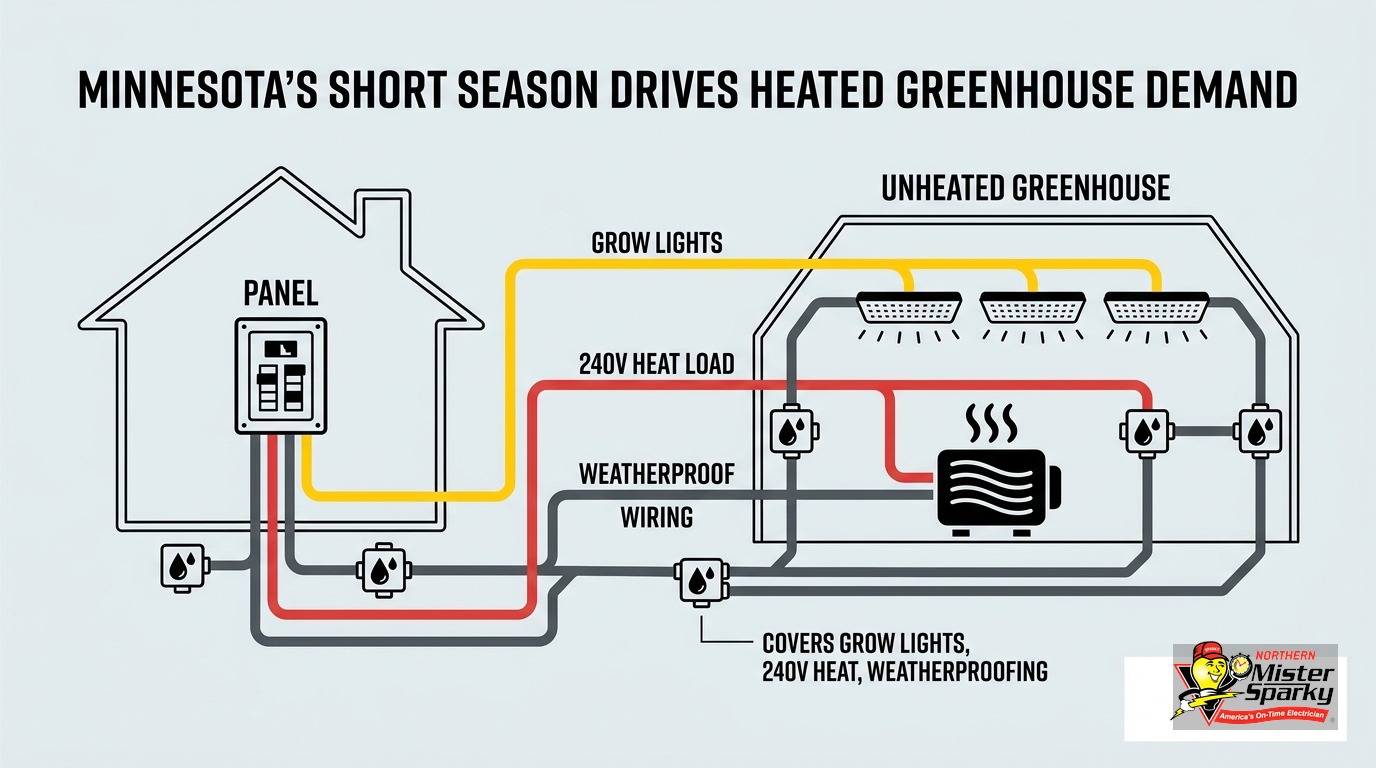
- A licensed electrical contractor must perform all detached greenhouse wiring in Minnesota. This is a permit-required job and is not legal as a DIY project.
- Romex (NM-B) is prohibited inside a greenhouse. Use THWN-2 conductors in PVC conduit, or UF-B cable for direct-burial runs.
- A 5,000W 240V heater needs a dedicated 30A, 240V circuit. A 20A breaker will not carry it continuously under the 80% rule.
- Keep heat and light circuits separate. Both run simultaneously during a cold Minnesota night, and a shared circuit will trip.
- NEC 210.20’s 80% continuous load rule governs circuit sizing. Run the math before you buy equipment.
- Every receptacle inside the greenhouse requires GFCI protection.
- Check panel capacity first. A full greenhouse setup adds up to 65A of new load.
Why Backyard Greenhouse Electrical Wiring in Minnesota Is a Different Project
Getting backyard greenhouse electrical wiring right in Minnesota starts with the calendar. The Twin Cities growing season runs about 140 frost-free days - roughly May 15 to October 1. For the other 225 days, your greenhouse needs electric heat, supplemental lighting, and wiring built for a damp, unheated structure.
Minneapolis sits in IECC Climate Zone 6A. The design heating temperature for MSP is well below freezing, per NOAA climate normals for the station. A greenhouse heater working against that load is not a 120V project with a few extra outlets. It is a 240V circuit, a dedicated 30A breaker, and a properly sized underground feeder run from your main panel.
Most online guides skip all of this. They show NM-B (Romex) stapled to greenhouse framing as if it is standard practice. They suggest running an extension cord for temporary heating. None of them cover Minnesota’s permit requirement, the 80% continuous load rule that actually sizes your breakers, or why Romex in a damp location is a code violation under NEC 2020 - the code Minnesota has adopted. This post covers all three.
Do You Need a Permit for Backyard Greenhouse Electrical Wiring in Minnesota?
Yes. Minnesota law requires a permit from the Department of Labor and Industry (DLI) for all electrical work in detached outbuildings. A licensed electrical contractor must pull the permit and do the work. Homeowners may only self-permit owner-occupied single-family homes and attached garages. A detached greenhouse is outside that exception, and there is no workaround.
Minnesota Stat. 326B.31 adopted the current edition of the NEC as the state electrical code. Every permanent electrical installation - including outbuildings - falls under it. The permit is not a technicality. It exists because wiring in unheated, damp structures carries real hazard, and the inspection process catches problems before they become fires.
Here is how the process works in the Twin Cities. Your electrician submits the permit application through DLI’s electrical contractors portal. DLI issues the permit number. Your local municipality (Minneapolis, Saint Paul, or your suburb’s building department) then schedules the rough-in and final inspections. Your electrician coordinates that timeline.
Skipping the permit creates real problems downstream. An unpermitted installation can void your homeowner’s insurance if a fire starts in the structure. It becomes an open permit issue when you sell the home. Retroactive permitting often costs more than doing it correctly the first time. Some inspectors require the work to be opened for visual inspection rather than simply signed off.
Hiring a licensed electrician handles the permit application, the code requirements, and the inspection scheduling in a single call.
Can You Use Romex Wire Inside a Greenhouse?
No. NM-B (Romex) is prohibited in wet or damp locations under the NEC, and a greenhouse qualifies as a damp location. All wiring inside must be THWN-2 conductors in PVC conduit, or UF-B cable for underground runs from the house. Every guide that shows Romex stapled to greenhouse framing is showing a code violation.
This is the most common error in DIY greenhouse wiring guides. The photos are persuasive because NM-B is cheap, familiar, and easy to run. But Romex jacket is not rated for prolonged damp exposure. Moisture wicks into the cable and the insulation degrades. The result is a shock hazard, a ground fault, or a fire.
Here is the correct approach by location:
- Inside the greenhouse: THWN-2 conductors in Schedule 40 PVC conduit (minimum). THWN-2 is listed for wet and damp locations. PVC conduit protects it from mechanical damage and from condensation. An unheated Minnesota greenhouse swings from near-ambient temperature at night to heated in the morning. That thermal cycling drives moisture into any material not rated for it.
- The underground run from house to greenhouse: Direct-buried UF-B cable is acceptable for short runs. PVC conduit with THWN-2 is also compliant and is the better long-term choice. Conduit lets you pull new conductors later without re-excavating.
- Outlet boxes and fittings: Every outlet box, junction box, and conduit body inside the greenhouse must be rated for wet locations. Gray PVC boxes with gasketed covers meet that requirement.
One more note on conduit entries. Where conduit penetrates from an underground run into your heated house, Minnesota’s State Energy Code (IECC Climate Zone 6A) requires air-sealing at electrical penetrations. Your electrician seals the conduit with an approved foam or caulk rated for that exposure. The same applies at the greenhouse entry point.
How Do You Size a Circuit for Your Greenhouse Heater?
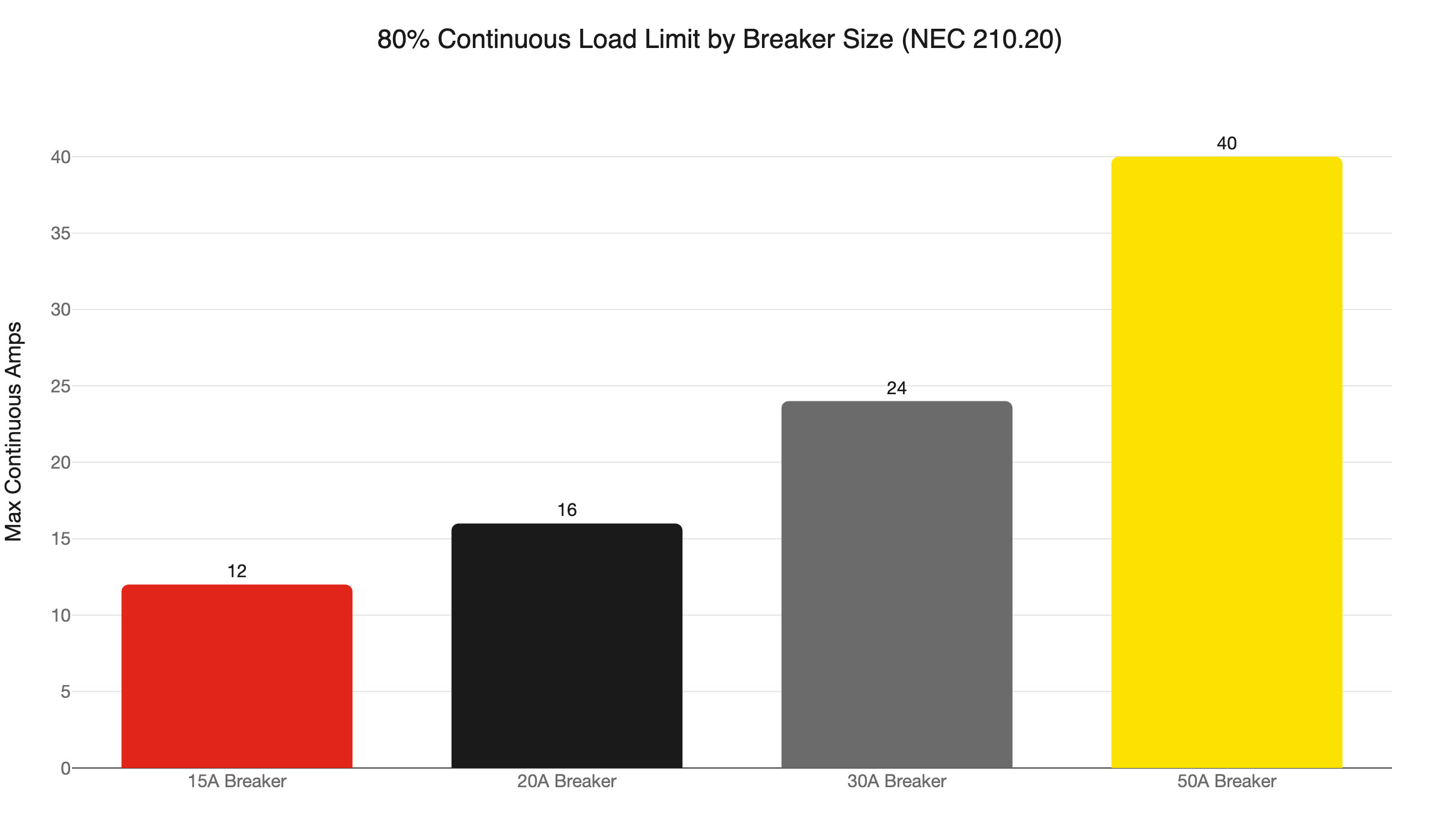
A 5,000W 240V heater draws 20.8A continuously. The NEC limits continuous loads to less than the breaker’s full rating. A 20A breaker maxes out at 16A of continuous draw. That 5,000W heater exceeds the limit on a 20A circuit and requires a dedicated 30A, 240V circuit.
Here is the calculation for any heater:
- Find the heater’s rated wattage.
- Divide by 240V to get amperage draw. A 5,000W heater: 5,000 / 240 = 20.8A.
- Divide that by 0.80 to get the minimum breaker size. 20.8 / 0.80 = 26A.
- Round up to the next standard breaker size. 26A rounds up to 30A.
A 10x12 hobby greenhouse in Climate Zone 6 typically needs a 3,000-5,000W heater. That range keeps interior temperatures at 40-50°F when outside air drops to -16°F. Most installations land on a dedicated 30A, 240V circuit. A larger greenhouse - 12x20 or bigger - may need a 4,000-6,000W heater. The same calculation yields the same answer: a 30A circuit.
Run the heater on a dedicated line. No shared loads. Greenhouse heaters cycle frequently on cold nights. Each time the heater ramps up to full draw, voltage on a shared circuit drops. Lights flicker. Timers reset. Anything sensitive to voltage sags can malfunction. A dedicated line eliminates that.
If your heater and grow lights can both run at 240V, your electrician may be able to source both circuits from a single subpanel run. That saves on underground conduit costs. Confirm the load math before combining anything on a shared feeder.
What Circuits Do Grow Lights Need?
It depends on fixture wattage and voltage. LED lights at 120V typically fit on one or two 20A circuits. HID fixtures need one 20A circuit per 1,000W fixture to stay within the 80% continuous rule. Running lights at 240V cuts amperage draw in half and allows more fixtures per circuit.
LED grow lights at 120V:
Four 200W fixtures draw 6.7A total. Well inside the 16A continuous limit on a 20A breaker. Four 400W fixtures draw 13.3A total. That is close to the limit. If you plan to add fixtures later, run a second 20A circuit now rather than loading one circuit near its continuous ceiling. See our post on grow light electrical requirements for your home for fixture-by-fixture amperage numbers.
LED grow lights at 240V:
A 600W 240V fixture draws 2.5A. Six fixtures total 15A, inside the 16A continuous limit on a 20A, 240V circuit. If your heater circuit already runs at 240V, your electrician may be able to source the grow light circuit from the same subpanel run and avoid a second underground feeder.
HID fixtures (HPS, metal halide):
A 1,000W HPS with ballast draws about 9.5A at 120V. Two on one 20A circuit hit 19A, a continuous load violation. Dedicate one 20A circuit per 1,000W HID fixture, or run both fixtures on a 30A circuit after verifying the load math.
Seedling heat mats:
A standard heat mat runs 40-120W and draws under 1A. Six heat mats on a seed-starting bench draw less than 2A total. A single dedicated 15A GFCI-protected circuit handles the whole bench with plenty of headroom.
Keep heat circuits and light circuits on separate breakers. Both run simultaneously on cold Minnesota nights. A combined circuit will exceed its 80% continuous limit when both loads are running. The breaker trips, the heater shuts off, and seedlings sit in a freezing structure overnight.
How Deep Does the Underground Feed to Your Greenhouse Need to Be?
PVC conduit must be buried to the minimum required depth under the NEC. Direct-buried UF-B cable requires 18 inches. Rigid metal conduit under a concrete slab needs only 6 inches. In the Twin Cities, 24 inches in PVC conduit is the standard for a greenhouse feed. It provides mechanical protection and makes future circuit additions possible without re-digging.
The NEC burial depth and the frost depth are separate requirements. Twin Cities frost depth runs 42-48 inches, but that is a standard for water lines. Conduit is not damaged by frozen soil. You meet the NEC minimum, not the frost depth.
When your electrician runs the trench, ask them to install a pull string (draw string) inside the conduit before backfilling. It costs nearly nothing at installation time. If you later want to add circuits or increase the feeder size, that string lets you pull new conductors without a full re-excavation. On a long run, that is several hundred dollars saved.
At both ends of the run, sealing matters. Where the conduit enters your heated home from underground, Minnesota’s energy code (IECC Climate Zone 6A) requires air-sealing at electrical penetrations. Your electrician will seal the conduit body with approved foam or caulk. The greenhouse entry point gets the same treatment.
For a larger greenhouse that needs a dedicated subpanel - a 60A or 100A feed rather than individual circuit runs - see our post on detached garage subpanel installation. The conduit, burial depth, and feeder sizing process is the same on any detached structure.
Does Your Existing Panel Have Enough Room for Greenhouse Circuits?
A basic greenhouse electrical setup - a 30A 240V heater circuit, a 20A 120V light circuit, and a 15A 120V receptacle circuit - adds 65A of new load. Many Twin Cities homes built before 1980 have 100A service. A panel running a furnace, water heater, kitchen circuits, and a dryer may not have 65A of spare capacity for a new outbuilding.
Check panel capacity before you plan circuits or order equipment. Your electrician will run a home electrical load calculation before pulling the permit. That calculation shows what the panel can actually support.
If the load calculation shows insufficient capacity, there are two paths:
- Upgrade to 200A service. This is the right long-term move for a home that also needs room for EV charging or other future loads. Our post on signs you need an electrical panel upgrade walks through the indicators in detail.
- Install a subpanel in the greenhouse. A 60A subpanel fed from the main panel consolidates all greenhouse circuits in one place. This works when the main panel has room for one large feeder breaker but not three individual circuits.
Xcel Energy, the primary provider in the Minneapolis metro, offers rebates through their Home Energy Improvement program. A panel upgrade triggered by a greenhouse installation may qualify. Confirm current eligibility and rebate amounts at xcelenergy.com before the project begins. Program terms change, so verify before counting on any specific dollar amount.
The No-Malarky Version of What Can Go Wrong
Most electrical failures in greenhouse wiring trace back to three decisions:
1. Romex in a damp location. NM-B jacket degrades under sustained moisture exposure. The insulation breaks down and the conductors corrode. The fault you get is a shock hazard or a fire. If you have an older greenhouse with Romex still in place, that wiring needs to come out and be replaced with the correct materials.
2. Combining heat and light on one circuit. At -10°F, your heater runs at full draw and your grow lights are also on. One 20A circuit cannot carry both loads continuously within the 80% rule. The breaker trips, the heater shuts off, and the structure drops to outside temperature. Anything that needed warmth overnight does not survive.
3. Sizing for peak draw instead of continuous draw. A 2,000W 120V heater draws 16.7A. A 20A breaker looks like it fits - barely. But NEC 210.20 limits continuous loads to 16A on a 20A circuit. That half-amp gap means the breaker runs at its limit, trips earlier than expected, and wears out faster. Size for the continuous rule, not the nameplate.
All three mistakes appear in older permitted installations done under earlier code cycles, not just in DIY work. If your greenhouse has existing wiring, ask a licensed electrician to inspect it before you add new loads.
Ready to Wire Your Minnesota Greenhouse? Call Northern Mister Sparky.
Backyard greenhouse electrical wiring in Minnesota is a permitted, licensed-electrician job. The permit protects your insurance. The licensed electrician protects the work. The inspection confirms both.
Our team is locally owned and operated in the Twin Cities. We know the DLI permit process, the load math for Minnesota winters, and the conduit details that matter when you are running a feeder through clay soil to a detached structure. As America’s On-Time Electrician(R), we back every job with the UWIN(R) 100% satisfaction guarantee.
If the project includes a panel upgrade, we can walk you through financing options to spread the cost. Call 763-200-5956 or book online to schedule your estimate.
Frequently Asked Questions
Can I wire my own backyard greenhouse in Minnesota? +
What size circuit does a greenhouse heater need? +
Can I use regular Romex wire inside a greenhouse? +
Do greenhouse outlets need to be GFCI protected? +
How deep does underground wiring to a greenhouse need to be buried? +
Need an electrician now?