
Backyard Ice Rink Electrical Requirements Minnesota
Key Takeaways
- Every backyard ice rink in Minnesota needs at least two dedicated circuits: one for the flood pump and one for lighting.
- All outdoor receptacles require GFCI protection under NEC 210.8. Minnesota enforces the 2026 NEC as of August 17, 2026.
- A typical 1/2 HP submersible flood pump draws 6A at 120V. A 20A dedicated circuit is the correct size under NEC 430.22.
- Pre-2010 GFCI outlets can nuisance-trip in sub-zero temperatures. Use devices rated to -35°F for outdoor Minnesota use.
- Any new circuit or outlet requires a Minnesota electrical permit. Minneapolis and St. Paul permit independently of DLI.
- Call Northern Mister Sparky at 763-200-5956 before the ground freezes.
What Are the Backyard Ice Rink Electrical Requirements in Minnesota?
Every fall, Twin Cities homeowners start planning their backyard rink. The conversations cover boards, liner material, flooding technique, and ice thickness. Almost nobody talks about the electrical side - and that gap is a real problem.
The backyard ice rink electrical requirements in Minnesota are specific. A pump running near water without GFCI protection is a shock hazard. An overloaded circuit during peak winter load can trip a breaker at the worst possible moment. An unpermitted circuit can surface as a problem when you sell the house.
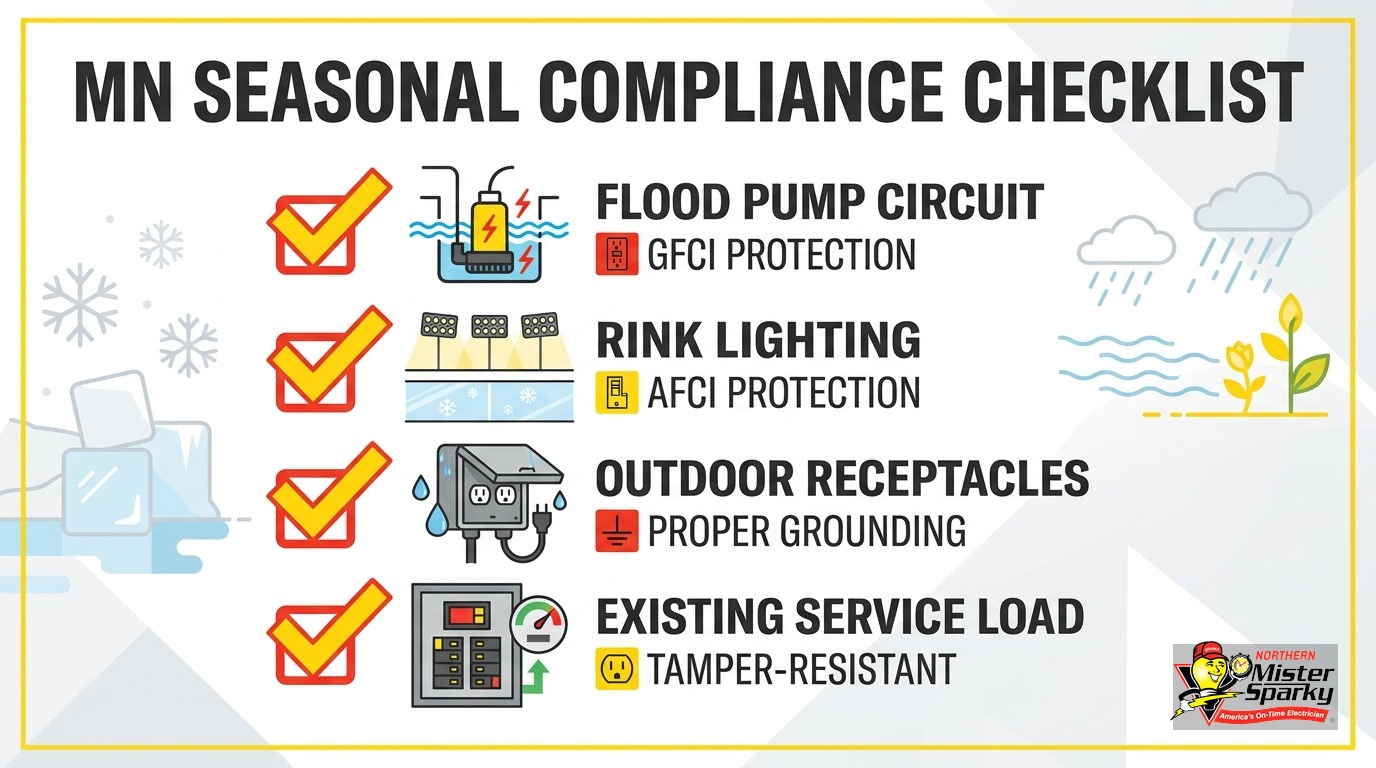
No rink installer, rink-kit retailer, or generic electrician guide has written the full answer. This is it. Four topics: flood pump circuit sizing, rink lighting wiring, GFCI protection at outdoor wet locations, and load on your existing service. Get these right and the electrical side of your rink is solid.
Do You Need a Dedicated Circuit for a Flood Pump?
Short answer: Yes. NEC 430.22 requires a branch circuit rated at 125% of the pump’s full-load current. A typical 1/2 HP submersible flood pump draws 6A at 120V. At 125%, the minimum circuit rating is 7.5A. A 20A dedicated circuit is the correct call - 15A leaves no real headroom.
A flood pump is a motor load. Motor loads behave differently from resistive loads like heaters or lights. Motors draw start-up (inrush) current that can run two to six times their steady-state draw. The NEC 125% rule for motor branch circuits accounts for that starting surge. It also accounts for sustained heat buildup during a long flooding session on a cold January night.
The math is straightforward. A 1/2 HP pump at 6A times 1.25 equals 7.5A minimum. The next standard breaker size up is 20A. That headroom matters. On a cold night, the pump may run for an hour straight to lay down a fresh inch of ice.
A 15A circuit might look like plenty on paper. In practice, it leaves almost no margin for starting current. It gives you no room if you ever want to run a second pump or a heat lamp at the same outlet. Start with a 20A dedicated circuit.
The pump also operates at or near ice and water. That makes the outlet a wet-location outdoor receptacle. GFCI protection is required by NEC 210.8. Keep the pump on its own circuit, separate from lighting. If the pump circuit’s GFCI trips, your lights should stay on.
How Does GFCI Protection Work at an Outdoor Rink Outlet?
Short answer: NEC 210.8 requires GFCI protection on every outdoor receptacle at a residential location. You can use a GFCI outlet at the box or a GFCI breaker protecting the whole circuit. Either option satisfies the code.
A GFCI detects leakage current as small as 5 milliamps and cuts power in under 1/40 of a second. At a backyard rink, that leakage path could run through a person standing on wet ice while handling a pump cord. The GFCI is what keeps that from becoming a fatality.
The outlet hardware matters too. Standard flip-cap weatherproof covers are not code-compliant for new outdoor outlets at open, unroofed locations. Since the 2014 NEC, in-use (bubble) covers are required at those locations. An in-use cover maintains protection while a cord is plugged in. A standard flip cover leaves the outlet exposed the moment you connect the pump.
The outlet box must be weatherproof. The receptacle must be weather-resistant and tamper-resistant, designated TR/WR, per NEC 406.9. That is the full spec for any new outdoor outlet in Minnesota.
For an existing outdoor outlet you plan to use for a rink, check three things:
- The outlet tests as GFCI-protected. Press Test to verify it trips, then press Reset to verify it resets.
- It has an in-use bubble cover, not a standard flip cap.
- It is on a circuit sized for the pump’s starting current load.
If any of those are not in place, see our GFCI outlet requirements guide or call us before rink season starts.
Will Cold Minnesota Temperatures Trip My GFCI?
Short answer: Modern GFCI devices rated to -35°F handle Minnesota winters without nuisance tripping. Pre-2010 units are the known problem. If your outdoor GFCI trips in extreme cold with no fault present, replace the device - do not bypass it.
Rink season peaks in January and February, exactly when temperatures drop below zero. Older GFCI outlets used components that became sensitive to temperature extremes. In single-digit or sub-zero conditions, those units can trip on their own with no actual ground fault on the circuit.
The Minnesota DLI publishes a technical bulletin on circuit breaker performance in low ambient temperatures. The practical takeaway: current-generation GFCI devices are designed and rated for full Minnesota winters. Pre-2010 units are not.
If an outdoor GFCI outlet was installed before 2010, replace it with a current TR/WR-rated device before you depend on it for a rink pump. That is typically a short repair visit. It eliminates the nuisance trip problem for the whole season.
A nuisance trip in the middle of the night is an inconvenience. A fault with no GFCI protection is an emergency. Never swap a GFCI for a standard outlet because it trips in the cold. Diagnose the cause first, then fix the right thing.
How Should Rink Lighting Be Wired?
Short answer: Low-voltage (12V) rink lights plug into a GFCI outlet and require no permit on the 12V side. Line-voltage (120V) lights need a dedicated circuit, direct-burial cable in conduit, a permit, and a licensed electrician. Keep the lighting circuit separate from the pump circuit.
Skating after dark means lighting. Most homeowners choose between plug-in low-voltage LED setups and hardwired line-voltage flood lights. The electrical requirements are very different, and choosing the right option depends on your budget and how seriously you want to build it out.
Low-voltage (12V) rink lights
Low-voltage LED rink lights run on a step-down transformer that plugs into a standard GFCI outlet. The 12V side of the system carries minimal code regulation. No electrical permit is required for the 12V wiring itself.
The transformer still draws 120V current at the outlet. Four low-voltage LED rink lights typically draw well under 1A on the 120V side. Any outdoor GFCI outlet handles that load. The outlet must still meet the GFCI, TR/WR, and in-use cover requirements described above.
Low-voltage is the right starting point for most homeowners. Lower upfront cost, no permit, and it is fully plug-and-play.
Line-voltage (120V) rink lights
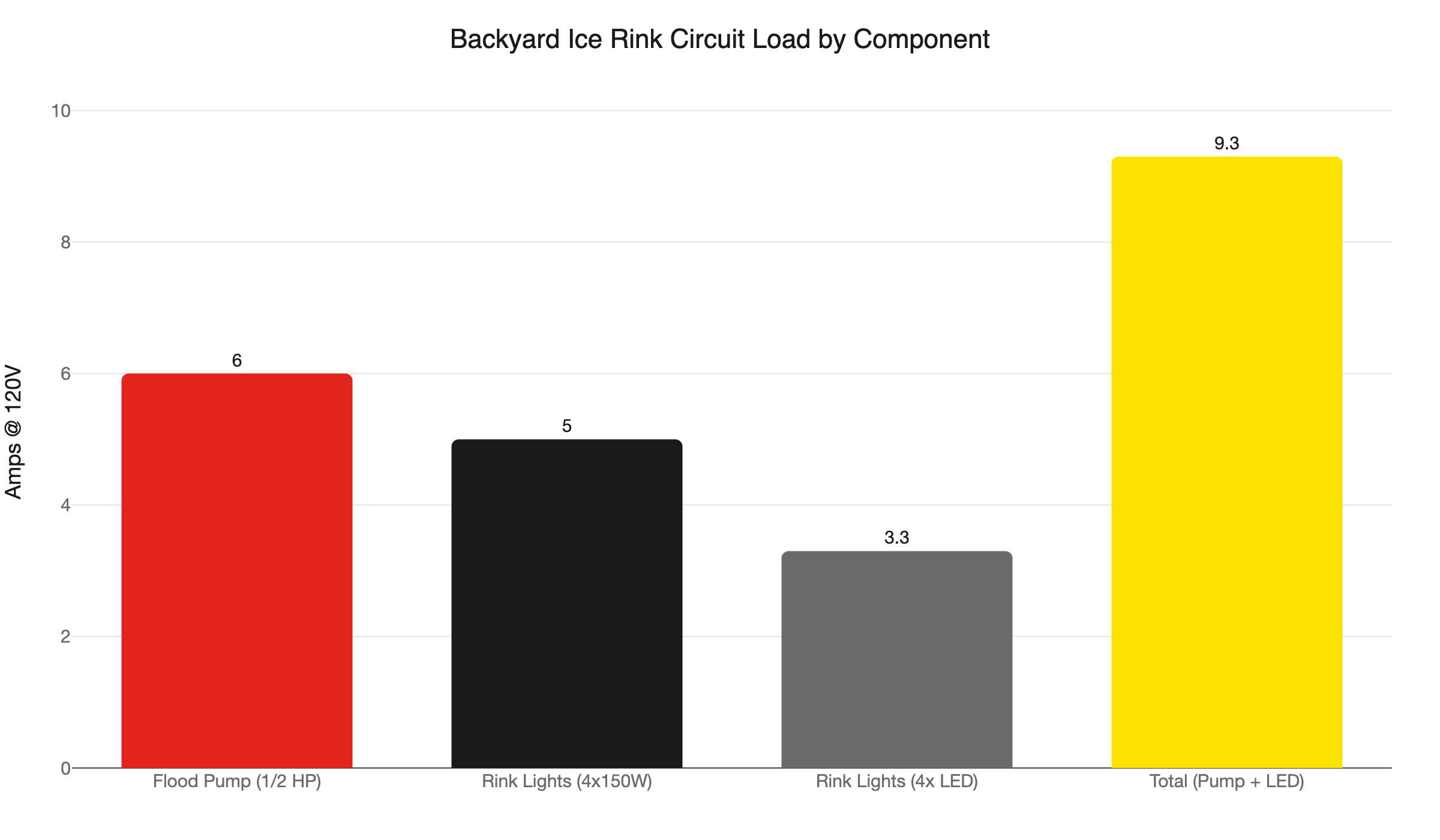
Hardwired 120V flood-style lights draw more current and require proper permanent wiring. Four 150W fixtures equal 600W, or about 5A at 120V. Four LED equivalents at 100W each draw roughly 3.3A. A 15A circuit handles either load with room to spare.
The installation requires an electrical permit, a licensed electrician, and direct-burial cable run in conduit. Burial depth for line-voltage cable runs 12 to 18 inches depending on wiring method. See the burial depth section below for the full code details.
Whichever lighting type you choose, keep it on a circuit that is independent from the pump. A tripped GFCI on the pump circuit should not also take out your lights. Independent circuits mean independent failure modes.
Will My Existing Service Handle the Added Rink Load?
Short answer: A typical rink setup adds roughly 9 to 10 amps of new load. Many Twin Cities homes built before 1970 have 100A service. Combined with winter furnace, water heater, and holiday lighting loads, that addition can push a 100A panel to its practical limit.
Rink season and peak household electrical load season are the same season. November through March brings longer nights (more hours of rink lights running), lower temperatures (furnace cycling more), and holiday appliances. The rink adds to that stack - it does not run when the panel is idle.
A rough load estimate for a typical backyard rink setup:
- Flood pump (1/2 HP, running): 6A at 120V
- Rink lighting (4 LED equivalents): 3.3A at 120V
- Combined new rink load: approximately 9.3A
For a 200A service, that addition is easy to absorb. For a 100A service already carrying a furnace blower, electric water heater, and full household base load, 9.3A of new winter demand is worth evaluating carefully. NEC 220.83 provides the optional load calculation method for additions to existing service. We run that calculation before pulling wire on any new circuit.
If you have a 100A panel and are stacking a rink, an EV charger, and other upgrades this winter, the panel upgrade conversation is worth having now rather than after a tripped main. Read our full breakdown of 100-amp vs. 200-amp electrical service to understand when the upgrade math tips in favor of the bigger service.
How Deep Does Underground Cable Need to Be Buried in Minnesota?
Short answer: A GFCI-protected 120V branch circuit at 20A requires at least 12 inches of cover per NEC Table 300.5. Minnesota’s freeze-thaw cycles add a second requirement: expansion capability in direct-buried runs under NEC 300.5.
Running a circuit from the panel to a backyard rink outlet usually means trenching through the yard. Minimum burial depth depends on voltage class, wiring method, and whether a GFCI device protects the circuit at its source.
For a standard GFCI-protected 20A residential branch circuit at 120V, 12 inches of cover is the minimum. Non-GFCI circuits at the same voltage require 24 inches. The GFCI protection at source earns you the reduced burial depth. That is one practical reason to use a GFCI breaker at the panel rather than a GFCI outlet at the end of a long buried run.
Minnesota’s frost line creates a concern that most code summaries skip. The ground freezes and thaws multiple times each winter. That movement can shift and stress direct-buried cable. NEC 300.5 requires expansion fittings or adequate slack in direct-buried runs to accommodate ground movement. In Minnesota, this is not a code formality - it is a real-world concern.
Running cable in PVC conduit costs a bit more upfront. It makes future access and modifications easier. It adds physical protection against frost heave and against any future digging. For a rink circuit that may be extended or modified over the years, conduit is worth the investment.
See our dedicated post on underground electrical wire depth in Minnesota for the complete breakdown by wiring method and voltage class.
Do You Need an Electrical Permit for a Backyard Ice Rink in Minnesota?
Short answer: Yes. Any new circuit or outlet in Minnesota requires an electrical permit, separate from any building permit. Permit fees typically run $50-100 depending on the city. Skipping the permit can create real problems at sale time.
The permit question comes up on almost every outdoor project. The answer is consistent: yes, you need one.
Minnesota requires an electrical permit for any new circuit installation. Running a 20A circuit from the panel to the backyard for the flood pump is new work. Installing a new outdoor outlet is new work. Both require a permit before any wire is pulled.
The permit triggers an inspection. The inspector verifies that the work meets the 2026 NEC (in effect for all permits pulled on or after August 17, 2026), that burial depths are correct, that GFCI devices are properly installed, and that the circuit is correctly sized. That inspection is a protection for you, not a bureaucratic hurdle.
Unpermitted electrical work shows up on home inspection reports. Buyers flag it. Lenders flag it. Remediation after the fact typically costs more than the permit and inspection would have. A $75 permit pulled upfront is the right call every time.
See our post on electrical permits in Minnesota for more on the process, including how to verify your permit status before a home sale closes.
Minneapolis and St. Paul: A Note on Independent Permit Authority
Minneapolis and St. Paul do not use the state DLI permit system. Homeowners and contractors in those cities must apply for electrical permits through their city’s own permit department, not through DLI.
For the rest of the Twin Cities metro - Bloomington, Brooklyn Park, Woodbury, Blaine, Maple Grove, Plymouth, and surrounding communities - permits go through the Minnesota Department of Labor and Industry.
Northern Mister Sparky serves both cities and the broader metro. We handle the permit paperwork as part of the job. You do not have to navigate the permit system on your own.
Get the Rink Right Before the Ice Sets
The backyard ice rink electrical requirements in Minnesota come down to a clear checklist. Two dedicated circuits. GFCI protection on every outdoor outlet. In-use bubble covers. Proper burial depth. A permit pulled before work starts. Handle those five things and the electrical side of your rink is solid for years.
What makes it worth doing right is the payoff: kids skating safely under proper lights on a February night when the thermometer reads single digits, a setup that passes inspection, and wiring that does not resurface as a problem when you sell. No malarky.
Northern Mister Sparky is locally owned and operated in the Twin Cities. We handle outdoor circuit work across the metro - from decks and docks to generators and rinks. We are America’s On-Time Electrician(R), and every job is backed by the UWIN(R) 100% satisfaction guarantee.
Call us at 763-200-5956 or book online before the frost goes deep. Once the ground is frozen solid, trenching for cable becomes an expensive problem. Let us get your circuits right while the ground is still workable.
Frequently Asked Questions
Do I need a dedicated circuit for a backyard ice rink flood pump? +
Does a backyard rink outlet need GFCI protection in Minnesota? +
Do you need an electrical permit for a backyard rink circuit in Minnesota? +
Need an electrician now?