
Outdoor Projector Power for Your Backyard: A Wiring Guide
Key Takeaways
- A typical backyard theater setup draws 400-600W. That includes a projector, speakers, string lights, and a charging hub.
- A shared 15A circuit can handle that load on paper. In practice, interior devices on the same circuit often cause it to trip mid-movie.
- One 20A dedicated outdoor circuit meets the code minimum for a new entertainment area. Two circuits is the practical plan for any backyard where cooking, tools, and AV run at the same time.
- NEC 210.8(A) requires GFCI protection on every outdoor receptacle at a dwelling unit - no exceptions for low-wattage loads or seasonal use.
- An open, unroofed yard is a wet location under code. The outlet must carry WR and TR markings and sit behind an extra-duty in-use cover.
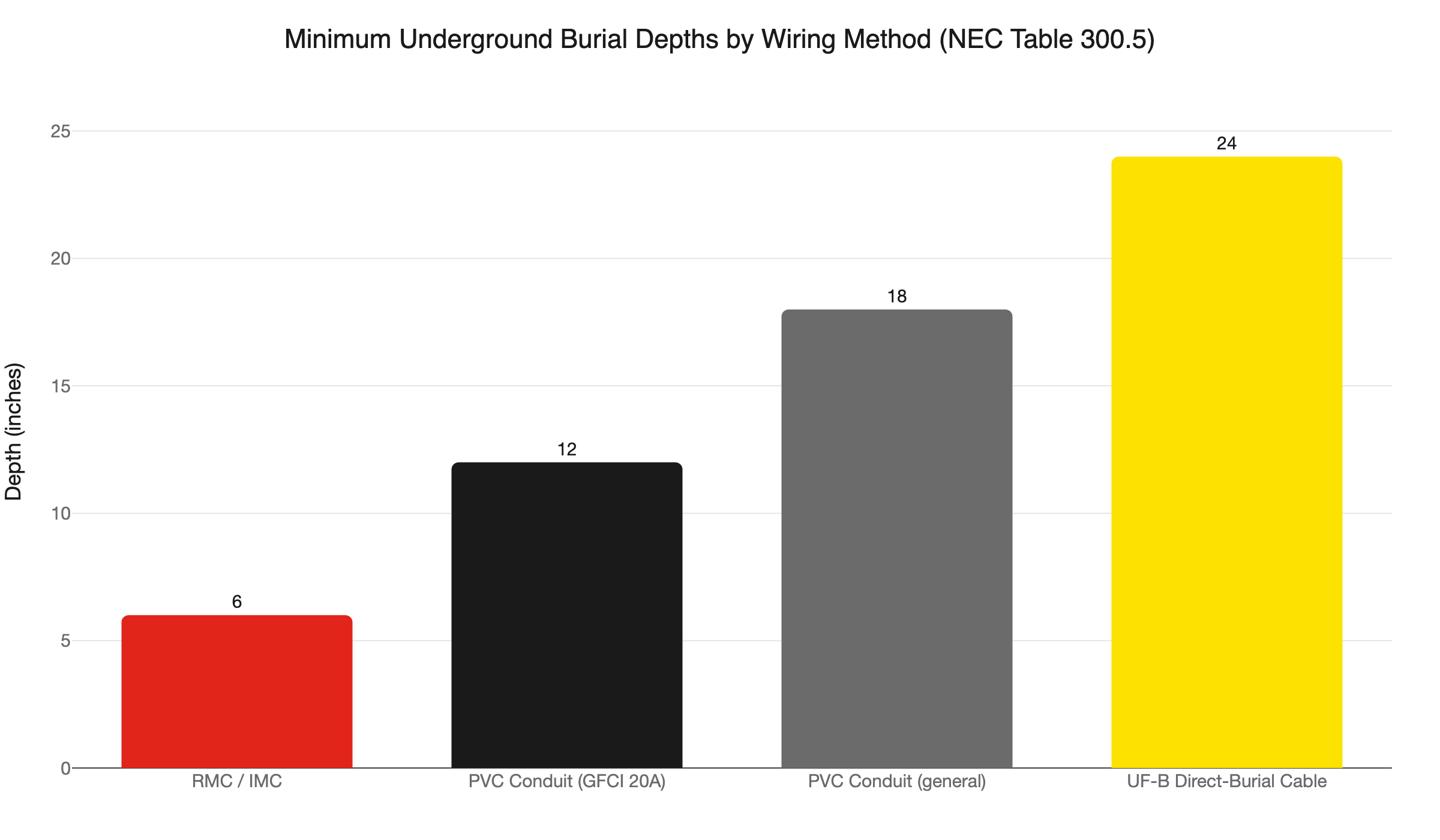
- Burial depth depends on the wiring method: 12 inches for GFCI-protected PVC conduit on a 20A circuit, 18 inches for general PVC, and 24 inches for direct-burial cable.
- Minnesota requires an electrical permit and a rough-in inspection before any wiring is concealed.
- A hard-wired outlet near the screen eliminates voltage drop, removes the trip hazard, and is the only permanent, code-compliant answer.
What Does a Backyard Theater Setup Actually Draw?
A projector, speakers, string lights, and a charging hub together draw roughly 400-600W. That load fits on a 15A circuit in isolation, but the circuit rarely runs in isolation. Interior devices sharing the same circuit can push the combined draw over the breaker limit mid-movie.
A mid-range outdoor projector draws approximately 200W. Add a pair of outdoor speakers at 30-60W, a string of LED lights, and a USB charging hub. That puts you at 400-600W before anything else plugs in.
On a standard 15A/120V circuit, the practical continuous limit is 1,440W - 80% of the 1,800W rated maximum. The math looks comfortable.
The catch is what else shares that circuit. In most homes, the nearest outdoor receptacle is on a circuit that also feeds interior outlets. A refrigerator cycling on or a kitchen appliance running can push the combined draw close to the limit. Add a warm summer evening with multiple outdoor loads and the breaker trips.
The fix is a circuit dedicated to the outdoor theater area. Nothing else shares it. No surprises mid-movie.
Why Extension Cords and Shared Circuits Fall Short
Extension cords are the first instinct when the outlet is not near the screen. They work as a short-term bridge. They are not a reliable or safe long-term solution.
A 50-foot cord in 16-gauge wire causes measurable voltage drop that produces projector flickering and audio dropouts. Sensitive electronics notice when supply voltage falls below spec. The projector may dim unexpectedly or trigger a protection shutdown. Audio cuts out. The picture stutters.
A 12-gauge outdoor-rated extension cord kept under 50 feet reduces the drop, but does not eliminate it. Cords laid across a yard are a fall hazard for anyone walking after dark. Sunlight and moisture degrade the jacket over a Minnesota summer. Most outdoor extension cords are rated for occasional temporary use, not seasonal continuous service.
Every Minnesota winter puts another freeze-thaw cycle on a cord left outdoors. The insulation cracks. Connection points corrode. What worked in June may be a shock hazard by the following May.
A dedicated circuit with an outlet located near the screen solves all of these problems at once. Our guide on extension cord hazards and when to add a permanent outlet explains why relying on cords long-term is a problem worth fixing properly.
What Does Code Require for Outdoor Outlets?
Every outdoor receptacle at a dwelling unit must have GFCI protection. That is NEC 210.8(A), with no exceptions for low-wattage loads or seasonal use. An open, unroofed yard is classified as a wet location, which adds outlet device and cover requirements on top of GFCI.
NEC 210.8(A) is unambiguous: GFCI protection is required for all outdoor receptacles at dwelling units. Ground-fault protection interrupts the circuit in milliseconds when it detects current imbalance. It prevents serious shock in wet conditions - exactly the outdoor theater scenario on a humid summer evening.
Beyond GFCI, NEC 406.9 governs the device and enclosure. Open, unroofed yard locations are wet locations under that section. A wet-location outlet requires:
- A receptacle device listed and marked for wet locations.
- An in-use cover listed as extra-duty, which stays weatherproof with a cord inserted.
- Proper mounting in a weatherproof box.
A covered porch changes the classification to damp location. A damp location allows a standard spring-loaded flip cap, but only when nothing is plugged in. Plug in the projector under a standard flip cover in a wet location and you are out of compliance.
Minnesota adopted the 2026 NEC effective August 17, 2026. Permits filed on or after that date follow 2026 NEC rules.
What Kind of Outlet Do You Need in a Wet-Location Yard?
The receptacle must be stamped “WR TR” on the device face. WR is weather-resistant; TR is tamper-resistant. These are two separate NEC requirements - 406.9 and 406.12 - combined in a single device. A WR-only outlet fails the tamper-resistant requirement, and a TR-only outlet is not rated for wet locations.
This is a common installation mistake. People treat “weatherproof” as a single marking when the code tracks WR and TR separately. A standard indoor TR outlet installed inside a weatherproof enclosure does not satisfy the WR requirement. The device body itself must carry both stamps.
NEC 406.9 also specifies the distinction between wet and damp location covers. An extra-duty in-use cover must remain weatherproof with the cord inserted and the projector running. That is a different product than the standard flip-cap sold at most hardware stores, and the difference matters during a three-hour movie on a humid August night.
The full assembly for a compliant wet-location backyard outlet:
- A WR TR receptacle.
- GFCI protection, either from a GFCI receptacle or a GFCI breaker upstream.
- An extra-duty in-use cover box, deep enough to close fully with the cord inserted.
- Weatherproof conduit fittings at every entry to the box.
Our outdoor GFCI outlet installation guide walks through device selection and cover assembly in detail.
How Deep Does Underground Conduit Need to Go?
Depth depends on the wiring method. PVC conduit on a GFCI-protected 20A circuit can go as shallow as 12 inches. General PVC conduit requires 18 inches. Direct-burial UF-B cable requires 24 inches. Rigid metal conduit can go as shallow as 6 inches.
NEC Table 300.5 sets the minimums based on wiring method, circuit voltage, and GFCI protection status. For a typical 120V/20A backyard theater circuit in Schedule 40 PVC conduit with GFCI protection upstream, 12 inches is the code minimum. A flat spade and an afternoon, or a half-day rental of a walk-behind trencher, gets the trench done at that depth.
Direct-burial UF-B cable at 24 inches is substantially more digging. It also offers no protection against a future shovel strike. PVC conduit is almost always the better choice. You can pull new wire later without reopening the trench.
For details on how Minnesota frost depth and soil conditions affect the installation decision, see our underground electrical wire depth guide for Minnesota.
How Does Conduit Get from Your House to the Screen?
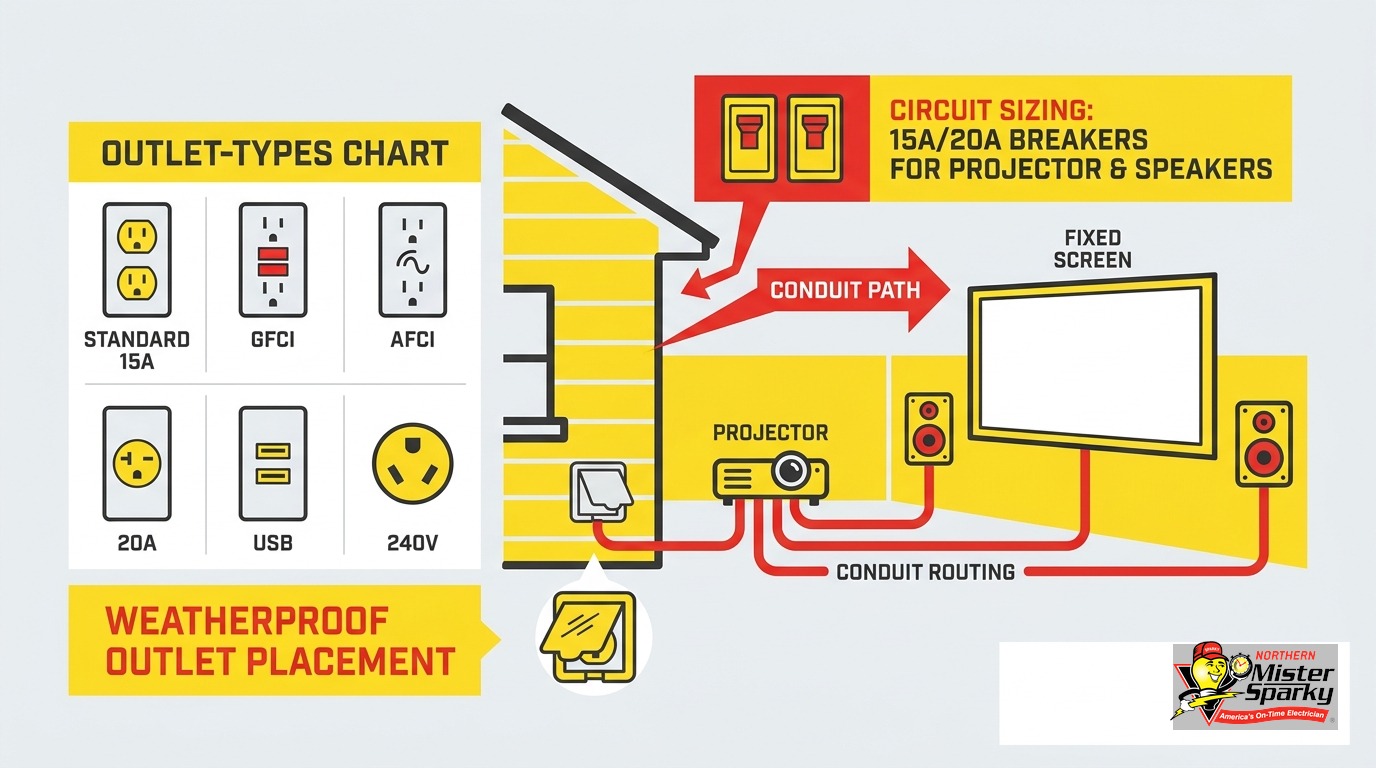
Conduit takes four paths: from the panel to the exterior wall, through the wall to outside, underground in a trench at the code-required depth, and up a protected riser to the outlet near the screen. Each segment has its own code requirement and inspection point.
Routing conduit across a backyard is methodical work. Here is what each segment involves.
Panel to exterior wall. The circuit starts at the main panel or a subpanel and runs to the exit point. A 20A circuit requires 12-gauge wire throughout. Do not step down to 14-gauge anywhere in the run, even for a short interior segment.
Exterior wall penetration. The conduit passes through the rim joist or band joist. A weatherproof LB conduit body and exterior caulk seal the penetration. The caulk line matters: moisture wicking into the wall cavity causes rot over time, and a poorly sealed penetration is a common callback.
Below-grade trench. Schedule 40 PVC conduit runs underground at the required depth. Solvent-weld every joint carefully. Minnesota freeze-thaw cycles work on poorly sealed fittings year after year. Backfill in layers and tamp gently to prevent settling that shifts the conduit.
Above-grade riser at the outlet end. NEC 300.5(D) requires physical protection from damage up to 8 feet above grade where conduit exits the ground. Schedule 80 PVC is the standard choice for the exposed riser in Minnesota. Schedule 40 PVC cracks at the grade transition after a few freeze-thaw cycles. Rigid metal conduit (RMC) is an alternative: harder to clip with a lawn mower and more durable at the grade line, though it costs more.
The outlet box mounts at the top of the riser. A weatherproof deep-hood in-use cover finishes the assembly. Position the box high enough to keep the cord off the ground but low enough to reach without a step ladder.
Do You Need a Permit for a New Outdoor Outlet?
Yes. Minnesota requires an electrical permit for any new circuit and for any extension of an existing circuit to a new outlet. A rough-in inspection must happen before the trench is backfilled or any wiring is concealed. Skipping the permit creates problems at resale and can affect coverage on a homeowner’s insurance claim.
The permit process in most Twin Cities suburbs works like this: apply with DLI or the local building department, receive the permit (typically within a few business days), complete the rough-in, schedule the inspection, pass, then backfill and close. The inspector checks conduit depth, GFCI protection, device markings, and cover type. Everything must be accessible and visible at the rough-in stage.
Minneapolis, St. Paul, Plymouth, and Maple Grove operate their own permit departments with separate inspection schedules. Minneapolis and St. Paul also restrict homeowner self-permitting on circuit-level work more tightly than outstate Minnesota. In those cities, a licensed electrical contractor is typically required for any new circuit work.
The electrical permit is separate from any deck or landscaping permit you may already have. If a new patio, pergola, or fence post is part of the project, both permits may be required.
One more thing: the outdoor theater use case is seasonal in Minnesota - May through September in a normal year. The wiring is permanent. That permit and inspection record stays with the property. Home inspectors look for unpermitted electrical work at every sale.
How Many Circuits Does a Backyard Theater Actually Need?
One 20A dedicated outdoor circuit meets the code minimum for a new outdoor entertainment area. Two circuits is the practical answer for any backyard where cooking, power tools, and AV run simultaneously. Roughing in the second conduit run during the initial install costs far less than reopening a trench later.
Think in load groups:
High-draw circuit (20A). Projector, powered outdoor speakers, a charging hub. These loads cannot share a breaker with anything else. A tripped breaker mid-movie is the whole problem you are trying to solve.
Ambient circuit (15A or 20A). String lights, pathway lighting, a small outdoor refrigerator or cooler. These run at low, steady draw all evening without spiking.
Two circuits also leave room for future additions. An outdoor kitchen, a landscape lighting transformer, a ceiling fan on a pergola - all of those need power. Planning for two circuits now avoids a second trench and a second permit next summer.
Wire gauge follows breaker size throughout the entire run. A 20A circuit requires 12-gauge wire from panel to outlet, with no exceptions for short runs or interior segments.
The Permanent Fix: A Hard-Wired Outlet at the Screen
Every workaround is still a workaround. A long extension cord, a battery pack, a shared outdoor outlet on the far side of the deck - each one introduces a failure point. Voltage drop, a tripped breaker, a dead battery, a cord stretched across the yard in the dark. These are not edge cases. They happen on the first warm movie night of summer.
The permanent solution is a GFCI-protected, WR TR-rated outlet on a dedicated 20A circuit, routed via conduit at the correct burial depth, placed within reach of the projector cord at the screen. Nothing trips. Nothing flickers. No cord cuts across the yard. No worrying about battery life during the third act.
This is a standard outdoor electrical installation. It is not a specialty upgrade. It is what a correctly installed outdoor theater looks like. The work is permitted, inspected, and on record with the property. It matters at resale, and it matters the next time you have guests over for a Friday night film.
As America’s On-Time Electrician(R), Northern Mister Sparky is locally owned and operated across the Twin Cities - Minneapolis, St. Paul, Bloomington, Brooklyn Park, Woodbury, Blaine, Maple Grove, Plymouth, and the surrounding suburbs. We show up when we say we will, every time. No malarky. Every job is backed by the UWIN(R) 100% satisfaction guarantee.
Ready to Set Up Your Backyard Theater Right?
Call 763-200-5956 or book online to schedule an outdoor circuit installation. We will assess your panel capacity, plan your circuit layout, pull the permit, and have your backyard theater powered correctly before the next good movie night.
Frequently Asked Questions
Do I need a permit to add an outdoor outlet in Minnesota? +
What kind of outlet do I need for an outdoor projector in my backyard? +
Can I run a long extension cord to my outdoor projector? +
Need an electrician now?