
Central Vacuum System Electrical Wiring: Twin Cities Guide
Key Takeaways
- A central vacuum system has two separate electrical systems: a 120V motor circuit and a 24V inlet valve signal circuit.
- Most residential units draw 10-15A and require a dedicated 15A or 20A circuit under NEC §422.15.
- Adding a new dedicated circuit is permitted work in Minnesota. A licensed electrician must pull the permit.
- AFCI breakers can nuisance-trip on central vacuum motors due to commutator arcing.
- Minnesota adopted the 2026 NEC on August 17, 2026. Garages and unfinished basements are no longer exempt from AFCI requirements under the new code.
- The 24V inlet valve wiring uses 22 AWG copper wire run in parallel and is not permitted work in Minnesota.
- About 95% of existing homes can be retrofitted. Twin Cities ramblers and split-levels with unfinished basements are the easiest candidates.
Central vacuum system electrical wiring covers two completely separate systems that follow different rules. The motor unit runs on 120V line voltage and almost always requires a dedicated circuit and a permit in Minnesota. The inlet valves run on 24V low-voltage signal wiring that uses entirely different wire and requires no permit. Getting these two systems right from the start means a clean inspection, no nuisance trips, and a vacuum that works every time you plug in the hose.
What Does a Central Vacuum System Need Electrically?
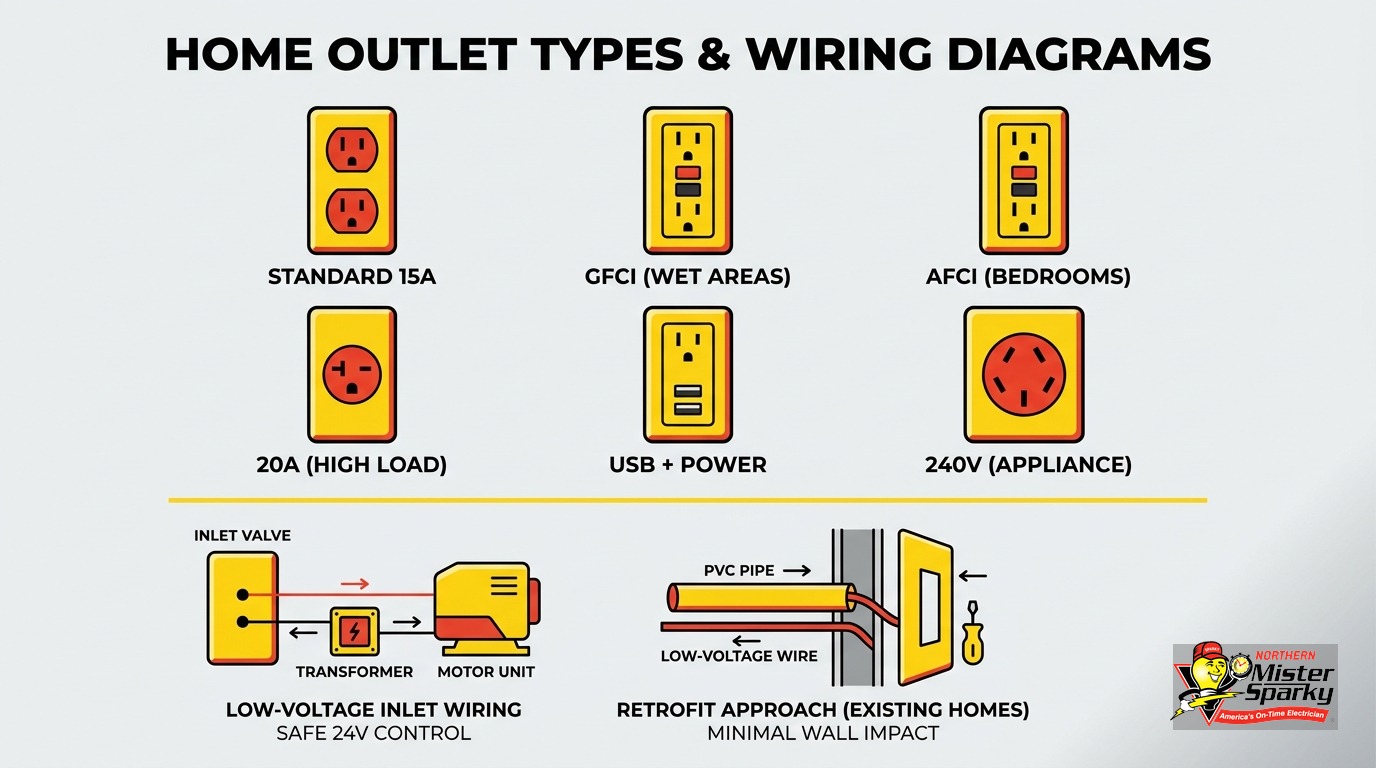
A central vacuum system needs a 120V dedicated circuit for the motor unit and a 24V low-voltage wiring run for the inlet valves. These are two separate systems with different wire gauges, different voltage levels, different rules, and in most cases, different installers.
These two systems do not interact electrically. The 120V motor circuit is a standard branch circuit that follows NEC rules, requires a permit in Minnesota, and must be installed by a licensed electrician. The 24V inlet valve circuit is low-voltage signal wiring, similar to doorbell wire, and is not a branch circuit under the NEC. A homeowner can run that portion themselves.
Understanding this split is the most important thing a Twin Cities homeowner can know before planning an installation. Retailers and DIY guides often blur the line between the two, which leads to permitting confusion and code violations at inspection.
Does a Central Vac Need a Dedicated Circuit?
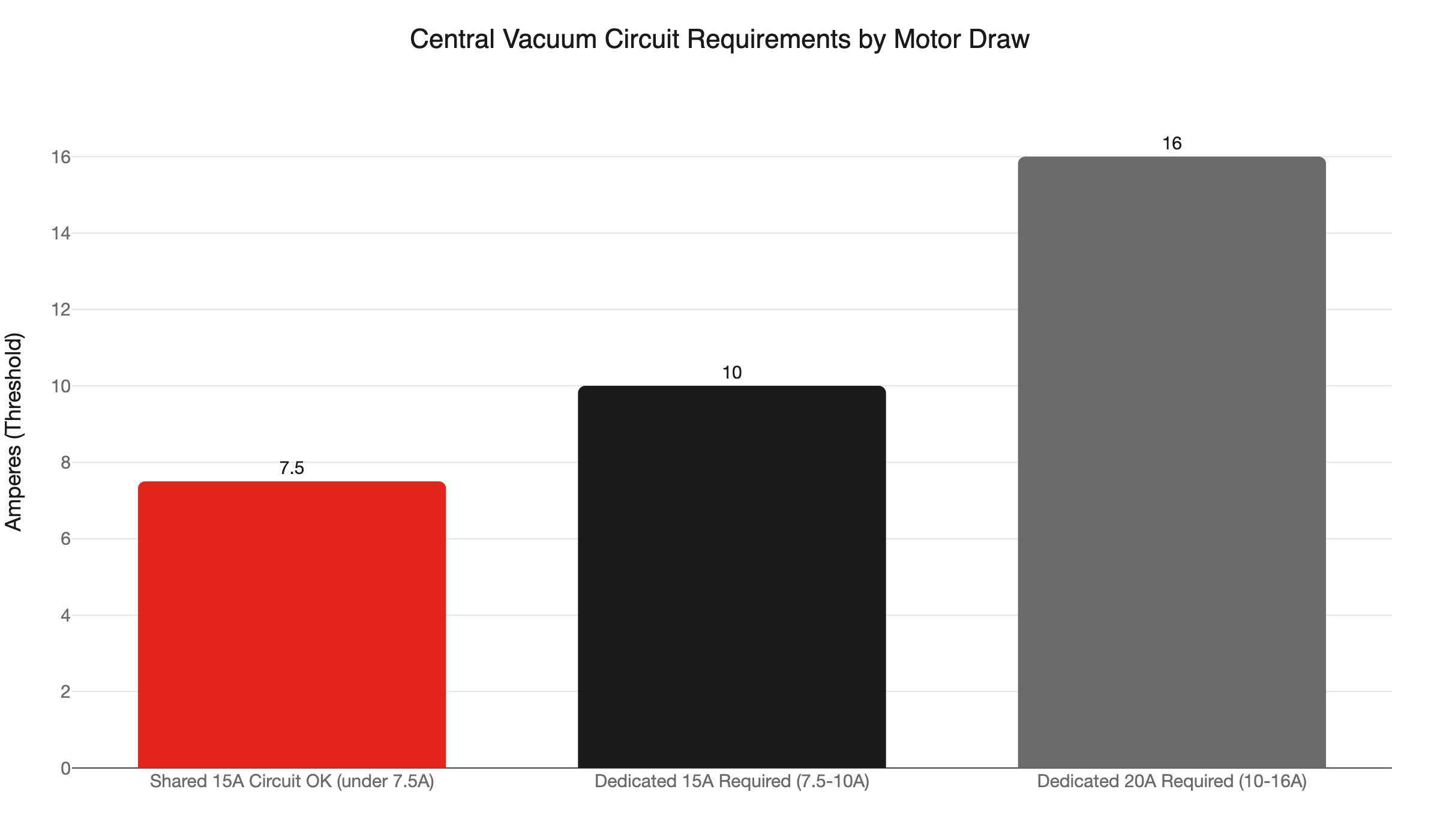
Usually yes. Under NEC §422.15 and §210.23(A)(2), a listed central vacuum unit requires a dedicated circuit when its rated draw exceeds 50% of the branch circuit’s ampere rating. On a 15A circuit, that threshold is 7.5A. Most residential units draw well above that.
A dedicated circuit serves only one appliance. It does not share a breaker or wiring with outlets, lights, or other loads. For a central vacuum motor, that isolation matters because the startup surge can trip a shared circuit, and because a vacuum is typically the largest single load in the space where it is installed.
There is a narrow exception. A very small unit drawing 7.5A or less could legally share a 15A circuit, as long as it is not the dominant load. In practice, most units sold for whole-home use draw 10-15A. That puts them over the threshold. Check the nameplate on the motor unit before assuming you can tap an existing circuit.
Our guide to dedicated circuits for home appliances walks through how to read nameplate data and figure out which appliances in your home already need their own circuit.
How Many Amps Does a Central Vacuum Require?
Most residential central vacuum units draw between 10 and 15 amps at 120V. A unit drawing up to 10A can run on a dedicated 15A circuit. A unit drawing between 10A and 16A requires a dedicated 20A circuit. Units drawing more than 15A at 120V require a 20A outlet.
The amp draw you care about is the running draw, not the startup surge. Both figures appear on the motor unit’s nameplate label. Look for “Rated Amps” or “Running Current” rather than “Max Amps” when sizing the circuit.
Here is how the math works under the NEC 50% rule:
- 15A circuit: Dedicated circuit required if draw exceeds 7.5A (50% of 15A).
- 20A circuit: Dedicated circuit required if draw exceeds 10A (50% of 20A). The unit must also draw no more than 16A (80% of 20A) to run on a 20A circuit at all.
- Above 15A running draw: A 20A outlet is required regardless of circuit configuration.
Most contractors install a 20A dedicated circuit for any central vacuum unit. It covers the full range of residential units and avoids a return trip if the homeowner later upgrades to a higher-powered model.
What Wire Type Does a Central Vacuum System Use?
The motor unit circuit uses standard 14/2 Romex for a 15A circuit or 12/2 Romex for a 20A circuit. The inlet valve wiring is entirely different: 22 AWG 2-conductor copper wire, run at 24V DC in parallel from the power unit to each valve. Never mix these two systems up.
For the 120V motor circuit, wire gauge follows standard branch-circuit rules: 14 AWG for 15A, 12 AWG for 20A. This is the same wire used for any household outlet circuit. It runs from the panel to a dedicated outlet at the power unit location, nothing unusual.
For the 24V inlet valve circuit, the wire is much smaller and carries only the low-voltage signal that opens each inlet valve when you plug in the hose. The standard is 22 AWG 2-conductor solid or stranded copper.
Wire all inlet valves in parallel, not in series, from the power unit. One pair of conductors runs from the power unit to each valve independently. For runs over 150 feet, step up to 18 AWG to avoid voltage drop on the signal circuit.
The Low-Voltage Inlet Valve Wiring
The 24V inlet valve circuit is the part of a central vacuum installation that most homeowners can tackle themselves. It is not a branch circuit, it carries no shock risk at 24V DC, and it does not require a permit in Minnesota.
Each inlet valve in the wall gets its own run of 22 AWG wire back to a terminal block on the power unit. Do not daisy-chain valves in series. Run each valve in parallel so that any one inlet can signal the unit independently.
The wire itself is thin and flexible, similar to doorbell or thermostat wire. It can be fished alongside the 2-inch vacuum tubing in wall cavities without conduit. Keep the low-voltage wire physically separate from the 120V circuit to avoid induction noise on the signal line.
For a typical Twin Cities home with three to five inlet locations, the full low-voltage run will stay well under 150 feet. 22 AWG is adequate for that distance. If you are running inlets to a far corner of a large two-story home, measure your total run length before buying wire.
Will an AFCI Breaker Cause Problems with My Central Vac?
It can. Central vacuum units use universal (brush) motors. The commutator inside these motors produces broadband electrical noise that resembles an arc fault signature, and an AFCI breaker may interpret that noise as a genuine arc and trip. This is called nuisance tripping, and it is a documented problem in retrofits.
Under the 2023 NEC, garages and unfinished basements were exempt from AFCI requirements. That made either location the natural choice for a central vacuum power unit. You could install a dedicated 20A circuit there without AFCI, and the nuisance-tripping issue did not come up.
The 2026 NEC closes that option. Under the 2026 NEC, AFCI protection is required on all 120V, 15A and 20A branch circuits in dwelling units. There are no location exceptions. Garages and unfinished basements are now in scope.
Minnesota adopted the 2026 NEC effective August 17, 2026. Permits filed on or after that date must comply with the 2026 NEC. Permits filed before that date use the 2023 NEC. The transition date matters: if you pulled a permit before August 17, 2026, your installer may have placed the unit in the garage specifically to avoid AFCI. That remains a code-compliant installation under the 2023 NEC.
For new permits filed after August 17, 2026, there are two practical paths. The first is to use a modern AFCI breaker with improved motor-noise filtering, specifically one carrying UL 489 Amendment 7 certification. These breakers are better at distinguishing real arc faults from motor noise. The second is to install an outlet-branch-circuit AFCI (OBCAFCI) device at the first outlet of the new circuit. The Minnesota DLI accepts the OBCAFCI as a compliant retrofit method when replacing the panel breaker is not practical.
If you are already seeing nuisance trips on a recently installed circuit, our post on diagnosing AFCI breaker nuisance trips has a step-by-step walkthrough.
Do I Need a Permit to Add a Central Vacuum Circuit in Minnesota?
Yes. Adding a dedicated circuit for a central vacuum unit is new electrical installation work, which requires an electrical permit in Minnesota. Only a licensed electrical contractor can pull that permit. The permit authority is the Minnesota DLI statewide, except in about 66 cities, including Minneapolis and St. Paul, that run their own inspection programs.
The permit process is straightforward for a single new circuit. The electrician files the permit, runs the circuit, and schedules an inspection. For most retrofits, the work passes in one visit. What you want to avoid is skipping the permit: an unpermitted circuit shows up as a defect in a home inspection when you sell, and it can complicate your homeowner’s insurance if there is ever a claim.
Minnesota adopted the 2026 NEC on August 17, 2026. Permits filed on or after that date are governed by the 2026 NEC, which includes the expanded AFCI coverage discussed above. If your home is in Minneapolis or St. Paul, the permit goes through the city electrical inspection program. If you are in Bloomington, Brooklyn Park, Woodbury, Blaine, Maple Grove, or Plymouth, it goes through DLI.
For a full breakdown of which electrical jobs require a permit and which do not, see our guide on when to pull an electrical permit in Minnesota.
Retrofitting an Existing Twin Cities Home
Most existing homes can be retrofitted with a central vacuum system. Twin Cities homes are often excellent candidates because of how they were built.
Split-levels and ramblers with unfinished basement ceilings give the installer a clear path to run 2-inch tubing along ceiling joists and fish inlets up interior walls without opening finished drywall. The power unit mounts in the basement or garage. A single new circuit drops from the panel to the power unit location.
For the electrical portion of a retrofit, two questions determine the scope:
- Is there a dedicated outlet within 6 feet of the planned power unit location?
- Does the panel have capacity for a new 15A or 20A circuit?
If no dedicated outlet exists within 6 feet of the power unit, a new circuit is required. That is the most common scenario in a retrofit, because the area of the basement or garage where the unit mounts best rarely has a dedicated outlet. New circuit means permit, licensed electrician, and an inspection.
Panel capacity is the second check. Older Twin Cities homes with 100A service may have limited breaker slots. If your panel is already full, talk to your electrician about whether a tandem breaker fits or whether the service itself is the constraint. The comparison of 100-amp vs. 200-amp service is a useful starting point for that conversation.
Homes with finished basements require a different approach for the tubing. It must be concealed inside walls or routed through closets. That increases the tubing cost but does not change the electrical scope. The motor circuit is the same regardless of how the tubing is routed.
A retrofit in a well-suited Twin Cities rambler is typically a one-day job for an experienced installer. The licensed electrician handles the dedicated circuit. The vacuum installer handles tubing and inlets. The low-voltage inlet valve wiring can be done by either party, or by the homeowner.
Can I Use PVC Pipe for Central Vacuum?
Yes. Central vacuum tubing is typically 2-inch white PVC, but it is not electrical conduit and it carries no electricity. It handles the airflow path from each inlet valve back to the motor unit. The 120V and 24V electrical wiring run separately, they do not travel inside the vacuum tubing.
This question comes up because “central vacuum PVC pipe” and “central vacuum electrical wiring” appear together in searches. The two systems can run alongside each other in the same wall cavity without being combined.
The tubing itself has no electrical code requirements. It is mechanical work. The electrical wiring running near it must still follow NEC rules: the 120V circuit uses Romex in interior walls and conduit in garages and other exposed locations. The 24V signal wire can run as-is in a wall cavity without conduit.
One hard rule: do not run the 120V supply cable inside the 2-inch vacuum tubing. Keep them separate. This is not a code ambiguity. It is basic separation of electrical and mechanical systems.
Schedule Your Central Vacuum Circuit with Northern Mister Sparky
Northern Mister Sparky is locally owned and operated in the Twin Cities. We handle the electrical scope of central vacuum retrofits: the dedicated circuit, the permit, the AFCI compliance question, and the inspection.
We are America’s On-Time Electrician(R). That means we show up when we say we will, pull the permit before we start, and do not leave you with an open permit at the end. The UWIN(R) 100% satisfaction guarantee backs every job.
Central vacuum units are one of the appliances where the electrical scope is frequently underestimated at the planning stage. Getting an electrician involved before the vacuum installer schedules their visit prevents surprises. We can tell you in advance whether your panel has room, whether a permit is required (it almost certainly is), and how the 2026 NEC AFCI requirements apply to your specific installation location.
For jobs that touch larger electrical scope, like a panel that needs additional capacity before the new circuit fits, we can discuss financing options to keep the project moving.
Call 763-200-5956 or book online. We serve Minneapolis, St. Paul, Bloomington, Brooklyn Park, Woodbury, Blaine, Maple Grove, Plymouth, and the surrounding Twin Cities area.
Frequently Asked Questions
Can a homeowner wire a central vacuum system in Minnesota? +
How close does the power unit need to be to its outlet? +
Does the 2026 NEC change central vacuum wiring in Minnesota? +
Need an electrician now?