
Egress Window Well Light Wiring: Basement Code Guide
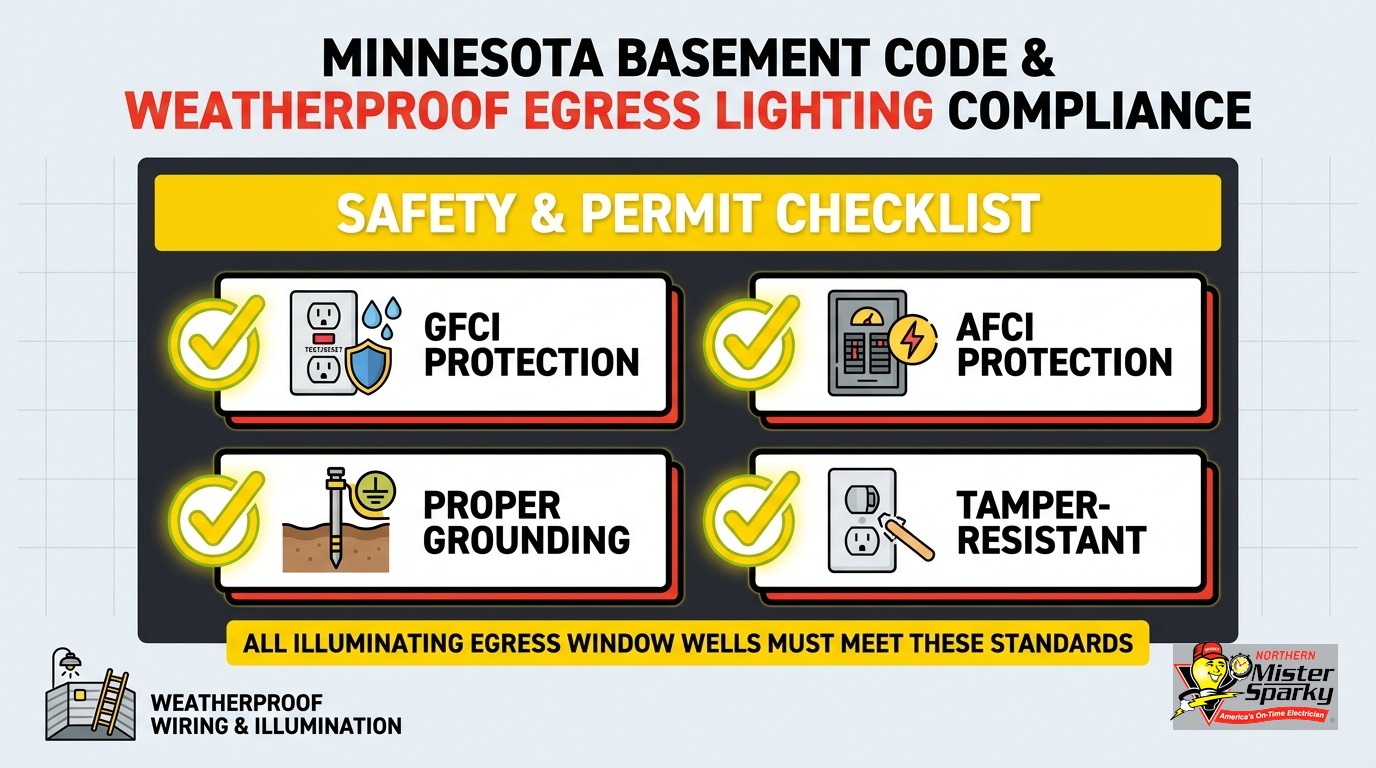
Key Takeaways
- A window well open to the sky is a wet location under the NEC, not a damp location. Fixtures must carry a wet-location listing to pass inspection.
- Minnesota adopted the 2026 NEC effective August 17, 2026. Any permit filed today must comply with the 2026 NEC.
- Adding a window well light typically requires two permits: a building permit for any well modifications and an electrical permit for the circuit and fixture.
- GFCI protection is mandatory for all circuits serving wet locations under NEC 210.8. No exceptions apply here.
- Twin Cities frost depths commonly push basement window wells past 44 inches. That is the threshold that triggers a permanently attached ladder requirement under Minnesota code.
- Minneapolis and St. Paul run their own electrical inspections. Most Twin Cities suburbs file permits with the Minnesota DLI.
- NM-B (Romex) cannot be used in wet locations. Use THWN conductors in conduit or UF-B cable for any run through the foundation wall or inside the well.
- No Xcel Energy rebate applies to window well lighting.
Why Does a Window Well Need Its Own Light?
An egress window is your backup escape route in a fire. A light in the well marks that exit when smoke fills the basement, lets you see what you are stepping into, and deters break-ins. Without a light, your emergency exit is invisible in the moment you need it most.
In a basement bedroom or sleeping area, the 2020 Minnesota Residential Code, Section R310, sets the minimum egress window dimensions. The net clear opening must be at least 5.7 square feet. The minimum opening height is 24 inches. The minimum opening width is 20 inches. The sill must be no more than 44 inches above the floor. Those dimensions keep the escape path physically open. A light keeps it visible.
Good egress window well lighting does three things well. It marks the exit when smoke cuts visibility. It lets you see what you are stepping into before you drop into the well. And it removes the dark hiding spot that makes an unlit well a convenient entry point for an intruder.
A fixture mounted in the well itself is the most reliable solution. Motion sensors and timers add convenience without reducing safety. But installing that fixture correctly means understanding two things most online guides skip entirely: the wet-location classification and Minnesota’s current electrical code cycle.
Is a Window Well a Wet Location or a Damp Location?
A wet location. The NEC Article 100 definition covers any location exposed to weather or subject to water saturation. A window well open to the sky qualifies. Fixtures must carry a wet-location listing. Damp-rated fixtures are not acceptable and will fail inspection.
The NEC Article 100 definitions draw a precise line. A damp location is a protected area subject to moderate moisture, like a covered porch ceiling or a partially protected exterior soffit. A wet location is any spot exposed to weather or subject to saturation with water. A window well sits below grade, collects rain and snowmelt, and is open to the sky. It qualifies as a wet location without question.
This matters because NEC Article 410.10(A) requires fixtures in wet locations to be listed and marked specifically for wet locations. A label reading “suitable for damp locations” is not sufficient. An inspector will look at that label. If it says damp only, the fixture fails.
The same standard applies to every device installed in the well or on the foundation wall inside the well. Receptacles, switches, motion sensors, and occupancy sensors all need wet-location listings when they are mounted in the well environment. NEC 404.4(A) requires surface-mounted switches in wet locations to be in weatherproof enclosures.
Most home-improvement content online treats “outdoor rated” and “wet location listed” as interchangeable. They are not. When you spec a fixture or a device for a window well, the label must say wet location specifically.
What Minnesota Code Applies to Egress Window Well Light Wiring?
Two codes apply: the 2026 NEC governs the electrical work (Minnesota adopted it August 17, 2026), and the 2020 Minnesota Residential Code governs the egress window and well structure. Both may trigger permit requirements, and both must be satisfied for the job to pass inspection.
The 2026 NEC for electrical work
Minnesota does not have a standalone state electrical code. The state adopts the National Electrical Code under Chapter 1315 of the Minnesota State Building Code. The 2026 NEC became effective August 17, 2026. Licensing exams transitioned to the 2026 NEC on September 8, 2026.
Any permit filed on or after August 17, 2026 must comply with the 2026 NEC. Most content you find online still cites the 2020 or 2023 NEC. For any Minnesota job today, that content is out of date.
The 2020 Minnesota Residential Code for the well structure
The 2020 Minnesota Residential Code, Section R310, governs egress window dimensions and well requirements. If you modify the well structure as part of the lighting project, a building permit may apply to that work separately from the electrical permit. Well cover installations, liner changes, and depth modifications all fall into this category.
Both code requirements apply to a single project. Permit them correctly, and inspection goes smoothly.
Do You Need a Permit for Egress Window Well Light Wiring?
Yes. Adding a new circuit or new fixture requires an electrical permit in Minnesota. Homeowners can pull their own permit for their primary residence, but the work must pass inspection. Skipping the permit can surface as a disclosure problem when you sell the home.
The permit requirement applies whether a homeowner or a licensed electrician does the work. Review the DLI residential electrical inspection checklist before the inspector arrives. It is updated for the 2026 NEC and tells you exactly what the inspector will verify.
Two separate permits may apply to a single project:
- An electrical permit for any new circuit, new wiring run, or new fixture installation.
- A building permit if the well structure itself is being modified.
If you are doing a like-for-like fixture swap on an existing circuit, some jurisdictions treat that differently. Check with your local authority first. When in doubt, pull the permit. An unpermitted installation is a disclosure item at home sale and can delay closing.
For a full look at how electrical permits work in Minnesota, see our post on Minnesota electrical permits.
Who Issues Your Electrical Permit in the Twin Cities?
It depends on your address. Minneapolis and St. Paul run their own electrical inspections through local authorities. Most suburbs file with the Minnesota DLI. Filing with the wrong authority delays inspection. Use the DLI inspector lookup tool to confirm before you file anything.
Minneapolis runs its own inspections through the Minneapolis Inspections Division. St. Paul properties go through the St. Paul Department of Safety and Inspections (DSI). Most Twin Cities suburbs, including Bloomington, Brooklyn Park, Maple Grove, Plymouth, Woodbury, and Blaine, are state-inspected. Those file with the Minnesota DLI.
Getting this wrong costs real time. Filing a DLI permit for a St. Paul property means re-filing with DSI. That delays inspection and holds up any related finish work. The DLI inspector lookup tool on the homeowner permits page confirms which authority covers your address. Use it first.
The Wet-Location Fixture Requirement in Detail
Not all outdoor-rated fixtures are equal. Wet-location listing is specific, and it applies to everything installed in or on the well.
A wet-location fixture carries a label reading “Suitable for Wet Locations” or “Listed for Wet Locations.” That label is not marketing language. It means the fixture is tested and certified for direct water exposure. That testing matters in a Minnesota window well.
Conditions inside a Twin Cities window well are harsh. Rainwater pools at the bottom. Snowmelt saturates the liner. The freeze-thaw cycle works every joint and seal repeatedly. The metro area averages more than 100 freeze-thaw cycles per year. A fixture not listed for wet locations will fail within one or two seasons. Water enters the housing, corrodes the socket, and creates a shock or fire hazard.
LED fixtures with sealed, gasketed housings are the right choice for this application. They handle temperature swings and moisture better than standard incandescent or halogen models. Look for an IP65 or higher ingress protection rating alongside the wet-location listing. The combination means the fixture is sealed against dust and direct water jets.
Any control device mounted in the well or on the foundation wall inside the well must carry the same listing. If a timer or dusk-to-dawn switch is mounted inside the conditioned basement, no outdoor listing is required. But the moment any device moves into the well environment, the wet-location requirement applies.
What Wiring Method Is Correct for Egress Window Well Light Wiring?
Not Romex (NM-B). That cable is rated for dry or protected damp locations only. Once wiring passes through the foundation wall or enters the well, you need THWN conductors in rigid PVC or EMT conduit, or UF-B cable. Both are rated for wet locations and direct exposure.
This is where many DIY installations fail code. The common mistake: run NM-B from the basement ceiling, push it through a knockout in the foundation wall, and connect it to the fixture in the well. That is a code violation at the wall penetration. The cable is not rated for that environment.
The correct approach:
- Run NM-B cable inside the conditioned basement from the panel or a junction box to the foundation wall penetration point.
- Transition to THWN conductors in conduit, or to UF-B cable, at the point where the wire enters the wall.
- Use rigid PVC or EMT conduit for any run exposed inside the well.
- Strap conduit tight to the foundation wall so it does not obstruct the escape path.
- Seal the foundation wall penetration with approved sealant to block water infiltration and air leakage.
Minnesota’s freeze-thaw cycle adds stress to conduit joints. Soil movement, concrete expansion, and repeated temperature swings can work loose-fit connections free over time. Glued PVC joints and properly made EMT compression fittings hold up far better than push-fit connections in this climate.
For more on when to use conduit versus cable throughout a home, see our post on conduit versus Romex for residential wiring.
GFCI Protection Is Not Optional
Every circuit serving a window well fixture must have GFCI protection. NEC 210.8 requires it for circuits in wet locations. There is no workaround that applies here.
GFCI protection trips the circuit when it detects a small ground fault. That is precisely the kind of fault that occurs when water contacts a wiring defect. In a wet location like a window well, that protection is the difference between a nuisance trip and a serious shock.
You can provide GFCI protection three ways:
- A GFCI circuit breaker in the panel protecting the whole circuit.
- A GFCI outlet upstream of the fixture, with the fixture wired through the LOAD terminals.
- A GFCI outlet at the first device in the circuit, wired to protect all downstream devices.
Any of these methods passes inspection. The GFCI breaker option is clean and keeps no devices in the weather. The upstream GFCI outlet is a common choice when the circuit also serves an interior outlet. Document your GFCI protection method clearly for the inspector before the visit.
For a broader overview of where GFCI protection is required in a home, see our post on GFCI outlet requirements.
The Twin Cities Frost Depth Problem
Minnesota’s climate creates a wiring challenge that no national DIY guide mentions.
The minimum foundation depth in the Twin Cities is 42 inches. That requirement is driven by frost protection standards in the 2020 Minnesota Building Code. Most basement windows in the area sit close to the 44-inch well depth threshold. That threshold matters because IRC R310.2.1, reflected in the 2020 Minnesota Residential Code, requires a permanently attached ladder or steps in any window well that exceeds 44 inches in depth.
Many Twin Cities wells already have this ladder. The wiring for your light must be routed to keep the ladder and the full escape path completely clear. A wire or conduit crossing the escape path is a code violation. In a real emergency, it is also a hazard.
Route all wiring tight to the foundation wall. Use conduit straps and mount conduit flush to the concrete or CMU block surface. Position the fixture itself to illuminate the well floor and the window without hanging over ladder rungs or the sill opening.
If your well runs deeper than 44 inches and does not yet have a ladder, that is a separate compliance item. A building permit may cover that correction alongside the lighting work. Address it at the same time.
What Controls and Timers Can You Add?
Motion sensors, photocells, and timer switches all work with window well lighting. Any device mounted inside the well must carry a wet-location listing. Controls mounted inside the home, such as a dusk-to-dawn photocell switch in the basement, do not need an outdoor or wet-location listing.
A dusk-to-dawn photocell switch wired inside the conditioned basement is the simplest approach. It turns the light on at dark and off at dawn. No device is exposed to the weather. No wet-location listing is needed for the switch itself.
Motion sensors mounted in the well are effective for security. They activate the light when someone enters the well. If you choose this option, buy a sensor with an explicit wet-location listing. Verify that both the sensor body and its cover plate carry that listing. Generic “outdoor” motion sensors often carry only a damp-location rating.
NEC Articles 410 and 404 govern luminaires, switches, and control devices in outdoor and wet-location applications. Every device must carry a listing appropriate for the environment it serves. An inspector may ask to see installation instructions, which will clearly state the listed application.
What Does the Installation Actually Involve?
Five main steps: run NM-B inside the basement to the foundation wall, transition to wet-location wiring at the penetration, run conduit inside the well to the fixture point, mount a wet-location-rated fixture, and add GFCI protection. Pull the permit before work starts. Schedule inspection when rough-in is complete.
Here is a closer look at each step:
- Source circuit: Identify the panel circuit that will feed the fixture. A new dedicated circuit is the cleanest option. Sharing an existing circuit is possible if load capacity allows.
- Interior run: Run NM-B cable inside the basement from the panel or junction box to the foundation wall penetration point.
- Wall penetration: Core-drill or use an existing knockout in the foundation wall. Install conduit through the wall. Seal the penetration after conduit is in place.
- Conduit run in the well: Mount rigid PVC or EMT conduit on the foundation wall surface inside the well. Run it to the fixture mounting location.
- Fixture mounting: Mount a wet-location-listed fixture at a position that illuminates the well floor and the escape route. Keep the ladder and the window sill completely clear.
- GFCI protection: Install a GFCI circuit breaker or an upstream GFCI outlet to protect the circuit.
- Permit and inspection: Pull the electrical permit before any work starts. Schedule rough-in inspection and final inspection through the correct authority for your address.
Each step has specific material requirements. A misstep at the wiring method transition or the fixture specification means a failed inspection and rework.
When Should You Call a Licensed Electrician?
For any project that involves new wiring. Running conduit through a foundation wall, making correct wet-location wiring transitions, and verifying GFCI protection are straightforward for a licensed electrician and error-prone for a first-timer. One failed inspection costs more than the savings from a DIY attempt.
Minnesota homeowners can pull their own electrical permits. But the permit is not the hard part. Knowing which authority covers your address, running conduit correctly through concrete, getting the wiring transition right at the foundation wall, and having documentation ready for the inspector all require experience to do correctly the first time.
As America’s On-Time Electrician(R), our team shows up when we say we will and backs the work with the UWIN(R) 100% satisfaction guarantee. If you are also finishing a basement or adding a sleeping room, bundling the work saves on inspection trips and can reduce overall cost. See our post on basement finishing electrical costs for a sense of what that broader scope looks like.
Get Your Window Well Wired Right
Egress window well light wiring is a focused job with real code complexity underneath it. The wet-location fixture requirement, the 2026 NEC, the dual-permit reality, and the Twin Cities frost depth threshold all add up to details that generic online guides miss entirely.
Our team serves Minneapolis, St. Paul, Bloomington, Brooklyn Park, Woodbury, Blaine, Maple Grove, Plymouth, and the surrounding Twin Cities area. We are locally owned and operated. We know which permit authority covers your address, and we have handled the freeze-thaw realities on hundreds of Twin Cities basement projects.
Call us at 763-200-5956 or book online to schedule your estimate. We will get your window well lit, wired correctly, and through inspection.
Frequently Asked Questions
Can I use Romex (NM-B) to wire a window well light? +
Does my window well fixture need a wet-location or damp-location rating? +
Do I need a permit to add a light to a basement window well in Minnesota? +
Who inspects electrical work in Minneapolis and St. Paul? +
Need an electrician now?