
Electric Baseboard Heater Wiring: Minnesota Circuit Guide
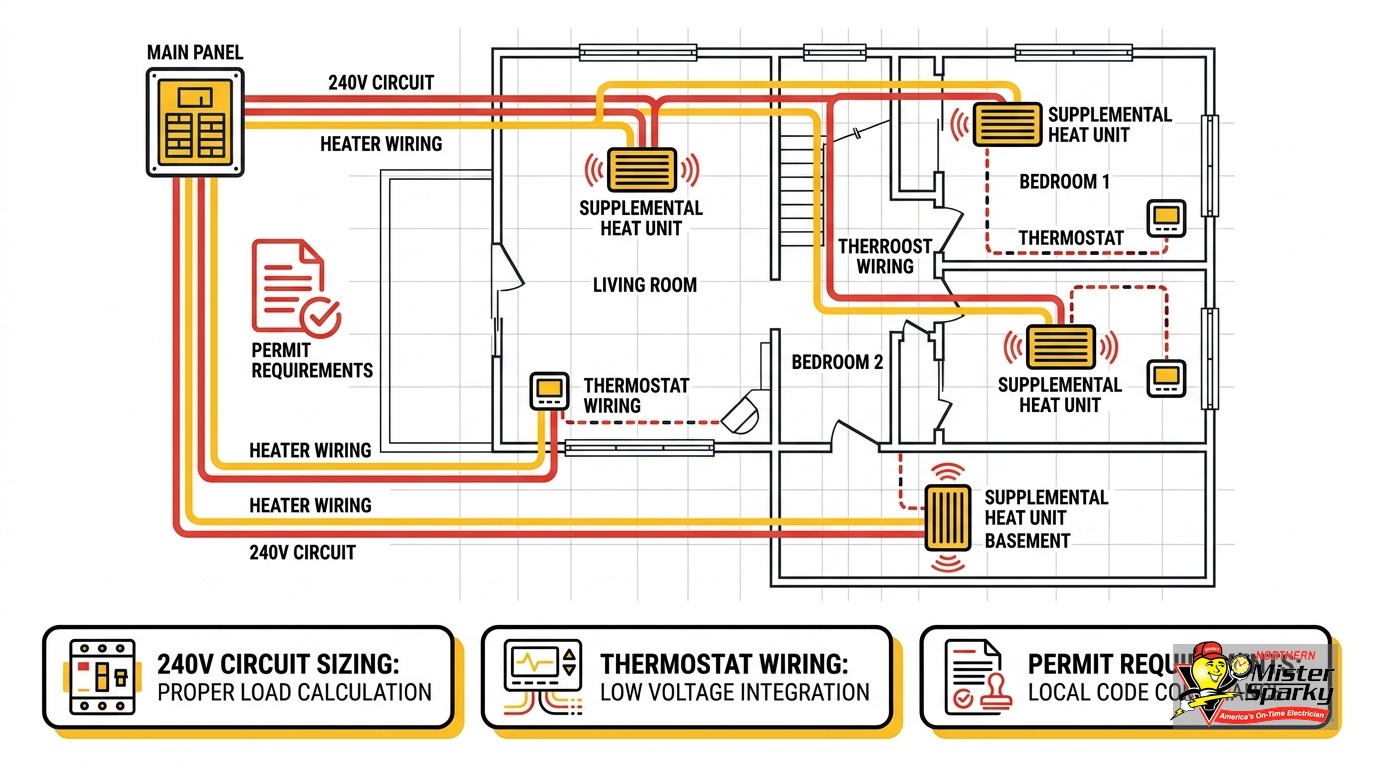
Key Takeaways
- Electric baseboard heater wiring is classified as a continuous load under NEC 424.3(B). Branch-circuit conductors must be rated at 125% of the total heater load, not 100%.
- A standard 3,000-watt, 240-volt baseboard circuit needs a 20-amp double-pole breaker and 12 AWG copper wire.
- Older Twin Cities homes may have 60C or 75C-rated wire insulation. That wire carries less current than modern 90C wire, even on the same breaker.
- Aluminum wiring is common in Minnesota homes built in the late 1960s and early 1970s. It must be sized separately from copper and evaluated before you add any heating load.
- A permit is required for any new baseboard heating circuit in Minnesota under MN Statute 326B.35. Homeowners can pull their own permit for their primary residence.
- Minnesota adopts the 2026 NEC on August 3, 2026. Permits filed before that date follow the 2023 NEC. Permits filed on or after August 3 follow the 2026 NEC.
- A 240-volt baseboard heater requires a double-pole, line-voltage thermostat. The white wire in 12/2 NM-B cable carries a hot leg and must be re-identified with black tape at both ends.
- Xcel Energy offers no rebate for electric baseboard heaters. Their program directs residential customers toward cold-climate heat pumps for efficiency upgrades.
Why Do So Many Older Twin Cities Homes Have Baseboard Heaters?
Electric baseboard heat was the economical choice for supplemental heat in pre-1980s Minnesota homes. Extending forced-air ductwork into a finished basement or addition cost more than running a 240-volt circuit. Many of those circuits are still in use today.
The heaters themselves are simple: a heating element, a reflector, and a thermostat. When the element fails, you replace the unit. When the circuit fails or a new run is needed, that is where the code requirements start to matter.
What Circuit Does Electric Baseboard Heater Wiring Actually Need?
A 3,000-watt, 240-volt baseboard heater needs a 20-amp double-pole breaker and 12 AWG copper wire. The NEC classifies fixed electric space heating as a continuous load, so the circuit must be sized at 125% of the heater’s actual draw, not 100%.
Here is the math. A 3,000-watt heater at 240 volts draws 12.5 amps. NEC 424.4(B) and 210.19(A)(1) require branch-circuit conductors to be rated at not less than 125% of the continuous load. Multiply 12.5 amps by 1.25 and you get 15.625 amps minimum ampacity. A 20-amp double-pole breaker with 12 AWG copper wire clears that bar.
NEC 424.3(B) treats fixed electric space heating as a continuous load by default. The 125% rule is a hard code requirement, not a conservative guideline.
A few practical points follow:
- Multiple heaters on one circuit are allowed. Total wattage still drives the sizing math.
- A 30-amp circuit is needed when the combined load exceeds what a 20-amp circuit can carry at 125%.
- Run a dedicated branch circuit for each heating zone. Do not mix baseboard heaters with other loads on the same circuit.
Our post on dedicated circuits for high-draw appliances explains why shared circuits create problems over time, especially in older panel setups.
Does Old Wiring Change the Circuit Sizing Math?
Yes, and it matters in older Twin Cities homes. The allowable load on a circuit depends not just on the breaker size but on the temperature rating of the wire insulation. 90C wire is the current standard. Wire rated at 60C or 75C carries less current safely, even at the same gauge and on the same breaker.
King Electric’s sizing table separates new-construction wire (90C) from old-construction wire (75C) and shows a separate column for aluminum conductors. If your home has 75C wire on a 20-amp circuit, the safe load limit is lower than what the same circuit would carry with 90C wire. Running at the 90C ampacity limit on 75C-rated insulation generates heat inside the walls, even if the breaker never trips.
Aluminum wiring is a separate concern. It was common in Minnesota homes built in the late 1960s and early 1970s when copper prices spiked. Aluminum conductors carry less current per gauge than copper and require different termination methods and device compatibility ratings. A 12 AWG aluminum wire on a 20-amp breaker is not equivalent to 12 AWG copper. It is not close.
Before adding any load to an existing circuit in a pre-1985 home, check the insulation rating stamped on the wire jacket. If you cannot read it, or if you find aluminum conductors, stop and call a licensed electrician before doing any circuit work. Our post on aluminum wiring dangers and fixes covers the compatibility issues in detail.
How Do You Wire a 240V Baseboard Thermostat?
A 240-volt baseboard heater requires a double-pole, line-voltage thermostat. Both hot legs connect to the LINE terminals. The heater wires connect to the LOAD terminals. A double-pole design opens both hot legs when the thermostat shuts the heat off, which is the only safe configuration for a 240-volt circuit.
The wiring sequence with 12/2 NM-B cable works like this:
- The black wire is hot leg L1. Connect it to one LINE terminal on the thermostat.
- The white wire carries hot leg L2 in a 240-volt circuit. It is not a neutral. Connect it to the other LINE terminal.
- Both ends of the white wire must be re-identified with black electrical tape. This is a NEC requirement. It is also one of the most commonly skipped steps, and inspectors flag it consistently.
- From the LOAD terminals, the black wire and the re-identified white wire run to the heater’s wiring compartment.
Never use a single-pole thermostat on a 240-volt baseboard heater. A single-pole thermostat opens only one leg of the circuit. The heater remains energized on the other leg when the thermostat is in the off position. That is a shock hazard and a code violation.
One more code requirement worth knowing: NEC 424.19 requires a disconnecting means within sight of the heater and within 50 feet. A line-voltage thermostat qualifies as the disconnect if it is within sight of the heater and opens both ungrounded conductors. If the thermostat is around a corner or otherwise not in sight of the heater, a separate disconnect switch is required.
The No-Receptacle Rule: What NEC 424.9 Means for Older Homes
If there is an outlet on the wall where you want to install a baseboard heater, that outlet must move. NEC 424.9 prohibits installing listed baseboard heaters below receptacle outlets. The reason is thermal: the heater warms the receptacle wiring above its rated temperature and dries out cords plugged in nearby. That is both a fire risk and a shock risk.
This comes up often in older Twin Cities homes where baseboard-height outlets were standard construction. If the outlet is in the way, you have two options:
- Relocate the receptacle to another position on the same wall, away from the heater’s footprint.
- Move the heater to a wall section where no outlet exists.
Leaving the outlet in place and installing the heater below it is a code violation. It also voids the heater’s listing under the manufacturer’s installation instructions. An inspector will reject it.
Do You Need a Permit for Electric Baseboard Heater Wiring in Minnesota?
Yes. Any new circuit or extension of an existing circuit to add electric heat in Minnesota requires a permit under MN Statute 326B.35. There are no exceptions for small jobs or single-heater installs.
This is the question most homeowners search for, and the one most guides skip entirely. The answer in Minnesota is straightforward: permit required, inspection required, no exceptions.
Homeowners can pull their own electrical permit for their primary residence. You do not need to be a licensed electrician to do the work yourself on a home you own and occupy. You do need to pull the permit before work starts and pass inspection when it is done.
If someone other than the homeowner does the work, that person must hold a Minnesota electrical license. This includes capable family members and friends who are not licensed, regardless of their experience level.
See our post on electrical permits in Minnesota for a full walkthrough of the filing process and what inspectors check on a new heating circuit.
DLI or Local AHJ: Which Office Handles Your Permit?
Minnesota splits electrical inspection authority between the Department of Labor and Industry and local Authority Having Jurisdiction offices. The right office depends on where you live. Check the DLI inspector directory before you file anything or call anyone.
Find your municipality in the directory. If the AHJ column shows “State,” file your permit online at ims.dli.mn.gov/ims. If the column shows a local entity, contact that city or county office directly.
Minneapolis, St. Paul, and most larger suburbs, including Bloomington, Maple Grove, and Plymouth, run their own electrical inspection programs. Smaller communities typically fall under DLI jurisdiction. Both paths require a permit before work starts and inspection after the circuit is roughed in.
Do not skip this step. An inspector who cannot see the wire run cannot approve the work. A hidden circuit that was never inspected becomes a problem at the next real estate inspection, not a minor paperwork issue.
The 2026 NEC Transition: Does Your Timing Matter?
Minnesota adopted the 2026 National Electrical Code with an effective date of August 3, 2026. If you are planning a baseboard heater installation this summer, your permit filing date determines which code version governs the work.
- Permits filed before August 3, 2026: the 2023 NEC applies.
- Permits filed on or after August 3, 2026: the 2026 NEC applies.
The baseboard heater wiring rules in this guide carry forward from the 2023 to the 2026 NEC. The 125% continuous-load rule, the double-pole thermostat requirement, and the no-receptacle-above rule are not changing. Other residential electrical sections in the 2026 NEC do include updates, particularly around grounding and arc-fault protection in certain spaces.
If your project falls close to the August 3 cutoff, confirm the applicable code version with your AHJ or inspector before you start. Licensing exams also transition to the 2026 NEC on September 8, 2026.
Will Your Panel Handle a New Heating Circuit?
Maybe not, especially in an older home. A 100-amp service panel in a 1960s or 1970s Twin Cities home was sized for the loads of that era. Many are now running near capacity with added appliances, home office circuits, or EV chargers. A new 20-amp or 30-amp double-pole heating circuit needs an open slot and available panel headroom.
NEC 220.40 requires a load calculation when you add substantial fixed electric space-heating load to an existing service. If electric heat is the sole heat source in the added space, a heat-loss calculation is also required to properly size the equipment.
Adding a circuit to a panel with no available slots, or to slots that are already double-tapped, is not just a code problem. It is a fire hazard. If your panel is full or aging, the baseboard heater project may need to start with a panel evaluation or upgrade before any circuit work begins.
Read our post on signs you need an electrical panel upgrade to see whether your panel has room before you plan a new heating circuit.
What About Xcel Energy Rebates for Electric Baseboard Heaters?
Xcel Energy does not offer rebates for electric baseboard heaters. Their 2024-2026 residential program directs efficiency incentives toward cold-climate heat pumps, which qualify for rebates up to $2,000.
If you are weighing whether to add baseboard wiring now or invest in a heat-pump upgrade instead, the rebate structure tilts toward the heat pump for long-term planning. That said, a dead baseboard unit is an immediate problem in a Minnesota winter. Replacing the unit and bringing the circuit up to code is faster and less disruptive than a heat-pump install. Treat the heat-pump conversation as a future project, not a reason to delay a repair the room needs now.
When Should You Call an Electrician for Electric Baseboard Heater Wiring?
Call a licensed electrician if you have aluminum wiring, a full or aging panel, an outlet that needs relocation, or any uncertainty about the existing circuit’s condition. No malarky: these are not edge cases in older Twin Cities homes. They are the common conditions our team finds on nearly every pre-1985 call.
Here is when to bring in our team at Northern Mister Sparky:
- You have aluminum wiring. Aluminum conductor sizing, terminations, and device compatibility require different materials and methods than copper work.
- Your panel is full or has no open double-pole slot. Adding circuits to an overloaded panel is not a DIY fix.
- You cannot confirm the wire’s insulation rating. If you are not sure whether you have 60C, 75C, or 90C wire, do not add load to that circuit until someone verifies it.
- An outlet is in the way. Relocating a receptacle adds a junction box, may require fishing wire through finished walls, and needs its own inspection.
- You are working in a finished basement with closed walls. Running new circuit wire through finished construction without damaging drywall is a practical skill that takes real practice.
- You are not the owner-occupant. Anyone other than the homeowner doing electrical work on a Minnesota home must be licensed.
We are locally owned and operated in the Twin Cities. As America’s On-Time Electrician(R), we show up when we say we will, size the circuit correctly the first time, pull the permit, and handle the inspection. Our UWIN(R) 100% satisfaction guarantee backs every job.
If your baseboard heater circuit is dead, undersized, or the unit finally quit after 30 Minnesota winters, call us at 763-200-5956 or book online. We will get it handled before the cold settles in.
Frequently Asked Questions
Do I need a permit for electric baseboard heater wiring in Minnesota? +
What size breaker do I need for a 240V baseboard heater? +
Can I wire a baseboard heater myself in Minnesota? +
What thermostat do I need for a 240V baseboard heater? +
Does aluminum wiring affect baseboard heater circuit sizing? +
Need an electrician now?