
Outlet for Electric Lawn Mower Charging in Your Garage
Key Takeaways
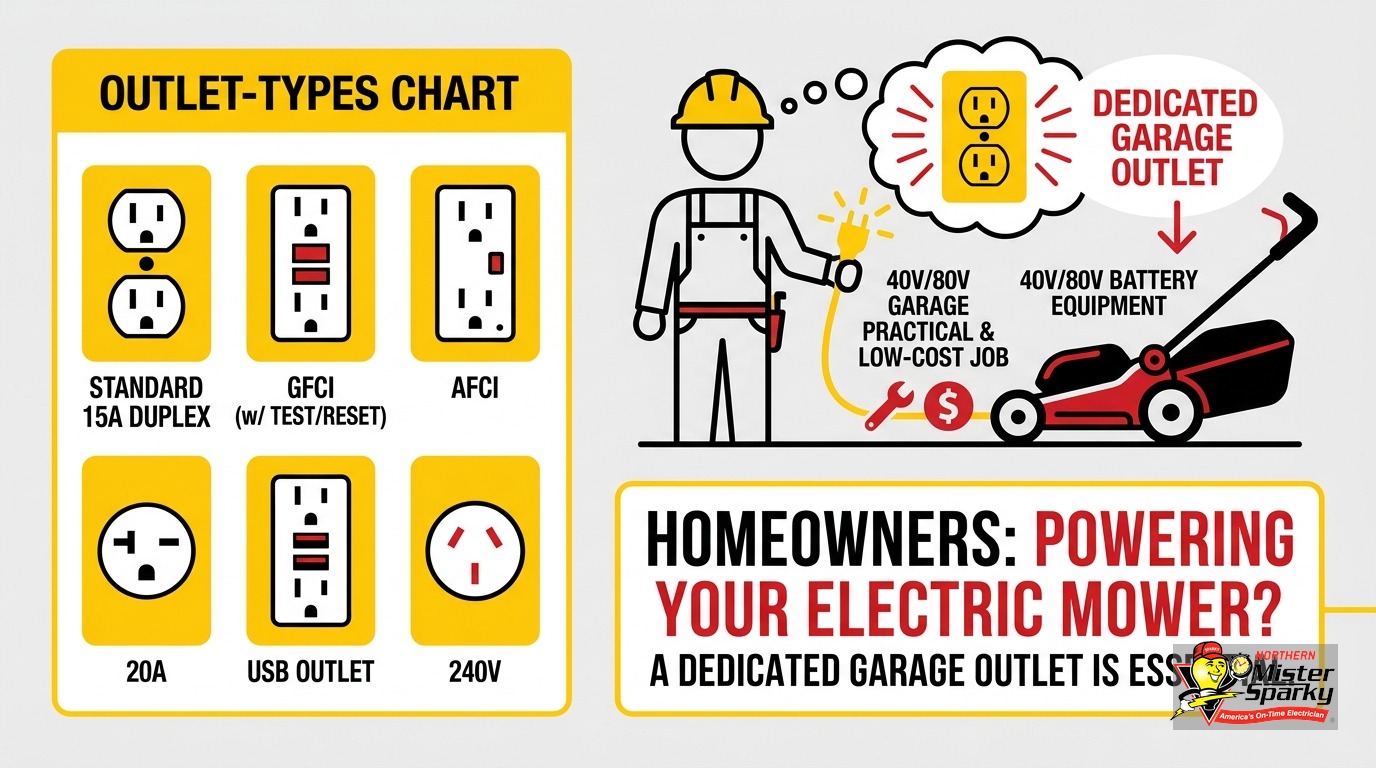
- 40V and 80V battery mowers plug into standard 120V outlets. No 240V wiring required.
- Battery chargers are continuous loads. They draw steady current for one to four hours, not a brief startup spike.
- NEC 210.11(C)(4) requires at least one dedicated 20A circuit for garage receptacles. That circuit cannot carry other loads.
- All garage outlets must be GFCI-protected under NEC 210.8.
- Adding a circuit in Minnesota requires a permit. Owner-occupants of single-family homes can pull their own. Rentals and condos require a licensed contractor.
- About 66 Minnesota cities are local AHJs and issue permits themselves. Filing with the wrong entity loses days.
- Minnesota adopted the 2026 NEC effective August 17, 2026. Permits filed on or after that date must comply with the new code.
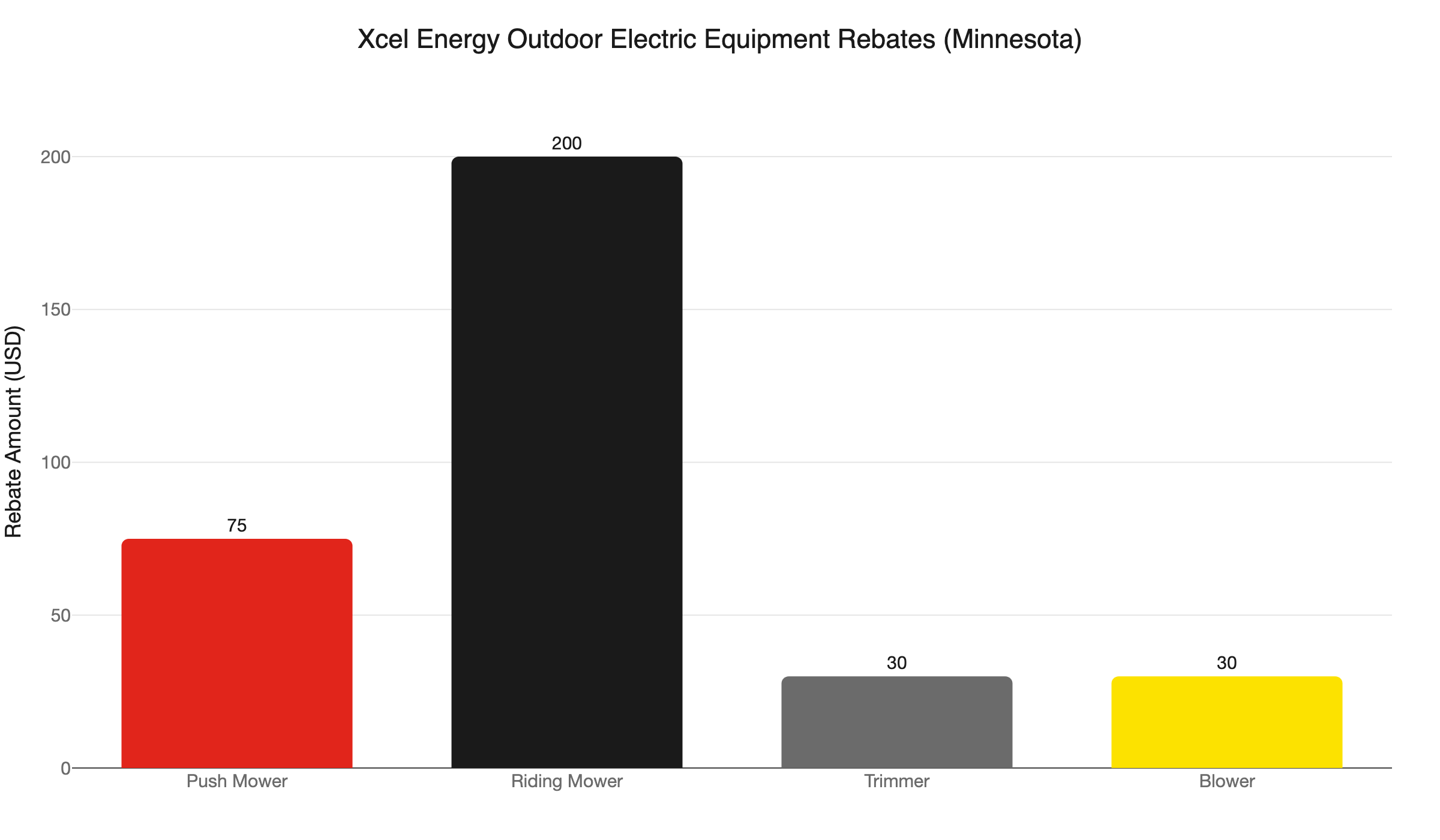
- Xcel Energy offers rebates of up to $200 on qualifying electric outdoor equipment in Minnesota. A separate state program runs through June 30, 2027.
Why Your Current Garage Outlet May Not Be Enough
Older garages in Minneapolis, Bloomington, Brooklyn Park, and across the Twin Cities metro were typically wired on 15A general-purpose circuits. The load in mind was simple: garage door opener, fluorescent shop light, and occasional use of a shop vac.
Battery chargers are different. Electricians classify them as continuous loads. A continuous load draws current steadily for three or more hours rather than a brief inrush spike. The NEC sizes continuous loads at 80% of the breaker rating. On a 15A breaker, the sustained load ceiling is 12A. On a 20A breaker, it is 16A.
Here is what that looks like in practice. Your garage door opener peaks at startup but idles low. A shop light draws a modest, steady load. Add a mower charger pulling 4-6A continuously for two hours. You are now near the 80% ceiling on an already-loaded circuit. A second person plugs in a leaf blower battery charger at the workbench, and you may cross it.
The result is a tripped breaker. You come back to the garage and the mower is at 20%. Or the breaker holds but the wire runs warm for two hours. That second scenario is quieter and more concerning.
The 2017 NEC update that created the dedicated garage circuit requirement anticipated exactly this kind of loading conflict. Garages were picking up new continuous loads: EV chargers, battery outdoor equipment, air compressors. A shared circuit was no longer adequate.
What Does NEC Code Require for Garage Outlets?
The short answer: At least one 120V, 20A dedicated circuit. GFCI protection on every outlet. At least one outlet per vehicle bay, mounted no higher than 5.5 feet above the floor.
NEC 210.11(C)(4) requires at least one 120V, 20A dedicated branch circuit for garage receptacles. The rule is specific: this circuit shall have no other outlets. The 2017 NEC edition separated it from lighting circuits to handle equipment and EV charging loads that were increasingly common in residential garages.
NEC 210.52(G)(1) adds the placement requirement. At least one outlet per vehicle bay, mounted no higher than 5.5 feet above the finished floor. A three-car garage requires three outlets at minimum. The ceiling outlet for the garage door opener does not count toward that total.
Every garage outlet must be GFCI-protected under NEC 210.8. The 2023 and 2026 NEC editions apply this to all garage receptacles without exception. If you are not sure whether your current outlets have GFCI protection, look for test and reset buttons on the outlet face. If you cannot find them anywhere in the garage, the circuit likely predates the requirement.
For a deeper look at garage-specific wiring rules, see our post on attached garage electrical wiring and code requirements.
Does an Electric Lawn Mower Charger Need Its Own Dedicated Circuit?
The short answer: The code requires a dedicated circuit for the garage receptacle zone, not a single device. Placing your charger on a circuit with no other continuous loads is the right setup and the right time to do it.
A 40V or 80V battery mower uses a brand-specific charger. EGO, Greenworks, Ryobi, and Kobalt all supply standard 120V chargers with the mower. They plug into any properly wired 120V outlet. Typical charge time is one to four hours, depending on battery capacity and charger speed.
The continuous-load consideration is what makes a dedicated circuit for garage appliances the practical choice, not just a code obligation. A circuit that serves only the mower charger has headroom. You can add a trimmer charger or a blower charger later without recalculating your load from scratch.
If you are also planning to charge an electric snowblower in the same space, this is the right moment to run both circuits. Our post on electric snowblower charging outlet setup in the garage covers why bundling the scope at once cuts the total cost significantly compared to two separate jobs.
Signs Your Existing Garage Wiring May Already Be Strained
You do not need to wait for a breaker trip. Here are the practical signals:
- The breaker has tripped before when you ran multiple things in the garage at once.
- The outlet near your workbench is a two-prong ungrounded receptacle. That signals the circuit predates modern garage wiring standards.
- There is no GFCI outlet in the garage, or you cannot locate the test and reset buttons on any outlet.
- A single 15A breaker labeled “garage” covers the door opener, lights, and outlets all together.
- The outlet you have been using feels warm to the touch after an hour of charging.
- The garage door opener is wired into the same circuit as the wall outlets, with no separation.
Any one of these is worth a look before adding charging load. Two or more is a reason to call before plugging in the new charger.
What Does Adding a Garage Circuit Cost?
The short answer: Most Twin Cities homeowners pay $200-$500 for a single dedicated 20A garage circuit. The range depends on panel access, wire run distance, and whether you need to make room in the panel.
Here is what drives the variation:
- Short run, panel nearby, open slots available: $200-$300
- Longer run or finished walls to fish through: $300-$450
- Panel is full, needs a tandem breaker or additional space: add $100-$300 on top
The permit fee in Minnesota is typically $50-$100 for a single circuit, depending on the city. It is a modest cost for a job that protects your wiring and your insurance coverage.
Running two circuits at the same time costs less than two separate trips. If a chest freezer, workbench circuit, or future snowblower charger is also on your list, bundle the scope now. The incremental cost of a second circuit while the panel is already open and the wall is already fished is well below a return visit fee.
If your panel is already at capacity and you are weighing a subpanel versus a service upgrade, that is a separate conversation. The garage circuit itself is a straightforward job in most homes built after 1980.
Do You Need a Permit to Add a Garage Outlet in Minnesota?
The short answer: Yes. Any new circuit or outlet requires a permit in Minnesota. No exceptions for small jobs or low-current work.
Minnesota requires a permit for adding any new circuit or outlet. Owner-occupants of single-family homes can pull their own permit and personally perform all the work. That option does not extend to rentals, duplexes, or condos. Those properties require a licensed contractor.
Skipping the permit has two concrete risks. First, unpermitted electrical work can void your homeowners insurance. If a fire starts in a garage with unpermitted wiring, the adjuster looks at that work, and the claim is on the table. Second, unpermitted work shows up on the buyer’s home inspection report when you sell. It becomes a negotiating point, and sometimes a deal-breaker.
Two inspections are required in Minnesota: a rough-in inspection before the walls close, and a final inspection after devices are installed and the panel is energized. Both are required by the Minnesota DLI.
For a detailed walkthrough of the permit process, see our post on electrical permits in Minnesota.
Which Twin Cities Cities Handle Their Own Electrical Permits?
The short answer: About 66 Minnesota cities are local AHJs and issue permits themselves, bypassing the state DLI. File with the wrong entity and you start over from scratch.
Minnesota’s permit system is split. The state DLI handles most of the state, but approximately 66 cities have their own electrical inspection departments. Minneapolis, St. Paul, Minnetonka, Eden Prairie, and Eagan are all local AHJs. File with the DLI if you live in Minneapolis, and nothing happens until you refile with the city.
The DLI offers an inspector lookup tool that confirms whether your address falls under state or local jurisdiction. Use it before filing anything.
One specific change worth knowing: as of January 1, 2026, Minnetonka no longer handles permits for Deephaven or Woodland. Residents of those two cities now file directly with their own municipal offices. If you assumed Minnetonka still covered that area, check before submitting.
When we pull permits for customers across the metro, we handle the jurisdiction check as a standard step. We know which desk gets which filing. It is a routine part of doing this work every day in the Twin Cities rather than dispatching from a regional call center.
Does the 2026 NEC Change Anything for This Project?
The short answer: If your permit is filed on or after August 17, 2026, yes. Minnesota adopted the 2026 NEC with that effective date, and permits filed now must comply with it.
Minnesota adopted the 2026 NEC effective August 17, 2026. Permits filed before that date used the 2023 NEC. Permits filed on or after that date must comply with the 2026 edition.
For a basic garage circuit, the transition does not dramatically change the scope. GFCI requirements and the dedicated circuit requirement were already in the 2023 NEC. The practical point is that if you have been putting this project off, the 2026 NEC is the current standard. There is no advantage to waiting.
Some homeowners assume they can grandfather a project by delaying the start. The permit filing date is what locks in the applicable code. The date construction begins does not matter.
Xcel Energy Rebates to Stack on Top
Xcel Energy offers outdoor electric equipment rebates in Minnesota. These are checks mailed to the account holder after you submit the application. Current amounts: push mower up to $75, riding mower up to $200, trimmer up to $30, blower up to $30. Apply at xcelenergy.com/OutdoorEquipment or call 800-895-4999.
The rebate is on the equipment purchase, not on the electrical work itself. You qualify based on what you bought.
On top of that, the Minnesota Legislature appropriated $1,000,000 for a Lawn and Snow Removal Equipment Electrification Rebate Program under MN Stat. 116.996. That funding runs through June 30, 2027. The two programs are separate, and stacking both is the right move if you qualify for each.
Neither rebate is complicated to file. Keep the equipment receipt and submit the form. If you are already buying the mower and scheduling the outlet for electric lawn mower charging garage this season, file both applications the same week. No reason to leave money sitting.
What the Full Job Looks Like, Start to Finish
Here is the typical scope for a garage circuit installation in the Twin Cities:
- Panel assessment. We check available breaker slots, existing garage circuits, wire gauge, and any signs a circuit is already running warm.
- Wire run plan. We route 12-gauge wire (required for a 20A circuit) from the panel to the outlet location.
- GFCI outlet installation. We install a weather-resistant GFCI outlet at the correct height per NEC 210.52(G)(1) placement requirements.
- Permit filing. We confirm the correct jurisdiction (city or DLI) and file before any work begins.
- Rough-in inspection. Required before the wall closes.
- Final inspection. After devices are installed and the panel is energized.
- Done. The outlet is code-compliant, permitted, and ready for whatever battery equipment you add next.
A straightforward garage circuit is usually a half-day job for one electrician. If you are bundling a second circuit, running conduit for a future EV charger, or scheduling a full garage wiring assessment at the same time, add a few hours. We give you a straight quote before we start. No malarky on the pricing, and no surprises at the invoice.
Get the Right Outlet for Electric Lawn Mower Charging in Your Garage
The job is not complicated. A dedicated 20A circuit, a GFCI outlet in the right location, and a permit filed correctly for your city. Done once, it sets up the garage for every piece of battery-powered outdoor equipment you add from here on.
We are locally owned and operated in the Twin Cities. As America’s On-Time Electrician(R), we show up when we say we will and back every job with the UWIN(R) 100% satisfaction guarantee.
Call 763-200-5956 or book online to schedule. Most garage circuit jobs are on the calendar within a few days.
Frequently Asked Questions
Do I need a dedicated circuit for an electric lawn mower charger? +
Do I need a permit to add a garage outlet in Minnesota? +
Which Minnesota cities handle their own electrical permits? +
When did Minnesota adopt the 2026 NEC? +
Need an electrician now?