
Electric Snowblower Outlet Garage: What MN Homeowners Need
Key Takeaways
- Battery snowblower chargers draw 1 to 5 amps. Any working 15A or 20A garage outlet handles them with ease.
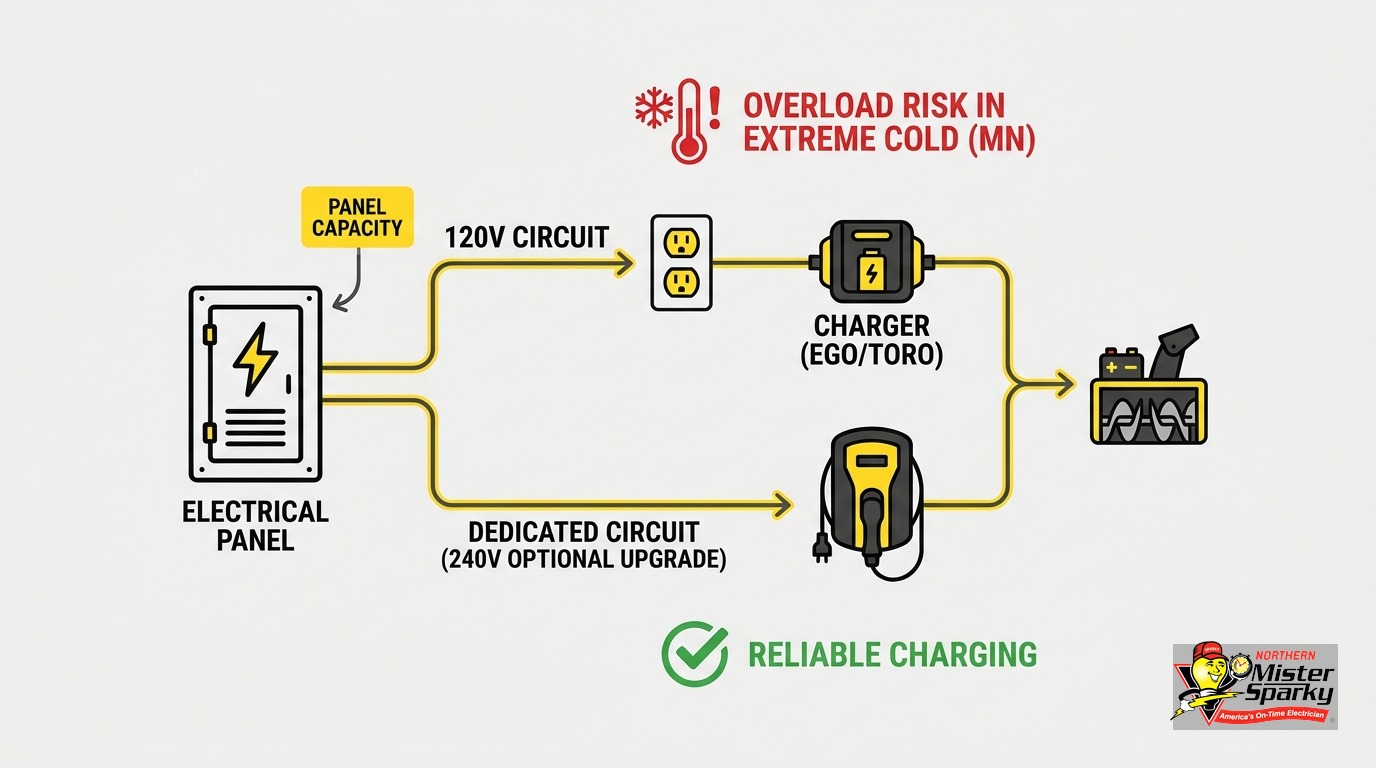
- The real winter problem is temperature, not power. EGO chargers will not charge below 41°F.
- Minnesota’s unheated garages routinely drop below that threshold from October through March.
- A dedicated circuit for the charger alone is rarely justified. Bundling one with an EV charger installation, using Xcel Energy rebates to offset costs, often changes that math.
- Minnesota’s 2023 NEC adoption requires GFCI on all garage receptacles, a 20A minimum circuit in new builds, and one outlet per car space.
- Call us at 763-200-5956 or book online for a straight answer on your garage circuit before committing to any work.
You bought an EGO or Toro battery snow thrower to skip the gas mess this winter. Now you are standing in the garage wondering whether your existing outlet can handle it. The short answer: for charging, almost any garage outlet is fine. But there is a Minnesota-specific problem that stops chargers dead on the mornings you need the machine most, and it has nothing to do with amperage or circuit size.
Corded or Battery? The Answer Changes Everything
Most articles about “electric snowblower outlet garage” treat all electric snow machines as the same. They are not. The right answer depends entirely on which type you own.
Corded electric snowblowers run while plugged into the wall. Their motors draw 12 to 15 amps continuously while the machine is clearing snow. That sustained load genuinely stresses a circuit. You want a dedicated 20A outlet close enough that cord length does not add resistance. A light-duty extension cord or an already-loaded circuit causes real problems with corded models.
Battery-powered snow throwers work differently. You charge a removable lithium pack using a compact wall charger. The charger plugs into your outlet. When the pack is full, you snap it into the machine and run it untethered. The charger, not the machine, connects to your garage outlet. Chargers draw very little power.
This post is about battery models. That is what most Twin Cities homeowners are buying today: an EGO SNT2112, a Toro 60V thrower, or a similar battery machine. If you own a corded model, you need a real circuit conversation before the season. For battery models, the electrical question is simple. The temperature question is the one that catches people off guard.
Here is why the distinction matters for your search: nearly every article that ranks for “electric snowblower outlet garage” mixes corded-model advice into the battery-model answer. If you apply that guidance to a battery machine, you may add an expensive dedicated circuit you do not need, or miss the temperature problem that will actually stop you from charging on the worst morning of the season.
What Kind of Outlet Does an Electric Snowblower Charger Need?
A standard 120V, 15A or 20A outlet handles any battery snowblower charger on the market. No 240V circuit, no dedicated breaker, no special receptacle. If your garage has a working, GFCI-protected outlet, you have everything the charger requires.
The charger converts wall AC power to the DC voltage the lithium pack needs. It is a compact electronics device, not a power-hungry appliance. The outlet it uses is the same three-prong 120V receptacle your garage door opener and shop light already share.
How Much Power Does a Battery Snowblower Charger Actually Draw?
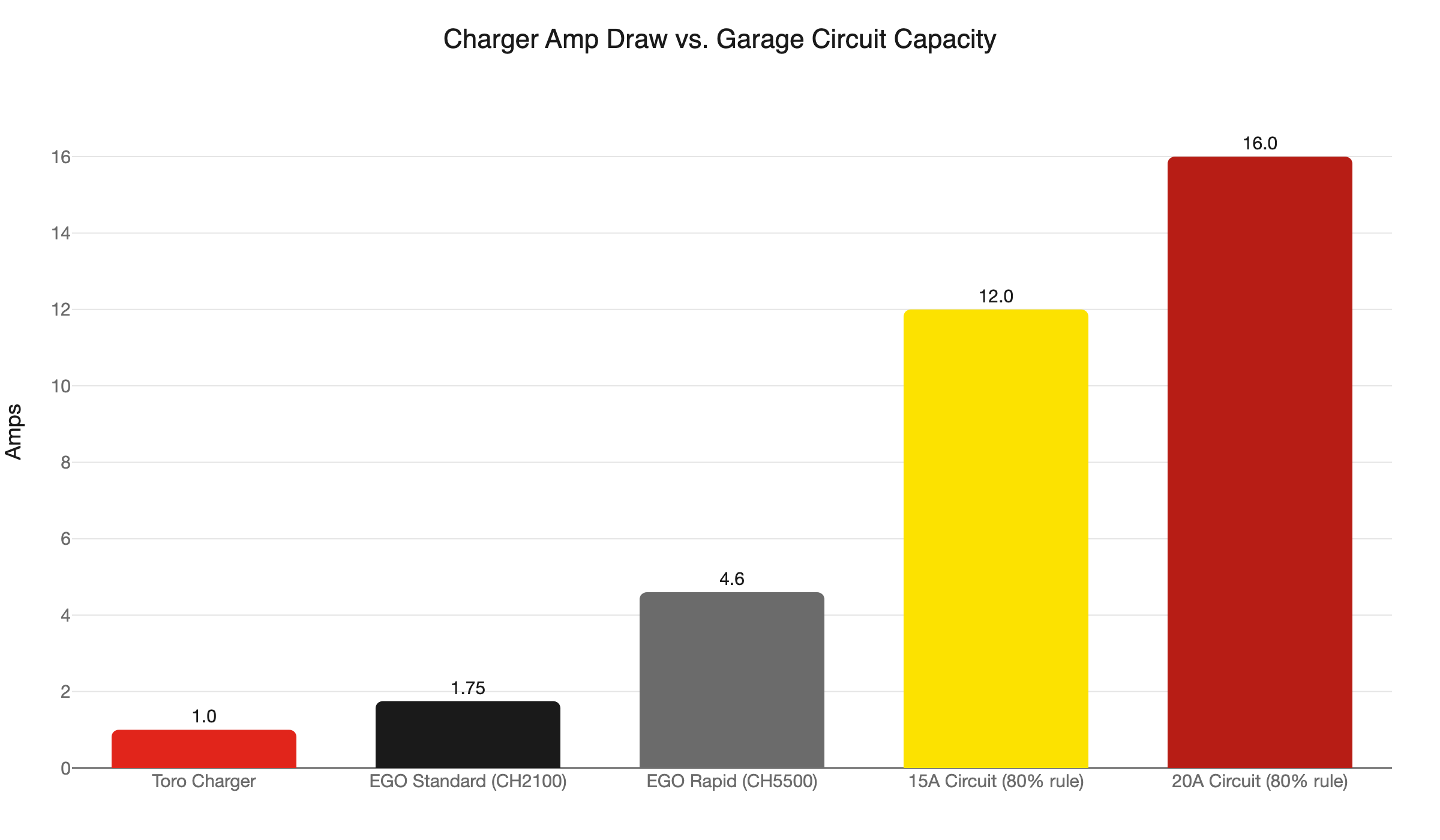
Almost nothing by household circuit standards. The EGO CH2100 standard charger draws about 1.75A, and Toro’s charger draws roughly 1A. Even the EGO CH5500 rapid charger peaks at about 4.6A. A 15A circuit’s safe continuous load is 12A. You have significant headroom with any of these chargers.
To put 4.6A in perspective: that is about what a 60-watt LED desk lamp and a phone charger draw together. The rapid charger is the most aggressive option in the lineup, and it barely registers on a household circuit.
Where cumulative load can creep toward the limit: some older Twin Cities homes run the entire garage off one 15A circuit. That circuit may serve outlets, lights, a garage door opener, a chest freezer, and block heaters in winter. Adding a rapid charger pushes the total higher. In a modern garage with a dedicated 20A receptacle circuit, this is not a concern. In a home wired in the 1960s or 1970s, it is worth checking.
The most common real-world scenario: a pre-1980 garage with one 15A circuit that has accumulated load over the years. A chest freezer, a second fridge, block heaters for both cars, and now a rapid charger on top. A load assessment is the right call before assuming the circuit can handle one more thing. We can run that check with a clamp meter in under a minute on any service visit.
Why Won’t My EGO Charger Work in the Garage in January?
Because the garage is too cold. EGO battery chargers stop charging below 41°F (5°C) and signal this with a red blinking indicator. An unheated Twin Cities garage in January sits well below that threshold on most mornings. This is the problem almost no article about garage outlets addresses, and it catches Minnesota homeowners off guard every season.
The 41°F cutoff is stricter than most people expect. Many battery-tool owners have internalized “don’t charge below freezing,” meaning 32°F. EGO’s cutoff is nine degrees above freezing. Your unheated attached garage in Minneapolis or Maple Grove may already be below 41°F by late October.
The practical timeline: an unheated garage in the Twin Cities typically drops below 41°F sometime in late October or early November. It does not recover until April. That window covers the entire snowblower season. If you do not account for this, you will wake up to a blinking red charger on the morning of a major overnight snowfall.
Three solutions, each of which works:
Bring batteries inside the night before a storm. A 56V battery pack charges in 2 to 3 hours on a basement or utility room outlet. This costs nothing and requires no electrical work. Add it to your storm-prep routine the same way you charge your phone before a long drive.
Add a radiant heater aimed at the charging corner. A 1,500W mounted radiant heater raises the microclimate near the charger above 41°F within 15 to 20 minutes. It also benefits your car battery, the garage door opener’s battery backup, and any other cold-sensitive equipment in the space.
Mount the charger at bench height, not on the floor. Cold air is denser and sinks to the concrete slab. A charger and battery sitting on a shelf or wall bracket 36 inches up experiences measurably warmer air than equipment resting on the floor. This is the simplest fix and requires no new hardware.
If you heat your garage, or are planning to, this problem disappears entirely. A heated garage electrical plan gives you the complete picture on what circuits a heater, new outlets, and shop lighting require. A properly heated garage changes how the space functions from October through April.
One final note on battery health: charging lithium cells at very low temperatures accelerates cell degradation, even on chargers that technically allow it. If your battery pack’s runtime has dropped noticeably after one or two Minnesota winters, cold-temperature charging is the most likely culprit. The damage to affected cells is cumulative and permanent. Charging indoors or in a heated space protects your battery investment regardless of what the charger’s minimum spec says.
What Does Minnesota Electrical Code Require for Garage Outlets?
Minnesota adopted the 2023 NEC effective July 1, 2023, and the state is under the 2026 NEC as of mid-2026. In plain terms: new garages need a dedicated 20A circuit, GFCI on every outlet, and at least one outlet per car space. Older garages are grandfathered until permitted work triggers an update.
Here is what the key sections require:
Dedicated 20A circuit. NEC 210.11 requires at least one 20A, 120V circuit serving only garage receptacles in new construction. That circuit cannot be shared with lighting or the garage door opener.
One outlet per car space. NEC 210.52(G)(1) requires at minimum one receptacle per car bay. A two-car garage needs at least two outlets.
GFCI on everything. The 2023 NEC extended GFCI protection to all 125V-250V garage receptacles, including 240V outlets. An EV charger, a welder outlet, or a 240V heater circuit in the garage requires GFCI if the circuit is touched under a permit. This caught a lot of homeowners off guard when the 2023 NEC took effect.
Permit jurisdiction. About 40 Minnesota cities run their own electrical inspection authority, including Minneapolis and St. Paul. Filing with the wrong authority delays the permit and the inspection. We know which jurisdiction covers your address and file there directly. You do not have to navigate that part.
Older garages are not required to upgrade unless permitted work opens the space to inspection. But EV charger installations, new circuits, and panel upgrades all require permits. When those permits open, an inspector reviews the surrounding area. Unprotected outlets or missing GFCI will be flagged before the permit closes.
A full assessment before any permitted work tells you exactly what is grandfathered, what an inspector will flag, and what a complete bring-to-code would cost. We do that assessment before pulling any wire. Our attached garage electrical wiring code guide goes deeper on the specific NEC sections and how they apply to existing Twin Cities garages.
When Should You Add a Dedicated Circuit for Your Garage?
You do not need one just for the snowblower charger. Three scenarios make it worth doing: you are adding an EV charger and can bundle the work on one permit, your existing garage circuit is already overloaded, or you want a permanent heated charging station with the heater on its own circuit.
Bundle it with an EV charger. This is the most compelling case. A Level 2 EV charger requires a 240V circuit from the panel to the garage. While conduit is open and the permit is active, adding a 20A 120V outlet costs a fraction of what a separate job would. One visit, one permit, one pull of wire. Our EV charger installation guide walks through the process from evaluation through rebate submission.
Your existing circuit is already loaded. If you see lights dim when the garage door opener engages, or the breaker trips without an obvious cause, those are signs of a circuit at or near capacity. Adding any more load on top is asking for a problem. A dedicated second circuit is the right fix, not a workaround. We can also check whether the symptoms are a load issue or something else entirely: a loose connection, a failing outlet, or a breaker that needs replacement. Getting the diagnosis right before adding circuits saves time and money.
You want a permanent heated charging corner. A 1,500W space heater draws 12.5A continuously. On a 15A circuit, that leaves almost no margin for anything else. Give the heater its own 20A circuit and the charger draws 4.6A alongside it with no issue. This setup runs all winter without any thought about what else is running on the circuit.
If the garage is a detached structure and you are adding more than one circuit, a detached garage subpanel is often the cleaner and cheaper long-term approach. Run one larger feed from the main panel to a subpanel in the garage. Distribute individual circuits from there. It is less expensive over time than running multiple separate circuits all the way back to the main panel on separate trips.
Can You Bundle This With an EV Charger and Get Xcel Energy Rebates?
Yes, and this is the angle most homeowners miss. Xcel Energy currently offers up to $500 for EV charger wiring (up to $1,300 for income-qualified households) and up to $1,500 for a panel upgrade done at the same time. A snowblower outlet added to the same permit comes along at minimal additional cost.
Xcel’s home wiring rebate covers materials and labor for adding a 240V circuit for a Level 2 EV charger. If the existing panel needs to be upsized to support the added load, the panel upgrade rebate stacks on top. Both apply to the same project on the same invoice.
The federal Section 30C EV charger tax credit expired June 30, 2026. Xcel rebates are now the primary financial incentive for most Twin Cities homeowners. We walk through eligibility with you before filing any permit, so the expected rebate amount is clear before work starts.
A typical package: panel upgrade, 240V EV charger circuit, and a new 20A outlet in the garage corner. Two of those three items receive Xcel rebate coverage. The snowblower outlet rides along at marginal added cost. For many homeowners, this is the scenario where adding garage circuits becomes nearly free.
What to Do Before Snowblower Season
Whether or not your garage needs electrical work, run through this checklist before the first forecasted snow:
Test your outlet. A $10 outlet tester from any hardware store tells you in 30 seconds whether the outlet is properly wired, grounded, and GFCI-protected. An improperly wired outlet can damage sensitive electronics and is a shock hazard. If the tester flags anything, that is a quick fix before the season starts.
Know your garage temperature. A wireless thermometer with a remote sensor inside the garage costs about $20 and gives you a real-time reading from inside the house. If the garage drops below 41°F before a forecast storm, bring the batteries inside to charge overnight.
Assess your circuit load. If your garage runs a freezer, block heater, lights, and charger all on one 15A circuit, call us for a load check. An overloaded circuit trips at the worst possible moment: the coldest morning of the year, when everything is running at once.
Check your extension cord. If you run the charger on a cord, confirm it is at least 16 gauge and rated for outdoor use. For runs over 25 feet, use 12 gauge. An undersized cord wastes power as heat and can overheat during a long charging session.
Store batteries at a partial charge. For winter storage, keep packs at 50 to 80% charge. Not full and not empty. This protects cell health through a long Minnesota winter and keeps the pack in a usable state after extended storage.
Ready to Sort Out Your Garage Electrical?
If you want a straight answer on what your garage circuit can actually handle, or you want to add an outlet and bundle the work with an EV charger to capture Xcel rebates, call the locally owned Twin Cities team at 763-200-5956 or book online.
We are America’s On-Time Electrician(R). We show up when we say we will, explain the work before we start, and back every job with the UWIN(R) 100% satisfaction guarantee. One visit, straight answers, no malarky.
Frequently Asked Questions
Do I need a dedicated circuit for my electric snowblower charger? +
Why won't my EGO snowblower charger work in my cold garage? +
What outlet does an electric snowblower need in the garage? +
Need an electrician now?