
Garage Outlet for Engine Block Heater: The Minnesota Guide
Key Takeaways
- Block heaters are continuous loads. NEC 210.20 requires a circuit sized at 125% of the load - a dedicated 20A circuit is the correct choice.
- All garage outlets in Minnesota must be GFCI-protected under NEC 210.8.
- Standard GFCI outlets at the receptacle face nuisance-trip on most block heaters. A GFCI breaker at the panel solves both the code requirement and the tripping problem at once.
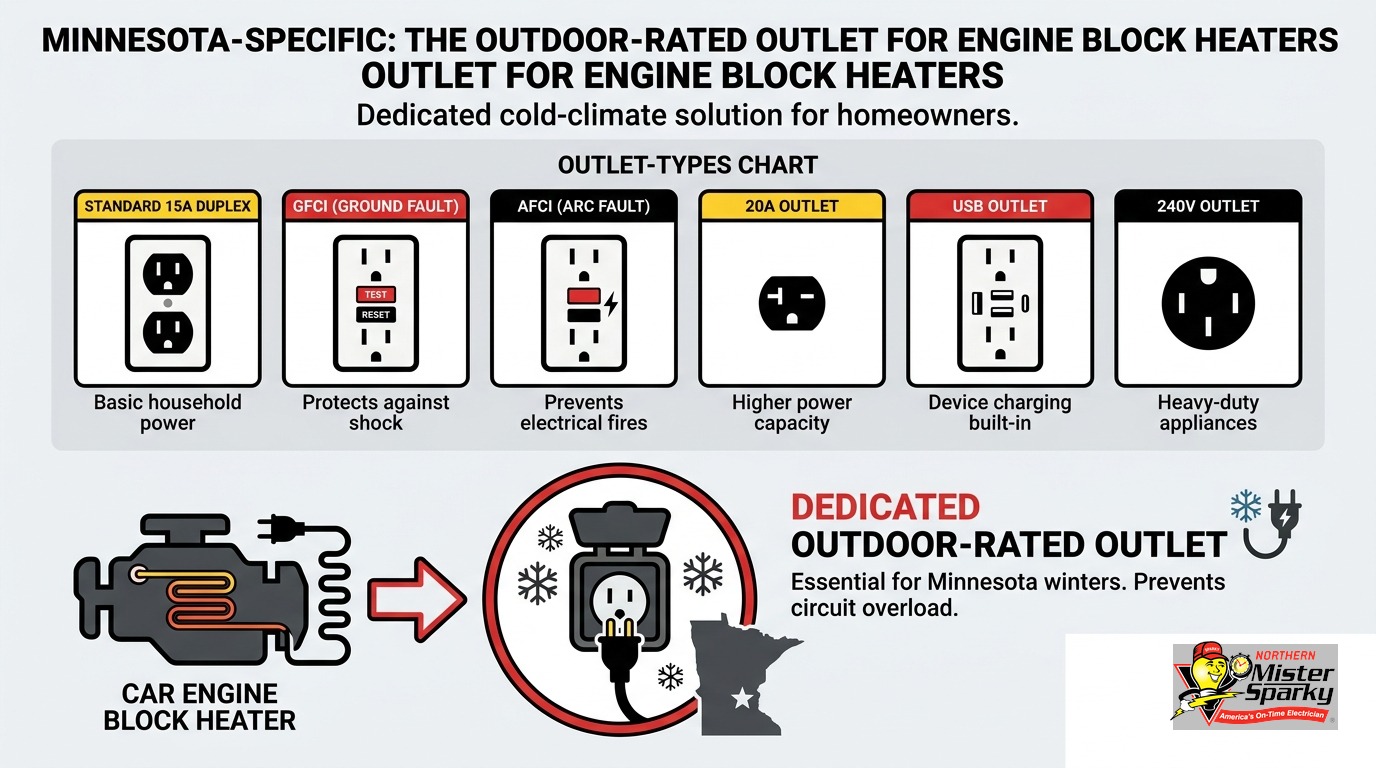
- The outlet hardware must include a weatherproof box, a WR/TR-rated receptacle, and an in-use bubble cover that seals around the cord while the heater is plugged in.
- Minnesota adopted the 2026 NEC on August 17, 2026. Any permit pulled on or after that date uses the new code.
- A permit is required. Minneapolis and St. Paul each use separate permit systems from the statewide DLI.
Minnesota winters test every system in your house, and the one most homeowners overlook until November is the garage outlet for engine block heater use. A block heater is simple: plug it in overnight, and the engine starts on the first turn in the morning. The problem is where you plug it in. The wrong outlet trips constantly, overloads a shared circuit, or leaves you with a heater that is running but not code-compliant. This guide covers what the correct installation looks like, why standard GFCI outlets trip with block heaters, and what Minnesota’s newly adopted 2026 electrical code means for permits pulled today.
Why Does a Block Heater Need Its Own Circuit?
Short answer: Block heaters run for hours overnight, which makes them a continuous load under the electrical code. Continuous loads require circuits rated at 125% of the draw - a shared garage circuit rarely has that margin, and adding a block heater to one risks trips throughout the night.
Under NEC 210.20, any load that runs for three or more continuous hours must be served by conductors and overcurrent protection rated at 125% of that load. A block heater running from 10 p.m. to 6 a.m. qualifies easily.
The math shows why a shared circuit fails. If your garage circuit is 15A and already carries a shop light, a battery maintainer on an overnight charge, and a chest freezer, adding a block heater that draws 6-12A pushes the circuit past its continuous-load limit. The breaker does what breakers do.
A dedicated 20A circuit eliminates the calculation entirely. The block heater gets its own breaker, its own wire run, and its own outlet. Nothing else on that circuit can knock out your heater at 2 a.m.
Homeowners who have run block heaters on dedicated 20A non-GFCI circuits confirm that a properly installed dedicated circuit handles the load without incident through a full Minnesota winter.
How Much Power Does a Block Heater Draw?
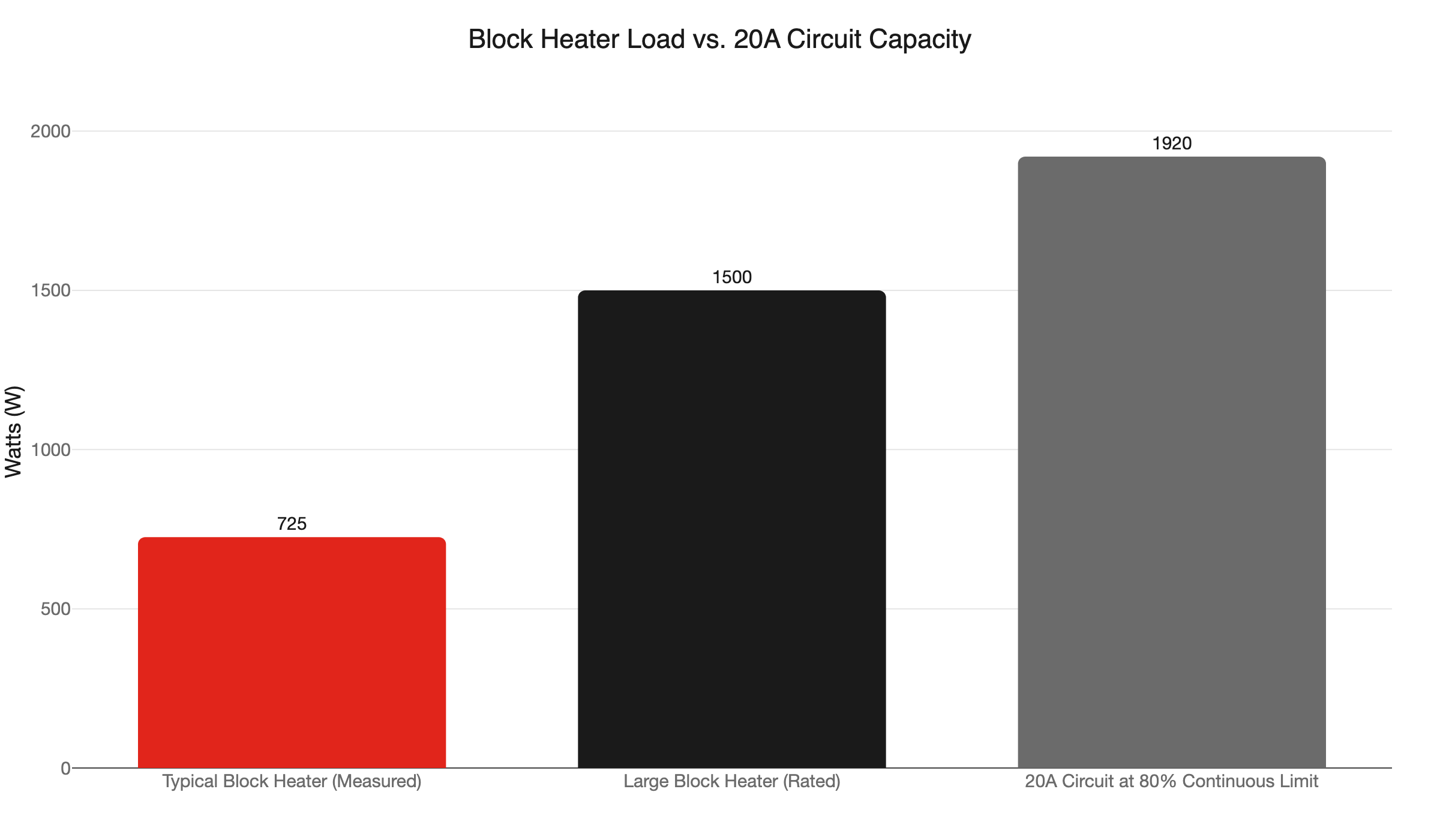
Short answer: Factory ratings run 1,000W to 1,500W, but measured real-world draw on many vehicles is closer to 725W once the coolant warms up. For circuit sizing, always design to 1,500W and apply the 125% continuous load factor - that math lands you squarely on a 20A circuit.
The rated wattage on a block heater label is the maximum draw at startup. Once the coolant reaches temperature, the element cycles and actual draw drops. Field measurements on diesel engines have confirmed draws as low as 725W - about 6A at 120V - under real overnight conditions.
Do not size the circuit to the measured draw. You do not know which vehicle will be in that garage in five years or which block heater a future owner will use. Design to 1,500W:
- 1,500W / 120V = 12.5A
- 12.5A x 1.25 (continuous load factor) = 15.6A
- A 20A circuit with 12-gauge wire satisfies this with a reasonable safety margin.
A 15A circuit technically passes the math only when the heater draws 1,200W or less - a margin too thin to rely on in a Minnesota January. A 20A circuit is the professional standard for this installation.
Why Does My Block Heater Keep Tripping the GFCI?
Short answer: Block heaters have inherent leakage current built into their design. A GFCI trips at just 5 milliamps. Most block heaters leak enough current from the heating element to ground to trigger a properly functioning GFCI every single time. This is not a faulty outlet - it is a mismatch between the protection device and the load.
The heating element inside a block heater sits in engine coolant. Coolant conducts electricity slightly, and current can track from the element to the metal engine block through the fluid. That path has measurable resistance to ground. A block heater cord measuring even 2,400 ohms to ground will trip a properly functioning GFCI, because the leakage current through that resistance at 120V exceeds the 5mA trip threshold.
The GFCI is working exactly as designed. It cannot tell the difference between leakage current from a heating element and leakage current flowing through a person.
There is a second problem specific to Minnesota. Older pre-2010 GFCI outlets can nuisance-trip in extreme cold - internal components lose calibration accuracy at very low temperatures. Current-generation GFCIs are temperature-rated to -35°F and that cold-weather failure mode is eliminated. But even a new, cold-rated GFCI outlet will still trip on block heater leakage current.
The fix that actually works
Install a GFCI breaker at the panel rather than a GFCI outlet at the receptacle face. A GFCI breaker has a higher practical leakage tolerance before tripping, and it protects the entire circuit while fully satisfying the NEC 210.8 requirement. The outlet face becomes a standard duplex receptacle. You get code compliance and no more predawn trips to the panel in your slippers.
The 2026 NEC, in effect in Minnesota since August 17, 2026, added a Class C GFCI exception for listed heating equipment - similar to the exemption already in place for HVAC compressor motors. If your permit falls under the 2026 NEC and your block heater qualifies as listed heating equipment, ask your electrician whether that exception applies to your installation. For most homeowners, the GFCI breaker is the simpler, universal solution under either code version.
For a complete breakdown of when to choose each option, read our GFCI breaker vs. GFCI outlet comparison.
What Kind of Outlet Do I Need for a Garage Block Heater in Minnesota?
Short answer: You need three components: a weatherproof electrical box, a WR/TR-rated receptacle (weather-resistant and tamper-resistant), and an in-use bubble cover that seals around the cord while the heater is plugged in. All three are required for any new garage or outdoor receptacle installation under current Minnesota code.
Here is what each component does and why it matters:
Weatherproof box. A standard nail-in plastic box is not rated for the temperature swings, condensation, and vehicle exhaust that a garage outlet faces daily. The box must be weatherproof-rated for the installation environment.
WR/TR-rated receptacle. Weather-resistant contacts resist corrosion and maintain reliable contact through freeze-thaw cycles. Tamper-resistant shutters block accidental insertion of objects into unused slots. Both ratings are required for new receptacle installations in garage and outdoor locations.
In-use bubble cover. The old clamshell cover that flips down over an empty outlet has not been code-compliant for new installations since the 2014 NEC. The in-use cover seats a bubble or hood around the cord body and seals the box even when the heater is plugged in and running. This requirement applies to all new outdoor receptacle installations - and a garage wall outlet qualifies as an outdoor location under the code.
A block heater cord will sit in that outlet from October through March. The cover needs to seal with the cord in it, through temperature swings from 40°F to -25°F. Do not cut corners on the hardware.
For more on the full installation process, see our guide on outdoor GFCI outlet installation.
Does Minnesota Require a Permit for a New Garage Outlet?
Short answer: Yes. Any new circuit in Minnesota requires an electrical permit pulled by a licensed electrical contractor. Jurisdiction depends on your city: most of the state uses the statewide DLI system, but Minneapolis and St. Paul each operate their own separate permit departments. No permit means real insurance and resale exposure.
Minnesota’s electrical code sits in Chapter 1315 of the State Building Code, which adopts the NEC as the installation standard. The Department of Labor and Industry (DLI) administers electrical permits for most of the state through its online contractor system.
Minneapolis and St. Paul are the exceptions. Both cities run their own permit and inspection programs and do not participate in the DLI system. If your home is in either city, your electrician pulls the permit through the city directly.
Why the permit matters for you:
- Insurance. Electrical fire claims are routinely denied when the work was done without a permit. Your carrier will ask whether it was permitted.
- Sale. An inspector hired by a buyer will find an unpermitted circuit. It becomes a negotiating point at the worst possible moment.
- Safety. The permit triggers an inspection that verifies wire gauge, breaker rating, box type, and GFCI protection before the wall closes.
For a full walkthrough of what the permit process looks like from the homeowner’s side, read our electrical permit in Minnesota guide.
What Changed with the 2026 NEC in Minnesota?
Short answer: Minnesota adopted the 2026 NEC on August 17, 2026. Permits pulled on or after that date use the new code. The most relevant change for block heater installations is a new Class C GFCI exception for listed heating equipment. For most homeowners, a GFCI breaker is still the cleanest solution under either code version.
Minnesota’s Board of Electricity adopted the 2026 NEC with an effective date of August 17, 2026. Permits filed before that date use the 2023 NEC. Permits filed on or after it use the 2026 NEC. Minneapolis and St. Paul adopt through their own local processes, so confirm the active code version with your city’s permit office.
The two versions differ in ways that matter for a block heater circuit:
Under the 2023 NEC: NEC 210.8 requires GFCI protection for all garage receptacles from 125V through 250V. This expanded the requirement beyond standard 120V outlets to include 240V tool receptacles and EV charger outlets. No heating-load exception existed.
Under the 2026 NEC: A Class C GFCI exception applies to listed heating equipment, effective after September 1, 2026 - similar to the motor-load exemption already in place for HVAC compressors. If your block heater is a listed heating device and your permit falls under the 2026 NEC, a non-GFCI circuit may be permissible. Ask your electrician whether your specific equipment qualifies.
For most homeowners, the GFCI breaker remains the right answer. It satisfies both code versions without any equipment-qualification question, and it permanently eliminates the nuisance-tripping problem.
A note on online advice: most national blog posts and forum threads about block heater outlets reference the 2020 or 2023 NEC. Minnesota moved to 2026 on August 17. If a source cannot tell you which edition your state is on, treat its code citations with skepticism.
GFCI Breaker vs. GFCI Outlet: Which One Solves the Tripping Problem?
Short answer: A GFCI breaker solves both the code requirement and the nuisance-tripping problem together. A GFCI outlet at the receptacle face meets the code requirement but will still trip on most block heaters because of leakage current. For a block heater circuit, the GFCI breaker is the correct tool.
Here is the side-by-side:
| GFCI Outlet | GFCI Breaker | |
|---|---|---|
| Meets NEC 210.8 for garage | Yes | Yes |
| Trips on block heater leakage | Usually yes | Usually no |
| Protects entire circuit | No | Yes |
| Reset location | Outlet face | Panel box |
| Installed cost | Lower | Higher |
The GFCI breaker costs more upfront. It earns that cost back the first morning you do not need to go to the panel at 6 a.m. in January before your car will start.
One nuance: if your panel is older and uses a brand with limited GFCI breaker availability, your electrician may recommend a different solution path. That is a conversation to have during the estimate. But for any standard residential panel with current breaker inventory, the GFCI breaker installation is straightforward.
What Does It Cost to Add a Dedicated Block Heater Outlet in the Twin Cities?
Short answer: Budget $300-$500 for a straightforward installation with a short circuit run in an unfinished garage. Longer runs, finished walls, or a full electrical panel push the cost to $500-$900 or more. The permit and inspection are included in any complete quote from a licensed Minnesota electrician.
The primary cost variable is how far the new circuit has to travel from the electrical panel to the garage outlet location. A house where the panel sits on the garage wall and the run is 10 feet costs less than a panel in a finished basement on the far side of the house.
General ranges for the Twin Cities:
- Short run, unfinished garage walls: $300-$500, including permit and inspection.
- Longer run or walls that require patching: $500-$900.
- Panel has no open slots or needs a subpanel: Variable - the circuit cost stacks on top of the panel work. If your panel is running short on breaker slots, that conversation belongs at the start of the project, not after the electrician is already on site.
One rebate worth knowing about: Xcel Energy offers an EV Home Wiring Rebate of up to $500 - or $1,200 for income-qualified customers - for a 240V EV circuit installation. There is no standalone rebate for a 120V block heater outlet. But if you are adding both a block heater outlet and an EV charger circuit in the same project, the wiring work overlaps and the rebate may apply to a portion of the total. Contact Xcel at EVRebates@xcelenergy.com for eligibility details before scheduling.
Schedule Your Installation Before the First Freeze
We are a locally owned and operated Twin Cities electrical contractor, and we install dedicated block heater circuits all winter. Our team knows the permit jurisdiction split between DLI, Minneapolis, and St. Paul - we pull the right permit for your address and schedule the inspection.
What a complete block heater outlet installation from Northern Mister Sparky includes:
- A dedicated 20A circuit from the panel to the garage wall
- Weatherproof box, WR/TR receptacle, and in-use bubble cover
- GFCI breaker installed at the panel (not a GFCI outlet at the receptacle face)
- Permit and inspection, completed and documented
Every installation is backed by the UWIN(R) 100% satisfaction guarantee. As America’s On-Time Electrician(R), we arrive when we say we will and finish the job right the first time. No malarky.
Call 763-200-5956 or book your block heater outlet installation online today - before Minnesota hands you its first -20°F morning.
Frequently Asked Questions
Why does my block heater keep tripping the GFCI outlet? +
Does a block heater need its own dedicated circuit? +
What kind of outlet do I need for a block heater in a Minnesota garage? +
Does Minnesota require a permit for a new garage outlet? +
Need an electrician now?