
Electric Smoker Electrical Circuit Requirements in Minnesota
Key Takeaways
- Electric smokers running a long cook are a continuous load by code. A 15A circuit allows only 12A of continuous draw. A 1,500W smoker pulls 12.5A and exceeds that limit.
- A dedicated 20A circuit is the right choice for any smoker rated above 1,200W.
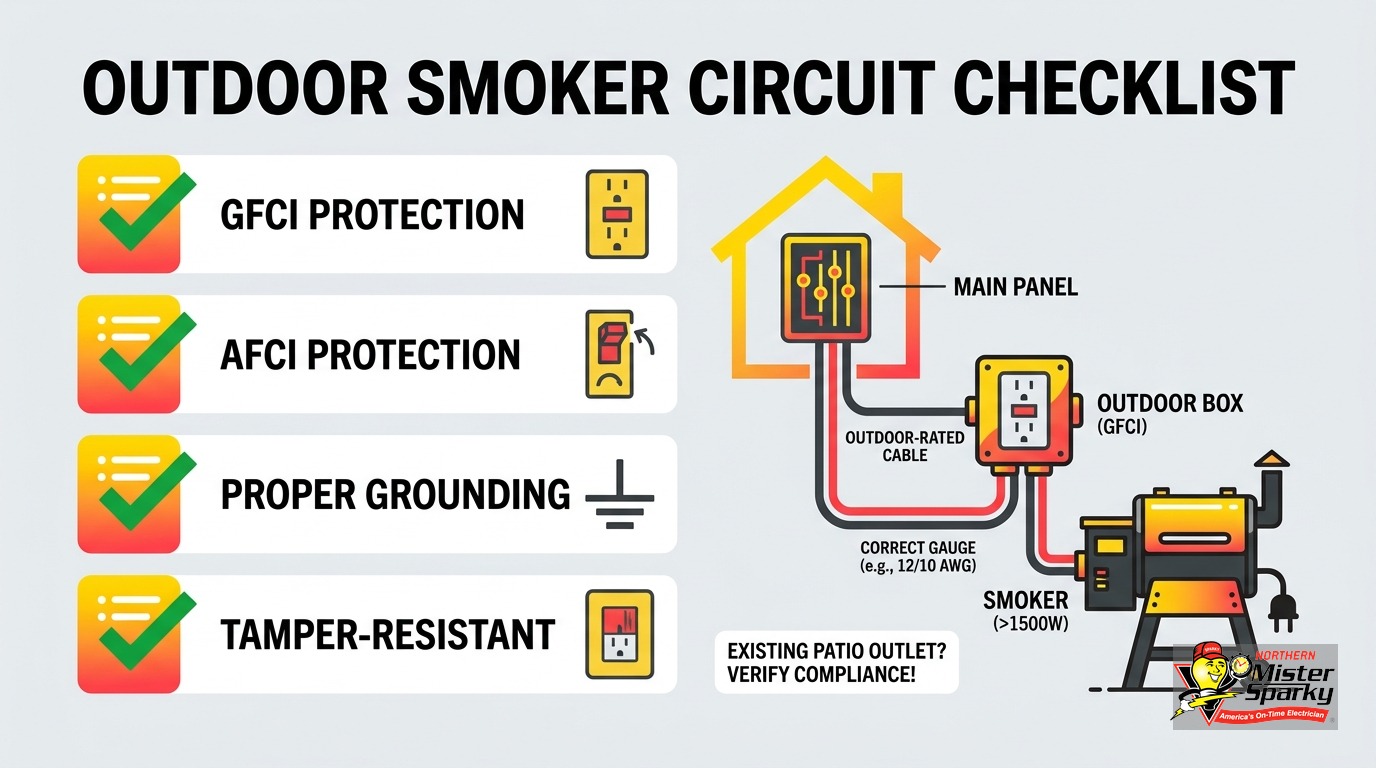
- Your existing patio outlet must pass four checks to legally qualify: GFCI protection, a weather-resistant (WR) device rating, an “extra duty” in-use cover, and adequate circuit ampacity.
- Minnesota adopted the 2026 NEC on August 17, 2026. Any permit pulled today falls under those rules.
- Adding a new outdoor circuit requires a permit filed with Minnesota DLI before work starts.
- GFCI trips during a smoke almost always point to moisture. Do not bypass the GFCI.
What Are the Electric Smoker Electrical Circuit Requirements?
Any electric smoker rated above 1,200W needs a dedicated 20A, 120V circuit. The outlet must be GFCI-protected, weather-resistant (WR rated), and fitted with an “extra duty” in-use cover. That combination satisfies both the continuous-load rule and Minnesota’s outdoor outlet code.
Most buying guides and manufacturer manuals offer the same advice: plug your smoker into a GFCI-protected outdoor outlet. That is not wrong. It is incomplete. It does not explain what “GFCI-protected” actually requires in code terms, whether your existing patio outlet legally qualifies, or whether a 15A circuit can carry a 12-hour brisket smoke under code.
This post fills that gap. We will cover the continuous-load rule, the four checks your outdoor outlet must pass, how pellet smokers differ from electric models, why GFCI trips happen during a cook, and what the permit process looks like in Minnesota.
Does a Smoker Count as a Continuous Load Under Electrical Code?
Yes. NEC 210.19(A)(1) and 210.20(A) define a continuous load as any load expected to run three hours or more. A smoker on an all-day cook is a continuous load by definition. That triggers the 80% rule: your draw cannot exceed 80% of the circuit’s rated ampacity.
What 80% means in practice
The Minnesota DLI electrical inspection checklist confirms the wire and circuit sizing requirements. The math on the continuous-load limit is straightforward:
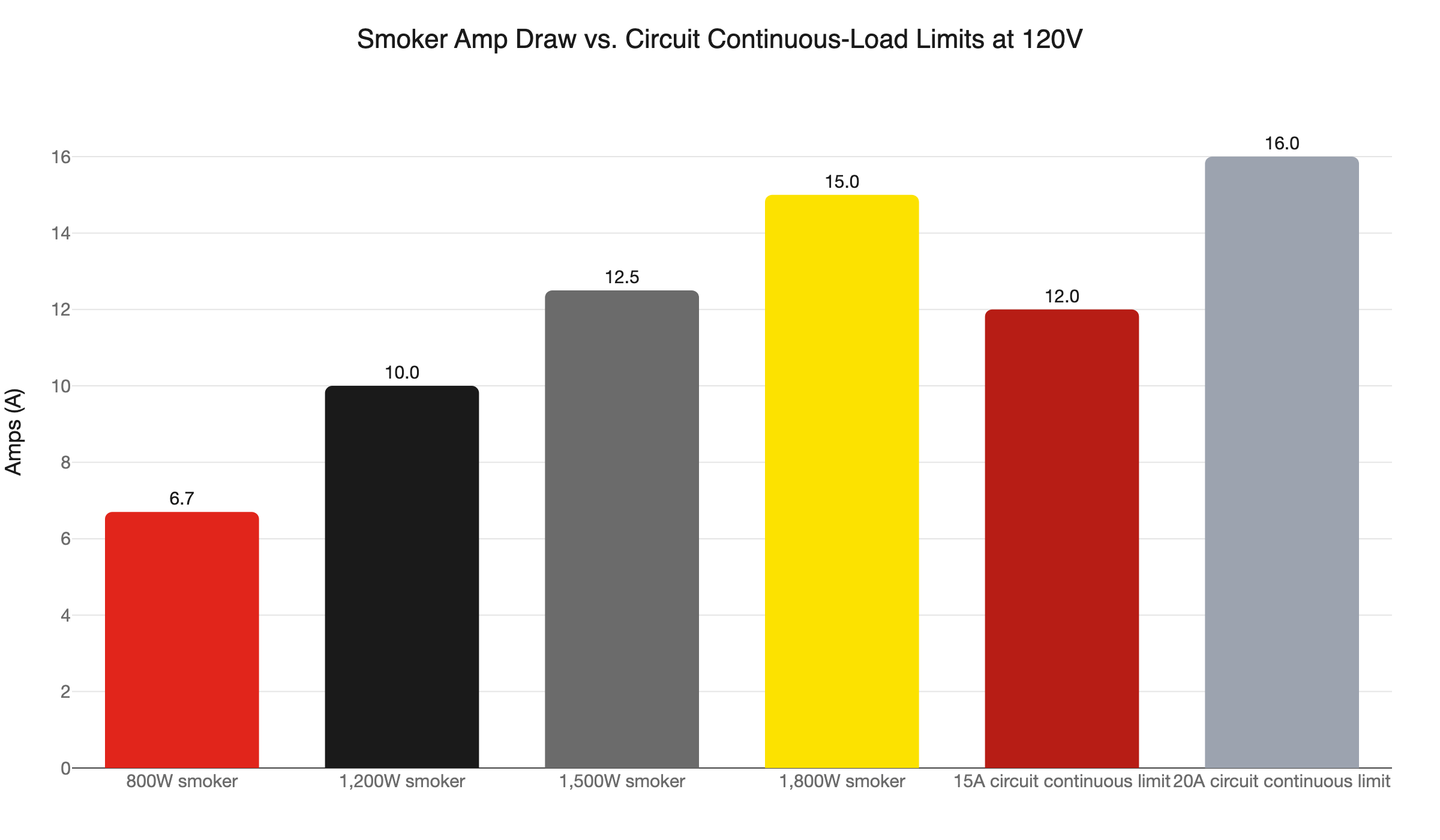
- 15A circuit: maximum 12A continuous draw (80% of 15A)
- 20A circuit: maximum 16A continuous draw (80% of 20A)
Here is how common smoker wattages translate to amps at 120V:
- 800W smoker: 6.7A. Well within a 15A circuit’s 12A continuous limit.
- 1,200W smoker: 10.0A. Within the 15A limit, but little margin remains.
- 1,500W smoker: 12.5A. Exceeds the 15A continuous limit of 12A. Requires a 20A circuit.
- 1,800W smoker: 15.0A. Far over the 15A limit. At the edge of a 20A circuit’s 16A continuous limit.
A 1,500W smoker will not necessarily trip a 15A breaker. The heating element cycles on and off to hold temperature, keeping the average draw lower than the rated wattage. But code requires sizing for the rated load at continuous operation, not the time-averaged draw. The correct solution is a dedicated 20A circuit, and that is what an inspection will expect.
That same DLI checklist confirms that 20A circuits require 12 AWG copper wire minimum. A 15A circuit uses 14 AWG copper. Aluminum is not permitted for 15A or 20A residential branch circuits in Minnesota.
What Makes an Existing Patio Outlet Qualify?
Four things must all be true at once: GFCI protection, a weather-resistant (WR) device rating, an “extra duty” in-use cover, and adequate circuit ampacity for a continuous load. Most older patio outlets fail at least one of these.
GFCI protection
NEC 210.8(F) requires GFCI protection on all outdoor outlets at dwelling units supplied by single-phase branch circuits rated 150V to ground or less, at 50A or less. The 2023 NEC expanded that to cover garages, accessory buildings, and boathouses. It also raised the voltage threshold from 125V only to 125V through 250V. That means 240V outdoor appliance outlets now require GFCI protection.
The equipment-replacement rule adds a second trigger. When you replace any covered outdoor outlet, you must upgrade it to GFCI protection at the same time. That requirement is spelled out in NEC 2023 210.8(F). Minnesota has been under the 2026 NEC since August 17, 2026, which made further refinements to section 210.8. For a full breakdown of the rules, see our post on GFCI outlet requirements explained.
Weather-resistant (WR) device
NEC 406.4 and 406.9 require outlets installed or replaced in wet locations to be listed as weather-resistant. Look for the letters “WR” molded into the face of the device, below the slots. This is separate from the cover. It means the outlet itself is built to handle moisture, UV exposure, and temperature swings. An outlet without the WR stamp does not meet current code for outdoor use, regardless of what cover sits over it.
”Extra duty” in-use cover
The cover must remain weatherproof with a cord plugged in. A standard flip-lid that will not close over an inserted cord does not qualify. You need a bubble-style or deep-flip cover that maintains a seal around the cord. The words “extra duty” should be stamped or molded on the cover itself. Minnesota DLI inspections enforce this under NEC 406.9.
Minnesota freeze-thaw cycles are hard on plastic covers. A warped or cracked cover that no longer seats properly is a code violation. It is also the most common GFCI-trip cause we see in Twin Cities homes. Check yours at the start of every smoker season and replace it if there is any cracking, warping, or gap at the hinge.
Tamper-resistant (TR) device
NEC 406.4 and 406.12 require all 15A and 20A, 125V-through-250V receptacles installed or replaced in dwelling units to carry a tamper-resistant (TR) rating. Three exceptions exist: outlets more than 5.5 feet above the floor, dedicated-appliance spaces, and outlets integrated into a light fixture. For a patio outlet at normal height, the TR requirement applies.
Circuit ampacity
Even an outlet that passes every physical check still fails if the circuit behind it is undersized. A 15A circuit feeding a 1,500W smoker exceeds the continuous-load limit. If you are adding or upgrading a patio outlet to serve a smoker, plan on a dedicated 20A circuit with 12 AWG copper wiring from panel to outlet.
For a broader look at what a properly wired outdoor space requires, our guide on deck and patio outdoor electrical planning walks through the full scope.
Do Pellet Smokers Have Different Electrical Requirements Than Electric Smokers?
Mostly no - but the startup igniter surge is worth understanding. Pellet smokers draw 300-800W during the igniter phase, which lasts four to six minutes. After that, the controller settles into a 50-150W maintenance draw. The surge is brief, but it can trip a marginal GFCI on a shared circuit that is already under load.
Why the surge matters
At steady state, a pellet smoker draws under 1.5A. The continuous-load rule is not a concern. The problem is that igniter surge at startup. If the patio outlet shares a circuit with outdoor lighting, a fridge, or other appliances, that surge lands on top of the existing draw. On a loaded shared circuit, it can push past the GFCI’s trip threshold.
A dedicated 20A circuit eliminates this problem entirely. With no other load on the circuit, a brief igniter surge is well within the breaker’s capacity and will not trip a properly installed GFCI.
If your pellet smoker consistently trips the GFCI at startup, the fix is almost certainly a dedicated circuit, not a GFCI replacement.
Extension cord warning
Do not run any smoker on an extension cord. Extension cords add resistance that generates heat under continuous load. They are not rated for sustained outdoor use. A cord on a wet deck is both a GFCI-trip source and a fire hazard. Install a permanent outdoor outlet at the location where the smoker actually sits.
Why Does My GFCI Keep Tripping When I Run My Smoker?
Moisture is almost always the answer. GFCI devices trip at 4-6 milliamps of ground-fault current. A smoker’s heating element or a damaged cord can create exactly that level of leakage when wet. The GFCI is not broken. It is telling you there is a ground fault. The job is to find the moisture source, not bypass the protection.
Where to look first
Cracked or warped in-use cover. This is the most common cause in Minnesota. A cover that no longer seals allows rain and condensation to reach the outlet box. Start here. If the cover shows any cracking, warping, or gap at the hinge, replace it before doing anything else.
Damaged power cord. Inspect the cord along its full length. Look for nicks, abrasion marks, and a pulled strain relief where the cord enters the plug. A nick that exposes bare copper is a direct leakage path to ground when the cord is wet.
Moisture inside the smoker. If the unit sat outside uncovered during rain, or under a non-breathable tarp, condensation can settle on the heating element. Running the smoker at low heat with the door open for several minutes before a cook lets it dry out. This often stops the tripping before a single brisket is loaded.
Accumulated leakage on a shared circuit. Multiple appliances on one outdoor circuit can each contribute a small amount of harmonic leakage current. Those currents add up. If the GFCI trips with the smoker running but not with any other individual device, a dedicated circuit is the fix.
Never replace the GFCI with a standard outlet to stop the tripping. That removes the protection the code requires and the protection that guards against electric shock. If you cannot isolate the moisture source, call an electrician for a full circuit and device inspection. Our post on outdoor GFCI outlet installation covers what a proper installation looks like and what an inspection checks.
Does Running a New Outdoor Circuit Require a Permit in Minnesota?
Yes, always. Adding a new circuit from your panel to an outdoor outlet is electrical work subject to inspection under Minnesota law. A separate permit must be submitted to Minnesota DLI at or before the start of work. There are no exceptions for small jobs.
How the permit process works
Minnesota routes residential electrical permits through the Department of Labor and Industry, not the local city building department. A licensed electrician files the permit before work begins and schedules a state electrical inspection after the job is complete.
Homeowners who own and occupy their residence can pull their own permit and perform the work themselves. That requires signing an affidavit confirming ownership and occupancy. The homeowner exemption does not apply to rental properties or multi-family buildings.
Minnesota adopted the 2026 NEC effective August 17, 2026. Permits filed on or after that date must comply with 2026 NEC requirements. Permits filed before that date comply with the 2023 NEC. If your project crosses that date, confirm with your electrician which code edition governs the inspection.
Unpermitted electrical work surfaces at sale time. Buyers’ inspectors find it, lenders flag it, and a retroactive permit is more expensive and disruptive than doing it right the first time. For a full overview of what electrical work requires a permit in Minnesota, we have a dedicated post.
Four Things to Check Before Smoker Season
You may not need a full circuit upgrade. Run through this list before your first cook of the year:
- Look for “WR” on the outlet face. The letters should be molded below the slots. No WR marking means the device does not meet current code for wet locations and needs to be replaced.
- Look for “extra duty” on the in-use cover. Check the inside face of the cover. If it will not close over an inserted cord, it does not qualify regardless of any other markings.
- Check the cover for cracks and warping. Freeze-thaw cycles in Minnesota crack outdoor covers over time. A cover that no longer seats properly is a code violation and the most common GFCI-trip cause we see at the start of grilling season. Replace it before the first cook.
- Check your panel label for circuit ampacity. If the patio outlet is on a 15A breaker and your smoker is rated 1,500W or above, you are over the continuous-load limit. A dedicated 20A circuit is the fix.
If any check fails, call us before you fire up the smoker. No malarky: a cover replacement takes minutes, and a dedicated circuit takes a few hours. Both are far less painful than a GFCI trip at hour six of a brisket cook.
When to Call Northern Mister Sparky
We are locally owned and operated in the Twin Cities. As America’s On-Time Electrician(R), we arrive on time, scope the work honestly, and back every job with the UWIN(R) 100% satisfaction guarantee.
Call us when:
- Your patio outlet has not been inspected in several years and you are not sure it meets current code
- Your smoker is rated 1,500W or above and runs on a shared 15A circuit
- Your GFCI is tripping during cooks and you cannot find the moisture source
- You want a dedicated 20A outdoor circuit installed with a proper Minnesota permit
Call 763-200-5956 or book online. We serve Minneapolis, St. Paul, Bloomington, Brooklyn Park, Woodbury, Blaine, Maple Grove, Plymouth, and the surrounding Twin Cities metro.
Frequently Asked Questions
Do I need a dedicated circuit for an electric smoker? +
Why does my GFCI outlet keep tripping when I use my smoker? +
Does adding an outdoor circuit for a smoker require a permit in Minnesota? +
Need an electrician now?