
Outdoor Fire Pit Area Electrical Outlets: MN Code Explained
Key Takeaways
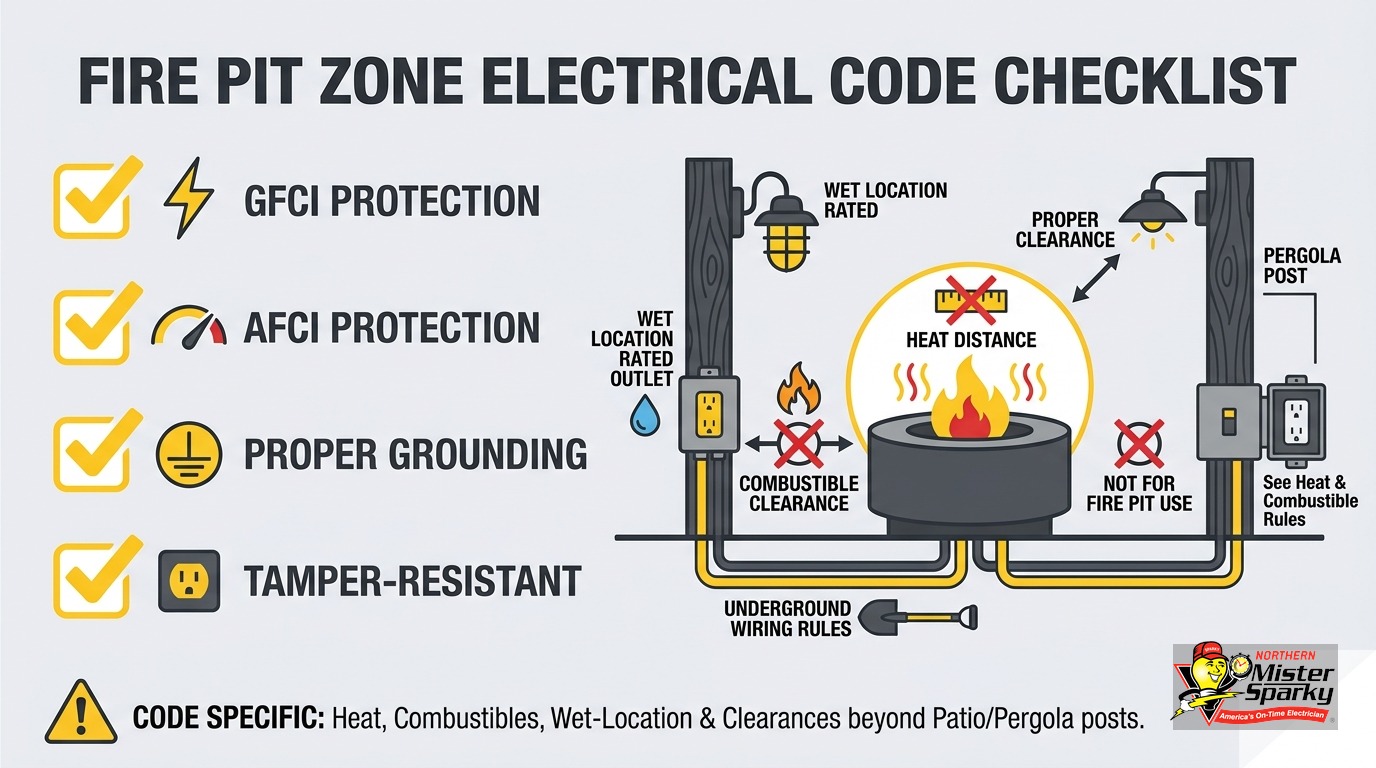
- All outdoor fire pit area electrical outlets require GFCI protection under NEC 210.8(A)(3), including 240V receptacles as of the 2023 NEC.
- Three code systems apply at the same time in a fire pit zone: the NEC (electrical installation), the Minnesota Fire Code / IFC Section 307 (open flame clearances), and UL equipment temperature ratings under NEC 110.3(B).
- Minnesota Statute 326B.33 prohibits homeowner DIY electrical work with no exemptions. A licensed contractor is required for every residential electrical installation in this state.
- Minnesota adopted the 2026 NEC effective August 17, 2026. Permits from that date forward are under the new code.
- IFC 307 (adopted by Minnesota) requires 25-foot clearance from structures and combustibles for recreational fires. Portable outdoor fireplaces require 15 feet.
- Outdoor receptacles need “extra duty” in-use covers under NEC 406.9(B)(1) to remain code-compliant when cords are plugged in during rain.
- Minnesota’s freeze-thaw cycle makes rigid metal conduit (RMC) or Schedule 80 PVC the preferred method over direct-buried UF cable for fire pit circuit runs.
Why Your Fire Pit Zone Needs More Than a Standard Outdoor Outlet
Short answer: A fire pit entertainment area combines sustained radiant heat, outdoor moisture exposure, and fire-code clearance requirements. Standard outdoor outlet guidance does not address this combination. Skipping any one of the three layers leads to a non-compliant or unsafe installation.
A fire pit patio is one of the most popular outdoor upgrades in the Twin Cities right now. Guests want speakers, string lights, phone chargers, and maybe a mini fridge. That is all achievable with the right electrical plan.
The electrical work for a fire pit zone is more complex than adding an outlet to a standard deck or screened porch. Most of what you read online about outdoor outlets was written for a generic patio without open flame.
The gap is specific. National guides cover the basics: use GFCI outlets, use weatherproof covers, hire a licensed electrician. What they skip are the three things that actually matter in a fire pit zone. First, how sustained radiant heat affects outlet box and conduit ratings. Second, what the Minnesota Fire Code says about clearances in the same zone as your electrical runs. Third, the fact that Minnesota does not allow homeowners to do their own electrical work at all.
This post covers all three so you can plan this project with a clear picture of what is actually required.
Three Code Systems That Govern Outdoor Fire Pit Area Electrical Outlets
Most outdoor electrical guides only reference the NEC. A fire pit installation requires three separate code lenses, and each one shapes where and how the outlets get installed.
1. The National Electrical Code (NEC / NFPA 70) governs the electrical installation itself. It sets requirements for GFCI protection, wet-location enclosure ratings, burial depth for underground feeders, and the rule that all equipment must be installed per its listing under NEC 110.3(B). Minnesota adopted the 2026 NEC effective August 17, 2026. Permits before that date used the 2023 NEC. Permits from August 17, 2026 forward are under the new code.
2. The Minnesota Fire Code (MN Rule 7511 / IFC Section 307) sets minimum clearances for open burning and recreational fires from structures and combustible materials. Those clearances define where the fire pit can legally sit relative to the house, fence, or pergola, and that in turn defines where underground conduit runs and outlet boxes can safely go. MN Rule 7511.0604, covering electrical equipment and wiring in fire-regulated zones, cross-references the NEC directly, making this a dual-code concern. For the permit side of outdoor electrical work, see our guide to getting an electrical permit in Minnesota.
3. UL equipment temperature ratings are the layer most guides miss entirely. The NEC does not set a minimum distance from a fire pit to an outlet. Instead, NEC 110.3(B) requires that all equipment be used in accordance with its listing and labeling. Standard PVC outlet boxes are listed to roughly 60-75°C. Standard Schedule 40 PVC conduit tops out around 60°C. If sustained radiant heat from a fire pit routinely pushes the ambient temperature in the outlet zone above those thresholds, the installation is non-compliant on a thermal basis, regardless of whether it passes a routine visual inspection.
A licensed electrician coordinates all three systems. A homeowner or DIYer typically misses two of them entirely.
How Far Should an Outlet Be from a Fire Pit?
Short answer: The NEC sets no minimum distance from a heat source to an outlet. NEC 110.3(B) requires that equipment operate within its temperature rating. Separately, the Minnesota Fire Code (IFC 307 via MN Rule 7511) requires 25-foot clearance for recreational fires from structures and combustibles, and 15-foot clearance for portable outdoor fireplaces.
Under IFC Section 307 as adopted by Minnesota Rule 7511.0307, recreational fires require 25-foot clearance from any structure and from combustible material. Portable outdoor fireplaces, the kind with a manufactured body and spark screen, require 15 feet. Minnesota deleted the residential exception to the 307.4.3 rules for portable outdoor fireplaces. The 15-foot standard applies statewide, without a homeowner loophole.
Here is the practical consequence. If your fire pit sits 10 feet from the house, it may not meet code before a single wire is run. That conversation belongs at the planning stage.
For outlet placement itself, the electrical contractor and the local inspector evaluate whether the proposed locations for boxes, conduit, and wiring fall within the temperature ratings of the materials being used. An outlet box on a pergola post 8 feet from a fire pit burning for three hours is in a very different thermal zone than one mounted 20 feet away on the house wall. That judgment call requires a licensed professional who has looked at the site and knows the equipment specifications.
What Type of Outlet Is Required Near a Fire Pit?
Short answer: All outdoor receptacles at dwellings require GFCI protection under NEC 210.8(A)(3). The 2023 NEC expanded this to cover 125V through 250V receptacles, so a 240V outlet near a fire pit also requires GFCI. Any outlet with a cord plugged in during rain requires an “extra duty” in-use cover under NEC 406.9(B)(1).
GFCI protection is non-negotiable for outdoor receptacles. But the enclosure type is where many installations fall short.
A standard “flip lid” weatherproof cover protects the outlet when nothing is plugged in. The moment you plug in a Bluetooth speaker, a phone charger, or a string light controller and it starts raining, that lid is forced open. The standard cover no longer provides protection.
NEC 406.9(B)(1) solves this with the “in-use” or “bubble” cover. This domed, gasket-sealed enclosure keeps the outlet protected even with a cord running out the bottom. For a fire pit patio where guests routinely plug in devices, in-use covers are the code-required choice, not an optional upgrade.
The distinction between wet and damp locations applies to every fixture and enclosure in the zone as well. An outlet mounted on an exposed pergola post in the open is a wet location. One mounted under a roof overhang that deflects direct rain is likely a damp location. The NEC requires enclosures and fixtures listed for wet locations in wet exposures, and listed for damp or wet in damp exposures. A fixture that meets “damp” but not “wet” is non-compliant on an exposed post. This distinction is routinely wrong in DIY installs.
The Heat Problem No One Else Addresses
Generic outdoor electrical guides do not discuss heat proximity because they are written for a generic outdoor outlet. This is a real code concern that separates fire pit electrical work from standard deck outlet work.
A wood-burning fire pit burns at temperatures exceeding 1,000°F at the combustion zone. Sustained radiant heat at 8 to 10 feet is significant. Standard materials used in outdoor electrical installations have temperature ceilings:
- PVC Schedule 40 conduit: rated to approximately 60°C (140°F)
- THHN/THWN wire insulation: 90°C dry, 75°C wet
- Standard PVC outlet boxes: 60-75°C depending on UL listing
On a cool Minnesota evening with a fire burning for two hours, the ambient temperature in a tight pergola corner 8 feet from the fire can approach or exceed those ratings. The wire inside conduit will not catch fire. But PVC conduit, PVC boxes, and enclosure gaskets can soften, deform, and crack over repeated high-heat cycles. That degradation breaks the moisture seal and compromises the physical protection of the wiring over time.
This is why NEC 110.3(B) is the governing provision even without a specific setback rule. Equipment must be used within its listed conditions. Metal boxes with rigid metal conduit (RMC) or intermediate metal conduit (IMC) have significantly higher thermal tolerance. They are the right material choice for any zone with sustained heat exposure near a fire pit.
A licensed electrician selects materials and plans placement with this exposure in mind. That is part of the job, not a conversation for later.
Does Minnesota’s Climate Make Outdoor Wiring Harder?
Short answer: Yes. Minnesota’s freeze-thaw cycle degrades direct-buried UF cable as the ground heaves and shifts over repeated winters. Rigid metal conduit (RMC) or Schedule 80 PVC conduit are the preferred methods in the Twin Cities because they protect wire from movement and allow access without excavation.
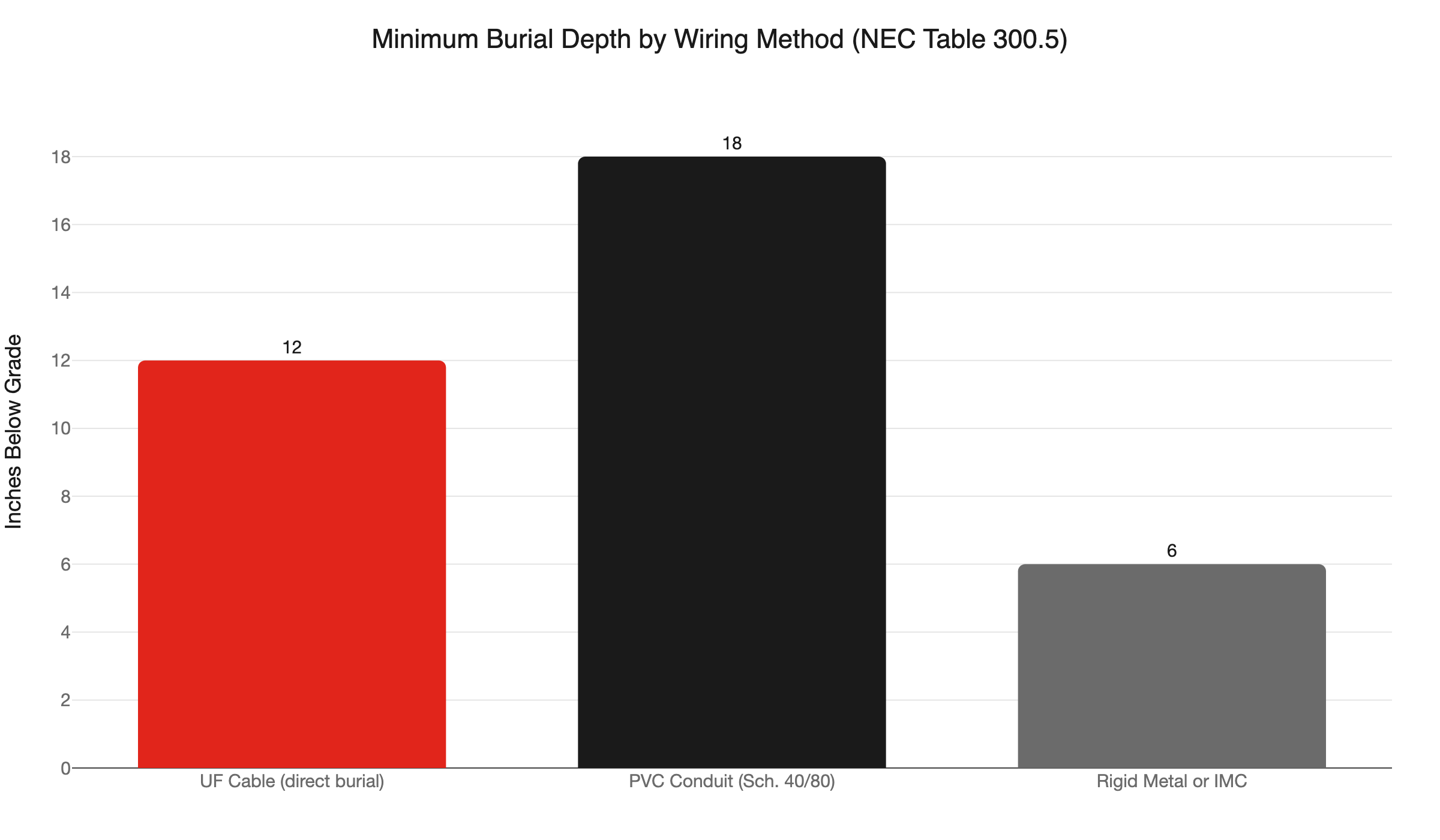
NEC Table 300.5 sets minimum burial depths for underground wiring:
- Direct-buried UF cable: 12 inches minimum
- PVC conduit (Schedule 40 or 80): 18 inches minimum
- Rigid metal conduit (RMC) or IMC: 6 inches minimum
These are code floors. In Minnesota, the ground freezes 42 to 60 inches deep in a hard winter. Frost heave pushes soil upward as water freezes and expands. Direct-buried cable shifts along with it. That movement creates stress at connection points and along the wire jacket over repeated freeze-thaw cycles.
Twin Cities inspectors often prefer conduit-protected runs for exactly this reason. The wire is mechanically protected from ground movement. If a problem develops later, the wire can be pulled and replaced without excavating the entire run.
There is also an enclosure concern specific to Minnesota’s climate. Outdoor season runs from roughly May to October, with hard transitions at each end. Enclosure gaskets and in-use covers that perform well through a humid August can become brittle and crack after one severe winter if they are not rated for cold-temperature flexibility. Extra-duty rated enclosures with quality gaskets are the correct specification for a Minnesota installation.
Can a Minnesota Homeowner Wire a Fire Pit Outlet Themselves?
Short answer: No. Minnesota Statute 326B.33 requires all electrical work to be performed by a licensed contractor employing licensed electricians. Minnesota does not offer the homeowner exemption that most other U.S. states provide. There is no legal DIY path for this project.
This is one of the most consequential differences between Minnesota and the rest of the country. It is entirely absent from every national article that ranks for fire pit electrical topics.
In most states, a homeowner can pull a permit and wire their own primary residence under a homeowner exemption. Minnesota prohibits it outright under MN Statute 326B.33. All residential electrical work, including adding a single outdoor outlet, requires a licensed electrical contractor with licensed electricians on the job. The Minnesota Department of Labor and Industry licenses both contractors and electricians under Chapter 326B. No malarky: there is no legal self-install path for this project in Minnesota.
The permit still gets pulled, the work still gets inspected, and a licensed contractor must do it. Planning with a licensed electrician from the start also means the fire pit placement, conduit routing, and outlet locations are designed as a system. It is far easier to get them right together than to retrofit code-compliant wiring into a layout built without those constraints.
What Happens During a Fire Pit Electrical Installation?
Short answer: A licensed electrician visits the site, assesses the fire pit location against code clearances, designs a circuit layout that satisfies NEC requirements and thermal exposure, pulls a permit, performs the installation, and coordinates the inspection. The permit and inspection are required steps, not optional add-ons.
Here is the typical sequence for a fire pit patio electrical build in the Twin Cities.
Site assessment. The electrician looks at where the fire pit sits relative to the house and structures. They check where outlets and lighting are needed, what conduit routing makes sense for the layout, and whether the panel has capacity for a new circuit. See our full overview of deck and patio outdoor electrical planning for the scope of decisions an outdoor circuit build involves.
Panel capacity check. A dedicated 20-amp GFCI circuit is the typical starting point for a fire pit entertainment zone. If the panel is near capacity or already full, a panel upgrade conversation happens before any outdoor work begins.
Permit pull. A permit is required for new circuit work in Minnesota. The licensed contractor pulls it before work starts, not after.
Trenching and conduit installation. An underground feeder runs from the house to the patio in conduit. In Minnesota, rigid metal conduit or Schedule 80 PVC is preferred over direct-buried UF cable for the freeze-thaw and longevity reasons described above.
Box and receptacle installation. Boxes are mounted with extra-duty enclosures and in-use covers. Placement accounts for fire pit heat exposure. Materials are chosen for the thermal zone.
Inspection. The local authority having jurisdiction (AHJ) inspects the completed work. The permit closes when the inspection passes. No shortcuts on this step.
What Does It Cost to Add Outdoor Fire Pit Area Electrical Outlets?
Short answer: A single GFCI outlet added to an existing circuit typically runs $150-$400. A full fire pit patio build with a new dedicated circuit, underground conduit run, multiple outlets, and lighting commonly runs $800-$2,500 or more, depending on run distance, material choices, and whether the panel needs additional capacity.
These ranges reflect real variables in a Twin Cities installation.
Distance from panel to patio. A 30-foot run from an attached garage is far less labor and material than a 120-foot run to a back-lot fire pit. Every additional foot of conduit, trench, and wire adds to the total.
Material selection. Rigid metal conduit costs more than direct-buried UF cable. Near a heat source in Minnesota’s climate, it is the correct choice. The premium is real, and so is the reason for it.
Number of circuits. Dedicated circuits for lighting and receptacles versus a combined circuit affects both upfront cost and long-term flexibility. Multiple devices running at a fire pit patio can load a shared circuit quickly.
Panel capacity. If the panel needs new breaker slots or a full upgrade, that is a separate line item with its own cost. A licensed electrician can assess capacity on the same site visit that scopes the outdoor work.
Financing is available for larger outdoor electrical projects, including panel upgrades. Ask about it when you book.
Ready to Add Outdoor Fire Pit Area Electrical Outlets?
Northern Mister Sparky is locally owned and operated in the Twin Cities. Our licensed electricians pull permits, work to current Minnesota NEC code, and know what inspectors in Hennepin, Ramsey, Anoka, and Dakota counties look for on a fire pit installation.
Call us at 763-200-5956 or book online to schedule your estimate. As America’s On-Time Electrician(R), we show up when we say we will, and we back every job with the UWIN(R) 100% satisfaction guarantee.
Frequently Asked Questions
Do outdoor fire pit outlets require GFCI protection? +
Can I wire my own fire pit outlet in Minnesota? +
How far should an outlet be from a fire pit? +
Which NEC applies to Minnesota fire pit electrical permits right now? +
Need an electrician now?