
ERV HRV Electrical Wiring Requirements: A Minnesota Guide
Key Takeaways
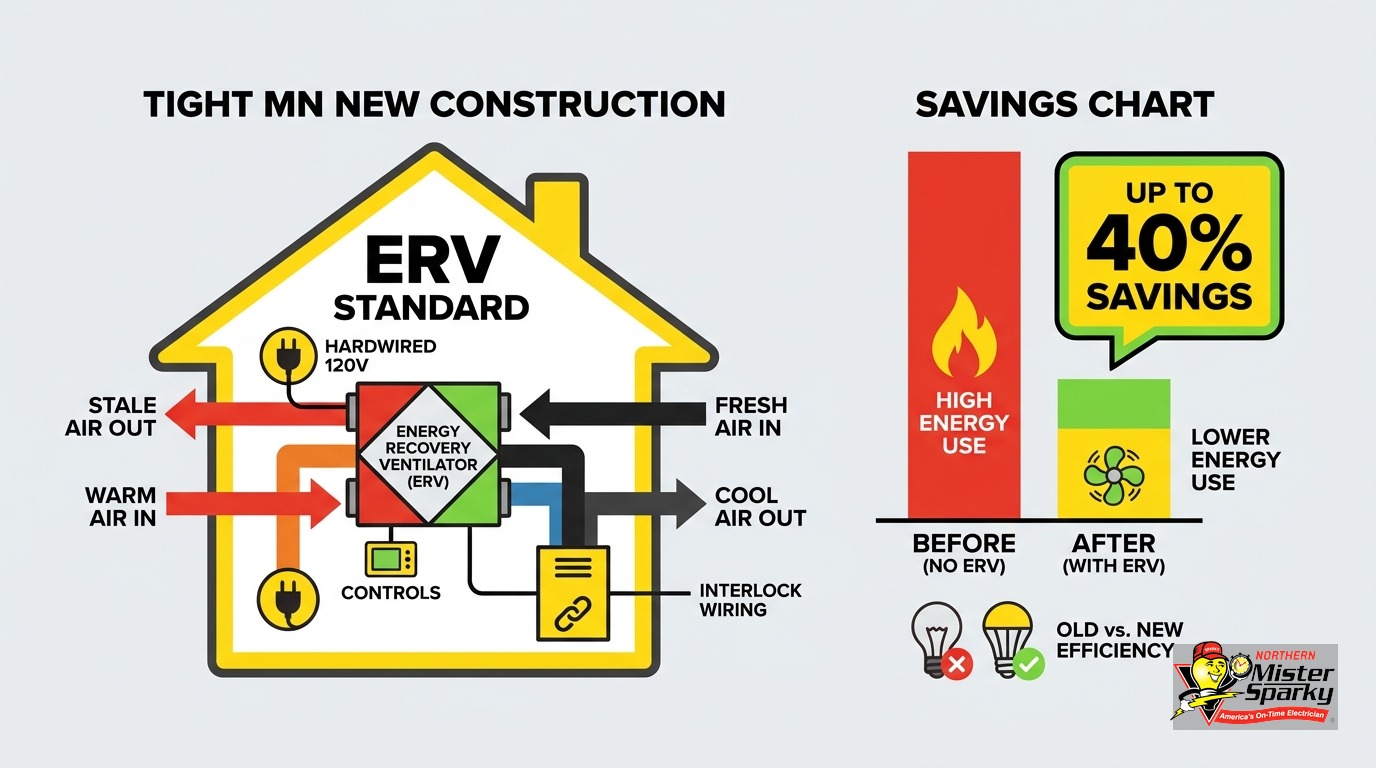
- ERVs and HRVs require a dedicated 15A/120V circuit on a single-pole breaker with 14 AWG wire.
- Electricians handle two scopes: the 120V power circuit and the 120V controls wiring to wall switch locations.
- The furnace interlock (24V to the air handler G terminal) is the HVAC tech’s scope. The electrician rough-ins power first.
- A permit is required for the dedicated circuit in Minnesota. Two inspections follow: rough-in before walls close, and final after devices are installed.
- Minnesota adopted the 2023 NEC on July 1, 2023. All permits filed on or after that date follow 2023 code.
- NEC 440.14 requires a local disconnect within sight of the unit and within 50 feet.
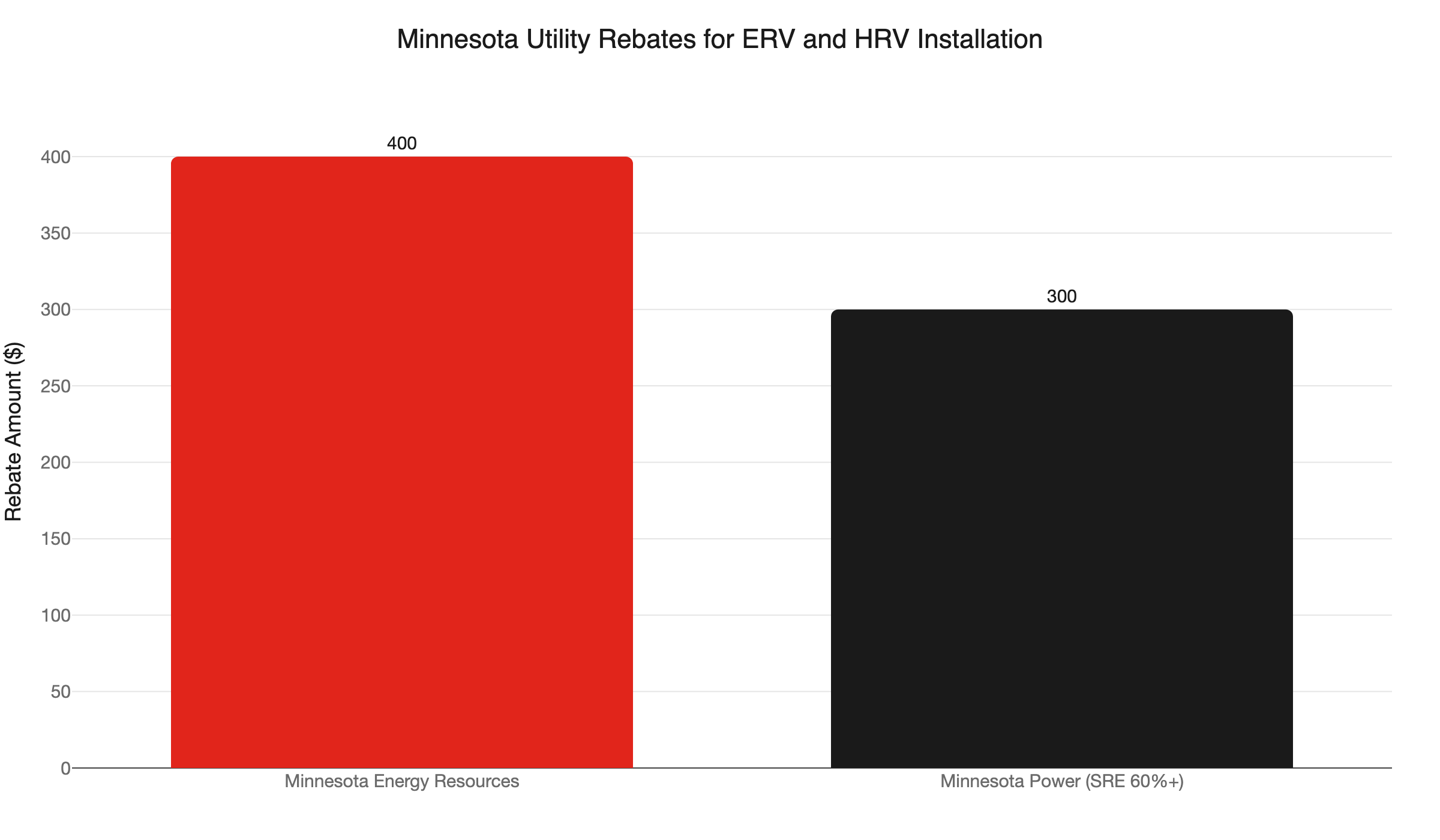
- Minnesota Energy Resources offers $400 and Minnesota Power offers $300 for qualifying installations. Verify directly with your utility before scheduling.
ERV and HRV electrical wiring requirements apply on every tight new-construction project in the Twin Cities. These units are now standard equipment in Minnesota homes. Before any HVAC tech arrives, an electrician needs to complete three tasks. Run a dedicated circuit, rough in controls wiring, and document the work for inspection. Miss that sequence and the mechanical inspection stalls.
This post covers all three electrical scopes, the Minnesota code behind the mandate, and what the permit process looks like for the circuit itself.
Why Does the Electrician Show Up Before the HVAC Tech?
Short answer: The 120V power circuit and controls rough-in must be in the wall before the HVAC tech can hang the unit, test controls, or wire the interlock. Inspectors check the electrical rough-in as part of the permit sequence. No rough-in inspection means no mechanical sign-off.
Three separate wiring scopes make up what most people call “ERV wiring”:
- The 120V dedicated circuit from the panel to the unit location (electrician’s scope)
- The 120V controls wiring to wall switches and boost switch locations (electrician’s scope)
- The 24V furnace interlock wiring to the air handler G terminal (HVAC tech’s scope)
The electrician owns scopes one and two. The HVAC tech handles the third. That hand-off point is where job-site miscommunication creates delays and failed inspections.
This split matters for homeowners managing a new build or a retrofit. If you ask your HVAC contractor to handle the electrical rough-in, someone has to license that work. In Minnesota, new circuits require a licensed electrician and a pulled permit. That work cannot legally fold into the mechanical contract.
Understanding the scope split also prevents surprise charges. Your HVAC contractor’s quote does not include the 120V rough-in unless it specifically says so. Get that scope quoted separately before scheduling either trade.
What Are ERV HRV Electrical Wiring Requirements?
Short answer: An ERV or HRV needs a dedicated 15A/120V circuit, a local disconnect within 50 feet of the unit, and 14/3 cable run to each switch location. Under MN Rules Chapter 1322, Section R403.5.6, installation must comply with both the Minnesota Mechanical Code and the manufacturer’s instructions. When the manual specifies wiring details, those details carry the force of code.
An energy recovery ventilator (ERV) transfers both heat and moisture between incoming and outgoing air. A heat recovery ventilator (HRV) transfers heat only. In Minnesota winters, HRVs are common because they do not add humidity during extreme cold. Both types share nearly identical electrical requirements.
Most residential units draw 34-80W on low speed and up to 150-200W on boost. That load is modest. But manufacturers specify a dedicated circuit to prevent nuisance trips from other appliances sharing the same breaker. The unit runs at low speed continuously in most ventilation designs. A shared circuit creates interference problems over time and can void the manufacturer warranty on some models.
The 120V Dedicated Circuit
The power circuit is the electrician’s primary task on every ERV rough-in.
Circuit specifications:
- 15A single-pole breaker
- 14 AWG copper wire (use 12 AWG if the manufacturer specifies a 20A circuit)
- Dedicated: no other loads share this breaker
- Local disconnecting means within sight of the unit and within 50 feet
The circuit runs from the panel to the unit location. Most ERVs mount in a mechanical room, crawl space, or basement utility area. The electrician installs a receptacle or hardwires the connection per the manufacturer’s instructions.
NEC Article 440 governs motor-driven ventilation equipment. NEC 440.14 requires the disconnect within sight of the unit and within 50 feet. The 2023 NEC added a requirement that the disconnect also meet 110.26(A) working clearance. Minnesota adopted the 2023 NEC on July 1, 2023. Every permit filed after that date follows the updated standard.
One detail that generates callbacks: polarity. A reversed hot and neutral at the receptacle creates a shock hazard through the ERV’s internal door safety switch. That mistake is easy to make on a fast rough-in and serious when it happens. The final inspection catches a polarity reversal with a simple tester. Getting it right the first time avoids a correction trip.
For more on circuit sizing and code requirements, see our guide on dedicated circuits for appliances.
Does an ERV or HRV Need a Dedicated Circuit?
Short answer: Yes. Manufacturers universally require a dedicated 15A/120V circuit. Under MN Rules Chapter 1322, Section R403.5.6, manufacturer installation instructions carry code-level authority. If the manual says dedicated circuit, that requirement is code.
Some older installs share a circuit with the furnace or an adjacent outlet. Those setups may have run for years without a tripped breaker. But they do not meet current installation standards. The permit process will flag a shared circuit.
A 15A circuit handles the continuous low-speed load with significant headroom. On boost, most units draw well under 12A, which is the 80% continuous load limit for a 15A circuit. The dedicated circuit requirement is about reliability and manufacturer compliance, not raw amperage.
If your panel is running short on open slots, plan the ERV circuit into the panel conversation before scheduling rough-in. See our post on what to do when your electrical panel is out of breaker slots for your options.
Controls Wiring: The Rough-In Behind Every ERV Switch
ERV wall switches and boost switches use 120V wiring, not low-voltage. That surprises many contractors seeing their first ERV installation.
Current NEC code requires a neutral at every switch location. That means even a single switch run needs 14/3 cable, not 14/2. Running 14/2 on a controls rough-in is one of the most common mistakes on new builds. The fix after walls are closed costs far more than doing it right at rough-in.
Controls rough-in checklist:
- Run 14/3 from the unit location to each wall switch location
- Confirm switch box locations with the homeowner and HVAC contractor before running wire
- Label all switch legs clearly before insulation and drywall go up
- Account for every boost switch location the homeowner wants covered
For multi-room boost control, boost switches wire in parallel. A kitchen switch and a bathroom switch can both trigger boost mode without a 3-way circuit. Each additional boost switch adds a parallel leg off the same switched conductor. Read the manufacturer’s wiring diagram before running wire, not after. Every brand handles this slightly differently.
This scope is the electrician’s from start to finish. The HVAC tech installs the switch devices later. But if the 14/3 rough-in wire is not in place at inspection, the whole rough-in fails.
Confirm with the HVAC contractor where the unit will mount before running wire. If the unit location shifts after rough-in, controls wiring may need to be extended or rerouted. A 10-minute conversation before rough-in saves hours later.
What Is the Furnace Interlock and Who Wires It?
Short answer: The furnace interlock connects the ERV’s 24V dry-contact output to the G terminal on the furnace control board. This signals the air handler blower to run whenever the ERV is ventilating. It is 24V Class 2 wiring, which is the HVAC tech’s scope. The electrician rough-ins 120V power first and steps aside.
The interlock matters because whole-house ventilation works best when the air handler distributes fresh air through the duct system. Without the interlock, fresh air discharges at one return location without mixing through the house. Most whole-house ventilation designs assume the interlock is wired and working.
Two warnings the HVAC tech needs to know:
First, on some older thermostats, energizing R and G at the furnace also triggers the Y terminal, calling for cooling. If that happens in a specific installation, an alternate interlock wiring approach is required. This is not an electrician issue. But flagging it early prevents a job-site surprise.
Second, Lennox Infinity and Evolution systems do not use a standard interlock relay. They use a proprietary communicating control connection. If the home has one of these systems, the HVAC tech needs the manufacturer-specific interlock adapter before the job can close out. Standard dry-contact wiring will not work.
The electrician and HVAC tech do not need to be on-site at the same time. A clean rough-in with labeled wiring and a completed permit card is all the handoff requires. For related reading on furnace circuit requirements, see furnace electrical wiring and disconnect switches.
Do I Need a Permit for ERV HRV Electrical Wiring in Minnesota?
Short answer: Yes. Any new circuit requires a permit under MN Stat. §326B. The dedicated ERV or HRV circuit is a new circuit. Two inspections follow: rough-in before walls close and final after all devices are installed. No permit means no legal documentation that the work was done to code.
Minnesota processes electrical permits through two channels. Roughly 66 Minnesota cities are local AHJs (authorities having jurisdiction) and issue their own permits. The remaining cities file through the state at the Department of Labor and Industry. Our post on electrical permits in Minnesota explains how to identify your AHJ and what the application involves.
For new construction: The electrical contractor typically pulls the permit as part of the overall project. The ERV circuit rough-in gets inspected during the same walkthrough as the rest of the house wiring.
For retrofits: If you are adding an ERV to an existing home, the electrician pulls a separate permit for the new circuit. The rough-in inspection happens before walls close. The final inspection happens after the circuit is energized and all devices are installed.
Why permits matter long-term: Minnesota seller disclosure law requires disclosure of known unpermitted work. An unpermitted circuit surfaces at the home inspection when you sell. The cost of a delayed closing or a renegotiated sale price is far higher than the cost of a permit.
Homeowner permits exist in Minnesota for some electrical work. But an ERV circuit on a new build or significant retrofit is better handled by a licensed contractor. Licensed electrical work carries a warranty and satisfies lender and insurance requirements.
Minnesota Code: What MN Rules Chapter 1322 Requires
Minnesota is stricter than most states on whole-house ventilation. The electrical requirements flow directly from that mandate.
MN Rules Chapter 1322, Section R403.5 requires balanced whole-house mechanical ventilation in any new home that tests at 3 ACH50 or tighter on a blower door test. That threshold describes essentially all new Minnesota construction today. An ERV or HRV is the most common way builders meet it.
Section R403.5.5 adds a Minnesota-specific cold weather standard. The unit must pass the HVI Standard 920 72-hour cold weather test at -13°F (-10°C). Not every unit marketed for North America meets that threshold. Confirm HVI 920 certification before specifying a unit for a Minnesota build. A unit that passes generic North American testing may still fail the -13°F requirement.
Section R403.5.6 ties the installation to both the Minnesota Mechanical Code (MN Rules Chapter 1346) and the manufacturer’s installation instructions. When those instructions specify wiring details, those details carry the force of code compliance. This is the provision that makes the dedicated circuit requirement legally binding, even for units where the NEC alone would only recommend it.
ENERGY STAR-certified ventilation fans must meet minimum efficacy standards per HVI testing. For inline multi-port fans common in ERV and HRV duct configurations, the minimum is 3.8 CFM/W. ENERGY STAR certification is not required by Minnesota code, but it is a common specification on energy-efficient builds and supports rebate eligibility.
Are There Rebates for ERV and HRV Installation in Minnesota?
Short answer: Two Minnesota utilities currently offer rebates. Minnesota Energy Resources offers $400 for qualifying HRV/ERV installations. Minnesota Power offers $300 for units with a sensible recovery efficiency (SRE) of 60% or greater. Xcel Energy and CenterPoint do not currently list standalone ERV/HRV rebates. Verify directly with your utility before scheduling, because rebate programs change annually.
Rebates typically tie to the mechanical equipment, not the electrical work. Your HVAC contractor handles the primary documentation. But permit and inspection records from the electrical circuit may be part of the rebate file. Ask before closing out the permit whether those documents need to be saved for the application.
Do not budget for a rebate that has not been confirmed with the utility directly. The amounts listed here reflect currently available data. Programs can change or expire without advance notice.
Schedule the ERV Circuit Before Walls Close
ERV and HRV electrical wiring requirements are not complicated. The sequencing is what trips up most projects.
Get the 120V circuit and controls rough-in inspected before insulation and drywall go up. Confirm switch locations with the HVAC contractor before running wire. Label everything clearly for the handoff. Those three steps cost nothing extra and prevent the most common delays.
We are locally owned and operated in the Twin Cities and are America’s On-Time Electrician(R). We pull permits on every circuit we run and back the work with the UWIN(R) 100% satisfaction guarantee. If you have an ERV rough-in on a new build or retrofit, call us at 763-200-5956 or book online and we will get it on the schedule.
Frequently Asked Questions
Do I need a permit for ERV or HRV electrical wiring in Minnesota? +
Who wires the furnace interlock on an ERV or HRV? +
What size circuit does an ERV or HRV need? +
Need an electrician now?