
Garage Exhaust Fan Wiring: Minnesota's Code Requirements
Key Takeaways
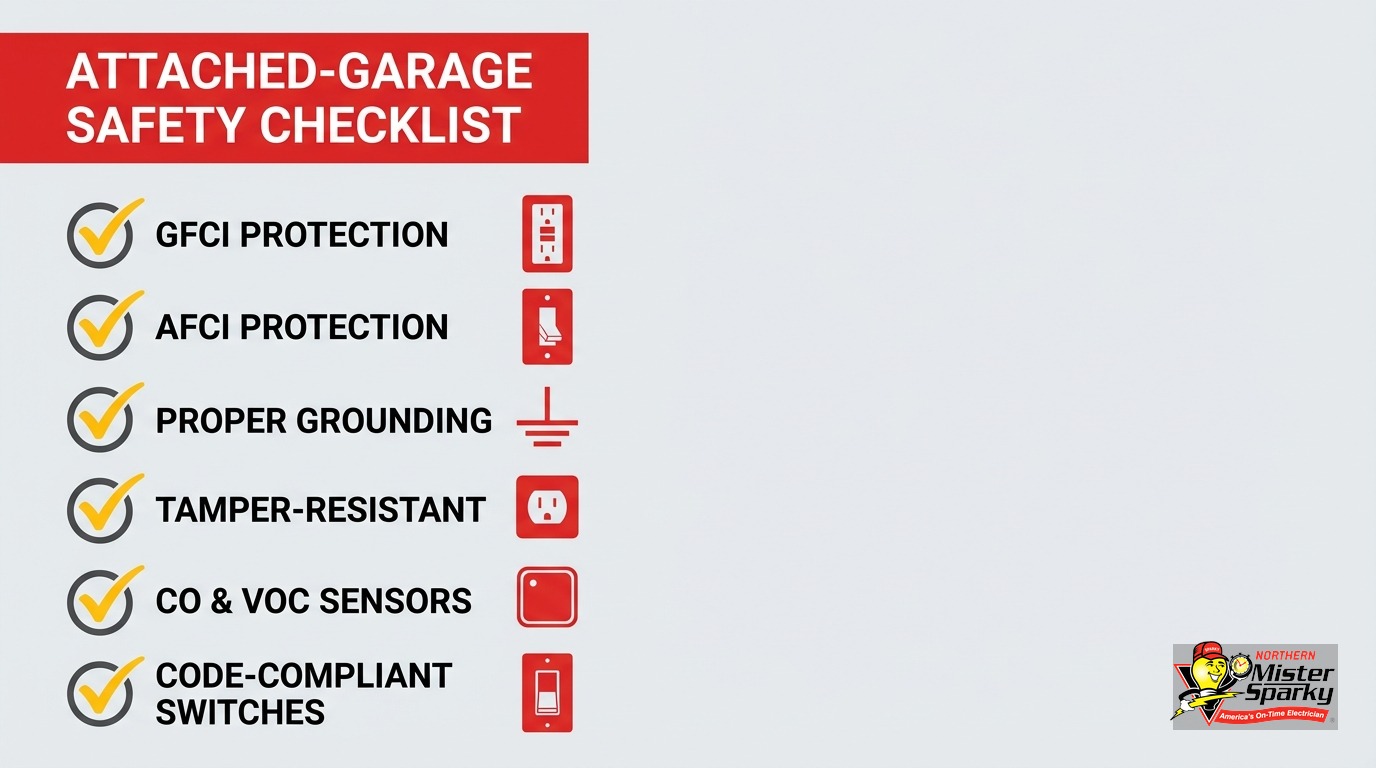
- Garage exhaust fan wiring for an attached garage follows a different code path than a detached garage. The shared wall creates a direct path for vehicle exhaust to reach the living space.
- NEC 210.8(A) requires GFCI protection on garage receptacle outlets, not on hardwired fans connected to a dedicated circuit.
- Minnesota Mechanical Code 404.1 requires both a CO detector and a NO2 detector in an attached garage, with automatic fan activation on either trigger. CO alone is not enough.
- Pulling an electrical permit for an attached garage project also triggers CO alarm requirements throughout the dwelling under MN Building Code R315.
- Standard gravity louvers freeze shut at Minnesota winter temperatures. Motorized damper shutters are the correct specification for this climate.
- The EPA minimum for a compliant attached-garage fan is 70 CFM installed, ENERGY STAR rated, venting directly outdoors.
What Makes an Attached Garage a Different Code Path?
Attaching the garage to your home changes both the electrical and mechanical code requirements. The shared wall creates a direct path for vehicle exhaust to migrate into the living space. That is why the code treats attached garages as a distinct hazard zone, with stricter rules than any freestanding structure.
When a garage is separated from the house, exhaust disperses before it can cause harm. When the garage shares a wall with the living space, CO, benzene, and combustion byproducts have a direct path in. They move through gaps, penetrations, and HVAC openings into the rooms where your family sleeps.
According to the DOE Building America Solution Center, attached garages carry both carbon monoxide and benzene from car exhaust. The DOE also notes that remote keyless fobs can accidentally start a parked car inside a closed garage. Without adequate ventilation, that scenario is far more dangerous than most homeowners realize.
That migration risk is why Minnesota’s mechanical code, permit statutes, and electrical code each add requirements to an attached garage project. None of those requirements apply to a freestanding detached structure.
For the broader picture on garage electrical requirements, see our guide on attached garage electrical wiring code.
Why Garage Exhaust Fan Wiring Starts with Sizing
Before you run a single wire, you need to know what size fan the space requires. An undersized fan does not clear exhaust fast enough to matter. An oversized fan on an undersized circuit creates a different problem entirely.
The sizing formula: (Length x Width x Height x air changes per hour) / 60 = minimum CFM required.
For a standard parking garage, target 6-8 air changes per hour. For a space that doubles as a workshop, target 12-15 air changes per hour. Add 20% to your result to account for duct resistance in the exhaust run. This formula and those targets come from the WholehouseFan.com installation guide.
Here is a real example. A 20 x 20 x 9-foot two-car garage has 3,600 cubic feet. At 6 air changes per hour: (3,600 x 6) / 60 = 360 CFM. Add 20% for duct resistance: 432 CFM minimum. Round up to the next available fan size.
The EPA Indoor AirPlus construction specification sets a hard floor for any attached garage installation. The fan must be ENERGY STAR rated, produce a minimum of 70 CFM when installed, and vent directly outdoors. The spec also requires continuous operation or a motion detector. That motion detector must keep the fan running for at least one hour after the garage is vacated.
Get the CFM right first. Then wire for it.
Does a Hardwired Garage Exhaust Fan Need GFCI Protection?
No, if the fan is directly wired to a junction box on its own dedicated circuit. GFCI protection applies to garage receptacle outlets, not to hardwired appliances. If the fan plugs into a garage outlet, that outlet needs GFCI. If the fan is hardwired directly to a junction box, GFCI is not required for the fan or the circuit.
This is the distinction that confuses more homeowners than any other rule on this topic, and no competitor guide explains it clearly.
NEC 210.8(A), as adopted in Minnesota, requires GFCI protection for all 125-250V receptacle outlets in a garage. Minnesota DLI adopted the 2020 NEC, with the 2023 NEC reported adopted July 1, 2023. The key word is “receptacle outlet”: a plug-in socket. A fan hardwired directly to a junction box is not a receptacle outlet. The GFCI requirement does not apply to it.
Here is how the decision breaks down in practice:
- Plug-in fan at a garage wall outlet: That outlet must have GFCI protection. If it does not, it needs a GFCI outlet or a GFCI breaker upstream. The fan itself just plugs in.
- Hardwired fan on a dedicated circuit: No GFCI required on the fan or the junction box. The circuit still needs proper grounding and the correct wire gauge for the motor’s amperage.
For most residential garage exhaust fans, 14 AWG wire on a 15-amp breaker is sufficient. Larger fan-heater combos or high-CFM units may require 12 AWG on a 20-amp breaker. Check the fan’s nameplate amperage and size the wire and breaker to match.
For a full breakdown of where GFCI is and is not required in a home, see our GFCI outlet requirements guide.
What Detectors Does Minnesota Require in an Attached Garage?
Both a CO detector and a NO2 detector, per Minnesota Mechanical Code 404.1. Both must be listed to UL 2075. The ventilation system must activate automatically when either one triggers. A CO-only unit does not meet the Minnesota standard for an attached garage.
This requirement is what separates Minnesota code from the generic advice in most national guides.
Minnesota Mechanical Code 404.1 requires enclosed parking garages to have a CO detector that activates at 25 ppm or higher AND a NO2 detector that activates at 3 ppm or higher. Both must be listed to UL 2075. The ventilation system must switch on automatically when either one triggers.
NO2 is nitrogen dioxide, a byproduct of internal combustion. It is heavier than air and settles near the floor. That affects mounting height: the NO2 detector belongs near floor level, per the manufacturer’s listed instructions. CO is close to air density and is typically mounted 5-7 feet off the floor. Installing either detector at the wrong height defeats the purpose of having it.
The interconnection requirement has a direct wiring implication. A simple on-off switch loop is not sufficient if the detectors need to automatically activate the fan. You need a relay in the circuit that allows either detector to trigger the fan regardless of the wall switch position. Plan for that relay from the start of the wiring design.
For placement guidance on CO detectors throughout the rest of the home, see our smoke and CO detector placement guide.
Does Installing a Garage Exhaust Fan Require a Permit in Minnesota?
Yes, if you are adding a new branch circuit. New circuits require permits in Hennepin and Ramsey counties. Pulling that permit on an attached garage project also triggers CO alarm requirements throughout the dwelling under MN Building Code R315.
This is the rule that surprises homeowners more than any other on this list.
MN Stat 299F.51 requires CO alarms within 10 feet of each sleeping room in every single-family dwelling. That requirement has applied to all Minnesota homes since August 1, 2008. Most homes already comply. Some older homes do not.
MN Building Code R315 adds the permit-trigger rule: when work requiring a permit occurs in a dwelling with an attached garage, CO alarms must be provided and verified at the time of inspection. If your home already has compliant CO alarms in the right locations, this adds nothing to the project. If it does not, the inspector can flag their absence.
A licensed electrician should confirm CO alarm placement when pulling a permit on an attached garage project. That is part of the job, not an optional add-on.
Skipping the permit is not a workaround. Unpermitted electrical work can void homeowner’s insurance coverage for related claims. It also creates a disclosure obligation when you sell the home. The permit protects you in both situations.
Our carbon monoxide detector service covers CO and NO2 detector installation as part of a full garage project.
The Minnesota Cold-Climate Problem: Louvers That Freeze
This is the detail no other guide covers, and it matters every single January in the Twin Cities.
Standard gravity-louvered exhaust vents rely on air pressure alone. When the fan runs, pressure pushes the louvers open. When the fan stops, they fall shut by gravity. At -20°F, a typical January low across the metro, gravity louvers freeze. They either stick open and let Arctic air pour into the garage, or they stick shut and block the fan from exhausting at all.
Neither outcome is acceptable for a garage attached to your home.
The correct specification for a Minnesota garage is a motorized damper shutter. It wires to the fan circuit and opens when the fan activates, then closes when the fan shuts off. The motor holds the shutter sealed against outside air and temperature when the fan is off. The control circuit is low-voltage and ties into the fan switch or relay. It adds a small amount of wiring work but prevents both freeze-up and cold-air backdraft.
Gravity louvers are fine in Georgia. In Maple Grove or Woodbury, they are a liability every winter.
What Does Garage Exhaust Fan Wiring Look Like Step by Step?
For a hardwired fan on a dedicated circuit, the sequence runs from panel to junction box to fan, then adds a wall switch, a motorized damper control, and detector relay wiring for automatic activation. The complexity scales with how far the panel is from the fan and whether detector interconnection is required.
Here is the step-by-step:
Step 1: Size and plan the circuit. Confirm the fan’s nameplate amperage. Size the wire and breaker: 14 AWG on a 15-amp breaker for most residential fans, 12 AWG on a 20-amp for larger motors. Measure the cable run from the panel to the fan location.
Step 2: Pull the permit. In Hennepin and Ramsey counties, a new branch circuit requires a permit before work begins. Schedule the rough-in inspection before closing any walls or ceilings.
Step 3: Run the wire. Use 14/2 or 12/2 Romex based on step 1. Secure to framing at NEC-required intervals, protect any exposed runs in conduit, and land the wire at both the panel and the fan’s junction box.
Step 4: Install the junction box and fan. Mount the fan per the manufacturer’s instructions. Connect the house wiring to the fan leads at the junction box. Close the box.
Step 5: Install the wall switch. A single-pole switch provides manual control. If automatic detector-based activation is required, add a relay between the detectors and the fan circuit at this step. The relay allows either detector to energize the fan regardless of switch position.
Step 6: Wire the motorized damper. Connect the damper’s control wire to the fan’s switch leg. The damper should open when the fan activates and close when it shuts off. Follow the damper manufacturer’s wiring instructions for the control voltage.
Step 7: Install CO and NO2 detectors. Mount at heights specified by each device’s instructions. Wire the relay outputs from both detectors to the fan circuit. Either detector must be able to trigger the fan independently.
Step 8: Schedule the inspection. Rough-in inspection happens before walls are closed. Final inspection follows after the installation is complete and all device covers are on.
This is a high-level overview of the sequence. The actual work includes opening a live panel and navigating junction box fill calculations, conduit requirements for exposed runs, and inspector checkpoints at each stage. These are the steps where hiring a licensed electrician makes the most sense.
Is This a DIY Project?
For most Twin Cities homeowners, no. Adding a new branch circuit requires a permit. In Minnesota, permitted circuit installations require a licensed electrician. The individual steps are not complicated, but the permit process, the inspection requirements, and the life-safety stakes make professional installation the right call.
A homeowner can legally perform electrical work on their own single-family home in Minnesota. But the permit and inspection process means the work must pass code. An incorrectly sized circuit, missing grounding, improper junction box fill, or a skipped detector relay will fail inspection.
Beyond the permit, this project touches a CO and NO2 detector relay, a motorized damper control circuit, and possibly the main panel if a new breaker slot is needed. Each of those points has a failure mode with life-safety implications.
Getting this done correctly the first time costs less than a failed inspection and a return-trip service call. It also protects your insurance coverage and your disclosure position on resale.
What Does a Garage Exhaust Fan Installation Cost in the Twin Cities?
Total costs typically run $500-$1,200 for a standard attached-garage installation in the Twin Cities. The main variables are fan CFM rating, run distance from the panel, detector installation, and the permit fee. As of August 2026, no utility rebates are available for residential garage fans through Xcel Energy or CenterPoint.
Here are the component ranges:
- Fan and motorized damper hardware: $80-$350 depending on CFM rating and brand.
- New 15 or 20-amp branch circuit: $200-$500 depending on run distance and panel access.
- CO and NO2 detector installation: $150-$300 for parts and labor.
- Permit fee: $75-$150 in most Hennepin and Ramsey county jurisdictions.
These are ranges, not quotes. The actual cost depends on your panel, your cable run, and whether any existing wiring in the garage needs correction. Call us for a real number specific to your home.
Ready to Schedule?
We are locally owned and operated in the Twin Cities. We wire garage exhaust fans with the correct circuit sizing, proper CO and NO2 detector integration, motorized dampers built for Minnesota winters, and a permit pulled so your inspection goes smoothly.
No malarky, no surprises. Call 763-200-5956 or book online to get on the schedule. As America’s On-Time Electrician(R), we show up when we say we will.
Frequently Asked Questions
Does a hardwired garage exhaust fan need GFCI protection? +
What safety detectors does Minnesota require in an attached garage? +
Does installing a garage exhaust fan require a permit in Minnesota? +
Need an electrician now?