
Garage Heater Electrical Requirements: Twin Cities Guide
Key Takeaways
- Garage heater electrical requirements start with heat loss, not the heater label. Size the heater first, then determine the circuit.
- NEC Article 424.3(B) classifies fixed electric space heaters as continuous loads. The circuit must be rated at 125% of the heater’s full-load amperage.
- The Twin Cities ASHRAE design temperature is -16 degrees F. Most two-car garages here need a 10-12 kW heater, which requires a 60A or 70A circuit, not the 30A circuit most articles describe.
- Minnesota adopted the 2026 NEC on August 17, 2026. Permits filed on or after that date must comply with the new code.
- A permit is required for every new circuit in Minnesota. Start work without one and you owe an investigation surcharge.
- There is no Xcel Energy rebate for electric garage heaters as of August 2026. Do not delay your project waiting for one.
- Ready to plan your circuit? Call Northern Mister Sparky at 763-200-5956 or book online.
What Size Heater Does a Twin Cities Garage Actually Need?
A well-insulated 450 sq ft two-car garage needs roughly 18,000-22,500 BTU/h against -16 degrees F. A poorly insulated one needs 27,000-31,500 BTU/h. That range puts most Twin Cities two-car garage heaters in the 6-9 kW class, or higher for large or drafty spaces.
Minnesota sits in Climate Zone 6A (Cold-Humid). Buildings here lose heat faster than nearly anywhere else in the continental US. You do not size a garage heater for an average January day. You size it for the worst one.
The standard method multiplies square footage by a BTU-per-square-foot factor based on insulation:
- Well-insulated garage (insulated walls, ceiling, and garage door): 40-50 BTU per sq ft
- Average insulation (walls insulated, ceiling and door basic): 50-60 BTU per sq ft
- Poor or uninsulated (bare concrete walls, no ceiling insulation): 60-70 BTU per sq ft
Applied to common garage sizes:
| Garage size | Insulation | BTU/h needed |
|---|---|---|
| 250 sq ft (1-car) | Well-insulated | 10,000-12,500 |
| 250 sq ft (1-car) | Poor | 15,000-17,500 |
| 450 sq ft (2-car) | Well-insulated | 18,000-22,500 |
| 450 sq ft (2-car) | Average | 22,500-27,000 |
| 450 sq ft (2-car) | Poor | 27,000-31,500 |
| 600 sq ft (3-car) | Average | 30,000-36,000 |
Hold onto your BTU number. Everything that follows depends on it.
How Do You Convert BTU to Watts for a Garage Heater Circuit?
Divide your BTU/h figure by 3,412 to get kilowatts (1 kW = 3,412 BTU/h). A 22,500 BTU/h requirement equals 6.6 kW. A 27,000 BTU/h requirement equals 7.9 kW. Knowing your kilowattage tells you exactly what circuit you need.
The conversion is a fixed thermodynamic relationship. Use it every time you translate between a heater’s BTU label and its electrical draw.
Quick reference:
- 10,000 BTU/h = 2.9 kW
- 15,000 BTU/h = 4.4 kW
- 20,000 BTU/h = 5.9 kW
- 25,000 BTU/h = 7.3 kW
- 30,000 BTU/h = 8.8 kW
- 36,000 BTU/h = 10.6 kW
Most Twin Cities homeowners with a two-car garage land between 6 and 10 kW. That range straddles the 30A, 40A, and 60A breaker thresholds. Knowing where you fall before you shop for a heater prevents a mismatch between the unit you buy and the circuit you can actually run.
What Are the Garage Heater Electrical Requirements Under NEC Article 424?
NEC Article 424.3(B) classifies fixed electric space heating as a continuous load. The circuit must be rated at 125% of the heater’s full-load amperage. A 5,000W heater on a 30A circuit is legal. A 10,000W heater on that same 30A circuit is not.
Here is the three-step calculation for any 240V heater:
Step 1: Divide heater wattage by 240 volts to get running amps. Step 2: Multiply by 1.25 for the continuous-load factor. Step 3: Round up to the next standard breaker size.
Applied to common heater sizes:
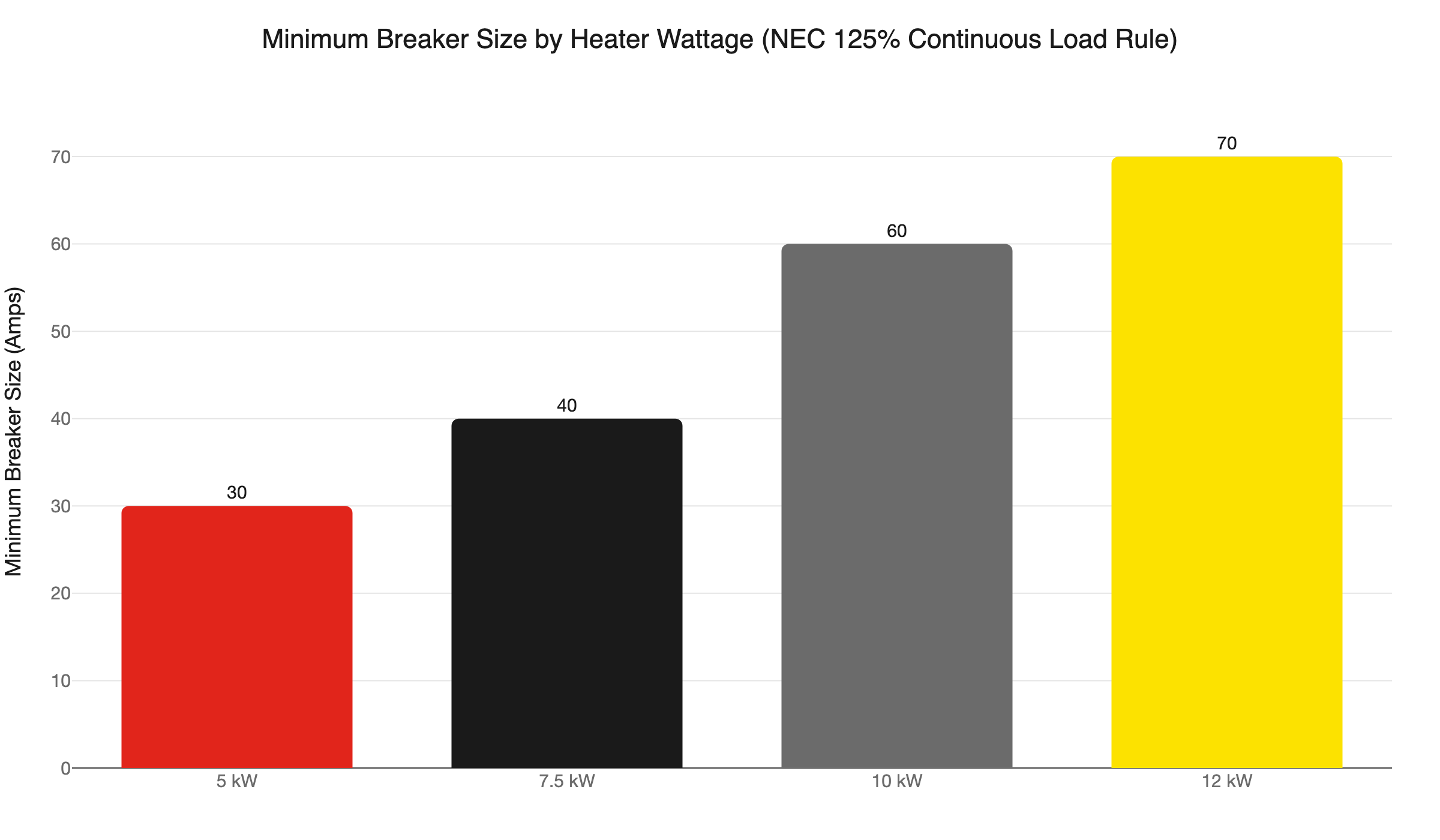
- 5,000W: 20.8A running, 26A required. Use a 30A breaker with 10 AWG copper wire.
- 7,500W: 31.3A running, 39.1A required. Use a 40A breaker with 8 AWG copper wire.
- 10,000W: 41.7A running, 52.1A required. Use a 60A breaker with 6 AWG copper wire.
- 12,000W: 50.0A running, 62.5A required. Use a 70A breaker with 4 AWG copper wire.
The chart above shows those breaker minimums visually. Notice the jump from 7,500W to 10,000W: it pushes you from a 40A circuit to a 60A circuit, which is a significant increase in material cost and panel load. That decision point matters when you are choosing between a heater that barely covers your heat-loss number and one that covers it comfortably.
NEC Article 424 also requires a disconnecting means for any fixed space-heating equipment. A lockable double-pole breaker at the panel can satisfy that requirement. Many Minnesota inspectors also expect a local disconnect switch mounted within sight of the heater. Confirm with your inspector before you finalize the installation plan.
Do Garage Heater Electrical Requirements Change for a Detached Garage?
Yes. A detached garage needs a feeder circuit from the house panel, not just a branch circuit. For heaters of 10 kW or more, a dedicated garage subpanel is almost always the right answer.
A branch circuit serves one piece of equipment. If your detached garage already has outlets, lighting, and a door opener, those loads cannot share a circuit with a heater drawing 40-52 amps. The clean solution is a detached garage subpanel: run a large feeder from the house (60A or 100A is common), install a small panel in the garage, and branch from there. One circuit for the heater. One for lighting. One for general outlets.
The feeder wire must be sized for the total anticipated load, not just the heater. If you plan to add a welder, a chest freezer, or an EV charger later, size the feeder for that now. Running a 100A feeder on the first trip is far cheaper than a second conduit run or trench later.
For an attached garage, the path is usually simpler: a dedicated branch circuit from the house panel if capacity exists. Our guide on attached garage electrical wiring code covers the NEC requirements specific to attached structures.
Does Your House Panel Have Room for a Garage Heater Circuit?
Maybe not. A 10 kW heater on a 60A double-pole breaker is a significant load. If your main panel is already running near capacity, you may need a panel upgrade before the heater circuit can be added at all.
This is the step most guides skip, and it is the one that surprises homeowners most often. An empty breaker slot does not mean the panel has headroom. Check your main breaker size. If it is a 100A main and you are already running an electric range, central air, a dryer, and a water heater, adding a 60A heater circuit may exceed the panel’s rated capacity.
A 200A main panel with modest existing loads usually has room for a 30A or 40A heater circuit without issue. A 60A or larger circuit on a 200A panel is still feasible but worth verifying with a load calculation first. If your panel has any signs it already needs an upgrade, address that before you add load.
If the panel needs to grow before the heater circuit can be added, our team handles both in one coordinated visit.
What Does Minnesota Require for a Garage Heater Electrical Permit?
Any new circuit in Minnesota requires an electrical permit. File before you start work. Starting without a permit triggers an investigation surcharge on top of normal fees. There is no exception for garage heater circuits.
Where you file depends on your address. About 66 Minnesota cities are local Authorities Having Jurisdiction and issue their own electrical permits. Minneapolis, St. Paul, Bloomington, Brooklyn Park, Woodbury, Blaine, Maple Grove, and Plymouth all have local permit offices. If your address falls outside a local AHJ, you file with the state Department of Labor and Industry at ims.dli.mn.gov/ims.
One important date: Minnesota adopted the 2026 NEC effective August 17, 2026. Any permit filed on or after that date must comply with the new code. For garage heater circuits, the 2026 NEC does not dramatically change Article 424 fundamentals. But if you are filing a permit this fall, confirm with your inspector whether any 2026-specific provisions affect your installation.
The permit fee is modest. The investigation surcharge for starting without one is not. Pull the permit first.
Can a Minnesota Homeowner Pull Their Own Permit for a Garage Heater Circuit?
Yes, with conditions. Minnesota law allows owner-occupants of single-family homes to pull their own electrical permit and personally perform the work. A rental, duplex, or condo requires a licensed contractor. Either way, the work requires a passing inspection before the circuit is energized.
The homeowner exemption is real and we are not going to pretend otherwise. Minnesota gives owner-occupants this option. The key word is “personally.” You must do the work yourself. Hiring a non-licensed friend to do it under your permit is not legal.
Whether to use the exemption depends on the scope. Wiring a 30A or 40A branch circuit in an attached garage with direct access to a 200A panel that has plenty of room is manageable for a careful, experienced homeowner who knows how to work safely around an energized panel.
Running a 60A or 70A circuit, installing a subpanel in a detached garage, or navigating a panel with limited capacity: those projects have compounding decision points. A wiring error on a 60A circuit carries real consequences. For those jobs, hiring a licensed electrician is the cleaner path. Not because the code forbids DIY, but because the cost of a mistake is higher than the cost of getting it done right.
What Wire Gauge Do Garage Heater Electrical Requirements Specify?
Wire gauge is determined by breaker size. Breaker size is determined by heater wattage after the 125% continuous-load factor. There is no guessing involved.
For copper wire on 240V garage heater circuits:
- 30A breaker: 10 AWG copper
- 40A breaker: 8 AWG copper
- 60A breaker: 6 AWG copper
- 70A breaker: 4 AWG copper
Using undersized wire is one of the most common causes of electrical fires in garages. A heater drawing 40 amps through wire rated for 30 amps will overheat the insulation inside the wall. The breaker may not trip fast enough to prevent damage. That is exactly why inspections exist.
If your wire run is long (over 100 feet in a detached garage, for example), voltage drop may require stepping up one wire gauge to maintain performance. Your electrician will calculate that for the specific run. Our wire gauge and breaker size guide covers the full NEC ampacity table in plain language if you want to run the numbers yourself first.
Is There an Xcel Energy Rebate for an Electric Garage Heater?
No. As of August 2026, Xcel Energy’s heating rebates focus on cold-climate heat pumps and heat pump water heaters. Electric garage heaters are not on the rebate list. Do not delay your project waiting for one.
We hear this question every fall from Twin Cities homeowners trying to time a project around utility incentives. For an EV charger or a heat pump, that timing can save real money. For a garage heater, there is nothing to wait for. Plan around your timeline and budget.
When to Call a Licensed Electrician for Your Garage Heater
If any of the following apply, call before you start:
- Your heater requires a 60A or larger circuit. Wire sizing, breaker selection, and conduit work compound quickly at that amperage.
- Your garage is detached. Feeder sizing, conduit or direct-burial cable, and a grounding electrode at the garage structure make this a multi-phase project.
- Your main panel has limited capacity. A heater install combined with a panel upgrade requires coordination and a load calculation.
- You are unsure which city department or state DLI office handles your permit. Getting that wrong delays the project.
- The structure is a rental, duplex, or condo. Minnesota requires a licensed contractor. No exception.
Northern Mister Sparky is locally owned and operated in the Twin Cities. Our team handles garage heater circuits, detached garage subpanels, and panel upgrades. We pull the permits, coordinate the inspections, and show up when we say we will. No malarky.
Call us at 763-200-5956 or book online to schedule your garage heater electrical installation.
Frequently Asked Questions
What circuit does a garage heater need? +
Do I need a permit for a garage heater circuit in Minnesota? +
Can a Minnesota homeowner wire a garage heater circuit themselves? +
What design temperature should I use to size a Twin Cities garage heater? +
Need an electrician now?