
Welder Outlet Installation Garage: 50A Circuit and MN Code
Key Takeaways
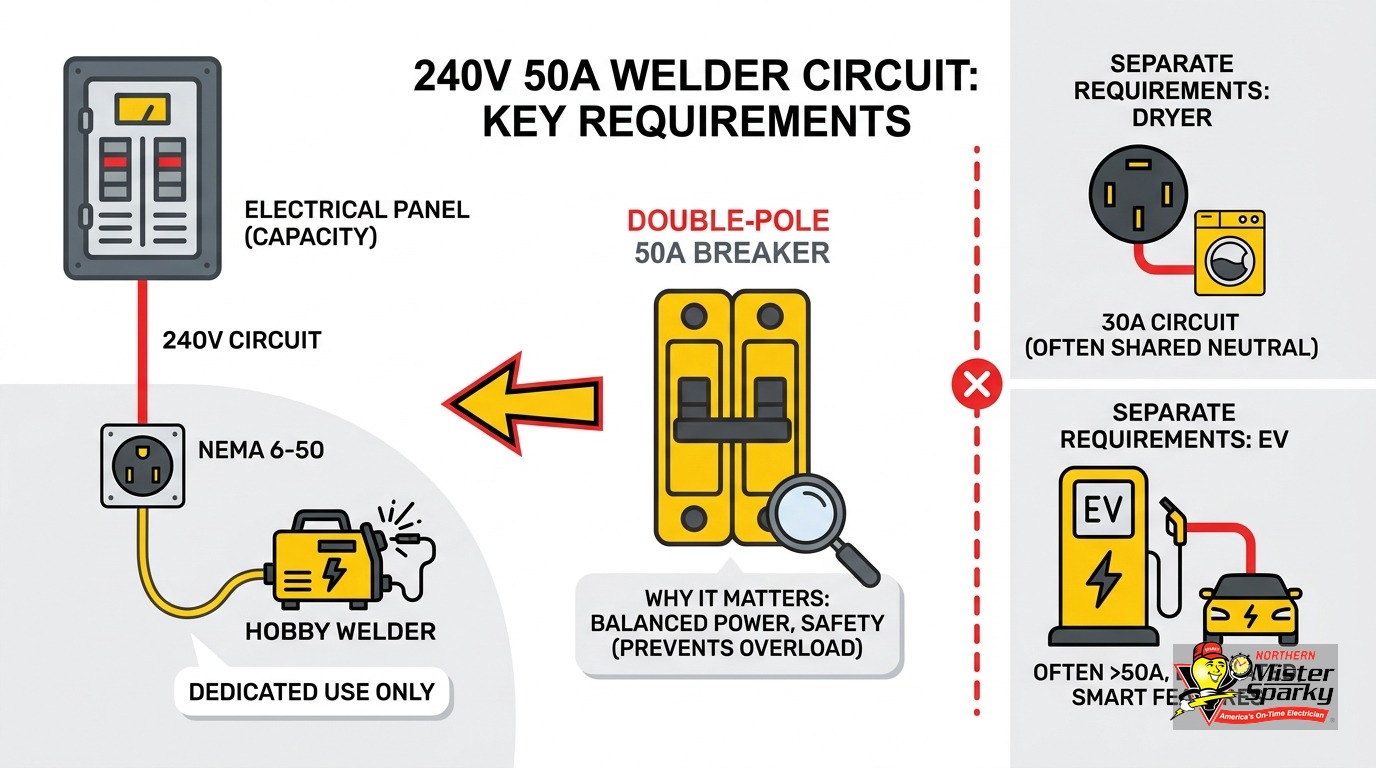
- Welders require a NEMA 6-50R receptacle: two hots, one ground, no neutral. It is not interchangeable with NEMA 14-50 (EV/RV) or NEMA 14-30 (electric dryer).
- NEC Article 630 governs welder circuits. Breaker size uses a duty-cycle factor, not the full nameplate current applied to continuous loads like dryers and EV chargers.
- Standard build: double-pole 50A breaker with 6 AWG copper conductors.
- NEC Article 630 requires a disconnecting means within sight of the welder, separate from the panel breaker.
- Minnesota adopted the 2026 NEC effective August 17, 2026. Permits filed on or after that date must comply with 2026 NEC.
- Starting work before pulling a permit triggers an investigation fee in Minnesota.
- Pre-1960 Twin Cities homes on 100A service may need a load calculation and possible panel upgrade before a 50A welder circuit goes in.
- Detached garage runs through uninsulated attic space or buried exterior segments should use THHN/THWN in conduit, not NM-B cable, due to Minnesota temperature extremes.
Why Welder Outlet Installation in Your Garage Requires Its Own Circuit
You picked your welder. Now you need an outlet in the garage. The natural first question is whether the dryer outlet in the laundry room, or the EV charger circuit you already have, can do the job.
Neither can — not safely, not legally, and in most cases not physically. A welder circuit follows a separate section of the National Electrical Code. It uses a different NEMA receptacle than both a dryer and an EV charger. And it requires a disconnecting means near the machine that nearly every DIY guide skips entirely.
Here is what a proper welder outlet installation in your garage actually involves, anchored in Minnesota permit reality and current NEC code.
What Makes a Welder Circuit Different from a Dryer or EV Outlet?
A welder draws power in short, intense bursts rather than continuously. NEC Article 630 sizes its circuit using a duty-cycle factor, not the full nameplate current used for dryers and EV chargers. This single difference changes the breaker math, the wire gauge, and the receptacle type.
Dryers and EV chargers are continuous loads. The NEC requires continuous loads to be sized at 125% of their rated draw to prevent sustained heat buildup in conductors. A welder is not a continuous load. It pulls maximum current only during the arc, then drops when you lift the electrode. NEC Article 630 recognizes this pattern and allows the branch circuit to be sized on rated primary current multiplied by a duty-cycle factor.
At 30% duty cycle, the math looks like this: 50A nameplate multiplied by the square root of 0.30 equals approximately 27.4A of effective demand. In theory, conductors sized for 27A could legally serve a 50A-nameplate welder.
In practice, most electricians size the circuit to a full 50A anyway. Hobby welders often run at higher duty cycles than the rated spec suggests. Headroom is cheap. A rewire is not. Our post on 240V outlet installation for dryers and ranges shows how the continuous-load calculation differs, if you want to see that contrast side by side.
What NEMA Receptacle Does a Welder Need?
A welder uses a NEMA 6-50R receptacle: two hot legs, one ground, no neutral wire, three-prong, rated 50A. It is not the same shape or wiring configuration as the four-prong outlets used for dryers and EV chargers.
Here is how the three common 240V outlet types compare:
- NEMA 6-50R (welder standard): Two hots, one ground. No neutral. Three prongs. 50A rated.
- NEMA 14-50R (EV and RV standard): Two hots, one neutral, one ground. Four prongs. 50A rated.
- NEMA 14-30R (electric dryer): Two hots, one neutral, one ground. Four prongs. 30A rated.
Plugging a 50A welder into a dryer outlet is a fire hazard: the circuit is rated for only 30A, and the plug pinout is wrong. The welder plug will not physically seat in the outlet. Any adapter that forces the connection puts the machine on a 30A breaker that cannot protect it.
The EV outlet (NEMA 14-50) is closer in amperage, but still wrong. A NEMA 6-50 welder plug cannot seat in a NEMA 14-50 outlet without an adapter. Using that adapter creates a floating neutral problem: the welder expects no neutral, and the 14-50 has one wired live. Do not use adapters between mismatched NEMA configurations on 240V equipment.
One nuance worth knowing: the NEMA 6-50 outlet is also valid for Level 2 EV charging because EV charger circuitry does not use the neutral wire. Install a NEMA 6-50 today for the welder, and a compatible EV charger can use that same outlet later. The reverse is not true: a 14-50 EV outlet cannot safely serve a NEMA 6-50 welder plug.
Why Does a Welder Circuit Need a Double-Pole Breaker?
A 240V circuit draws from two separate hot legs in your panel at the same time. A single-pole breaker disconnects only one leg. The second leg stays energized, leaving shock and fire risk for anyone who assumes the circuit is off.
This applies to every 240V circuit, not just welders. Your panel feeds power on two legs of 120V each. A 240V appliance connects across both legs to reach 240V. NEC Article 240.85 requires a double-pole breaker to open both legs simultaneously, which is the only way to fully de-energize a 240V circuit from the panel.
For a welder, this matters at the machine level too. The disconnecting means near the welder, covered in the next section, must also interrupt both hot legs. A single-pole switch on a 240V welder circuit is a code violation and a real hazard.
The Disconnecting Means Requirement Most Homeowners Miss
NEC Article 630 includes a requirement that nearly every DIY guide skips: a disconnecting means must be located within sight of the welder. This is not the panel breaker. It is a separate safety switch or fusible disconnect box mounted near the machine.
“Within sight” in NEC language means visible from the welder and no more than 50 feet away. The logic is the same as for HVAC equipment: a technician working on the machine needs to lock out power without walking to a panel in another room or another building.
For an attached garage where the panel is nearby, a wall-mounted safety switch beside the outlet typically satisfies the requirement. For a detached garage with the main panel inside the house, a local disconnect at the garage end is required because the panel is never within sight of the welder.
Budget roughly $100-$200 for the switch hardware and the labor to wire it in. Skipping it fails inspection, which means a return visit to add it before the final is approved.
Can I Use My EV Charger Outlet for the Welder?
The NEMA pinouts are different, and using an adapter between a 6-50 welder plug and a 14-50 EV outlet creates a floating neutral hazard. The circuits are incompatible by design, and adapters between them are not a safe workaround.
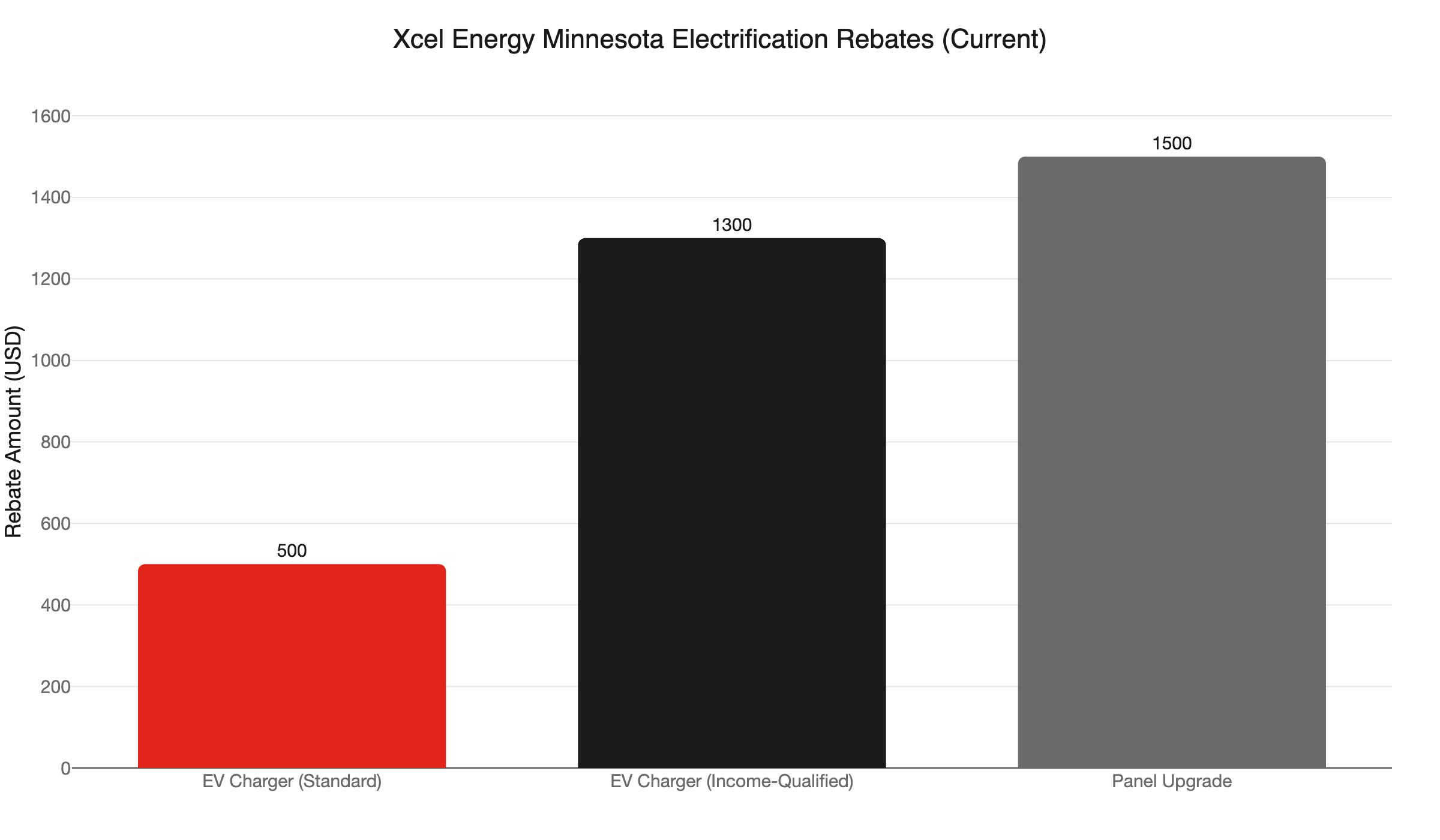
The question comes up constantly because Xcel Energy Minnesota offers up to $500 in rebates for a Level 2 EV charger and 240V circuit, with income-qualified customers eligible for up to $1,300. Homeowners who already have an EV circuit naturally ask whether the welder can share it.
The short answer is no. But here is the nuance if you are starting from scratch with no existing EV charger: install a NEMA 6-50 outlet and choose an EV charger that accepts a NEMA 6-50 plug. Many Level 2 chargers support the NEMA 6-50 connection. Check your charger’s plug spec before assuming compatibility.
One more item worth knowing: the 30% federal EV charger tax credit expired June 30, 2026. Any guide still advertising a federal credit is out of date. Xcel utility rebates and the Xcel panel upgrade rebate (up to $1,500 for service upgrades supporting electrification loads) are now the primary incentive programs available in Minnesota. Our EV charger installation guide for the Twin Cities covers the current rebate landscape in detail.
What Does Minnesota Require to Permit a Welder Outlet?
Any new 240V circuit requires an electrical permit in Minnesota. Look up your address at dli.mn.gov to find the right permitting authority. Two inspections are required: rough-in before walls close, and final after the panel is energized.
Minnesota’s Board of Electricity adopted the 2026 NEC effective August 17, 2026. If your permit is filed on or after that date, your installation must comply with 2026 NEC. Permits filed before that date fall under the 2023 NEC. This transition is active right now. The code your electrician works under depends on when the permit gets pulled.
Minnesota uses a dual authority having jurisdiction (AHJ) system. About 66 cities administer their own electrical permits. The rest use the state. Look up your address at dli.mn.gov. A “Local” result means contact your city’s building department. A “State” result means file online at ims.dli.mn.gov/ims.
St. Paul switched to the PAULIE permitting platform, live as of July 1, 2026. It publishes a specific Garage Electrical Checklist and a Residential Garage Wiring guide. If you are in St. Paul, check the St. Paul electrical permits and inspections page for the exact checklist your inspector will reference.
One rule applies everywhere in Minnesota: starting work before pulling a permit triggers an investigation fee on top of normal permit costs. Pull the permit first. Our Minnesota electrical permit guide walks through the full process, including the AHJ lookup.
What Wire Gauge and Breaker Size Does a 50A Welder Need?
Standard sizing for most hobby welders: a double-pole 50A breaker with 6 AWG copper conductors. If duty-cycle math pushes the required breaker to 60A, wire must step up to 4 AWG copper. The breaker-to-wire match is mandatory under NEC — never mix a 60A breaker with 6 AWG wire.
A 50A breaker requires 6 AWG copper at minimum. A 60A breaker requires 4 AWG copper at minimum. The reason: breakers protect wires, not machines. A 60A breaker paired with 6 AWG wire allows the conductor to overheat to a dangerous level before the breaker responds.
For most hobby welders rated between 140A and 200A at moderate duty cycles, a 50A breaker and 6 AWG copper is the right answer. If you run a heavier machine or plan for extended welding sessions, discuss the actual duty-cycle spec with your electrician before the circuit is sized.
Voltage drop matters specifically for welders. Arc instability and thermal faults can occur on runs where voltage sags under load. A 75-foot run of 6 AWG copper can lose enough voltage to affect arc quality, not just the conductors. Upsizing to 4 AWG on longer runs protects weld quality, not just the wire.
Does a Detached Garage Welder Circuit Need Special Wiring?
Yes. Minnesota’s temperature extremes mean that NM-B cable (Romex) is not rated for routes through uninsulated garage attics or direct-burial exterior runs. For those segments, use THHN/THWN conductors in conduit.
NM-B cable has a 60°C temperature rating. An uninsulated Minnesota garage attic in summer can exceed that rating when cable runs along the roof deck. For any detached garage run that passes through exposed attic space or goes underground, THHN/THWN in conduit is the required choice.
A detached garage run also adds complexity to the permit and inspection process. The route may require trenching, conduit fill calculations, and an evaluation of whether a subpanel makes more sense than pulling individual circuits from the house panel. If your detached garage has no subpanel and the welder is the first significant 240V load, a subpanel is usually the cleaner long-term solution. Our detached garage subpanel installation guide covers when that path makes more sense than a dedicated house-to-garage run.
The disconnecting means requirement is especially important for a detached garage. The main panel is inside the house, the welder is in the garage, and the panel breaker is never within sight of the machine. A local disconnect at the garage end is required, not optional.
Does My Panel Have Room for a 50A Welder Circuit?
Maybe not. Pre-1960 Twin Cities homes frequently have 100A service panels. A 240V/50A welder circuit is a large addition. A load calculation before installation is required, and a service upgrade may turn out to be necessary before the circuit can be added safely.
Adding a heavy 240V circuit without a load calculation when you are near capacity is how panels end up overloaded. The result ranges from nuisance breaker trips to a sustained overload condition the existing breakers were not sized to catch. Our 100A vs. 200A electrical service guide explains how to evaluate whether your current service can handle a new 50A circuit.
If the load calculation shows you are at or near capacity, two paths exist: upgrade the main service (typically 100A to 200A), or shed another load from the panel. Xcel Energy Minnesota currently offers up to $1,500 in rebates for panel upgrades that support electrification loads. If the welder circuit is what surfaces an undersized panel, that rebate can offset a meaningful portion of the upgrade cost.
Our electricians run a load calculation as a standard step before sizing any new heavy circuit. There are no shortcuts here that do not create problems downstream.
What Does Welder Outlet Installation Actually Involve?
The sequence is permit first, then rough-in work, then rough-in inspection, then energize, then final inspection. No work starts before the permit is in hand.
For a standard attached-garage install with adequate panel capacity, the steps look like this:
- Pull the permit before any wire is touched.
- Run the load calculation and confirm breaker size and wire gauge match the specific welder’s duty-cycle specs.
- Route conduit or cable from the panel to the garage outlet location, observing Minnesota temperature-rating requirements for the route chosen.
- Install the double-pole 50A breaker in the panel.
- Mount the NEMA 6-50R receptacle at the outlet location.
- Install the disconnecting means within sight of the welder.
- Call for rough-in inspection before closing any walls or concealing any work.
- Energize the circuit and call for the final inspection.
For a detached garage with a long run, the process expands: trenching for a buried segment, conduit selection and fill calculations, possible subpanel installation, and inspections that may be scheduled separately for the house end and the garage end.
A straightforward attached-garage install typically takes one day of work plus inspection scheduling. A detached garage with a longer run adds one to two days depending on trench distance and whether a subpanel is needed.
Get Your Welder Outlet Installed Right the First Time
A welder outlet installation in your garage involves more than a new breaker and a new receptacle. The NEC Article 630 sizing rules, NEMA receptacle requirements, disconnecting means code, Minnesota permit process, and panel capacity check all need to line up before the first arc runs.
Northern Mister Sparky is locally owned and operated right here in the Twin Cities. As America’s On-Time Electrician(R), we show up when we say we will, pull permits before we start, and back every job with our UWIN(R) 100% satisfaction guarantee. No shortcuts, no skipped inspections.
Call us at 763-200-5956 or book your appointment online to schedule your welder circuit installation. We will run the load calculation, size the circuit to your machine, and handle the permit and both inspections from start to finish.
Frequently Asked Questions
Can I use my EV charger outlet for a welder? +
What size breaker do I need for a 50A welder? +
Do I need a permit to install a welder outlet in Minnesota? +
What wire gauge does a 50A welder circuit require? +
What is the disconnecting means requirement for a welder? +
Need an electrician now?