
NEMA 6-50 Outlet Installation Cost: Twin Cities Guide
Key Takeaways
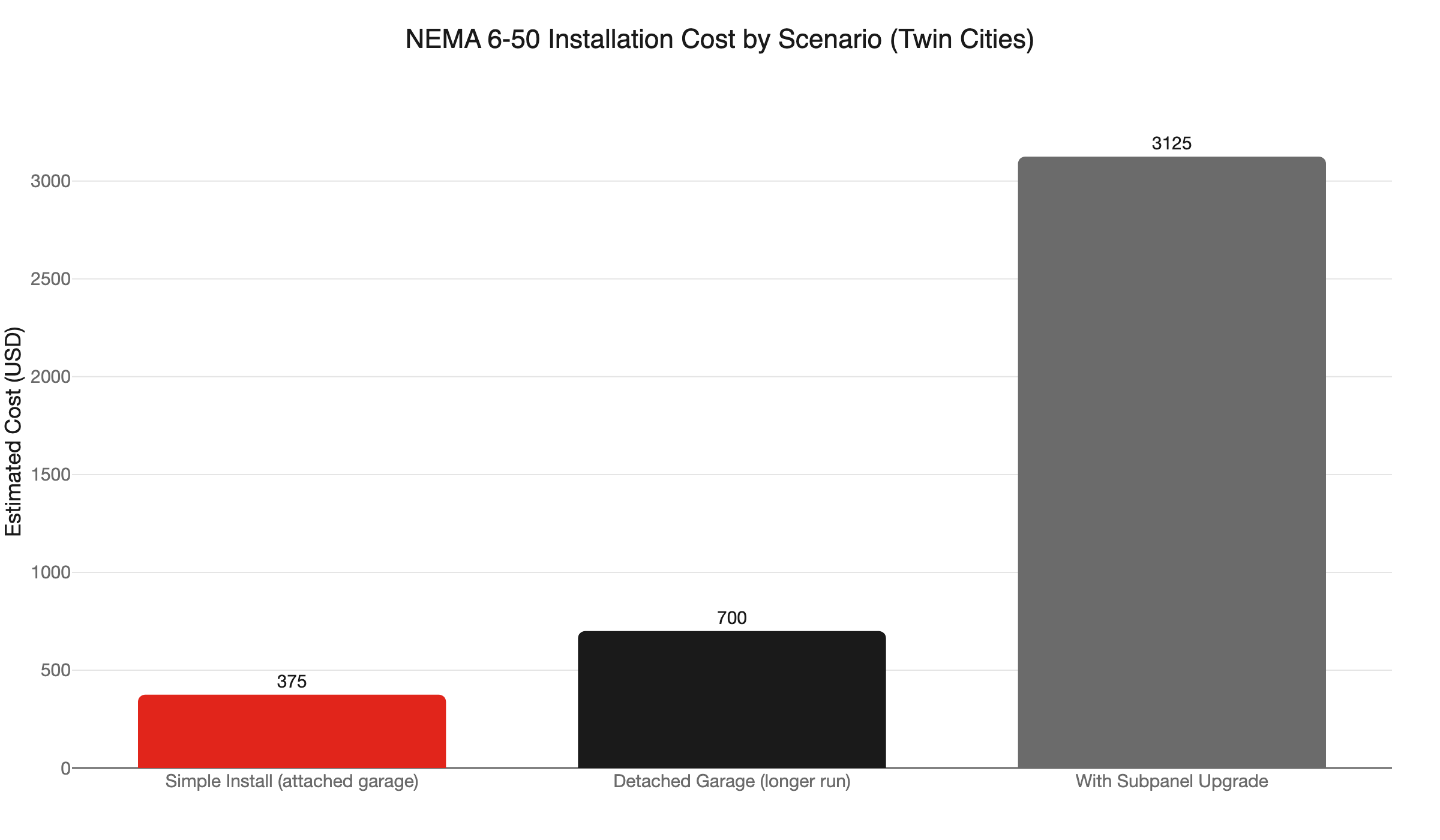
- NEMA 6-50 outlet installation cost in the Twin Cities ranges from roughly $250 to $500 for a simple attached-garage job.
- A detached garage with a longer wire run typically costs $500 to $900. Adding a subpanel or service upgrade pushes the total to $1,750 or more.
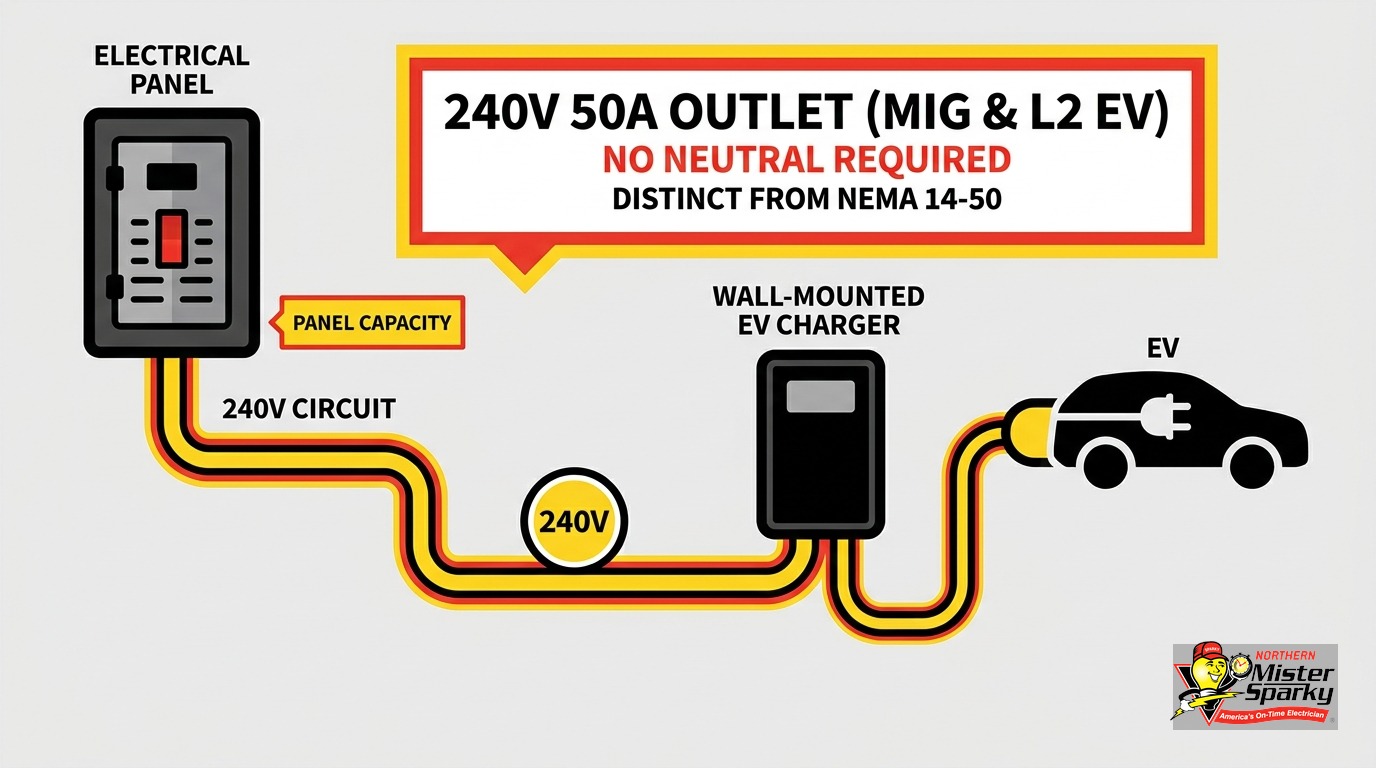
- The NEMA 6-50 runs two hot wires and a ground only - no neutral. That distinction makes it cheaper to wire on a long pull than a NEMA 14-50.
- It is the standard outlet for MIG welders. It also works with select Level 2 EV chargers that accept a 6-50 plug.
- Minnesota requires a permit from the Department of Labor and Industry for new circuits. Any permit filed today follows the 2026 NEC, in effect since August 17, 2026.
- The IRS Section 30C EV charger credit expired June 30, 2026. No federal rebate is available for equipment installed now.
- Call Northern Mister Sparky at 763-200-5956 or book online for a free estimate.
What Is a NEMA 6-50 Outlet?
Short answer: A NEMA 6-50 is a 240-volt, 50-amp receptacle with two hot slots and a ground slot. It carries no neutral wire. That no-neutral design makes it the standard outlet for MIG welders and a compatible option for select Level 2 EV chargers that accept a 6-50 plug.
The NEMA 6-50 looks similar to other 240V outlets but is wired differently from what most homeowners have seen. A dryer outlet or a typical EV charger outlet carries four conductors: two hot wires, a neutral, and a ground. The 6-50 drops the neutral. It runs only three conductors: two hots and a ground.
That distinction matters for two reasons.
First, it limits which loads the outlet can serve. Your MIG welder does not need a neutral. Most Level 2 EV chargers do not need one either, because they convert 240V AC to DC directly without relying on a neutral reference. But any appliance that depends on a neutral - a dryer, an electric range, certain heat pump equipment - cannot use a 6-50 outlet.
Second, fewer conductors means less expensive wire. Six-gauge, two-conductor cable is cheaper than six-gauge, three-conductor cable. On a 60-foot run to a detached garage - common in the Twin Cities - that difference is meaningful. Fewer conductors also means a simpler conduit fill calculation on long exposed runs.
Two loads, one outlet
A homeowner who owns a welder and an EV may not need two separate 240V circuits. If the welder and the EV charger will never run at the same time, a single NEMA 6-50 circuit can serve both. The EV charger must accept a 6-50 plug. Many portable Level 2 EVSEs (Electric Vehicle Supply Equipment) support multiple plug formats or ship with adapters for regular EVSE use. Check your charger’s documentation before your electrician visits, and confirm both the plug type and the maximum amperage draw.
How Much Does NEMA 6-50 Outlet Installation Cost?
Short answer: Expect $250 to $500 for a straightforward attached-garage install with a short wire run and an open breaker slot. A detached garage typically runs $500 to $900. A job that also requires a subpanel or service upgrade can reach $1,750 to $5,000 or more, depending on what the panel work involves.
These are material-plus-labor estimates. Here is what moves the number.
Wire run length. The biggest single variable. Twin Cities homes have a high proportion of detached garages, and a run from the main panel through the house foundation, underground or overhead, and into the garage can span 60 feet or more. National cost guides often assume a 15-to-25-foot attached-garage run. If your garage is detached, plan for your quote to come in higher than those guides show.
Panel capacity. A 50-amp circuit needs an open double-pole breaker slot and enough load headroom in the panel’s calculation. If your panel is full, your electrician cannot legally add a circuit without first making room - through a tandem breaker if the panel supports it, or through a subpanel or service upgrade if it does not.
Wire gauge. A 50-amp circuit requires 6-gauge wire. For a lighter-duty welder, some electricians install 10-gauge wire on a 30-amp breaker. Confirm the amperage rating on your specific equipment before the appointment so the right wire size is quoted the first time.
Conduit vs. cable. Outdoor and exposed runs typically require conduit. Runs inside a finished garage wall may use NM cable where the 2026 NEC allows. Conduit adds both material cost and labor time, especially on a long exterior run or a trench to a detached structure.
Permit fees. Minnesota DLI residential permits for a single new circuit typically run $30 to $75. Most licensed contractors include this in their quote - confirm before signing.
For comparison with a related outlet type, see our post on NEMA 14-50 outlet installation cost.
What Makes the NEMA 6-50 Different from a NEMA 14-50?
Short answer: The 14-50 has four prongs (two hots, a neutral, a ground) and is the standard for dryers and most home EV charger installs. The 6-50 has three prongs (two hots, a ground) and is standard for welders. The two outlets are not interchangeable. Confirm the plug type on your equipment before your electrician orders materials.
The confusion between the two outlets is common, and it costs homeowners money. A homeowner who orders a 6-50 outlet for a new EV charger that ships with a 14-50 plug has a problem on installation day. The reverse is also true: wiring a 14-50 for a welder that only needs a 6-50 means paying for an extra conductor you did not need.
Here is a side-by-side breakdown:
| NEMA 6-50 | NEMA 14-50 | |
|---|---|---|
| Voltage | 240V | 240V |
| Amperage | 50A | 50A |
| Conductors | 2 hot + ground | 2 hot + neutral + ground |
| Typical wire | 6/2 or 10/2 | 6/3 or 10/3 |
| Common uses | MIG welders, some portable EVSEs | Dryers, most EV chargers, RVs |
The practical upshot: if your EV charger has a 14-50 plug, install a 14-50 outlet. Do not use adapters for permanent or daily-use EV charging. Your charger manufacturer and your electrician both need the plug type confirmed before the job starts.
If your workshop also has a table saw, air compressor, or other high-draw equipment, you may want additional dedicated circuits planned at the same time. Our guide to welder outlet and 240V garage circuit installation covers multi-circuit garage planning in more detail.
Can a NEMA 6-50 Work for My EV Charger?
Short answer: It depends on the charger. Portable Level 2 EVSEs that ship with a 6-50 plug work fine on a 6-50 outlet. Most Level 2 chargers designed for permanent wall mounting use a 14-50 plug or are hardwired. Check your charger’s documentation for the plug type before the outlet is installed.
Minnesota law requires that EV chargers installed in the state charge any make or model of EV and comply with SAE standards. That requirement governs the charger, not the outlet type. A 6-50 outlet is fully code-compliant for EV charging when the charger is rated for it.
Minnesota also requires utilities to offer time-of-use or off-peak tariffs to residential EV owners under Minn. Stat. 216B.1614. Charging overnight on an off-peak rate can reduce your electricity cost meaningfully, even without an upfront installation rebate. Ask your utility about available rate options when your charger is installed.
Do I Need a Permit to Install a NEMA 6-50 in Minnesota?
Short answer: Yes. Minnesota requires a permit from the Department of Labor and Industry for any new circuit, including a NEMA 6-50 outlet. The permit is filed online at ims.dli.mn.gov. A licensed electrician typically pulls the permit and schedules the inspection on your behalf.
Owner-occupants of a single-family home can self-permit and perform the work themselves, but the DLI still inspects the completed installation before the permit closes.
Minnesota’s electrical code is Chapter 1315 of the Minnesota State Building Code, which adopts the National Electrical Code as published by the NFPA. Permits filed on or after August 17, 2026 must comply with the 2026 NEC - the edition currently in force. Earlier permits required 2023 NEC compliance.
Skipping the permit is not worth the risk. Unpermitted electrical work can void your homeowner’s insurance and create problems at resale. More importantly, it means no inspector has verified the circuit is safe. We pull permits on every job. That is part of what being a locally licensed Minnesota electrician means.
What Happened to the IRS EV Charger Tax Credit?
Short answer: The Section 30C Alternative Fuel Vehicle Refueling Property Credit expired June 30, 2026. It had covered 30% of installed EV charger costs, up to $1,000 per charging port. No federal credit is currently available for newly installed EV charging equipment.
If you find a blog post or cost guide that still describes the 30C credit as available, it is outdated. The IRS confirmed the credit’s termination date under the One Big Beautiful Bill (Public Law 119-21, signed July 4, 2025). The original IRS credit page remains live but reflects the expired status.
On the state side, Minnesota currently has no active state-funded rebate for residential EV charger hardware or installation. Some utility programs may still offer incentives - Xcel Energy has historically run charger rebate programs - but terms change frequently. Call Xcel directly to confirm current offerings before building a rebate into your budget.
What Drives Cost Up in Twin Cities Homes?
The national averages on aggregator sites assume a simple job: short wire run, open panel slot, accessible finished garage. Twin Cities homes often look different in three specific ways.
Detached garages are the norm. A large share of Minneapolis, St. Paul, and inner-ring suburban homes were built with detached garages. A wire run from the main panel inside the house to a detached garage can span 60 feet or more - through the foundation, underground or overhead, and into a separate structure. That adds conduit, wire, and labor that national cost guides simply do not account for.
For projects where running multiple circuits from the main panel is not practical, a subpanel in the detached garage is often the cleaner solution. See our guide to detached garage subpanel installation for a full breakdown of when a subpanel makes more sense than individual circuit runs.
Older panels are common. Many Twin Cities homes built between 1950 and 1975 carry 100-amp or 150-amp panels - sometimes Federal Pacific or Zinsco equipment that has known reliability issues. Adding a 50-amp circuit to a panel that is already near capacity, or one that a safety review flags as problematic, requires panel work before the circuit can be added. That work is an additional cost, but it is not optional.
Finished walls add labor. Pulling wire through a finished garage, running conduit along an exterior wall, or fishing through an older home’s plaster-and-lath construction takes more time than new-construction rough-in. Your electrician’s quote should specify whether the route is open-stud or finished - the difference in hours is real, and it affects the final number.
What to Expect on Installation Day
When our team arrives for a NEMA 6-50 install, the job follows a consistent sequence.
We start with a panel assessment. Before pulling any wire, we check that your panel has an open double-pole slot and that the load calculation supports a new 50-amp circuit. If the panel is full or marginal, we walk you through the options before any work starts.
Next, we plan the route and pull the permit. We file with the Minnesota DLI before work begins. The permit number goes in the job file, and we schedule the DLI inspection once the work is complete.
Then we run the wire, mount the outlet box, install the 50-amp breaker, and connect everything to the 2026 NEC. We use a recessed outlet box in most garage applications so the outlet sits flush with the wall and the plug is protected from accidental contact.
Finally, we pass inspection. The DLI inspector signs off, the permit closes, and you have a documented, code-compliant circuit.
A simple attached-garage install typically takes two to three hours. A detached garage with conduit work or trenching can take most of a day. We give you a time window before we arrive - and we keep it. That is what America’s On-Time Electrician(R) means in practice.
Schedule Your Install with Northern Mister Sparky
We are locally owned and operated in the Twin Cities. We pull permits on every job, show up when we say we will, and back every installation with the UWIN(R) 100% satisfaction guarantee. No malarky.
If your project involves a panel upgrade or a subpanel alongside the outlet install, ask about financing options when you call. We have plans that make larger electrical projects manageable.
Call 763-200-5956 or book your appointment online to schedule a free estimate. We serve Minneapolis, St. Paul, Bloomington, Brooklyn Park, Woodbury, Blaine, Maple Grove, Plymouth, and the broader Twin Cities metro.
Frequently Asked Questions
How much does it cost to install a NEMA 6-50 outlet in the Twin Cities? +
Is a NEMA 6-50 the same as a NEMA 14-50? +
Do I need a permit to install a NEMA 6-50 outlet in Minnesota? +
Is the IRS EV charger tax credit still available? +
Need an electrician now?