
Dust Collector Circuit Requirements for Your Garage Workshop
Key Takeaways
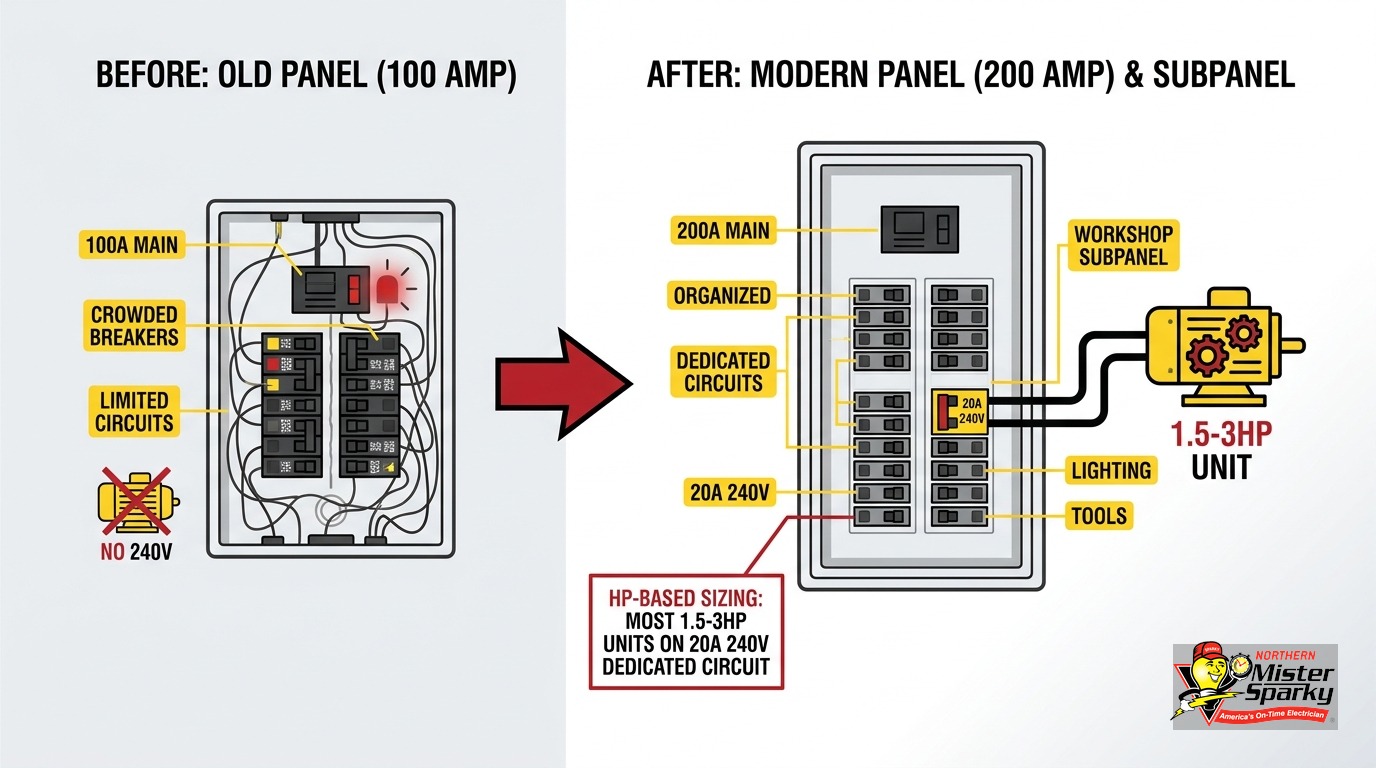
- Most 1.5 HP and 2 HP dust collectors run on a 20A 240V dedicated circuit with #12 AWG wire.
- A 3 HP unit steps up to a 30A 240V circuit on #10 AWG wire.
- “Use the dryer outlet” violates NEC 210.23(B). A 30A circuit may supply only one receptacle.
- Minnesota adopted the 2026 NEC on August 17, 2026. All 240V garage receptacles now require GFCI protection.
- Any new circuit or subpanel in a Minnesota garage requires an electrical permit.
- If you are also running a table saw, planer, or air compressor in the same shop, plan a subpanel before you run the first circuit.
What Circuit Does a Dust Collector Actually Need?
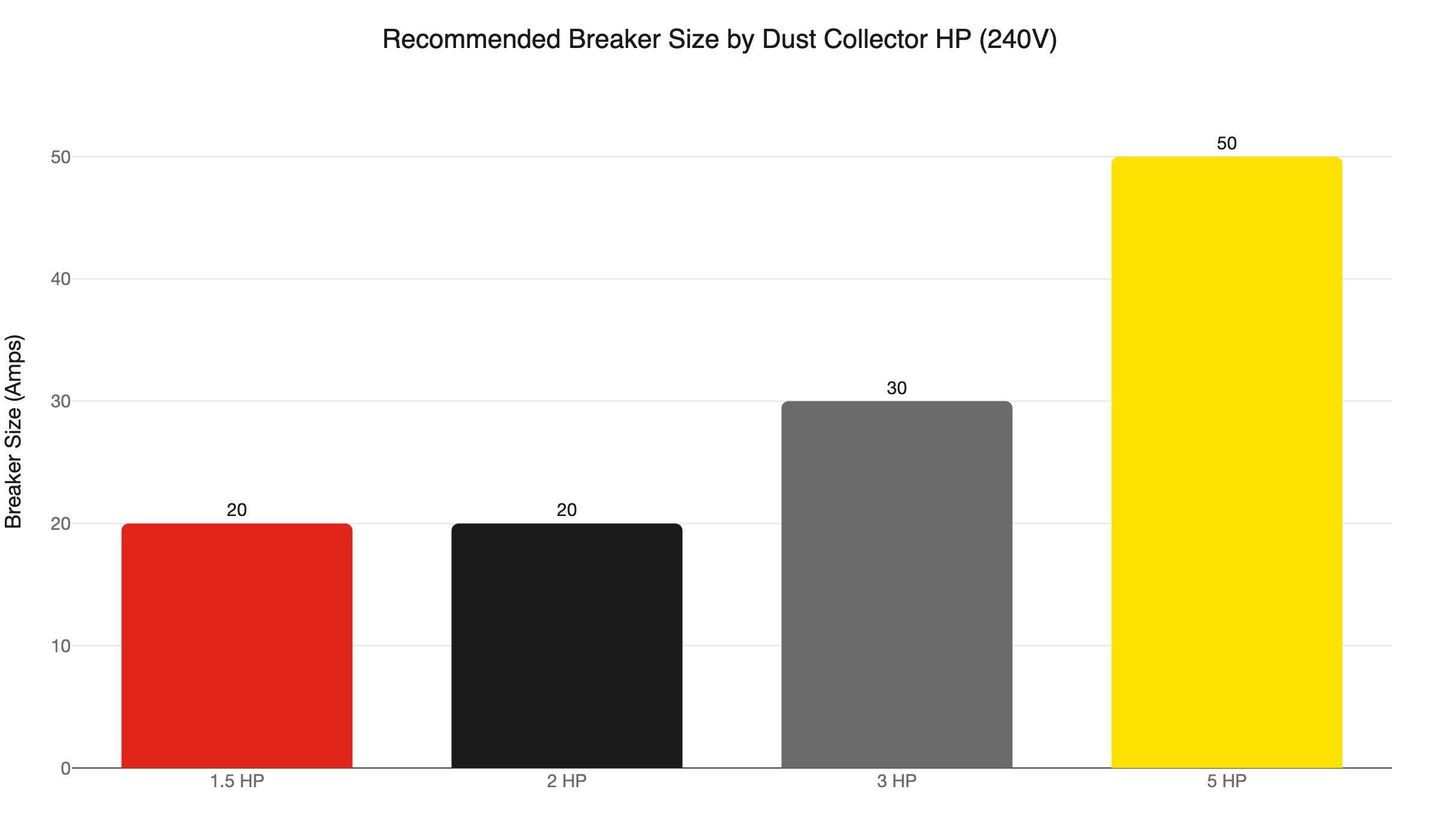
Short answer: For a 1.5 HP or 2 HP unit running at 240V, a 20A 240V dedicated circuit on #12 AWG wire is the correct choice. For a 3 HP unit, step up to a 30A 240V circuit on #10 AWG wire. The HP rating alone does not determine the circuit; the motor’s full-load amperage does.
Dust collectors are motor loads. The NEC sizes motor circuits from a published table of full-load amperage values, not from marketing horsepower. The NEC lists single-phase motor full-load amperage (FLA) values:
- 1.5 HP: 10A FLA
- 2 HP: 12A FLA
- 3 HP: 17A FLA
- 5 HP: 28A FLA
From those FLA values, two NEC rules determine the wire gauge and breaker size for any motor circuit.
How the NEC Math Determines Wire Gauge and Breaker Size
The NEC requires branch-circuit conductors to be rated above the motor’s FLA. That is the wire sizing rule.
The NEC allows the overcurrent device (breaker) to be sized above the FLA for a standard inverse-time breaker. That is the breaker sizing rule. The generous 250% ceiling exists because motors draw heavy startup current before settling into their running load.
Applying both rules to common dust collector sizes:
1.5 HP at 240V (10A FLA): Minimum conductor rating is 12.5A. #12 AWG copper, rated for 20A, covers this easily. The breaker ceiling is 25A. A 20A breaker is the practical standard.
2 HP at 240V (12A FLA): Minimum conductor rating is 15A. #12 AWG still works, and a 20A breaker handles the load with room for startup surge.
3 HP at 240V (17A FLA): Minimum conductor rating is 21.25A. That steps up to #10 AWG. A 30A breaker is the right fit here; the 20A circuit that worked for 1.5 HP and 2 HP is not the correct call for a 3 HP motor.
5 HP at 240V (28A FLA): Minimum conductor rating is 35A, so #8 AWG. A 50A breaker is standard for a residential 5 HP motor.
If your dust collector’s nameplate lists a specific running amperage at 240V, compare it to the NEC table value. If they differ, the NEC table value is what a licensed electrician sizes the circuit from, because that is the code standard.
Why Does a Dust Collector Need Its Own Dedicated Circuit?
Short answer: A motor draws 6 to 8 times its running amperage at startup. That surge will trip a breaker shared with other running loads. Dedicated means the circuit carries only the dust collector and nothing else.
At the moment a standard induction motor starts, it draws locked-rotor current of 6 to 8 times its full-load amperage. The 250% breaker allowance in NEC 430.52 exists precisely for this reason: the breaker has to tolerate the startup spike without nuisance tripping, while still protecting the wire against a sustained fault.
Put another tool on the same circuit and the math stops working. The breaker sees the combined running load of everything else plus the motor’s startup surge. A 20A breaker with a shop light and a battery charger already drawing 8A has 12A of headroom left. A 1.5 HP motor trying to start and pulling 60 to 80A for half a second will trip that breaker before the motor reaches full speed.
A dedicated circuit also means the dust collector circuit is sized for one motor load, which satisfies the NEC’s intent and keeps the installation straightforward at inspection.
Can You Use the Dryer Outlet for a Dust Collector?
Short answer: No. The NEC says a branch circuit at this amperage may supply only a single receptacle. Plugging both a dryer and a dust collector into the same 30A outlet is a code violation regardless of whether both devices fit the plug physically.
This advice appears constantly in woodworking forums: “just pick up an adapter and run it off the dryer outlet.” It violates a specific NEC rule and creates two practical problems.
First, a dryer outlet is a 30A 240V circuit that terminates at one receptacle by code. Adding a second device, whether via adapter or a second outlet on the same circuit, violates NEC 210.23(B). This will surface at inspection if the permit is ever pulled.
Second, a dryer draws close to its full circuit capacity. Running both a dryer and a dust collector from the same 30A circuit creates an overload condition. The breaker may hold temporarily, but it is not sized to sustain both loads together.
The correct answer is a dedicated circuit for the dust collector. If you want both the dryer and a workshop dust collector on 240V, each one gets its own circuit from the panel or a subpanel. See our guide on 240V outlet installation for dryers and large appliances for how that job is approached on the dryer side.
What Changed in Minnesota for Garage Electrical Work in 2026?
Short answer: Minnesota adopted the 2026 NEC on August 17, 2026. Any permit pulled on or after that date is reviewed under the new code. The biggest change for garage workshops: all 240V receptacles in garages now require GFCI protection under NEC 210.8(A)(2).
This is a meaningful change for anyone adding a dust collector circuit right now. Under the 2023 NEC, GFCI protection was required on 120V garage receptacles. The 2026 NEC extends that requirement to 240V receptacles as well.
A 240V dedicated circuit for a dust collector in a Minnesota garage must now include GFCI protection on the receptacle. This applies to work permitted after August 17, 2026. Work permitted before that date was reviewed under the 2023 NEC.
In practice, many electricians still reflexively skip GFCI on 240V because it was not required before. If you are hiring a contractor for a garage workshop circuit, ask specifically whether the 240V receptacle will be GFCI-protected. An omission caught at inspection means reopening the work.
It is also worth noting that September 2026 is not a gray-area timing issue. The 2026 NEC has been in effect for more than a month. Any permit pulled today is under the new rules.
Does Your Garage Workshop Need a Subpanel Before the Dust Collector Circuit?
Short answer: If you are planning to run a table saw, planer, air compressor, and dust collector in the same shop, yes. Each tool needs a dedicated 240V 20A or 30A circuit. That many circuits almost always calls for a subpanel rather than running each one back to the main house panel.
Adding a dust collector circuit is the moment many woodworkers realize the problem is not the dust collector, it is the panel capacity behind it. A 100A subpanel is the standard for a home workshop that includes multiple 240V tools. That size handles a table saw, planer, and dust collector each on their own dedicated 240V 20A circuit, plus lighting and a 120V outlet circuit, without exhausting the subpanel’s capacity.
Running circuits to a garage one at a time from the main house panel costs more per circuit than running a single feeder to a subpanel and branching from there. If you are adding two or more 240V circuits to a garage, get a quote for a subpanel alongside the individual circuit quotes. The subpanel option is often close in cost and leaves room for the tools you add in year two.
See our full breakdown of workshop subpanel and circuit planning for a circuit-by-circuit layout covering common shop tools. If you are deciding between a subpanel and a service upgrade, our subpanel vs. service upgrade decision guide walks through when each option makes more sense.
Detached vs. Attached Garage: Why the Distinction Matters for Your Circuit
If your workshop is in a detached garage, the NEC treats it as a separate building. That changes the electrical requirements beyond what an attached garage faces.
A detached garage served by a subpanel must have its own grounding electrode system. The NEC requires a minimum of two 8-foot ground rods driven at least 6 feet apart. This is the single most common inspection failure on detached shop electrical jobs.
A detached garage subpanel must also have a disconnecting means at the building itself. The NEC requires it. A main-lug-only panel without a separate disconnect does not satisfy this requirement.
Underground feeders from the house to a detached garage must meet NEC Table 300.5 burial depths: UF-B direct burial requires 24 inches of cover minimum; PVC conduit requires 18 inches. Under a driveway, add 6 inches to either minimum. Both burial depth and the grounding electrode system are things an inspector looks at on every detached structure job.
An attached garage feeds off the main house panel through the structure. The same GFCI requirements apply, but there is no separate building to ground and no feeder burial depth to get right. Knowing which situation you have before the job starts shapes the scope and the cost estimate.
Do Minnesota Homeowners Need a Permit to Add a Dust Collector Circuit?
Short answer: Yes. Any new circuit or subpanel addition in a Minnesota garage requires an electrical permit. Unpermitted work creates insurance and resale problems that are worse than the permit process itself.
The permit exists so an inspector can verify the wire sizing, breaker selection, GFCI installation, grounding, and burial depth before the walls close. A permit creates a documented record of compliant work. That record matters when you file a homeowner’s insurance claim or when a buyer’s inspector finds electrical work during a home sale.
Minnesota homeowners may pull their own electrical permit under Minnesota law if they own and occupy a single-family homestead. The requirement is that the homeowner personally performs all the work. No unlicensed helpers are allowed, including family members. The work must still pass inspection.
For most homeowners, the faster path is to hire a licensed electrician who pulls the permit, does the work, and passes inspection. The permit process for a single circuit addition is straightforward. See our electrical permit guide for Minnesota homeowners for what to expect, including typical timelines and how inspections work.
Cold Minnesota Winters Add a Real Sizing Argument
Most NEC motor sizing guidance is written for temperate conditions. Minnesota garages in January are not temperate.
When a dust collector motor starts cold at 0 degrees F or below, the mechanical load is higher, the motor oil is thicker, and the inrush current lands at the upper end of that 6 to 8 times FLA range rather than the middle. A properly sized dedicated circuit handles this without any issue. A marginal setup, where the wire is undersized or the breaker is already close to its thermal limit from shared loads, is more likely to trip or sustain heat stress at cold startup.
This is a genuine argument for right-sizing the wire and not running a dust collector on any shared circuit. It is also an argument for not cutting corners on wire gauge. The step from #12 AWG to #10 AWG on a 3 HP circuit is not an upsell. In a Minnesota garage, it is the correct specification for the conditions.
How Do Dust Collector Circuit Requirements Compare to Air Compressor Requirements?
If you have read our air compressor circuit requirements guide, you will recognize the same NEC Article 430 motor circuit framework here. The rules are identical: size the wire at 125% of FLA, size the breaker up to 250% of FLA.
The difference is voltage. Most portable air compressors in the 1 to 2 HP range run on 120V. Most woodshop dust collectors run on 240V. A 240V circuit draws half the amperage for the same power output. For the same HP rating, the 240V circuit uses smaller wire and a lower breaker rating than the 120V version.
If you are planning to add both an air compressor and a dust collector to a garage shop, that is exactly the subpanel conversation. Two dedicated 240V 20A circuits plus a 120V general circuit is a straightforward 100A subpanel job.
What a Licensed Electrician Handles That a Forum Post Will Not Tell You
Here is what the difference looks like between a licensed electrician doing a garage workshop circuit job and a homeowner working from twelve-year-old forum advice:
Wire gauge from the right table. A licensed electrician sizes from NEC Table 430.248 FLA values, not from the nameplate amperage sticker if the two disagree. The NEC table is the code standard.
Motor-rated breaker selection. Motor circuits sometimes call for breakers with different trip characteristics than standard thermal-magnetic breakers. Using the wrong breaker type causes nuisance trips under startup load.
GFCI on the 240V receptacle. Under the 2026 NEC now in effect in Minnesota, this is required. Most forum posts written before August 2026 do not mention it because the requirement did not exist yet.
Permit and inspection record. A licensed electrician pulls the permit, the inspector reviews the work, and you have documented proof of compliant installation. That proof matters for insurance and for resale.
Detached garage grounding and disconnect. The ground rod requirement and the disconnect requirement are easy to miss and easy for an inspector to catch. A licensed electrician doing a detached shop job knows to account for both.
Northern Mister Sparky is locally owned and operated in the Twin Cities. We are America’s On-Time Electrician(R). If you are planning a garage workshop circuit or a subpanel to power the whole shop, call us at 763-200-5956 or book online to schedule. For larger jobs like a subpanel installation or a panel upgrade, ask about financing when you call. The UWIN(R) 100% satisfaction guarantee backs every job we do.
Frequently Asked Questions
What size circuit does a 1.5 HP dust collector need? +
Do I need a permit to add a dust collector circuit in Minnesota? +
Can I share a dryer outlet with my dust collector? +
Does a 240V garage outlet need GFCI protection in Minnesota? +
Need an electrician now?