
Air Compressor Dedicated Circuit Garage: Size It Right
Key Takeaways
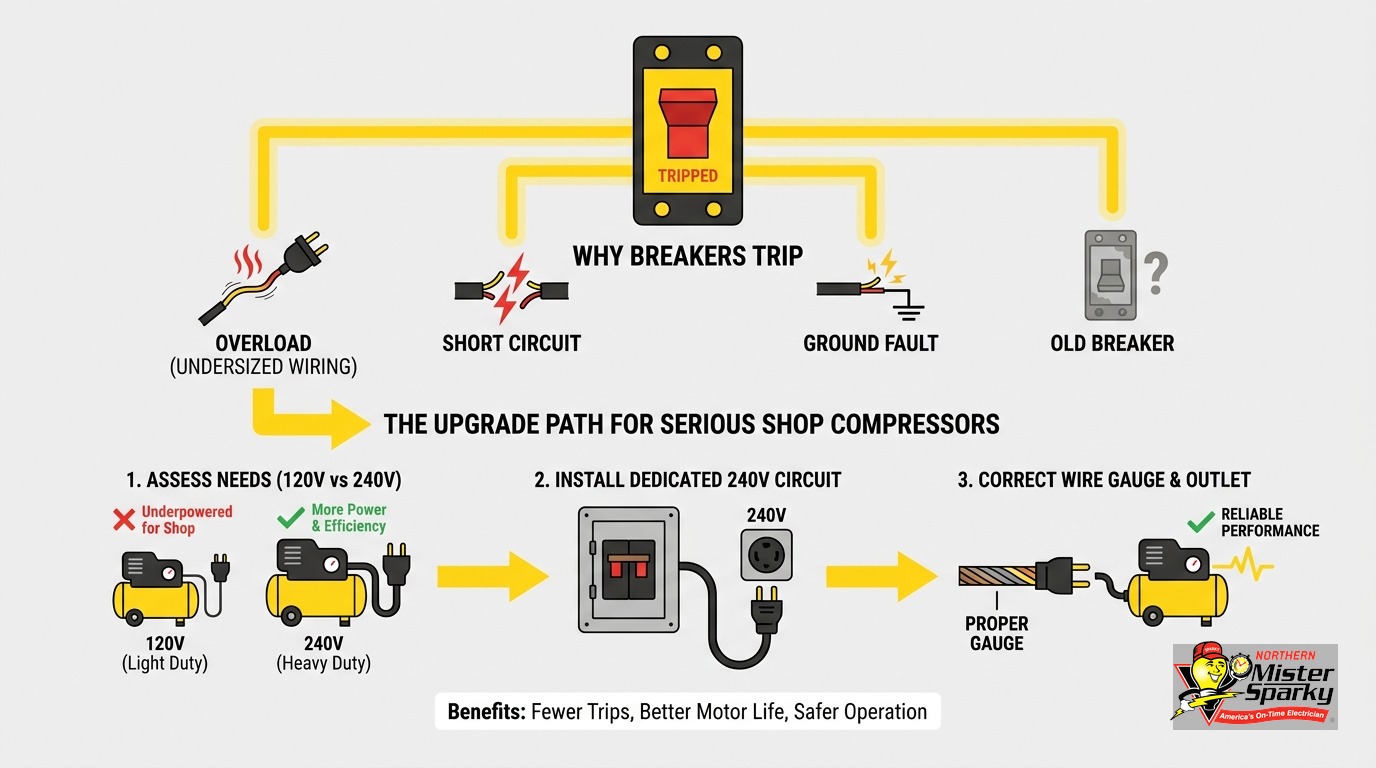
- Any compressor above 2HP requires a 240V dedicated circuit. A standard 120V outlet cannot handle the load.
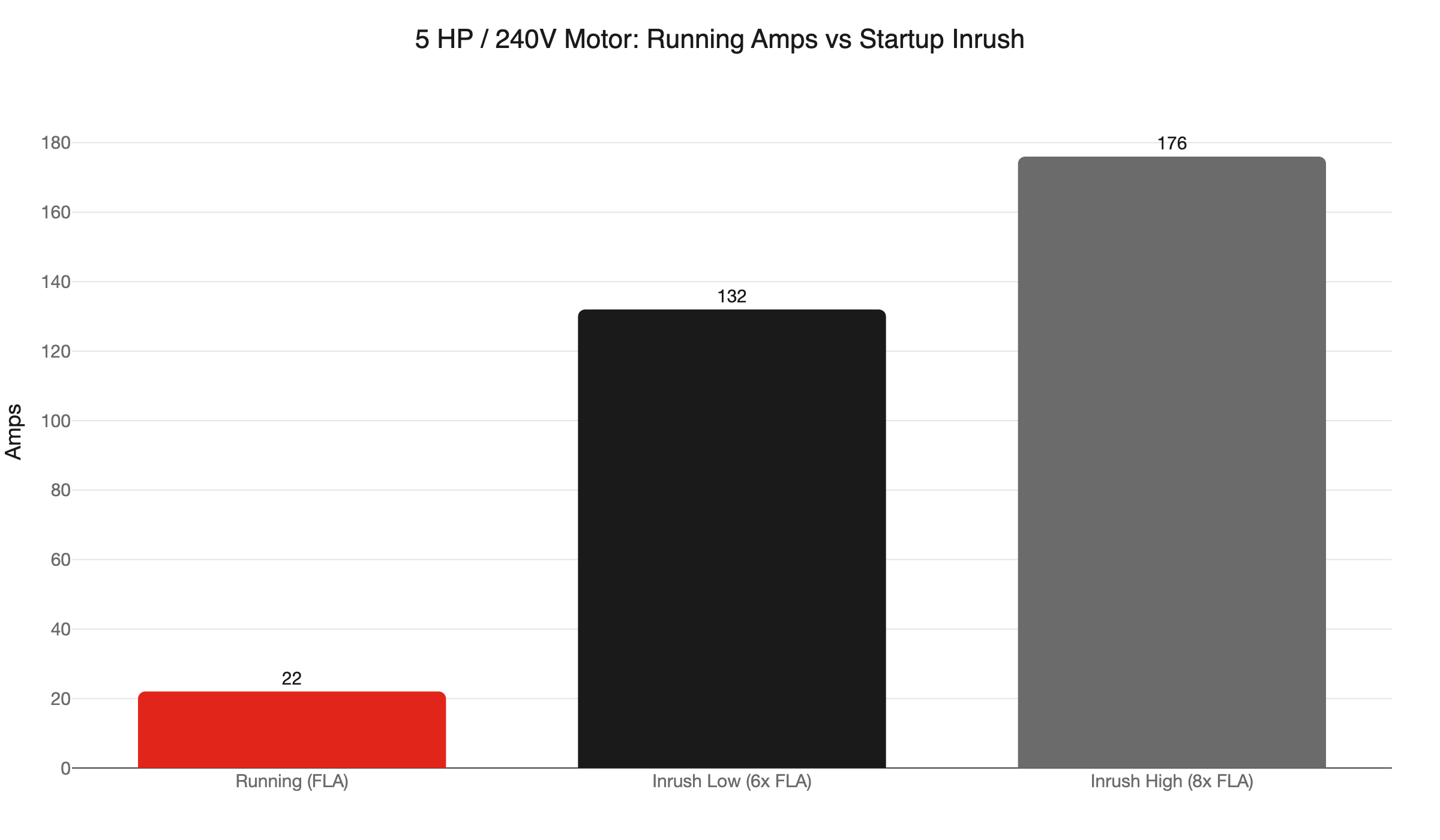
- Breakers trip on startup because inrush current is 6-8 times the running draw. Size your breaker to 250% of the full-load amps to give the motor room to start.
- Minnesota requires an electrical permit for any new circuit. As of August 17, 2026, those permits fall under the 2026 NEC.
- In an unheated Minnesota garage, cold-weather starting pushes inrush above the nameplate rating. Size to the upper end of what the code allows.
- When a new circuit is not enough, the answer may be a garage subpanel, a feeder upgrade, or both.
- Never use an extension cord as a permanent fix for a compressor.
What Voltage Does a Garage Air Compressor Actually Need?
The short answer: Any compressor rated at 2HP or more requires a 240V dedicated circuit. A 120V outlet cannot safely run anything above 1HP because the running amps exceed what a standard 20A circuit can carry.
This limit is physics, not a preference. A 3HP motor on a 120V supply draws around 22A at running load. That trips a 20A breaker. No production compressor above 2HP is rated for 120V for exactly this reason.
The math works cleanly on 240V. Split across two legs of your service panel, a 240V circuit delivers twice the power for the same wire size. A 5HP motor at 240V draws about 22A running. The same motor at 120V would need around 44A, far beyond any standard outlet.
If you run a small pancake or hot dog compressor for tire inflation and finish nailers, a 120V outlet may be sufficient. If you run a two-stage shop compressor, power a spray gun, or run air tools for extended periods, 240V is the correct starting point.
The voltage decision shapes every other choice: wire gauge, breaker type, outlet configuration, and whether your existing panel has the capacity for the load at all.
Why Does My Compressor Keep Tripping the Breaker?
The short answer: Startup inrush current. When a compressor motor kicks on, it draws 6-8 times its normal running amperage for a brief moment. A breaker sized for running amps alone sees that spike and opens the circuit.
Per NEMA MG1 standards, a motor with a 22A full-load rating generates 132-176A of inrush current at startup. That surge lasts half a second to two seconds. Standard breakers interpret sustained overcurrent as a fault and trip.
The fix is not simply swapping in a larger breaker on the same circuit. It is the right breaker on a properly sized, dedicated circuit.
NEC Article 430 addresses this directly. For motors, an inverse-time breaker can be sized up to 250% of the full-load amps (FLA). On single-phase motors where 250% still causes nuisance tripping, NEC 430.52 allows going as high as 400% of FLA. That latitude exists because motor startups are not faults. They are predictable, short-duration load events that a correctly selected breaker handles without opening.
If your compressor shares a circuit with anything else, tripping is almost guaranteed. The compressor startup alone taxes a 20A circuit. Add a shop light, a vacuum, or any other tool running at the same time, and the combined draw pushes the circuit past its rating. A dedicated circuit is not a luxury for a shop compressor. It is a code requirement for larger motors and a practical necessity even where code does not compel it.
For a broader look at why breakers trip, including causes beyond motor inrush, see our post on why your circuit breaker keeps tripping.
How Do You Size a Dedicated Circuit for an Air Compressor?
The short answer: Find the full-load amps (FLA) on the compressor nameplate. Multiply by 1.25 for minimum wire ampacity. Multiply FLA by 2.5 for the breaker size, then round up to the next standard size. Run a dedicated 240V, 2-pole circuit.
NEC 430.22 and 430.52 are the two rules governing motor circuits. They work together.
NEC 430.22 sets the wire rule: conductors must be rated for at least 125% of the motor’s FLA. This protects against heat buildup in the wire during sustained motor load. The motor draws near FLA whenever the compressor runs to pressure.
NEC 430.52 sets the breaker rule: the overcurrent protective device can be sized up to 250% of FLA for an inverse-time breaker. This gives the startup inrush room to pass without tripping the circuit.
Worked example, 5HP / 240V compressor:
- Nameplate FLA: 22A
- Wire: 22A x 1.25 = 27.5A minimum. Use 10 AWG copper, rated for 30A.
- Breaker: 22A x 2.5 = 55A. Round up to a standard 60A time-delay breaker.
That is a dedicated 2-pole 60A circuit wired with 10 AWG. Not a 30A circuit. Not a shared circuit.
Always pull the FLA from the nameplate, not from the horsepower alone. Two compressors with the same HP rating can have different FLA depending on motor efficiency and design. The nameplate number is the figure NEC references, and it is what your electrician will use when pulling the permit.
Wire Gauge and Breaker Size by Horsepower
Use this as a starting reference. Always confirm against the compressor’s nameplate FLA before any work begins, since actual FLA can vary between models with the same horsepower rating.
- 0.5HP at 120V: 14 AWG wire, 15A breaker
- 1HP at 120V: 12 AWG wire, 20A breaker
- 2HP at 240V: 12 AWG wire, 20A breaker
- 3-5HP at 240V: 10 AWG wire, 30A minimum circuit ampacity (up to 60A time-delay breaker for a 5HP motor per NEC 430.52)
- 7.5HP at 240V: 8 AWG wire, 40A breaker
- 10HP at 240V: 6 AWG wire, 55A breaker
Source: Air Compressor Power Requirements
Note the range on 3-5HP. A 3HP and a 5HP compressor share the same wire gauge in this table, but take different breaker sizing. For the 5HP example above, the 10 AWG wire is rated at 30A, but NEC 430.52 permits a 60A time-delay breaker because the wire ampacity and the breaker each serve different protective purposes. The wire handles sustained running load. The breaker tolerates inrush without false-tripping. Those are two separate calculations.
The nameplate also matters for the outlet type. A 240V compressor circuit uses a 2-pole breaker and a NEMA 6-30 or 6-50 receptacle depending on the amperage. Confirm the receptacle configuration before ordering components.
Can You Run an Air Compressor on an Extension Cord?
The short answer: Not as a permanent solution. Extension cords cause voltage drop, which forces the motor to draw more current to maintain output. That extra current heats the cord and damages motor windings over time. If you must use one temporarily, keep it under 25 feet with 12 AWG wire on a 120V compressor only.
Voltage drop is the core problem. When the voltage at the motor terminals falls below the rated supply, the motor compensates by pulling more amps to produce the same mechanical output. More amps mean more heat, in both the cord and the motor windings. On a 120V circuit with a long or undersized cord, this effect is especially punishing because current is already high relative to conductor size.
The cord itself resists current. A cheap 16 AWG extension cord on a 15A circuit can overheat well before the breaker trips. The breaker protects the wire in the wall. It does not protect the extension cord running across the floor.
For a 240V compressor, an extension cord is not a realistic option at all. The receptacle type alone makes it impractical, and no commonly available cord is rated for the continuous load.
The right answer is a permanent outlet at the compressor location. Our guide on extension cord dangers and when to add an outlet covers the typical process and cost for adding a dedicated receptacle near your equipment.
Do Minnesota Garages Need a Permit for a New Compressor Circuit?
The short answer: Yes. Minnesota requires an electrical permit for any new circuit, including a dedicated compressor circuit in a garage. Homeowners can pull their own permit for their primary residence. Apply online at ims.dli.mn.gov.
This is the detail every DIY forum thread skips. They discuss wire gauge and breaker amperage in detail without ever mentioning that running a new circuit in Minnesota without a permit is a code violation. An unpermitted circuit can affect your homeowner’s insurance coverage on related claims and complicate a future home sale when the inspector pulls a permit history.
Here is the timing detail that matters right now: Minnesota adopted the 2026 NEC on August 17, 2026. Permits filed before that date required compliance with the 2023 NEC. Permits filed today must comply with the 2026 NEC. If you received a quote in late July, confirm whether the scope was written under the 2023 or 2026 code. The two versions can differ on requirements that affect your project.
Minnesota homeowners can pull their own electrical permit for work on their primary residence at ims.dli.mn.gov. After the permit is issued, the email you receive specifies whether to schedule through the state’s “Ready for Inspection” system or contact a contract inspector. You do not have to determine your local jurisdiction on your own. The issued email tells you which system applies.
If you prefer to let a licensed electrician handle the permit, inspection, and coordination, we do that as part of the job. Our full breakdown of the Minnesota electrical permit process walks through every step so you know what to expect.
Why Do Minnesota Winters Make Compressor Sizing Even More Critical?
The short answer: Cold thickens motor oil and stiffens compressor internals, raising startup inrush above the nameplate locked-rotor amps. A breaker that passed testing in October may trip reliably in January. Size to the upper end of what NEC permits.
An unheated garage sitting at -10 degrees Fahrenheit is not the ambient environment a motor nameplate assumes. Motor nameplates specify locked-rotor amps (LRA) at rated ambient temperature. Cold conditions change that calculation. Thicker oil resists the pump. Cold metal contracts differently. The motor has to work harder on the first stroke, and it shows up as higher inrush current.
That means a breaker sized at 250% of FLA may still nuisance-trip in a January garage even though it cleared testing in the fall. NEC 430.52 allows single-phase motor circuits to go up to 400% of FLA with an inverse-time breaker when 250% causes nuisance tripping. In Minnesota, sizing to the higher end of what the code permits is not being overcautious. It is accounting for real operating conditions.
A practical step: if the compressor will sit in an unheated space, let it warm for a few minutes before full-load operation when temps are below freezing. Some shop owners run a small space heater near the compressor during extreme cold snaps. Neither replaces correct circuit sizing, but both reduce stress on the motor at startup.
If you are planning a heated garage shop, the electrical picture extends well beyond the compressor circuit. Our guide on heated garage electrical planning covers 240V heater circuits, panel load calculations, and full shop circuit layout.
When Do You Need a Subpanel Instead of a New Circuit?
The short answer: When the run from the main panel is too long for cost-effective large wire, when the main panel is out of breaker slots, or when the garage already carries several 240V loads. A subpanel centralizes the garage’s electrical demand and feeds it with one heavy-gauge feeder.
A dedicated circuit from the main panel works well when the compressor is close, the panel has an open 2-pole slot, and total garage load stays within the existing feeder’s rating. That works for a lot of attached garages with newer panels.
It does not work for every Twin Cities home. Many properties have a detached garage fed by a 60A or 100A feeder run from the main panel. If that garage already powers a heater, a lift, or heavy lighting, adding a 5HP compressor may push the feeder past its capacity. You can wire the compressor circuit perfectly and still lose the whole garage to a tripped feeder breaker every time everything runs at once.
The upgrade path typically falls into three tiers:
- New dedicated circuit from the main panel: correct when the panel has room, the run is short, and combined garage load stays within the feeder rating.
- Subpanel in the garage: correct when the run is long, the main panel is crowded, or multiple 240V loads share the space. A 60A or 100A subpanel at the garage keeps heavy wire runs short and puts breaker slots where the equipment lives.
- Service feeder upgrade: necessary when the garage feeder itself is undersized for the combined loads. This may mean upgrading from a 60A to a 100A or 200A feeder, which involves both the main panel and potentially the meter.
Our post on detached garage subpanel installation walks through feeder sizing, conduit options, and what drives the cost on a Twin Cities install.
The no-malarky answer: if you are adding a serious shop compressor, have an electrician evaluate the whole garage electrical picture before any wire gets pulled. A load assessment upfront prevents the expensive surprise of finishing the compressor circuit and then discovering the feeder trips under combined load every time you run the heater and the compressor together.
What Are the GFCI Rules for Garage Compressor Circuits?
The short answer: All 120V 15A and 20A receptacles in a garage require GFCI protection under NEC 210.8(A)(2). A 240V-only compressor circuit with no neutral is outside that rule as written, but confirm with your local authority having jurisdiction, since interpretations vary.
For a 120V compressor, the rule is straightforward. The outlet must be GFCI-protected, the same as any garage receptacle.
For 240V compressors on a 3-wire circuit (two hots and a ground, no neutral), NEC 210.8(A)(2) technically does not apply because it references 125V nominal circuits. However, some Minnesota authorities having jurisdiction apply the GFCI requirement to all garage receptacles regardless of voltage. That interpretation is not universal, but it is common enough that you should confirm before roughing in.
When we pull a permit for a 240V garage circuit, we verify the local requirement before the work starts. If a GFCI breaker is required, it changes both the breaker spec and the project cost. A 2-pole GFCI breaker for a 240V circuit is available and code-compliant, but it costs more than a standard 2-pole breaker. Better to know that before the permit is issued than after the panel is closed up.
Get the Right Circuit for Your Garage Compressor
A dedicated air compressor circuit is a straightforward job when sized correctly. The details matter: voltage, wire gauge, breaker type, inrush margin, permit, inspection. Get any one wrong and you are resetting breakers in January or explaining an unpermitted circuit to a home inspector at sale time.
Northern Mister Sparky is locally owned and operated in the Twin Cities. We know the Minnesota permit process, the 2026 NEC timeline, and what works in an unheated garage in February. As America’s On-Time Electrician(R), we show up when we say we will.
Call us at 763-200-5956 or book online. We size the circuit right the first time and stand behind it with the UWIN(R) 100% satisfaction guarantee.
Frequently Asked Questions
What size breaker do I need for a 5HP air compressor? +
Can I plug my garage air compressor into a regular outlet? +
Do I need a permit for a new compressor circuit in Minnesota? +
Need an electrician now?