
2-Post Car Lift Electrical Requirements: Complete Guide
Key Takeaways
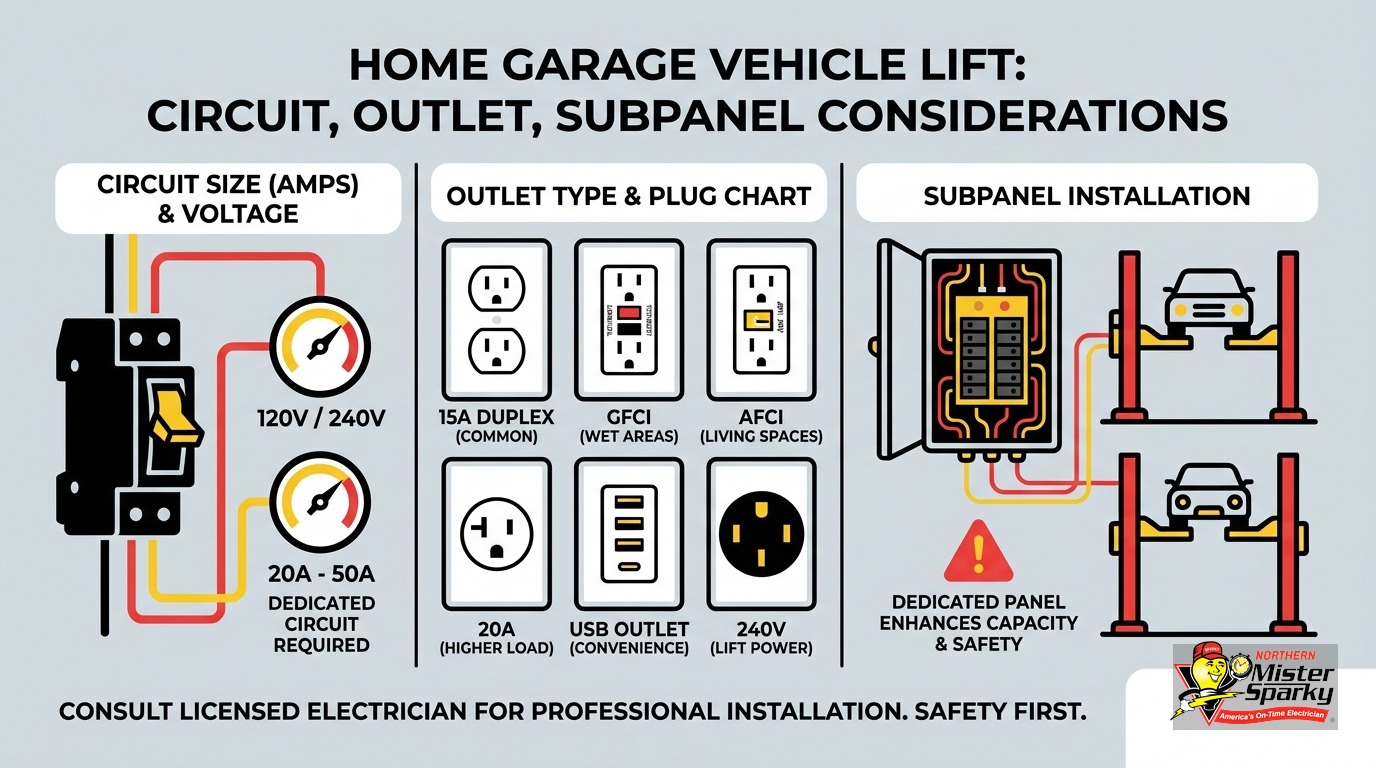
- Most professional 2-post and 4-post lifts (9,000 lb and above) need a dedicated 240V circuit, typically 30 amps, connected to a NEMA 6-30R or 6-50R outlet or a hardwired connection.
- NEC 430.52 allows motor branch-circuit breakers to be sized up to 250% of the motor’s full-load amperage. A 30A breaker on a 12A motor is correct, not oversized.
- Minnesota adopted the 2026 NEC on August 17, 2026. Every permit filed today must comply with the new code, not the 2023 version most articles still reference.
- Detached garages require a 4-wire feeder, a separate grounding electrode, and no neutral-ground bond at the subpanel under NEC 250.32. No lift manufacturer flags these rules.
- The lift is almost never the only 240V load in the garage. A compressor, heater, and EV charger combined can push the total demand to 100A or more. A 100A subpanel is usually the smarter investment over a 60A.
- An electrical permit is required in Minnesota for all 240V circuit work. Licensed contractor installation is the standard path.
What Are the 2-Post Car Lift Electrical Requirements?
A professional-grade 2-post lift needs a dedicated 240V circuit, a properly matched outlet or direct hardwired connection, an electrical permit, and in most Twin Cities garages, a subpanel sized for the full shop load. Minnesota’s current electrical code is the 2026 NEC, adopted August 17, 2026.
That is the compressed version. But if you are planning the electrical work before the lift arrives on a pallet, you need to understand each layer in detail. The circuit size, the outlet type, the GFCI rules, the subpanel math, and the detached-versus-attached garage distinction all shape what the job involves and what it costs.
This guide is written from a licensed Minnesota electrician’s perspective. The goal is to give you the same level of detail a good electrician would walk through before writing up a quote, so you understand exactly what is planned and why.
One more note before the specs: if you are still shopping for a lift, look for the ALI gold label. ALI-certified lifts meet ANSI/ALI ALOIM safety standards, and ALI recommends annual inspections after installation. A safe shop starts with the equipment itself, not just the wiring.
What Voltage Does a 2-Post Car Lift Need?
Most professional 2-post and 4-post lifts require a dedicated 240V circuit. Smaller lifts under 9,000 lb capacity may run on a dedicated 120V circuit, but the majority of home-shop lifts sized to raise a full-size truck or SUV operate on 240V.
The voltage and full-load amperage (FLA) your lift requires are printed on a nameplate attached to the motor. Write both numbers down before you call an electrician. You will need them to size the circuit, the wire gauge, and the breaker correctly.
If your lift documentation says 220V, that is the same supply as 240V in residential wiring. The two terms describe the same nominal voltage: two 120V legs of your home’s electrical service combined. Either way, you need a double-pole breaker and a two-hot, grounded circuit.
Most residential car lifts are single-phase motors. If you are considering a commercial-grade lift with a three-phase motor, that is a different conversation entirely. Residential electrical service does not include three-phase power. Confirm your lift is a single-phase unit before ordering.
What Circuit and Breaker Size Does a Car Lift Need?
A dedicated 30-amp, 240V circuit is the most common spec for home-shop 2-post lifts. The breaker is often sized larger than the lift’s running amps suggest, and that is intentional and code-compliant under NEC 430.52.
A car lift motor draws startup (inrush) current significantly higher than its sustained running amps. NEC 430.52 accounts for this directly. For single-phase motors on standard inverse-time breakers, branch-circuit protection can be sized up to 250% of the motor’s full-load amperage.
The math is straightforward. A lift motor with a 12A FLA can sit on a 30A breaker: 12 x 2.5 = 30. That is not an oversized breaker. It is code-correct motor protection. The breaker protects the wire, and the motor has its own internal overload protection.
Wire gauge is a separate calculation. A 30A circuit requires a minimum of 10 AWG copper. On runs longer than 50 to 60 feet, voltage drop may push you to 8 AWG copper to stay within 3%. That matters on a motor circuit more than it does on a lighting circuit. Low voltage at the motor causes overheating, reduced lifting torque, and shortened motor life. Ask your electrician to run the voltage drop calculation for your specific garage layout before pulling wire.
Hardwired vs. Cord-and-Plug: What Is the Difference?
A hardwired lift connects directly to the circuit conductors with no outlet or plug involved. A cord-and-plug lift uses a receptacle on the wall and a plug on the lift’s power cord. The choice affects your GFCI obligations and may affect the lift warranty.
Many lift manufacturers require professional electrical installation to keep the warranty valid, and hardwired connections are common for commercial-grade home lifts. Check your installation manual before deciding on a connection method.
From a code standpoint, the distinction carries real weight. NEC 210.8(A)(2) requires GFCI protection for all 125V-250V receptacles in garages. That covers 240V outlets. A 2-pole GFCI breaker (typically $40 to $80) is the cleanest way to satisfy that requirement when a receptacle is involved.
A hardwired lift has no receptacle, so NEC 210.8 does not apply to that connection point in the same way. The GFCI mandate targets the outlet, not the hardwired termination. That said, a 2-pole GFCI breaker remains a smart addition even for hardwired circuits in a garage environment. Many articles focused on outlet types miss this distinction entirely, and it can matter when a homeowner is choosing between connection methods.
Which Outlet Type Does a Car Lift Require?
For cord-and-plug 240V lifts, the standard outlet types are NEMA 6-30R (240V, 30A, no neutral) and NEMA 6-50R (240V, 50A, no neutral). The NEMA 6-30R is the most common choice for residential lift circuits.
A few key points on outlet selection:
- Neither the 6-30R nor the 6-50R carries a neutral wire. Car lift motors run on two hots and a ground. This is different from a dryer outlet (NEMA 14-30R) or a range outlet (NEMA 14-50R), both of which include a neutral.
- The outlet must match the plug on your lift’s power cord. Do not use an adapter to bridge mismatched 240V outlet types. The different blade configurations exist to prevent connecting equipment to the wrong voltage or amperage.
- Locate the outlet within reach of the lift’s factory cord. Running an extension cord from the outlet to the lift is not acceptable. Extension cords cannot sustain the motor load and are a fire hazard.
- Outlet placement matters practically. Install it high enough on the wall that the lift’s horizontal arms do not block access when the lift is in use, and far enough from the lift post that the cord hangs clear of the vehicle path.
Do You Need a Subpanel for a Car Lift?
In most cases, yes. If the garage is detached, if the main panel is full, or if other 240V loads share the space, a subpanel is usually the right move. A 60A subpanel handles the lift alone. A 100A subpanel is almost always the smarter investment once you add the compressor, heater, and EV charger.
This is the question manufacturer guides skip entirely. The lift’s spec sheet tells you what the lift needs. It says nothing about whether your existing panel has the capacity to deliver it, or whether your garage has any 240V supply at all.
A 60A subpanel can work if the lift is the only 240V load and you have a short feeder run from a panel with available capacity. That is a narrow scenario. Most Twin Cities home shops end up with more:
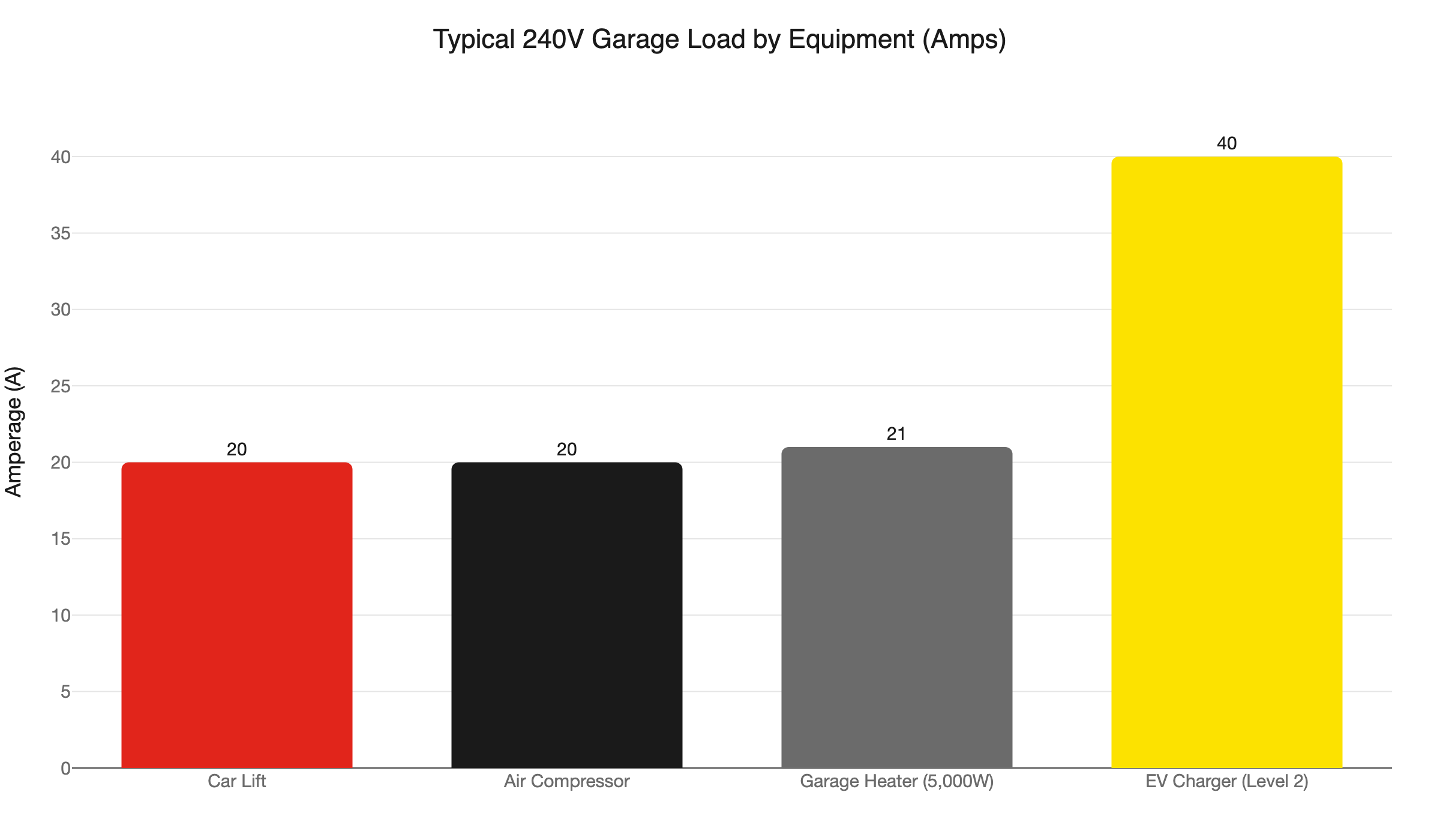
- Car lift: approximately 20A dedicated circuit
- Air compressor: approximately 20A dedicated circuit (our post on air compressor circuit requirements for the garage covers the sizing in detail)
- 240V garage heater (5,000W): approximately 21A dedicated circuit, near-universal in Minnesota winters
- Level 2 EV charger: 32 to 48A dedicated circuit, depending on the unit
Four loads. Four dedicated 240V circuits. Each uses a double-pole breaker slot. A 60A panel with four to six slots fills up before all four loads are wired. A 100A subpanel, fed with 3 AWG copper or 1 AWG aluminum on a 100A double-pole breaker, provides the slots and the amperage headroom to run everything without tripping the main feeder breaker.
Installing the 100A subpanel now is significantly cheaper than pulling a second feeder run later when you add the EV charger or the welder.
For feeder sizing and conduit specs, our guide on detached garage subpanel installation walks through the full calculation. And before you finalize the subpanel size, plan for the garage heater. A 240V heater drawing 21A competes directly with your lift for panel capacity. Our post on wiring a 240V garage heater circuit covers the circuit requirements for the most common Minnesota garage heater sizes.
Detached vs. Attached Garage: Why the Wiring Rules Differ
If the lift is going into a detached garage, the wiring rules are materially different from an attached garage, and no lift manufacturer will flag that for you. NEC 250.32 governs how power is fed to a separate structure, and it imposes three requirements.
Four-wire feeder required. The feeder from the main panel to the detached garage must carry two hots, one neutral, and one equipment grounding conductor (EGC). A 3-wire feeder (two hots and a neutral, no separate ground) is only permitted under a limited grandfather exception for pre-existing wiring. All new work must use 4-wire.
Separate grounding electrode required. The detached structure needs its own grounding electrode system: typically a ground rod driven at the garage, a ground plate, or another NEC-approved electrode. The detached structure cannot rely on the main building’s grounding electrode as a substitute.
No neutral-ground bond at the subpanel. Inside the detached garage subpanel, the neutral bar and the ground bar must remain separate. Bonding them at the subpanel, which is correct practice at the main service panel, creates a parallel fault path through the feeder’s neutral conductor and is a shock hazard. Many DIY subpanel installs get this wrong, and an inspector will flag it.
These requirements are spelled out in NEC 250.32. They apply even if the detached garage sits 15 feet from the house.
For a 60A feeder, the typical spec is 6 AWG copper (or 4 AWG aluminum) on a 60A double-pole breaker, in 3/4” EMT conduit, with a maximum run of 153 feet at 3% voltage drop. For a 100A feeder, step up to 3 AWG copper (or 1 AWG aluminum) in 1” EMT, with a maximum run of 184 feet at 3% voltage drop. Feeder runs to detached garages often go underground. Underground conductors require the appropriate burial depth and conduit fill per NEC 300.5, and the underground run counts toward the total length for voltage drop calculations.
Older Twin Cities neighborhoods, the Minneapolis bungalow districts and St. Paul row home blocks, are full of detached garages built decades before the modern NEC. The 4-wire feeder, separate grounding electrode, and no-bond-at-subpanel rules are directly relevant in these garages, and they are rules that no competitor article on car lift wiring bothers to explain.
Does Minnesota Require a Permit for Car Lift Wiring?
Yes. A new 240V circuit, a subpanel, or a service upgrade all require an electrical permit in Minnesota. Licensed contractor work is the standard path. Homeowner self-permit affidavits are available but are scrutinized closely for 240V and subpanel projects.
This is a two-track permit situation that most guides skip. You may need:
- An electrical permit from Minnesota’s Department of Labor and Industry (DLI) for the circuit, subpanel, or service upgrade. This is what a licensed electrician pulls on your behalf.
- A building or mechanical permit from your local municipality for the lift structure itself. Requirements vary by city, so check with your local building department before scheduling the lift delivery.
Both Minneapolis and St. Paul require permits for all garage electrical work. St. Paul publishes a Residential Garage Wiring checklist aligned with the current NEC and outlining what inspectors look for. Minneapolis has comparable requirements.
Our post on getting an electrical permit in Minnesota covers the process step by step, including what the inspection involves and how long the permit typically takes.
Skipping the permit is not worth the risk. An unpermitted 240V circuit can void your homeowner’s insurance coverage for an electrical fire claim. It also surfaces as a defect at home sale, when a buyer’s inspector flags work with no permit history. Both outcomes cost far more than the permit itself.
What Changed with the 2026 Minnesota Electrical Code?
Minnesota adopted the 2026 NEC on August 17, 2026. Every electrical permit filed on or after that date must comply with the 2026 NEC. Guidance written against the 2023 NEC is outdated for the Twin Cities market right now.
Minnesota’s electrical code is the NEC as published by NFPA, administered under Chapter 1315 of the Minnesota State Building Code. The state adopts no amendments to the NEC. When NFPA publishes a new code cycle, Minnesota transitions on the state’s adopted effective date. The DLI website at dli.mn.gov is the authoritative source for the current adopted code cycle and any transition dates.
The practical impact for anyone wiring a car lift right now: any article or manufacturer guide referencing the “2023 NEC” is technically outdated for the Twin Cities market. The 2026 NEC includes updates to motor circuit protection, GFCI requirements, and grounding provisions. Work with a licensed electrician who has kept their continuing education current for the new cycle. Licensing exams transitioned to the 2026 NEC on September 8, 2026, so electricians newly licensed after that date are already tested on the updated code.
Why Does My Breaker Seem Too Big for the Amps My Lift Draws?
Motor circuit protection follows NEC 430.52, not a simple match to running amps. Inverse-time breakers can be sized up to 250% of the motor’s full-load amperage. A lift with a 12A FLA on a 30A breaker is correctly sized, not oversized.
Electric motors draw a surge of current at startup, sometimes 5 to 7 times the running amps, before reaching operating speed. A breaker sized to the running amps would trip on every start. NEC 430.52 solves this by allowing an intentionally larger breaker for motor branch circuits.
The breaker still protects the wire: that protection is determined by wire gauge, not by the motor’s running amps. The motor has its own internal thermal overload protection built in. The larger breaker gives the motor the startup headroom it needs without creating a safety hazard.
This also explains why a 100A residential panel fills up faster than expected once 240V loads move into the garage. Each motor circuit takes a double-pole breaker slot sized above the motor’s running amps. Add a car lift, a compressor, a welder, and a heater, and a properly sized subpanel becomes the real project underneath the lift installation, not a side note.
Ready to Wire Your Car Lift the Right Way?
The 2 post car lift electrical requirements cover a lot of ground: voltage, dedicated circuit sizing, outlet types, GFCI rules, subpanel capacity, detached garage grounding, and Minnesota’s current 2026 NEC. Getting all of those pieces right before the lift goes in is the difference between a shop that runs cleanly and one that trips a breaker the first time the compressor and the lift run together.
Northern Mister Sparky is locally owned and operated right here in the Twin Cities. We pull the permits, handle the inspection, and back every job with the UWIN(R) 100% satisfaction guarantee. As America’s On-Time Electrician(R), we show up when we say we will, no malarky.
Financing is available for subpanel installations and service upgrades.
Call 763-200-5956 or book online to get your car lift circuit scheduled.
Frequently Asked Questions
What size circuit does a 2-post car lift need? +
Do I need a permit to wire a car lift in Minnesota? +
Can I use an extension cord with a car lift? +
Need an electrician now?