
Workshop Electrical Planning: Size Your Shop Subpanel Right
Key Takeaways
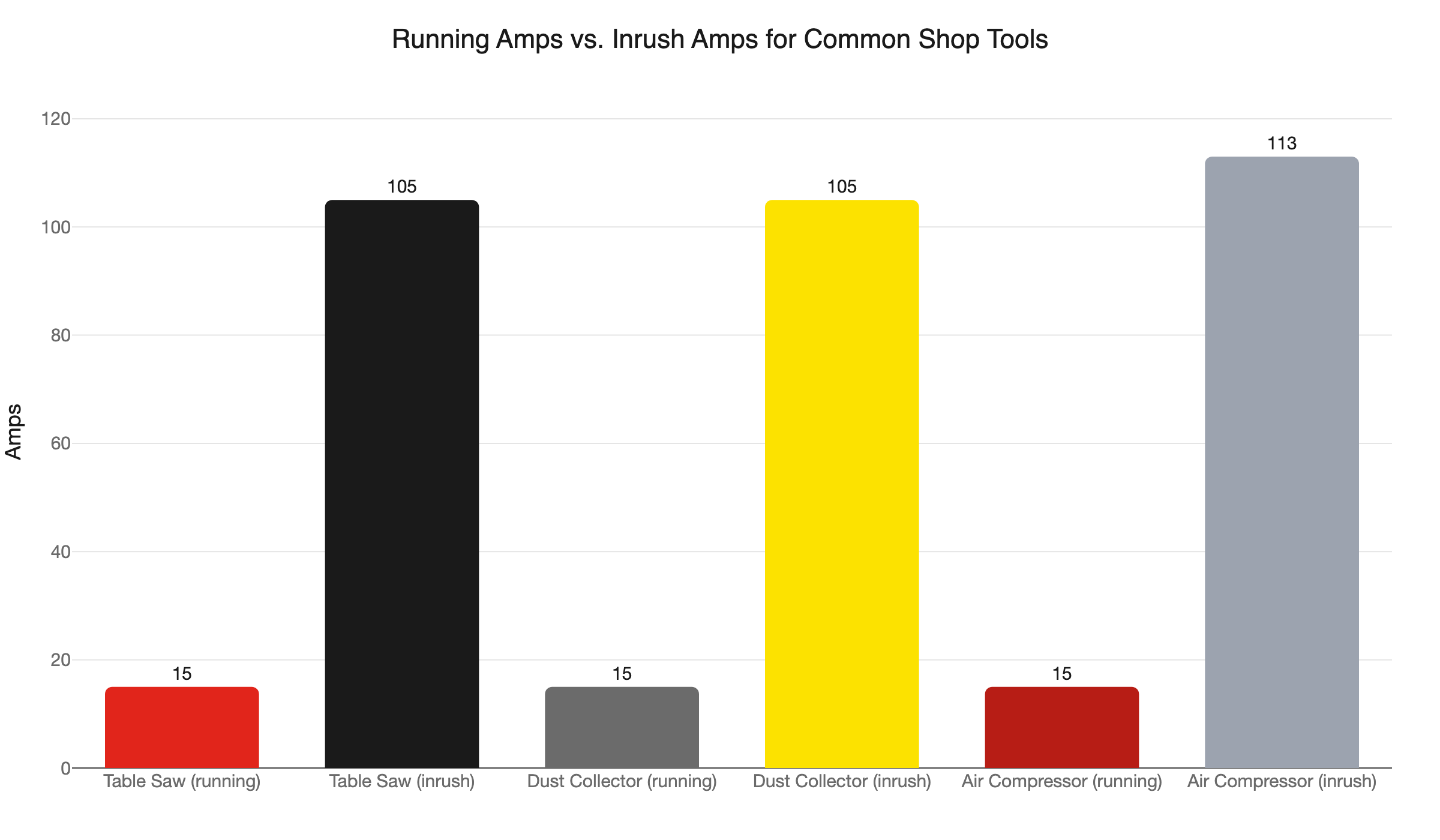
- Motor inrush current is the real cause of nuisance tripping, not running amps. A 15A table saw can pull 90-105A at startup.
- NEC Article 430 lets you size motor circuit breakers up to 250% of full-load amps. If tripping continues, up to 400% is allowed for single-phase motors.
- A 100A subpanel is the right size for a full hobby shop. A 60A panel runs out of capacity faster than most guides admit.
- Detached garage subpanels require a 4-wire feeder and a separate grounding electrode at the structure. Never bond neutral and ground inside the subpanel.
- Minnesota switches to the 2026 NEC on August 17, 2026. Permits filed before that date fall under the 2023 NEC.
- Xcel Energy offers up to $2,500 toward a residential panel upgrade in its Minnesota service territory.
Why Does My Table Saw Keep Tripping the Breaker?
In short: Your table saw’s motor draws 6-7 times its running amps at startup. That spike lasts under 300 milliseconds. It is enough to trip a standard breaker, even though the tool runs fine at full speed.
Here is the mechanism. Standard shop tools use NEMA Design B induction motors. When the motor starts, the rotor is still at zero speed. Line voltage is applied across windings with almost no back-EMF. The motor acts like a near short circuit. Standard NEMA Design B motors draw 600-700% of full-load amps (FLA) at startup. A 15A-rated table saw pulls 90-105A for 100-300 milliseconds.
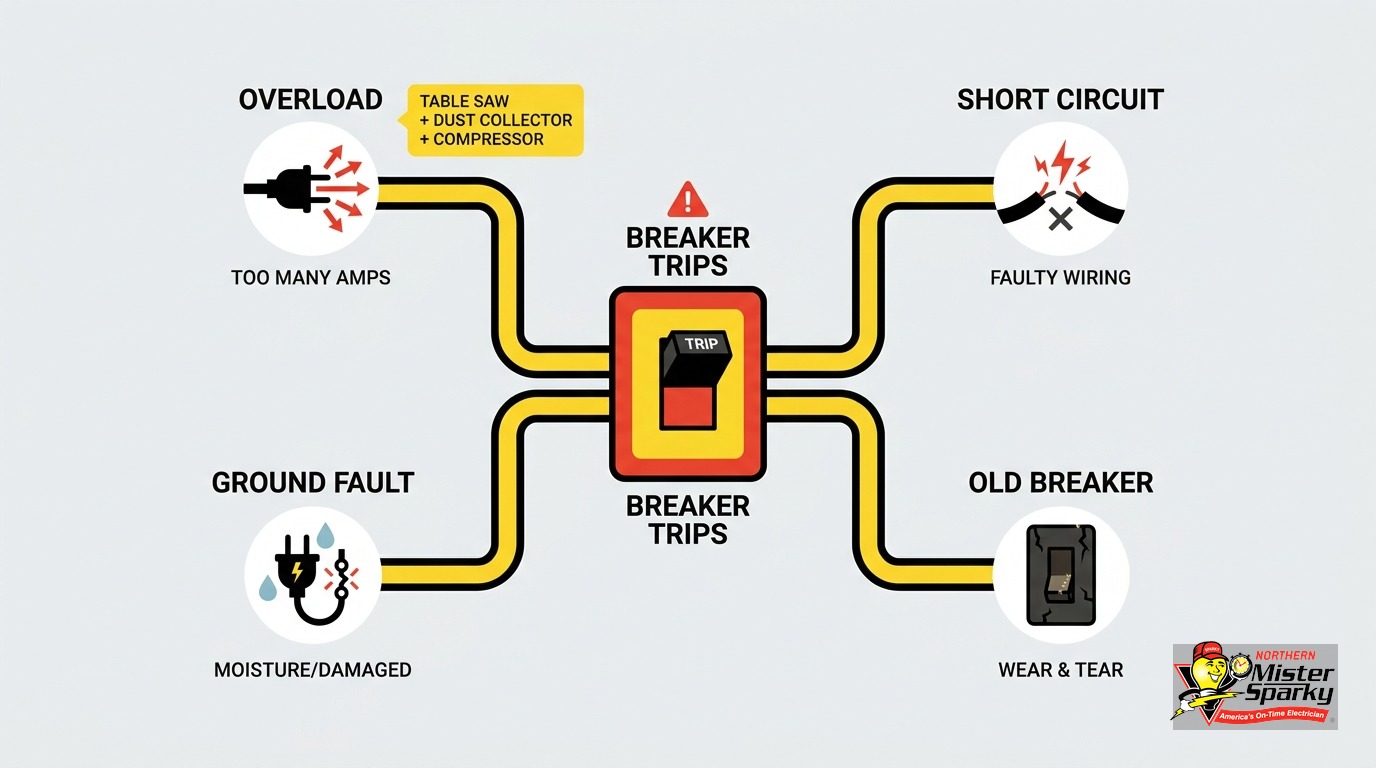
A standard 15A residential breaker is designed to trip on sustained overcurrent. A large enough inrush event can trip it even briefly. If another load is already drawing current on the same circuit, the margin shrinks further.
There is a second factor. Energy-efficient motors have lower winding resistance, which raises inrush relative to nameplate FLA. If you upgraded to a newer tool and the tripping got worse, that may explain it.
The fix is not a larger breaker on an existing 15A residential circuit. The fix is a proper motor branch circuit sized under NEC Article 430. That is the code’s answer to inrush, and it is covered below.
For a broader look at why breakers trip throughout the home, our post on why circuit breakers keep tripping covers the most common causes.
How Do I Start Workshop Electrical Planning for a Subpanel?
In short: List every load in the shop. Find each one’s running amps from the nameplate. Identify which loads run at the same time. Add those simultaneous loads together. That sum tells you what the subpanel feeder must carry continuously.
Here is a practical load inventory for a mid-size hobby shop:
- Table saw: 13-15A at 120V, or 6-8A at 240V
- Dust collector: 12-16A at 120V, or 6-10A at 240V
- Air compressor: 14-15A at 120V
- Shop lights (LED): 2-3A
- 240V electric garage heater (4,800W): 20A continuous
That heater number is the item most guides skip. Under NEC 210.19(A)(1), any load running three or more hours is a “continuous load” and the circuit must be sized at 125% of actual draw. That 20A heater needs a 25A minimum circuit, meaning a 30A breaker. It consumes one third of a 60A feeder before you touch a single tool.
The table saw and dust collector typically run together. Size for that combination plus lights and any continuously running loads. The compressor usually cycles on its own schedule. Sizing around simultaneous loads, not total connected load, is the right framework.
The same logic applies to dedicated circuits for large appliances throughout the home. See our post on dedicated circuits for appliances for more detail.
What Size Subpanel Does a Garage Shop Actually Need?
In short: A 100A subpanel is the right call for a full hobby shop. A 60A panel is enough only for a minimal one-tool setup. The cost difference in hardware rarely justifies stopping short.
Here is why 60A runs out fast. Start with the continuous heater load: 20A multiplied by 1.25 equals 25A reserved. Add a properly sized table saw circuit (19A reserved at 125% of 15A FLA) and a dust collector circuit (similar). You are already past 60A before the compressor or any 240V tooling hits the board.
100A is the standard recommendation for a full hobby shop. 60A works only for a minimal setup. The cost difference in wire and panel hardware is rarely worth stopping at 60A.
Go with 100A. Choose a panel with at least 16 circuit slots. You will use more slots than you expect: one dedicated circuit per motor load, a GFCI general-purpose circuit, a heater circuit, and lighting.
Sizing Your Workshop Subpanel Feeder: What the NEC Requires
This is where workshop electrical planning for a subpanel gets technical. It is also where most DIY guides fall short - and where one wrong decision means either a failed inspection or a perpetually tripping breaker.
Motor circuit breakers: NEC Article 430
NEC Article 430.52 allows inverse-time circuit breakers for motor branch circuits to be sized up to 250% of FLA. If nuisance tripping still occurs, up to 400% is allowed for single-phase motors.
Why is this legal? Because motor inrush is brief. The wire’s protection relies on correct conductor sizing under NEC 430.22. The breaker handles fault protection, not the only overcurrent defense.
In practice: a 15A-FLA table saw can legally be on a 40A breaker (250% = 37.5A, rounded up). If that still trips on startup, a 60A breaker is allowed by code. The wire must be sized at 125% of FLA per NEC 430.22. For a 15A-FLA motor, that means 12 AWG copper minimum, not 14 AWG.
Subpanel feeder conductors: NEC Table 310.16
For a 100A subpanel feeder: 4 AWG copper or 2 AWG aluminum at 75C terminations is the starting point. On runs longer than 100-150 feet, you will likely need to upsize for voltage drop. The field benchmark is 3% maximum voltage drop on a branch circuit and 5% combined across feeder and branch. The subpanel feeder sizing guide covers the full calculation.
Detached garage: the 4-wire rule under NEC 250.32
If your shop is in a detached garage or outbuilding, the feeder must be 4-wire. That means two hots, a neutral, and a separate equipment grounding conductor. You also need a grounding electrode, typically a ground rod, at the structure.
The neutral and ground must NOT be bonded inside the subpanel. Bonding them in both the main panel and the subpanel is one of the most common DIY mistakes. It is also a guaranteed inspection failure. Our post on detached garage subpanel installation covers the 4-wire requirement in detail.
Equipment grounding conductor sizing: 10 AWG copper for a 60A feeder, 8 AWG copper for a 100A feeder. Those are NEC Table 250.122 minimums.
Do I Need a Permit to Add a Workshop Subpanel in Minnesota?
In short: Yes. Adding a subpanel requires an electrical permit and final inspection in Minnesota. As a homeowner who owns and occupies the home, you can pull the permit yourself. You may not do so for rental property or a home occupied by others.
Minnesota DLI handles permits for most of the state, but approximately 66 cities have adopted local electrical inspection authority. Minneapolis is one of them. Several suburbs also use their own inspectors. Before pulling a DLI permit, confirm that your city does not have its own program.
Why bother? An uninspected subpanel can void homeowner’s insurance, create liability in a fire investigation, and complicate a home sale. Inspectors catch real problems: neutral-ground bonds in subpanels, undersized feeders, missing grounding electrodes. The inspection is the quality check.
Our post on electrical permits in Minnesota walks through how to apply, what it costs, and what to expect at the inspection.
How Does Minnesota’s 2026 NEC Transition Affect My Project?
In short: Minnesota switches to the 2026 NEC on August 17, 2026. Permits filed before that date are inspected under the 2023 NEC. Permits filed on or after August 17 must comply with the 2026 NEC.
If you are pulling a permit this week, you are right on the cusp of two code cycles. Minnesota’s 2026 NEC adoption date is documented by the DLI. The 2026 Residential Electrical Inspection Checklist takes effect on the same date.
This matters for real work. Knowing exactly where the August 17 line falls - and what the 2026 code changed - means an inspection that passes the first time. Our team has pulled permits and done shop installs on both sides of past NEC transitions. Current local knowledge pays off when an inspector shows up.
Can I Get a Rebate for a Panel Upgrade in the Twin Cities?
In short: Yes. Xcel Energy offers up to $2,500 for residential panel upgrades in its Minnesota service territory. The rebate requires a licensed electrician, pulled permits, and a capacity increase.
If your shop project also involves upgrading the home’s main panel - common in homes with 100A or older 150A service - the rebate can meaningfully offset the cost. Check Xcel Energy’s residential rebates page for current program details.
A separate state program, Save Energy MN, had a residential panel upgrade grant pool of about $5.8 million pending US DOE approval as of early 2026. It was not active at the time of writing. Check the Minnesota Commerce energy programs page for current status.
Ask about financing when you request a quote. We can structure the project to capture available rebates and keep the cost manageable.
Winter Shops and Cold Starts: The Minnesota Angle
Most workshop wiring guides assume a heated garage or a mild climate. Minnesota changes the sizing math in two ways.
Compressor cold starts
Below about 20 degrees Fahrenheit, a single-stage reciprocating compressor can struggle to unload residual pressure before the next start attempt. That increases both the frequency and the severity of the inrush event at startup. The same compressor that starts cleanly in October can trip a marginally sized breaker in January.
Compressors use NEMA Design C or D motors with higher starting torque. These motors draw 650-800% of FLA at startup. In a cold garage, actual inrush can exceed what the nameplate implies. Sizing the compressor circuit to 250% FLA, not the bare minimum of 125%, is the practical fix for a Minnesota shop. NEC Article 430 allows it, and cold winters justify it.
The heater that fills a 60A panel
A 240V/4,800W electric garage heater draws 20A. As a continuous load, it needs a 25A minimum rated circuit. That means a 30A breaker and 10 AWG copper at minimum. That single circuit plus motor circuit reserves will push a 60A subpanel to its limit before a single tool starts. Plan for 100A from the start and give the heater its own dedicated circuit.
Before the ground freezes
If your shop is in a detached garage with an underground feeder run, late summer or early fall is the time to trench. A 150-foot underground run from house to detached garage needs correct conduit type and burial depth for Minnesota soil conditions. Plan the excavation before October closes the window.
Ready to Stop Tripping Breakers?
Workshop electrical planning for a subpanel is one of those projects where the details stack up. A missing 4-wire feeder on a detached structure, the wrong breaker size on a motor circuit, or a neutral-ground bond inside the subpanel means a failed inspection or a January morning with no power in the shop.
Our team at Northern Mister Sparky is locally owned and operated, serving the Twin Cities. We handle workshop subpanel installs across Minneapolis, St. Paul, Maple Grove, Plymouth, Woodbury, Bloomington, Blaine, and everywhere in between. We know the DLI permit process and the August 17 NEC switchover. We know how to spec a compressor circuit that fires cleanly at minus 10 degrees.
Call 763-200-5956 or book online. We will scope the project, pull the permit, and get it inspected. If a panel upgrade is part of the plan, we will help you capture the Xcel Energy rebate. No malarky: just the right subpanel sized for your shop.
Frequently Asked Questions
Why does my table saw trip the breaker every time I start it? +
What size subpanel do I need for a garage workshop in Minnesota? +
Do I need a permit to add a subpanel to my garage in Minnesota? +
Need an electrician now?