
Garbage Disposal Wiring Cost in the Twin Cities
Key Takeaways
- Swapping a disposal on an existing GFCI-protected outlet adds little to no electrical cost.
- A first-time install with a new circuit, GFCI outlet, and wall switch typically runs $400-$900 or more in the Twin Cities.
- A disposal can share a 20-amp circuit with the dishwasher under specific NEC conditions, but it cannot share the countertop small-appliance branch circuit.
- Minnesota requires an electrical permit for any new circuit. Minneapolis and St. Paul issue their own permits, with fees in the $81-$101 range for a single-circuit kitchen job.
- Hardwired disposals need a wall switch as a listed disconnect. An air switch alone does not satisfy code.
- As of August 17, 2026, Minnesota moved to the 2026 NEC. Permits pulled before that date follow 2023 NEC rules.
What Does Garbage Disposal Wiring Cost?
The short answer: Garbage disposal wiring cost in the Twin Cities ranges from near-zero for a swap on an existing outlet to $400-$900 or more for a first-time circuit installation, depending entirely on what wiring already exists under your sink.
Most cost guides you find online bundle the appliance price and installation into a single national average. That framing hides the real variable: the electrical side of a disposal project costs almost nothing if the wiring is already in place, and it costs real money if it is not.
If a GFCI-protected outlet already exists under the sink and your panel has a spare 20-amp slot, the electrical portion of a disposal install is fast. If none of that exists, you are looking at a new circuit run from the panel, a new outlet or hardwired connection, possibly a new wall switch, and an electrical permit. The national total cost for a disposal installation, appliance and labor combined, runs $150-$950. The lower end of that range assumes an outlet is already in place. The upper end reflects new wiring, permit fees, and panel work. Twin Cities labor rates run toward the top of the national range, so build your budget accordingly.
Why Does a First-Time Install Cost More Than a Swap?
The short answer: Code requirements for a new installation are more involved than a unit swap. The electrician has to assess your circuits, run new wire, install a code-compliant outlet or hardwired connection, pull a permit, and schedule an inspection.
When a disposal already exists in the kitchen, the circuit is in place. An electrician swaps the unit, confirms GFCI protection, and leaves in under an hour. That work is straightforward.
A first-time install is a different scope. Here is what drives the cost:
- Circuit assessment. The electrician checks what circuits exist, what loads they carry, and whether the disposal can legally share one of them.
- Wire run. They route wire from the panel or an approved junction point to the cabinet location. This is usually the most time-consuming part of the job.
- Outlet or hardwire connection. Cord-and-plug units get a GFCI outlet installed inside the cabinet. Hardwired units get a direct wire connection with a proper disconnect.
- Wall switch. Hardwired units require a switch mounted within sight of the disposal motor. The electrician runs a switch leg and installs the box, switch, and cover plate.
- Permit and inspection. The licensed electrician pulls the permit before work begins, and an inspector verifies the work before the circuit is signed off.
A typical first-time hardwired install takes 1.25 to 1.5 hours of labor. Twin Cities electrician rates exceed the national average of $50-$120 per hour. Add permit fees and materials, and the electrical work alone is $400-$700 before you buy the disposal unit.
Cord-and-Plug or Hardwired: Which Type Does Your Disposal Use?
The short answer: Most residential disposals use a cord-and-plug connection to a GFCI outlet inside the cabinet. Hardwired installs connect directly to a wire in the wall and require a wall switch as a listed disconnect. Cord-and-plug is faster and simpler to install.
The connection type determines what the electrician needs to do and how long it takes.
Cord-and-plug: NEC 422.16(B)(E) allows a cord-and-plug connection if the cord is 18-36 inches long and the outlet is accessible inside the cabinet. The outlet must be GFCI-protected. Under code, the cord itself serves as the disconnect, which is why the setup requires only one GFCI outlet. No wall switch is needed for the electrical disconnect, although some homeowners add a switch for convenience.
Hardwired: Some disposals are wired directly to the circuit with no outlet or plug. A hardwired connection must have a listed disconnect within sight of the motor, per NEC 430.102(B). A wall switch mounted near the sink satisfies this requirement. Hardwired installs cost more because the electrician runs a switch leg from the disposal location to the switch box on the wall.
If you are installing a disposal for the first time and have flexibility in which unit you choose, a cord-and-plug model is typically the lower-cost option on the electrical side.
Does a Garbage Disposal Need Its Own Dedicated Circuit?
The short answer: Not always. Under NEC 210.23 and 210.52(B)(2), a disposal can share a 20-amp circuit with the dishwasher if the combined load stays under 80% of circuit capacity. It cannot share the small-appliance branch circuit that feeds your countertop outlets.
This rule matters for cost. If your kitchen already has a 20-amp circuit serving only the dishwasher, and the combined loads work out, the electrician may be able to extend it to the disposal without running new wire from the panel. That avoids a new breaker run and can save $150-$300 on the job.
If the dishwasher circuit is already loaded, or you do not have a dishwasher at all, a new dedicated 20-amp circuit is the answer. That means a new breaker, wire from the panel to the cabinet, and an electrical permit.
Understanding which appliances in your kitchen share circuits is worth knowing before any remodel work begins. Our guide on dedicated circuits for appliances covers the full code picture for kitchens and laundry rooms.
What GFCI Protection Does Your Disposal Outlet Need?
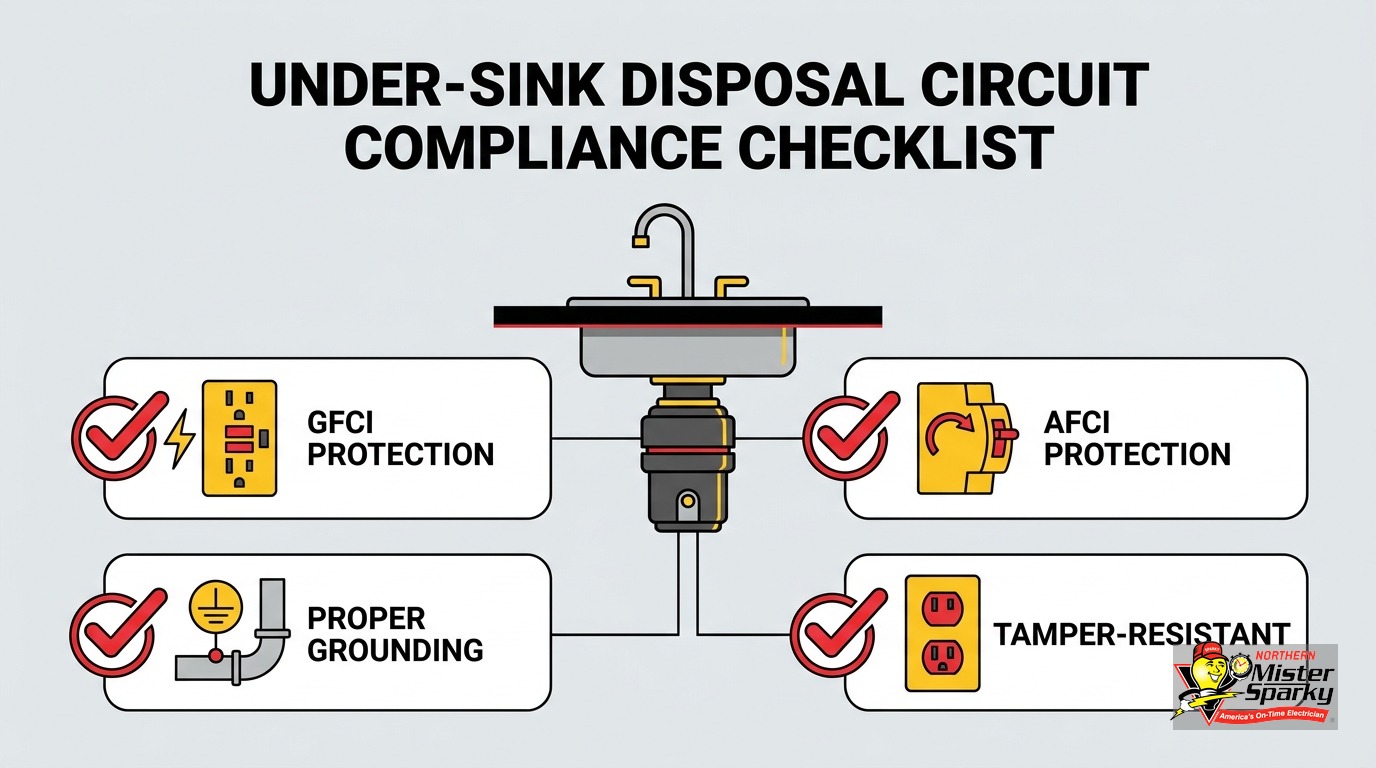
The short answer: Full GFCI protection is required for all kitchen receptacles, including under-sink outlets. Under NEC 2023 Section 210.8(A)(6), the old “within 6 feet of the sink” rule expanded to cover every kitchen receptacle regardless of distance. Any old non-GFCI outlet under your sink must be upgraded during permitted work.
This is a meaningful expansion from older code editions. Before 2023, an outlet eight or ten feet from the sink might have legally skipped GFCI protection. That gap is now closed. Every kitchen outlet needs GFCI protection under the 2023 and 2026 NEC editions.
What this means in practice:
- A non-GFCI outlet under your sink must be upgraded before a disposal can be legally connected during a permitted project.
- The upgrade can be a GFCI outlet at the under-sink location, or GFCI protection fed from the first outlet on the circuit (a feed-through configuration).
- Adding a single GFCI outlet runs $100-$200 in labor and materials when the wiring is already in place.
Not sure whether your outlet has GFCI protection? Look for the TEST and RESET buttons on the outlet face. If they are not there, it is not a GFCI outlet. Our GFCI outlet requirements explained guide covers testing, resetting, and when to call an electrician.
Is an Air Switch a Legal Disconnect for a Hardwired Disposal?
The short answer: No. An air switch mounted on the countertop is not a listed disconnect under the NEC and cannot substitute for a wall switch on a hardwired disposal. Air switches are only code-compliant on cord-and-plug units, where the cord itself is the listed disconnect.
Air switches are popular in kitchen remodels. A small chrome button on the countertop connects via a tube to a control box under the sink. They look clean and eliminate wall wiring on that side of the cabinet. But they are not listed disconnects under NEC 430.102(B).
Under NEC rules, the air switch is only compliant when used with a cord-and-plug disposal, because the plug serves as the disconnect in that configuration. On a hardwired disposal, you still need a wall switch that meets the listed-disconnect requirement. Some homeowners use both: an air switch on the countertop for everyday convenience, and a wall switch for code compliance. That combination works. The wall switch just has to be present.
If an installer puts in a hardwired disposal with an air switch and no wall switch, the job will not pass inspection. Beyond the code problem, there is a real safety issue: if you need to cut power quickly, there is no proper listed disconnect in reach.
Do You Need a Permit to Wire a Garbage Disposal in Minnesota?
The short answer: Yes, if you are adding a new circuit. Minnesota Statute 326B.35 requires an electrical permit for any new circuit work. Swapping a disposal unit on an existing, code-compliant GFCI outlet does not require a permit.
Here is how the permit question breaks down:
No permit required: You are replacing an old disposal with a new one. The outlet is already there, the circuit already exists, and the electrician makes the same connections the previous unit used. No new circuits, no permit.
Permit required: You are adding a disposal where none existed before. Or you are upgrading from a cord-and-plug outlet to a hardwired installation. Or you need a new circuit run for any reason. Any of those scenarios trigger the permit requirement under Minnesota law.
Who issues the permit: Minneapolis and St. Paul issue their own electrical permits through their local departments. Expect fees in the $81-$101 range for a single-circuit kitchen job in those cities. In suburban Twin Cities communities, permits typically run through the Minnesota Department of Labor and Industry.
Who pulls the permit: Minnesota requires a licensed electrician for all permitted electrical work. If you hire a contractor, the contractor pulls the permit and owns the inspection result. A homeowner cannot supply a homeowner permit for work they hired out.
Our electrical permit in Minnesota post explains the full process, from application to final inspection.
Can You DIY Garbage Disposal Wiring in Minnesota?
The short answer: Technically, Minnesota’s owner-builder exemption allows homeowners to do their own electrical work on an owner-occupied single-family home, as long as they pull the permit themselves. But the exemption is narrow, kitchen circuit work carries real risk, and the permit inspection must pass.
Here are the limits worth knowing:
- The exemption applies only to work you personally perform. If you hire an electrician to do any part of the wiring, the licensed contractor must pull the permit.
- A disposal circuit requires correct GFCI protection, proper circuit sizing, a code-compliant disconnect on hardwired units, and a passed inspection by a state or city inspector.
- Errors on a kitchen circuit can cause shock hazards or arc faults. The wet environment under the sink makes electrical mistakes there more dangerous than in a dry location.
For most Twin Cities homeowners, hiring a licensed electrician is the right call. The labor cost buys a passed inspection, a warranty on the work, and a correctly wired circuit that will not create problems five years from now.
What Does an Electrician Actually Do on a Disposal Wiring Job?
The short answer: On a first-time install, the electrician assesses your panel, pulls the permit, runs the circuit, installs the outlet or hardwired connection, adds the wall switch if needed, connects the breaker, and calls for inspection. Expect 1.5-2.5 hours of on-site time for a straightforward job.
Understanding the work helps you evaluate quotes and avoid surprises.
-
Panel assessment. The electrician checks whether your panel has an open breaker slot and enough capacity for the new circuit. If your panel is at capacity or needs upgrading, that is a separate conversation before any disposal work begins.
-
Permit pull. For any new circuit in Minnesota, the licensed electrician pulls the electrical permit before the first wire is run.
-
Circuit run. They route wire from the panel through the wall, floor, or cabinet to the under-sink location. The path depends on your home’s construction. Older homes with finished walls may require more labor to route wire cleanly.
-
Outlet or hardwire connection. For cord-and-plug disposals, they install a GFCI outlet inside the cabinet at the correct height for the cord. For hardwired units, they terminate the wire at the disposal’s wire connection points.
-
Wall switch (hardwired units only). They run a switch leg from the disposal location to the wall switch box, install the switch, and confirm it operates correctly.
-
Breaker connection. At the panel, they install the new breaker and connect the circuit conductors.
-
Inspection. The permit requires a final inspection. The electrician schedules it; an inspector from the city or state verifies the work meets code.
Most electricians also confirm the disposal unit itself is connected and operating before they leave, even though the disposal’s drain connection is a plumbing task.
How Minnesota’s 2026 NEC Adoption Affects Garbage Disposal Wiring
Minnesota was among the first states to adopt the 2026 NEC. The transition date is August 17, 2026. Permits filed on or after that date must comply with the 2026 NEC. Permits filed before that date follow 2023 NEC rules.
For disposal wiring, the primary difference between editions is AFCI requirements. The NEC has expanded arc-fault circuit interrupter requirements with each edition. Whether your new disposal circuit needs a standard GFCI breaker, an AFCI breaker, or a dual-function AFCI/GFCI breaker depends on which edition governs your permit.
Your licensed electrician will know which edition applies to your job and will spec the correct breaker. The takeaway for you: do not rely on a YouTube tutorial filmed in another state or under an older code edition. Minnesota runs on current code, and the inspector will hold you to it.
Our AFCI breaker requirements explained guide covers what is required and why.
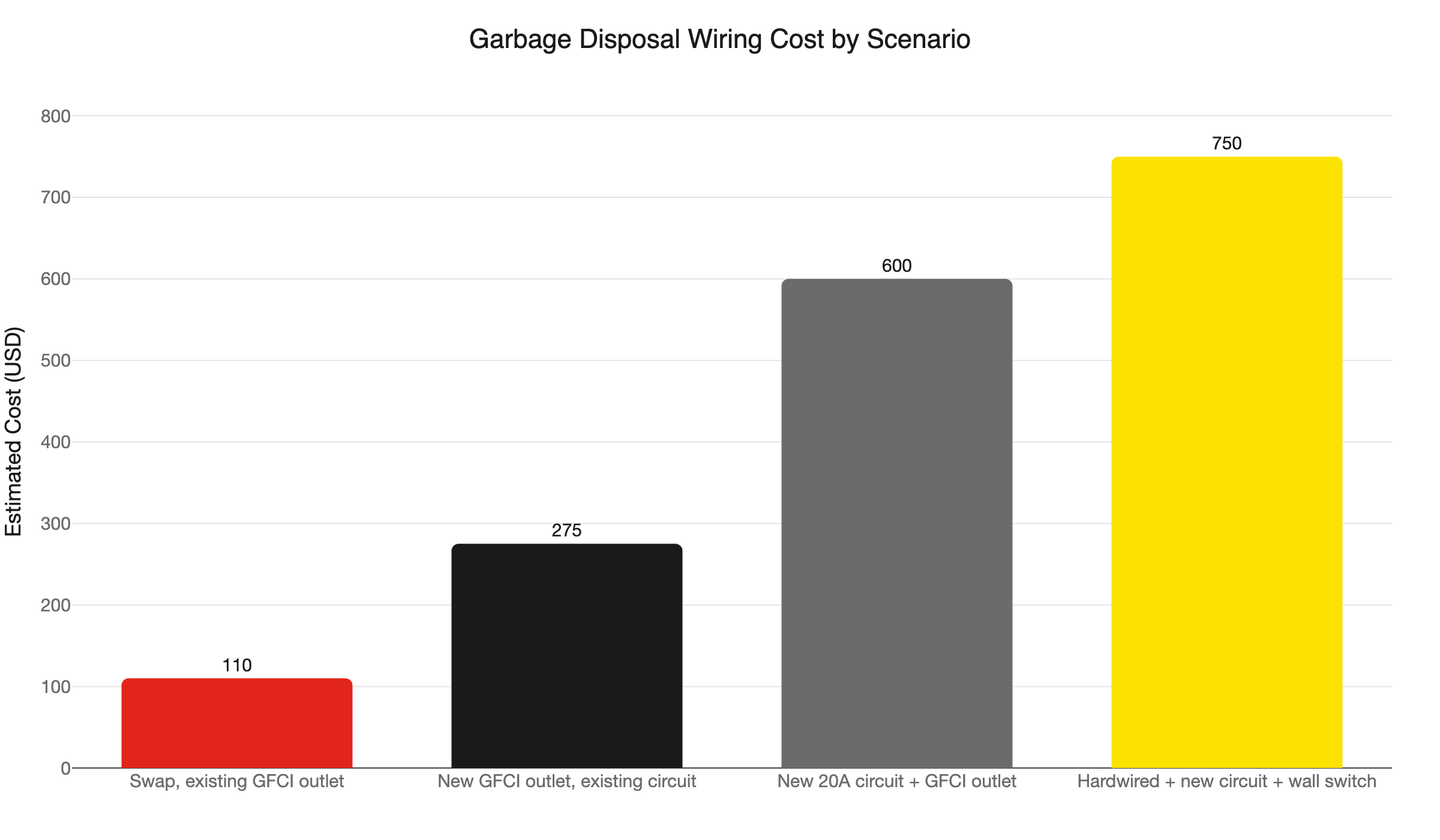
Garbage Disposal Wiring Cost: Common Scenarios in the Twin Cities
Here is how the electrical cost breaks down by situation. These ranges cover licensed electrician labor at Twin Cities rates, materials, and permit fees where required. They do not include the disposal unit itself.
Swap on an existing, code-compliant GFCI outlet: $75-$150. The electrician confirms the outlet and existing connections, installs the unit, and verifies the circuit is protected.
Add or upgrade a GFCI outlet on an existing circuit: $200-$350. One outlet added or replaced on an available circuit. No new wire from the panel, and no permit required if the circuit itself is not new.
New 20-amp circuit plus GFCI outlet (cord-and-plug disposal): $450-$750. Full circuit run from panel to cabinet, new breaker, GFCI outlet, and permit.
Hardwired disposal with new circuit, wall switch, and permit: $600-$900. Includes the switch leg, wall switch installation, and the correct breaker type for the applicable NEC edition.
If your panel is undersized, full, or one of the outdated brands that inspectors flag in Minnesota, a panel upgrade may need to happen before any of this. That is a larger project but often the right starting point for a full kitchen remodel.
Ready to Book? Call Northern Mister Sparky.
We are locally owned and operated in the Twin Cities, backed by the “America’s On-Time Electrician(R)” standard and the UWIN(R) 100% satisfaction guarantee. Our licensed electricians know Minnesota code, pull permits, and stay until the inspection passes.
If the disposal installation is part of a larger kitchen remodel, ask about financing options when you call. We serve Minneapolis, St. Paul, Bloomington, Brooklyn Park, Woodbury, Blaine, Maple Grove, Plymouth, and the surrounding metro.
Call 763-200-5956 or book online to schedule.
Frequently Asked Questions
Do I need a dedicated circuit for a garbage disposal? +
Is a permit required to wire a garbage disposal in Minnesota? +
What is the difference between a cord-and-plug and a hardwired disposal? +
Need an electrician now?