
Golf Simulator Electrical Requirements: A Twin Cities Guide
Key Takeaways
- A home golf simulator needs at least one dedicated 20A, 120V circuit.
- Premium builds with a high-end gaming PC may need two separate circuits.
- NEC 210.19(A)(1) limits a 20A breaker to 1,920W of continuous draw, not 2,400W.
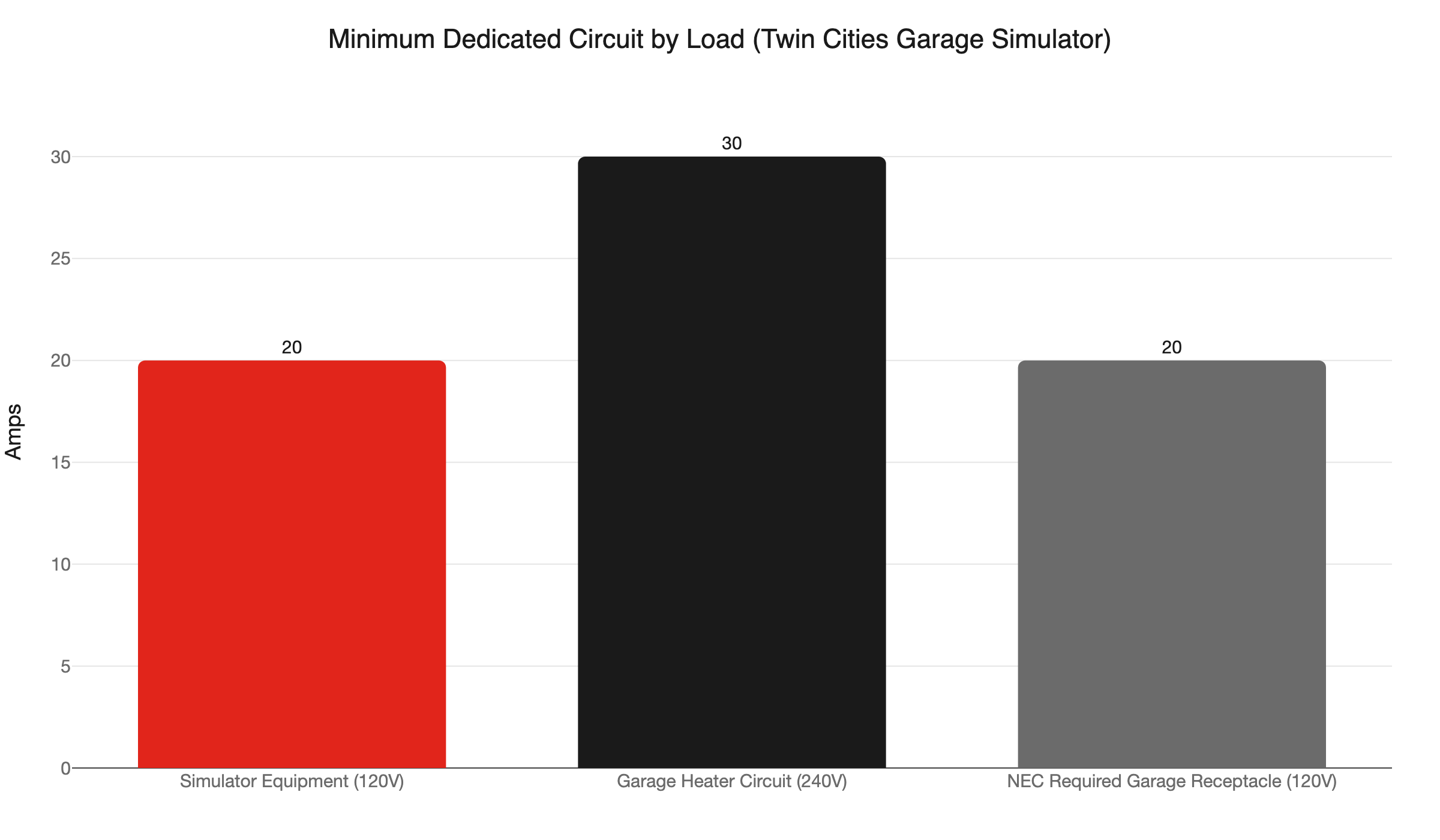
- In Minnesota garages, the heating circuit often needs more amperage than all simulator equipment combined.
- Minnesota adopted the 2026 NEC effective August 17, 2026. Permits pulled today are reviewed against that edition.
- All new garage receptacles require GFCI protection. No exceptions for new circuits.
- A permit is required for every new circuit. Starting without one triggers an investigation surcharge.
- Detached garages nearly always need a new subpanel before individual simulator circuits make sense.
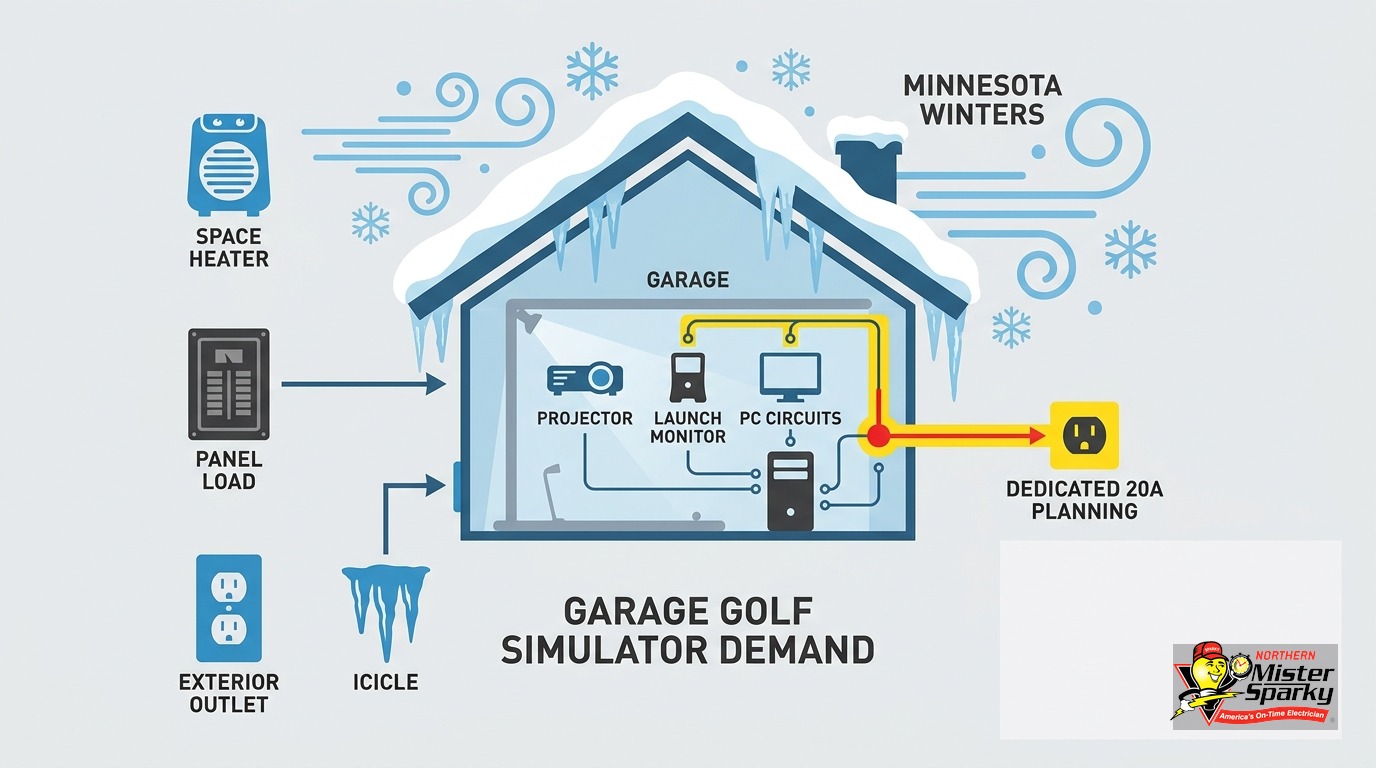
Long Minnesota winters give the garage a second job for a lot of Twin Cities homeowners. A home golf simulator fixes the off-season problem. Before you start shopping for projectors and launch monitors, you need to understand golf simulator electrical requirements. In Minnesota, those requirements include one critical circuit that national simulator guides consistently miss.
What Are the Golf Simulator Electrical Requirements for a Home Setup?
The short answer: A basic home simulator needs one dedicated 20A, 120V circuit. Premium setups with a high-draw gaming PC and a bright projector may need two. The circuit must serve the simulator exclusively, with no shared loads on the same breaker.
Most residential golf simulator setups combine a projector, a computer, and a launch monitor or sensor. Together, those components draw between 1,000 and 1,500 watts during a typical session, according to golf simulator electrical planning resources. Apply the standard formula: (total watts / 120V) x 1.2 safety margin equals required amperage. At 1,500W, you need 15A. At 2,000W for a premium 4K setup, you land at exactly 20A.
A single dedicated 20A circuit covers most setups. That said, if your build includes a high-performance gaming PC pulling 700-800W on its own, consider a second circuit for the computer. A tripped breaker mid-round on a shared circuit is a predictable outcome, not bad luck.
NEC 210.11(C)(4) adds a separate requirement your garage may not yet satisfy: at least one dedicated 20A circuit solely for garage receptacle outlets, with no appliance or equipment loads sharing it. That requirement exists whether or not you are installing a simulator. Your project likely needs to address it if the garage does not already have a compliant circuit in place. Plan for it from the start rather than discovering the gap at final inspection.
How Much Power Does a Golf Simulator Use?
The short answer: A typical home simulator draws 1,000-1,500 watts total. A premium 4K build can approach 2,000W. The individual components are modest, but they run continuously for hours at a time. That sustained draw determines how you size your circuits.
Here is how the load breaks down by component:
- Projector: 200-500W depending on brightness and technology
- Gaming PC: 150-500W for standard builds; up to 800W for a 4K rig
- Launch monitor or sensor system: 10-50W
- Typical full system: 1,000-1,500W
The critical figure is sustained draw, not peak draw. Per NEC 210.19(A)(1), a 20A breaker can only carry 16A continuously for loads running three hours or more. That is the 80% continuous-load rule. Your effective capacity ceiling on a 20A circuit is 1,920W, not 2,400W. Size circuits to that number, not the breaker rating.
If your equipment list totals more than 1,600W, plan for two circuits from the start. Retrofitting a second circuit after rough-in is closed costs considerably more than running both during the original installation. Extension cords are not a workaround here. Running a simulator on a heavy-gauge extension cord from a shared circuit bypasses the protection a dedicated circuit provides and creates a fire risk at sustained loads.
Do You Need a Dedicated 20-Amp Circuit for a Golf Simulator?
The short answer: Yes. A dedicated circuit is the baseline, not an upgrade. Sharing the simulator with a garage refrigerator, compressor, or existing lighting circuit reliably causes breaker trips during use.
Green Pro Golf Simulators’ electrical planning guide confirms that a dedicated 120V 20A circuit is the starting point for residential simulator rooms. Premium rooms benefit from separating the computer and projector onto different circuits. Detached garage builds often need a subpanel before individual circuits are even practical.
The NEC also requires a separate dedicated 20A circuit solely for garage receptacle outlets, per 210.11(C)(4). That circuit cannot share with any appliance or fixed equipment. A simulator build that adds new circuits must satisfy this requirement alongside the simulator-specific circuits, as reflected in Minnesota garage electrical code discussions.
The practical result: a complete simulator installation in a garage that does not already meet code typically involves at least two new circuits. One for the simulator equipment. One to satisfy the NEC-required dedicated garage receptacle circuit. In a detached garage or a space that needs heating, the total climbs from there.
What Changed With Minnesota’s 2026 NEC Adoption?
The short answer: Minnesota adopted the 2026 National Electrical Code, effective August 17, 2026. Any permit pulled on or after that date is reviewed against 2026 code. Permits pulled before that date followed the 2023 edition. If your simulator build is starting this fall or winter, you are on 2026 code.
For a simulator project, the practical shift is incremental rather than dramatic. GFCI requirements on garage circuits were already strict under 2023 NEC. The 2026 edition maintains those requirements and refines arc fault protection rules for branch circuits. Your licensed electrician will handle compliance automatically. What matters for you is that any quotes and permit applications you receive reference the correct edition.
The Minnesota Department of Labor and Industry maintains current NEC adoption status, contractor licensing information, and the inspector directory for the state.
What Electrical Load Is Bigger Than the Simulator Itself?
The short answer: Heating. A 240V electric unit heater or mini-split running in a Minnesota garage on a January night typically pulls 15-30A on a dedicated 240V circuit. That single circuit often exceeds the amperage demand of all simulator equipment combined. This is the most consistently missed circuit in national simulator build guides.
The Twin Cities average January low is around -9°F. A typical 2-car garage needs 5,000 to 10,000 BTU per hour of supplemental heat to hold 60°F against those temperatures. Below 50-60°F, projectors, gaming PCs, and launch monitors face cold-soak condensation risk. Below freezing, the room is not usable regardless of your equipment.
A 240V electric unit heater or mini-split requires a dedicated 240V circuit with a minimum 30A breaker. That circuit is separate from everything else in the garage. Wire it in 10 AWG minimum, label it at the panel, and route it independently from the simulator circuits. Do not share a neutral, and do not try to pull it off an existing garage circuit that was not designed for 240V.
Forefront Sims’ 2026 simulator construction guide notes that mini-splits are standard for temperature and humidity control in simulator rooms, even in partially conditioned spaces. Repeated swings generate body heat quickly. Humidity from extended sessions can damage electronics over time. The heater circuit is not a comfort upgrade. It is equipment protection.
For a detailed look at heater circuit sizing and installation in a Twin Cities garage, see our 240V garage heater circuit installation guide.
Do You Need a Subpanel for a Detached Garage Simulator?
The short answer: Almost certainly yes. A detached garage simulator build - simulator circuits, a 240V heating circuit, and NEC-required garage receptacle circuits - can total 50-80A of new demand. That capacity needs to come from a dedicated subpanel, not home-run circuits stretched across the yard.
Most attached garages share one or two circuits off the house panel. Detached garages often have even less dedicated capacity, sometimes just a single 20A circuit for lighting and an outlet. Adding a dedicated simulator circuit, a 30A heater circuit, and a separate NEC-required 20A receptacle circuit creates more new load than most existing garage wiring supports.
A subpanel feed from the house to the detached garage runs underground. The feeder must use UF-B cable rated for direct burial, or THWN conductors in conduit. Minnesota frost depth affects burial depth requirements, and local inspectors verify this at rough-in. A 60A or 100A subpanel is the practical starting size for a full simulator build. Size the feed for what you need now plus reasonable future load. Undersizing a buried feeder is an expensive fix.
Our detached garage subpanel installation guide walks through panel sizing, feeder sizing, and underground routing in Minnesota.
If your main house panel is already near capacity, the conversation starts at the service level before it starts at the garage. Our 100-amp vs. 200-amp electrical service guide explains when a service upgrade makes more sense than trying to juggle loads on a full panel.
Do Minnesota Homeowners Need a Permit for This Work?
The short answer: Yes. Every new electrical circuit in Minnesota requires a permit. Starting work without one triggers an investigation surcharge on top of normal permit costs. The inspection tied to the permit confirms the work is code-compliant and protects your homeowner’s insurance coverage.
Minnesota has a jurisdiction detail that catches homeowners off guard. Approximately 66 cities act as local Authorities Having Jurisdiction and issue their own permits. Minneapolis, St. Paul, Bloomington, Eden Prairie, Plymouth, and Minnetonka are all in this group, along with most other first-ring Twin Cities suburbs. Filing with DLI when your city issues its own permits, or vice versa, creates a permit that is not valid for your address. Confirm the right AHJ before filing anything.
Our Minnesota electrical permit guide explains the AHJ lookup process and covers the homeowner owner-occupant exemption. Minnesota homeowners can pull their own electrical permit only if they own and occupy the home as a single-family residence. Investors, landlords, and rental property owners must use a licensed electrical contractor.
One more date to keep in mind: permits pulled before August 17, 2026 were reviewed under 2023 NEC. Any permit pulled on or after that date falls under 2026 NEC. If your project bridges that date, confirm which edition your permit was issued under and ask your electrician to clarify.
Does Every Garage Outlet Need GFCI Protection?
The short answer: Yes. NEC requires GFCI protection on all receptacles in garages. This applies to every new circuit in a garage, including dedicated simulator circuits and heater receptacles. There is no grandfather clause for new work, and inspectors check this at the final.
GFCI protection guards against shock from ground faults in damp or wet locations. Garages qualify because they are unheated or semi-conditioned spaces with concrete floors and occasional moisture. The protection can be provided at the receptacle itself, via a GFCI outlet, or upstream via a GFCI breaker.
A common inspection failure is installing an AFCI breaker where a GFCI is required. The two devices are not interchangeable. AFCI (arc fault circuit interrupter) protects against arc faults in wiring. GFCI (ground fault circuit interrupter) protects against shock at the outlet. Your simulator build may need both: AFCI protection on branch circuits per 2026 NEC, and GFCI at each garage outlet. Our AFCI vs. GFCI explainer covers the difference and when each device is required.
How to Plan Your Golf Simulator Electrical Project
Planning a simulator build comes down to four questions. Answer them before you pick up a drill or contact a permit office.
1. Where is the simulator going?
The location sets your starting point. An attached garage may have panel capacity nearby but still need new circuits. A finished basement may already have adequate wiring. A detached garage almost certainly needs a subpanel before you plan anything else. Know the location before sizing any circuit.
2. What is your equipment list?
Add up the wattage of your projector, computer, and launch monitor. Multiply by 1.2. Divide by 120. That is your minimum circuit amperage. If it exceeds 16A (the continuous load ceiling on a 20A circuit), plan two circuits. If the PC alone pulls more than 500W, give it its own dedicated circuit.
3. What is your heating plan?
For a Minnesota garage build, this is not optional. A 240V 30A dedicated circuit for a unit heater or mini-split is the minimum. Price it into the project from day one. It is often the largest electrical line item in a full simulator installation, and it is the one most often forgotten until construction is already underway.
4. What does your main panel have available?
Before adding circuits, confirm the main panel has open slots and available ampacity. A full Twin Cities garage simulator build can add 70-100A of new demand between the subpanel feed, heater circuit, and simulator circuits. If the panel is full, that conversation happens before the simulator conversation. An electrician can check available capacity in a few minutes and save you a significant planning detour.
With those four answers documented, your electrician can give you a firm scope and a permit-ready circuit plan. The project is not complicated, but the pieces need to be sequenced correctly.
Ready to Wire Your Twin Cities Golf Simulator?
Golf simulator electrical requirements are manageable when they are addressed in the right order. A wrong GFCI device, a permit filed with the wrong AHJ, or a heater circuit sized too small for a Minnesota January will cost more to fix than to do correctly the first time.
Northern Mister Sparky is locally owned and operated in the Twin Cities. As America’s On-Time Electrician(R), we back every job with the UWIN(R) 100% satisfaction guarantee. We pull permits correctly, show up when we say we will, and give you a circuit plan that holds up to inspection.
Call us at 763-200-5956 or book online to schedule your golf simulator electrical assessment. We will walk your space, check your panel, and tell you exactly what you need before any work begins.
Frequently Asked Questions
Do I need a dedicated circuit for a home golf simulator? +
Do I need a permit for golf simulator electrical work in Minnesota? +
What circuit does a Minnesota garage golf simulator need for heating? +
Need an electrician now?