
Halloween Outdoor Safety: A Twin Cities Wiring Guide
Key Takeaways
- Halloween outdoor safety starts with your circuits, not just your cords. A 15-amp circuit safely handles about 1,440 watts for hours-long displays, and a 20-amp circuit about 1,920 watts. U.S. Department of Energy
- Minnesota code requires GFCI protection on all outdoor outlets. Plug your whole display into GFCI-protected receptacles. MN DLI
- Fog machines and inflatables pull heavy, continuous loads. Give each one its own outlet or circuit.
- Late-October moisture is the local failure point. Use outdoor-rated cords and in-use “bubble” covers.
- Flickering, buzzing, or a warm plug means stop. Unplug it and call our locally owned team at 763-200-5956.
Why Does Halloween Outdoor Safety Matter More in the Twin Cities?
Halloween outdoor safety matters more here because late-October weather turns wet fast. Rain, wet leaves, freeze-thaw swings, and early snow push moisture into cheap cord connections. That moisture is the local reason displays trip or fail. Minnesota’s outdoor GFCI rule shapes how you wire it all.
We see the same pattern every year. A homeowner strings lights on a dry Saturday. Then Sunday rain soaks a connection lying in the grass. The outlet trips, or worse, it does not. Wet leaves trap water against plugs. Overnight frost forms inside loose connectors. By the time trick-or-treaters arrive, a cord that looked fine now runs warm.
Our team is locally owned and operated, so we know Twin Cities Octobers. We plan for moisture first, not last. That single habit prevents most of the failures we get called about.
How Many Watts Can Your Halloween Circuit Really Handle?
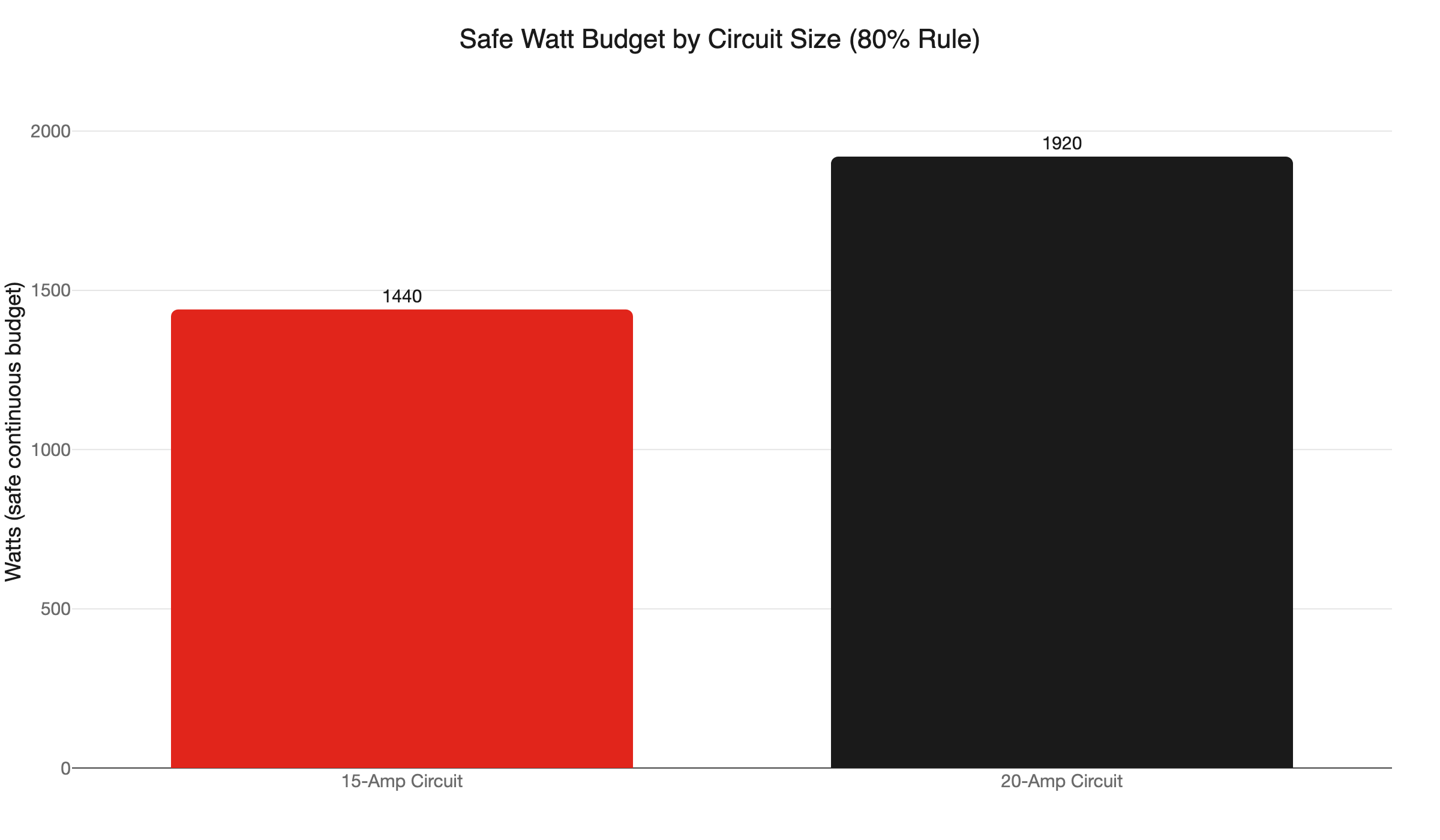
A standard 15-amp household circuit delivers about 1,800 watts, and a 20-amp circuit about 2,400 watts. But decorations run for hours, so apply the 80% continuous-load rule. That leaves roughly 1,440 watts on a 15-amp circuit and 1,920 watts on a 20-amp circuit. U.S. Department of Energy
This is the number every generic guide skips. “Do not overload the circuit” means nothing without math. So let us do the math for you.
First, find your circuit size. Open your panel and read the breaker number. Most exterior outlets sit on a 15-amp or 20-amp breaker. If you are not sure which outlets share a breaker, that is worth knowing before Halloween.
Next, add up the watts of everything on that circuit. Check the tag or box on each item. LED light strings sip power, often 5 to 10 watts per strand. Old incandescent strings can pull 40 watts or more each. Inflatables and fog machines are the heavy hitters, which we cover below.
Then stay under your safe budget. On a 15-amp circuit, keep the total under about 1,440 watts. Cross that line for hours and the breaker heats up, trips, or ages fast. If your display keeps tripping a breaker, you may have an overloaded circuit that needs a look.
What Should You Add Up Before You Plug In?
Add up every watt on the circuit, not just the lights. Count light strings, inflatables, fog machines, projectors, and any speakers or timers. Write the watt rating of each item on a notepad. Total them, then compare against your circuit’s safe budget before a single plug goes in.
Here is a simple walk-through. Say you want two inflatables, three LED light strings, and one fog machine on the same front-yard circuit. The inflatable blowers might run 150 watts each. The fog machine can spike far higher on startup. Add those and you may pass a 15-amp budget before the lights even count.
The fix is not fewer decorations. The fix is smart distribution across more than one circuit. Many homes have separate circuits for the front porch, the garage, and the backyard. Spreading the load keeps each circuit calm. If you only have one exterior outlet, that is a common reason to add another. Our outdoor lighting team installs weatherproof outlets built for this.
Are Fog Machines Safe to Plug In Outside?
Fog machines are safe outdoors with care, but they are not like light strings. They heat a coil to vaporize fluid, so they pull a heavy startup load. They also expel moisture that can collect on nearby outlets. Keep a fog machine on stable ground, in open ventilated air, and on its own outlet. Outdoor decorating safety guidance
Think about what a fog machine actually does. It boils fluid into vapor, and that takes real power in short bursts. Share that outlet with a light string and the sudden draw can trip the circuit. Give it a dedicated outlet and the spike has room to breathe.
Moisture is the second risk, and it is bigger here than in dry climates. Fog is water. Water plus a cold Minnesota night means condensation on plugs and strips. Never set a fog machine right next to an outlet or a power strip. Point the output away from any connection. Keep the machine off wet grass and up on a stable, dry surface.
Where Should You Plug In Inflatables?
Put inflatables on a separate circuit from your main light display. Each large inflatable runs a continuous internal blower fan plus lights. The blower never cycles off while the display is up. Two or three inflatables stack up fast, so isolating them protects your lighting circuit.
The word “continuous” is the key. A light string draws steady, modest power. A blower motor draws steady but heavier power, and it runs all night. That constant load is why one circuit can handle a yard of lights but choke on a few inflatables.
So map your yard in two groups. Group one is lights and static props. Group two is anything with a motor or a heater. Keep those groups on different circuits when you can. If your panel is full, or you are not sure it can take the load, an aging panel may need a panel upgrade to support your display safely.
Do You Really Need GFCI Outlets for Outdoor Decorations?
Yes. Minnesota requires GFCI protection on all 125V to 250V outdoor and damp-location receptacles under the adopted 2023 National Electrical Code. Your Halloween display must plug into GFCI-protected outlets. A GFCI cuts power in a fraction of a second when it senses current leaking into a puddle or wet cord. MN DLI
A GFCI outlet is the one that saves a life on a wet night. Picture snowmelt or rain reaching a connection in your yard. Without GFCI, that fault can energize metal or wet ground. With GFCI, the outlet trips before the current can hurt anyone.
Minnesota keeps tightening these rules, too. Starting Sept. 1, 2026, the state expands GFCI to readily accessible outdoor HVAC equipment. That trend tells you where code is headed. Outdoor GFCI is not red tape. It is the single best protection against wet-weather shock.
If your exterior outlets are old two-prong or non-GFCI types, that is worth fixing before the display goes up. We can add properly grounded and GFCI-protected outlets rated for Minnesota weather.
How Does Twin Cities Weather Wreck a Halloween Display?
Twin Cities weather wrecks displays through moisture, mostly. Late October brings rain, wet leaves, freeze-thaw cycles, and often first snow by Halloween. Water works into cheap cord connections and cold makes plastic brittle. The result is tripped GFCIs, corroded plugs, and cracked cords. Weatherproof every connection.
Start at the connection points, since that is where water gets in. Lift cord junctions off the ground. Use in-use “bubble” covers on outdoor outlets so a plug stays dry while energized. Wrap exposed connections with weatherproof covers made for outdoor cords, not household tape.
Freeze-thaw is the sneaky part. Daytime thaw wets a connector. Nighttime freeze expands that water inside the plug. Repeat that for a week and a snug connection loosens. A loose connection heats up, and heat near dry leaves is how fires start.
Wet leaves deserve their own warning. They pile against foundations and cords, trap water, and hide warm spots. Clear leaves away from every plug and cord run. Keep your setup dry and your connections covered all month long.
What Are the Warning Signs of an Overloaded Circuit?
Watch for flickering lights, a buzzing sound, or a plug or cord that feels warm to the touch. Any one of those means the circuit is stressed. Unplug the load right away. A breaker that trips again and again is a warning, not a nuisance. Do not just reset it and move on. Weekly Safety
Let us decode each sign. Flickering usually means the circuit cannot hold steady voltage under the load. Buzzing points to a loose connection or an overtaxed device. A warm plug means resistance and heat where there should be none. Warm is the most urgent. Heat is the last step before a fault.
A tripping GFCI tells a different story. It often means moisture or a ground fault, not just too many watts. If a GFCI keeps tripping after you dry and reseat the plug, stop guessing. Something in that circuit is leaking current, and that needs a licensed look.
Never fix a warm or damaged cord with electrical tape. Damaged extension cords cause roughly 3,300 home fires a year, and about 4,000 extension-cord injuries reach ERs annually. ESFI Retire the cord. Do not patch it.
Which Decorations Start the Most Fires?
Decorations themselves start hundreds of home fires each year. Between 2018 and 2022, decorations were the first item ignited in an average of 835 home structure fires a year. Those caused 3 deaths, 30 injuries, and $14 million in damage annually. Nearly half started because a decoration sat too close to heat. NFPA
Holiday and decorative lighting add to that total. An additional 150 or so home fires a year begin with holiday lights, causing 8 deaths, 16 injuries, and $8.9 million in property damage. ESFI Those numbers are small on their own. They are also almost entirely preventable.
The lesson is spacing and power. Keep decorations away from heat sources like bulbs, motors, and any open flame. Skip real candles in jack-o’-lanterns near fabric or cornstalks. Use battery LED lights inside props instead. For more seasonal habits, see our holiday lights safety guide.
What Extension Cord Rules Prevent Fires?
Use only cords rated for outdoor and wet use, and match the cord to the load. Never run cords under rugs, through pinched doorways, or daisy-chained one into another. Each of those traps heat or damages the cord. Overheating is how a cord fire starts. Weekly Safety
Pick the right cord first. Outdoor cords are thicker and jacketed for weather. A thin indoor cord under a heavy load will heat up. Heavier gauge means a lower number on the label, so a 14-gauge cord beats a 16-gauge one for big loads.
Then route it safely. Tape cords down across walkways so no one trips. Do not pinch a cord in a door or window. Do not chain two cords to reach farther, since each joint is a weak point. Run one properly rated cord the whole distance instead.
Inspect before you plug in. Look for cracks, cuts, melted spots, or bent prongs. Feel for stiffness from cold or age. Retire any cord that fails. A few dollars for a new cord beats the cost of a fire.
Should You Use a Timer or Smart Plug?
Yes. Use a timer or smart plug to shut your display off overnight and when you leave. Most decoration fires spread unnoticed, so lights left on while you sleep are the real danger. A timer removes that risk without any effort on your part. NFPA
Set the schedule for the hours that matter. Trick-or-treat traffic ends early on a Minnesota night. There is no reason to leave the yard lit at 2 a.m. A smart plug also lets you cut power from your phone if you forget.
An outdoor-rated smart plug adds another benefit. You can spot a plug that will not turn on, which often signals a tripped GFCI or a fault. That early warning beats finding a dead, possibly warm, display in the morning.
When Should You Call an Electrician Instead of Doing It Yourself?
Call a licensed electrician when the fix touches your permanent wiring, not just plug-in decorations. Minnesota lets a homeowner pull their own electrical permit and do the work, but they sign an affidavit taking full responsibility. Adding a new outdoor circuit or GFCI outlet is real electrical work. MN DLI
Plug-in decorating is do-it-yourself all day. Adding capacity is not. If you find yourself wanting one more outlet, splitting a circuit, or upgrading a panel to carry the load, that crosses into licensed territory. The permit and affidavit exist for a reason. Mistakes in permanent wiring are hidden and dangerous.
Here is our simple rule. If it plugs in, you can handle it with the tips above. If it involves the panel, a new circuit, or a new receptacle, call us. No malarky in that line. We would rather answer a quick question than repair a fault later.
Your Halloween Outdoor Safety Checklist Before You Decorate
Run this quick Halloween outdoor safety checklist before the first plug goes in. It takes about ten minutes and prevents the calls we get every November.
- Know your circuit size and safe watt budget for each exterior outlet.
- Add up the watts of every item, and split heavy loads across circuits.
- Plug the whole display into GFCI-protected outlets.
- Give fog machines and inflatables their own outlets.
- Use only outdoor-rated cords, and inspect each one for damage.
- Lift connections off the ground and cover them against moisture.
- Set a timer or smart plug to shut the display off overnight.
- Feel each plug after an hour. Warm means unplug.
Work down the list once and your display is far safer than most on the block. Keep the checklist handy for next year, too.
Book Your Twin Cities Halloween Outdoor Safety Check
Want a pro to confirm your outdoor circuits can carry the display? We are here to help. Our locally owned team can add GFCI outlets, split circuits, or upgrade your panel before the big night. Call 763-200-5956 or book online, and we will schedule you fast.
We back our work with the UWIN(R) 100% satisfaction guarantee, and as America’s On-Time Electrician(R), we show up when we say we will. Financing is available for larger jobs like a panel upgrade or a new circuit. So decorate big, stay safe, and let us handle the wiring behind the scenes.
Frequently Asked Questions
How many watts can a Halloween circuit safely handle? +
Do outdoor Halloween decorations need GFCI outlets in Minnesota? +
Why does my breaker keep tripping when I run my Halloween display? +
Can I add a new outdoor outlet for my display myself? +
Need an electrician now?