
Heated Towel Rack Wiring Installation: Minnesota Guide
Key Takeaways
- Minnesota requires a licensed electrical contractor and a permit for all heated towel rack wiring, plugin or hardwired.
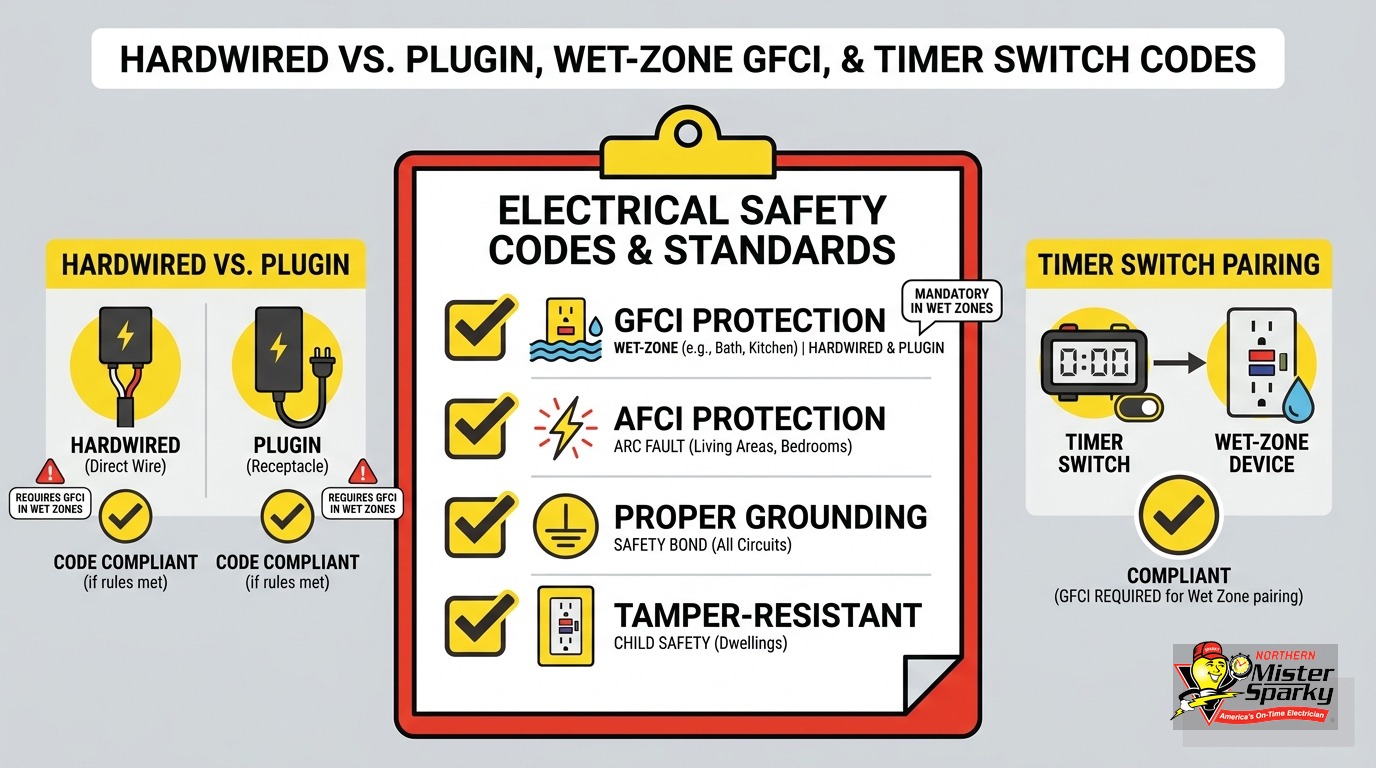
- Plugin units need a GFCI outlet that falls outside the NEC-defined 3-foot exclusion zone from the tub or shower rim. That limits placement in many bathrooms.
- Hardwired units eliminate the visible cord, satisfy GFCI code through a panel-level GFCI breaker, and pair cleanly with an in-wall timer switch.
- Never use a dimmer switch with a towel warmer. Dimmers damage the heating element.
- Wi-Fi timer switches require a neutral wire at the switch box. Many older Twin Cities homes do not have one without additional wiring.
- Minnesota adopted the 2026 NEC on August 17, 2026. Permits filed on or after that date fall under the updated code.
- Specify an IPX4-rated rack and a GFCI breaker for Minnesota’s humid winter bathrooms.
Hardwired vs. Plugin: Which Option Is Right for Your Bathroom?
Quick answer: Plugin units are simpler to install but face placement restrictions near tubs and showers that rule out many bathrooms. Hardwired units eliminate those restrictions, look cleaner, and pair with an in-wall timer. For most Twin Cities bathrooms, hardwired is the right call.
Both types heat towel bars using a low-wattage resistive element. The element warms the bar, and a towel dries in 15-30 minutes. The only real difference is how they connect to power.
A plugin model plugs into a standard wall outlet. Convenient in theory. In practice, Minnesota bathrooms place strict limits on where that outlet can be. NEC 210.8(A)(1) requires every receptacle in a dwelling-unit bathroom to have GFCI protection - that part is manageable. The harder rule is NEC 406.9(C), which bars any receptacle within 3 feet horizontal and 8 feet vertical from the tub rim or shower threshold. In a standard 5-by-8 bathroom, that exclusion zone covers the wall space closest to the fixture.
If the only available outlet falls inside the exclusion zone, a plugin unit will not work at that location without moving the outlet. Moving an outlet outside the zone means running a new circuit or extending an existing one. That labor can close much of the cost gap with a full hardwired installation. Then there is the cord itself: running it across tile to a compliant outlet location, and either exposing it or routing it through the wall, adds more work still.
A hardwired model connects directly to a dedicated branch circuit. No cord, no outlet, no exclusion zone problem. It requires a licensed electrician, a permit, and a circuit run to the bathroom wall. That is the right spec for a permanent bathroom fixture.
Aesthetics matter here too. A hardwired rack looks like it belongs in the room. A plugin rack with a visible cord does not.
Does GFCI Protection Apply to a Heated Towel Rack?
Quick answer: Yes, always. Plugin units use a GFCI-protected outlet. Hardwired units use a GFCI breaker at the panel. Both paths are required in a Minnesota bathroom, and neither has an exception.
For plugin units, the rule is direct. NEC 210.8(A)(1) requires GFCI protection for every 125V through 250V receptacle in a dwelling-unit bathroom. The requirement covers the entire room, not just a zone near the sink. Any outlet the rack plugs into must be GFCI-protected.
A second NEC section extends the reach of this rule. The NEC requires GFCI protection for receptacles within 6 feet of the outside edge of bathtubs and shower stalls. In a standard bathroom, 210.8(A)(1) already covers every outlet in the room, so 210.8(A)(10) overlaps. But if a master suite has a freestanding tub in a room without a sink, 210.8(A)(10) catches outlets near that tub even when 210.8(A)(1) does not apply.
For hardwired units, the path is slightly different. A hardwired appliance is not a receptacle, so 210.8(A)(1) does not apply directly to the appliance. Instead, NEC 210.8(D) and Article 422.5 address GFCI protection for listed appliances rated 150V or less to ground and 60A or less. Heated towel warmers are not named in the 422.5(A) appliance list, which names dishwashers and sump pumps. But manufacturer installation instructions and established trade practice require a GFCI-protected circuit.
The cleanest solution: a GFCI breaker at the panel. This satisfies 422.5(B)‘s “readily accessible” requirement and protects the entire circuit from the source, including the in-wall timer switch.
Where Can You Place the Outlet in a Bathroom?
Quick answer: Not within 3 feet horizontally or 8 feet vertically of the tub rim or shower threshold - even with GFCI protection. In most Twin Cities bathrooms, the best rack location sits inside that exclusion zone, which is the core reason hardwired installs often make more sense.
NEC 406.9(C) draws the boundary: no receptacles in the zone. The 3-foot horizontal measurement runs from the outside edge of the tub or the shower threshold. The 8-foot vertical measurement runs from the rim upward. In a bathroom with a tub on one wall and a toilet and vanity on the adjacent wall, the exclusion zone eliminates most of the usable wall space on two sides.
GFCI protection does not override this placement rule. An outlet inside the exclusion zone is a code violation even if it is GFCI-protected. Protection and placement are separate requirements.
This creates a real problem for plugin towel racks. The best rack location - close to the shower, easy to reach, visually centered on the wall - is usually right next to the tub or shower. That is exactly where the outlet cannot go. Options when a plugin unit is still on the table:
- Mount the rack on a wall outside the exclusion zone and accept a longer reach from the shower.
- Relocate an existing outlet outside the zone and manage the cord routing.
- Hardwire the rack and eliminate the outlet question entirely.
For most homeowners planning a remodel or renovation, hardwired is the answer. The electrical requirements for a bathroom remodel cover this decision alongside the full scope of what the room typically needs.
How Does GFCI Protection Work on a Hardwired Unit?
Quick answer: A GFCI breaker at the panel monitors the full circuit for ground-fault current. When it detects more than 5 milliamps of leakage, it trips and cuts power. This is the cleanest, most code-consistent path for a hardwired towel rack in a Minnesota bathroom.
A standard GFCI outlet protects itself and any outlets downstream on the same circuit. That works for receptacles. A hardwired appliance bypasses outlets entirely, so a GFCI outlet elsewhere on the same circuit does not necessarily protect the appliance.
A GFCI breaker at the panel solves this. It monitors the hot and neutral current at the source. Any imbalance above 5 milliamps - current leaking through an unintended path, including a person - trips the breaker immediately. Everything on that circuit is protected: the branch circuit wiring, the in-wall timer switch, and the towel rack element.
WarmlyYours notes that “a GFCI breaker powering the switch may be required by local Electrical Code.” In Minnesota bathrooms, this is not optional language. It is the standard spec.
One failure mode worth knowing before winter: degraded insulation in an aging heating element causes leakage current that can trip a GFCI breaker. If your rack’s breaker trips on cold February mornings after the shower runs, the element may be failing rather than the breaker malfunctioning. A licensed electrician can test the circuit and the element with a megohmmeter to tell the difference between a proper protective trip and nuisance behavior from aging equipment.
For a full breakdown of when to specify a GFCI breaker versus a GFCI outlet, see our GFCI breaker vs. GFCI outlet comparison.
What Timer Switch Options Work With a Towel Warmer?
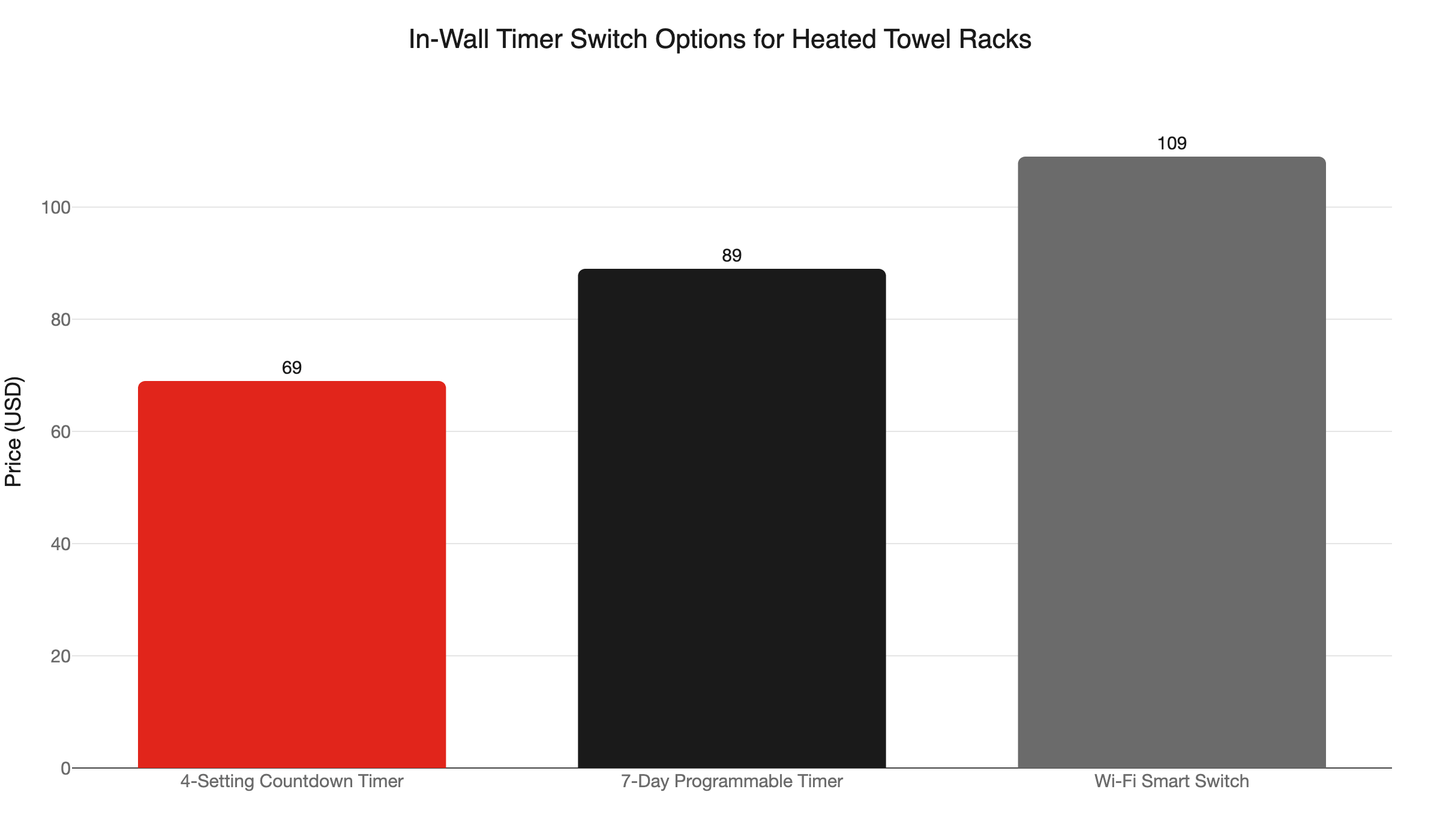
Quick answer: Three in-wall options are compatible with hardwired units: a 4-setting countdown timer at $69, a 7-day programmable timer at $89, and a Wi-Fi smart switch at $109. All three replace a single-gang wall switch. Do not use a dimmer switch - it will damage the unit.
A timer is not optional. Leaving a resistive heating element on all day wastes energy and shortens element life. The rack needs 15-30 minutes to warm a towel. A timer handles that automatically.
WarmlyYours lists three in-wall control options for hardwired towel warmers:
4-setting countdown timer - $69. Select 15, 30, 45, or 60 minutes. Press and go. No programming required, and it works with the existing wiring in virtually any home. The right choice when simplicity matters.
7-day programmable timer - $89. Set a weekday and weekend schedule once. The rack comes on before your alarm and shuts off automatically. No manual step required on a dark February morning.
Wi-Fi smart switch - $109. Full app control, schedule management from anywhere, and voice assistant compatibility. Requires a neutral wire at the switch box. Many older Twin Cities homes ran switch loops without a neutral. If your box lacks one, the Wi-Fi option needs additional wiring to bring a neutral to that location - worth discussing with your electrician before ordering the hardware.
The one hard rule: do not use a dimmer switch. Dimmers reduce power delivery by interrupting the AC sine wave. Towel warmer heating elements are resistive loads. That interrupted signal damages the element and voids most manufacturer warranties. A countdown timer is the correct trade-off, not a dimmer.
One more note: smart plugs can substitute for an in-wall timer on plugin models. In-wall timer switches do not work on plugin models because there is no wall switch box to replace.
Does Minnesota Require a Permit for This Work?
Quick answer: Yes. Minnesota requires a licensed electrical contractor and a permit through the DLI for all residential electrical work. This covers new circuits, outlet relocations, hardwired appliance installations, and timer switch wiring. No homeowner exemption applies here.
Minnesota requires a licensed electrical contractor for all residential wiring, and permits are filed through the Department of Labor and Industry. The DLI enforces this actively. In 2026, it issued cease-and-desist orders against unlicensed contractors performing exactly this type of work. The permit is not bureaucratic overhead - it triggers an inspection that confirms GFCI protection and circuit sizing meet code before the wall closes.
Minnesota adopted the 2026 NEC effective August 17, 2026. Permits filed on or after that date fall under the updated code. Permits filed before that date follow the 2023 NEC. If you are having existing work inspected after the switchover, the relevant code is whichever edition was in effect when the permit was originally filed. Your electrician will know which applies.
Minnesota adopts the NEC verbatim under Chapter 1315. There are no state-specific amendments to the bathroom GFCI or placement sections. The rules described in this post apply in Minneapolis, St. Paul, Bloomington, Maple Grove, Plymouth, Brooklyn Park, Woodbury, Blaine, and the rest of the Twin Cities metro.
When you work with us, we pull the permit and handle the inspection schedule. You do not deal with the DLI directly. For more on how the Minnesota permit process works, see our electrical permit guide.
What the Installation Actually Involves
Most heated towel rack wiring installations fall into one of two scenarios.
New circuit from the panel. This is the full job. An electrician runs a new 20-amp circuit from the panel to the bathroom, installs a GFCI breaker at the panel, runs wire to the switch box location, installs the in-wall timer switch, and brings the circuit to the rack mounting location. Rough-in wiring goes behind drywall. The rack mounts to wall blocking or framing. If the bathroom has not had electrical work recently, this is also a good time to verify the existing circuit count meets code for the room.
Tapping an existing circuit. In some cases an existing bathroom circuit has available capacity. An electrician can tap that circuit, confirm or add GFCI breaker protection, and run a branch to the rack location. This works when the load math supports it and the circuit is not already loaded near capacity.
Either scenario involves opening walls or running conduit in a finished bathroom. That work takes planning. Cutting into tile backer or lath-and-plaster incorrectly creates repairs that cost more than the original job. Finished-bathroom rough-in is where experience with older Twin Cities home construction makes a meaningful difference.
For a broader look at what a bathroom electrical rough-in involves, see our bathroom rough-in requirements guide.
The Twin Cities Climate Factor
Minnesota bathrooms run high humidity from November through April. A hot shower in a cold house pushes moisture into a room that is still warming up from overnight temperatures. That sustained humid environment changes how a towel rack should be specified.
Two things to confirm before the unit is ordered:
IPX rating. A towel rack installed in a bathroom should carry at minimum an IPX4 rating, meaning splash-resistant from any direction. Units marketed for bathrooms typically meet this standard. A rack rated for dry locations will degrade faster in a humid Minnesota bathroom. As the insulation breaks down, leakage current increases - and the GFCI breaker starts tripping. That is not a nuisance trip; that is the GFCI working correctly on a failing element.
GFCI behavior in a humid environment. High humidity can cause measurable leakage current in aging wiring and elements. A GFCI breaker that trips on cold February mornings after the shower runs is not necessarily a problem breaker. It may be detecting real leakage from a marginal element. A licensed electrician can test the circuit to tell the difference between a protective trip and equipment that is beginning to fail.
The right spec for a Twin Cities bathroom: an IPX4-rated rack, a GFCI breaker at the panel, and an in-wall timer switch. Getting this right at installation avoids a service call when February humidity tests the system.
Schedule Your Heated Towel Rack Installation
Heated towel rack wiring installation is a clean, contained job when a licensed electrician handles it. The code questions - wet-zone placement, GFCI requirements, permit, timer switch compatibility - are resolved before we arrive. You get warm towels every morning and no problems at the next inspection.
We are locally owned and operated in the Twin Cities. Our team pulls the permit, handles the inspection, and backs every job with the UWIN(R) 100% satisfaction guarantee. As America’s On-Time Electrician(R), we show up when we say we will. No malarky.
Call 763-200-5956 or book online to schedule your installation.
Frequently Asked Questions
Do I need a permit for heated towel rack wiring in Minnesota? +
Can I use a dimmer switch with a heated towel rack? +
Does a hardwired heated towel rack need GFCI protection? +
Can a Wi-Fi timer switch work in an older Twin Cities home? +
Need an electrician now?