
Electrical Cost for Home Addition: Twin Cities Price Guide
Key Takeaways
- Electrical rough-in for a home addition runs $3 to $5 per square foot in labor and materials.
- A kitchen or bathroom addition triggers expanded AFCI and GFCI requirements under Minnesota’s 2023 NEC, which adds $280 to $660 or more in breaker hardware alone.
- A load calculation determines whether you need a subpanel, a full service upgrade, or both - done before you pull permits.
- Panel upgrades from 100A to 200A in Minnesota run $1,800 to $4,500+.
- Twin Cities homeowners can stack the Xcel Energy $1,500 rebate with a MN Commerce grant of $2,000 to $3,000 on qualifying panel upgrades.
- All addition electrical work requires a permit filed with MN DLI or your local municipality.
- Only a licensed MN electrical contractor can legally perform this work under a contractor permit.
What Is the Electrical Cost for a Home Addition in the Twin Cities?
Answer capsule: The electrical cost for a home addition in the Twin Cities runs $3 to $5 per square foot for rough-in wiring, plus panel work if your current service cannot carry the new load. A 500-square-foot addition can run $1,500 to $7,500 or more, depending on whether a service upgrade is needed.
The total breaks into distinct layers.
Rough-in wiring covers the work done before drywall goes up: running cable through framing, installing junction boxes, rough-in for outlets and switches, and pulling circuits back to the panel or subpanel.
Panel work is the variable that drives the widest range. If your main panel has open slots and enough total amperage, you add breakers and move on. If it does not, you need a subpanel, a service upgrade, or both.
Code devices under Minnesota’s 2023 NEC add cost that older bids did not include. Combination AFCI/GFCI breakers are now required in kitchens, bathrooms, bedrooms, and laundry areas. Those breakers cost $35 to $55 each versus $8 to $15 for a standard breaker.
Permits are required for all of this work and are filed with MN DLI or your local municipality.
Electrical, plumbing, and HVAC combined typically represent 10 to 15 percent of total addition cost. On a $120,000 addition, that is $12,000 to $18,000 across all three trades. Electrical is usually one-third to one-half of that budget.
How Much Does Electrical Rough-In Cost for a Home Addition?
Answer capsule: Electrical rough-in wiring runs $3 to $5 per square foot. A 500-square-foot addition lands between $1,500 and $2,500 for rough-in alone, before panel work or code-required AFCI/GFCI devices are added. Electrician labor in the Twin Cities runs $50 to $130 per hour.
A 400-square-foot addition typically takes eight to sixteen hours of rough-in time, depending on complexity.
What drives cost higher:
- Distance from the main panel. Longer runs require more cable and more labor.
- Circuit count. A bedroom needs two to four circuits. A kitchen or home office with dedicated appliance circuits can need eight to twelve.
- Code-required protection devices. Under Minnesota’s 2023 NEC, AFCI protection is required in bedrooms, living rooms, kitchens, bathrooms, and laundry areas. GFCI now covers all kitchen receptacles - including the refrigerator, microwave, and garbage disposal - per NEC 422.5(A).
Where both AFCI and GFCI are required - kitchens, bathrooms, laundry rooms - a combination AFCI/GFCI breaker is mandatory. At $35 to $55 each, a kitchen addition with ten circuits adds $350 to $550 in breaker hardware before a single foot of cable is run.
What keeps cost lower:
- A simple bedroom or study addition needs fewer circuits and no specialized breakers.
- Short runs to a panel with open slots avoid subpanel and upgrade costs entirely.
- Straightforward framing - no load-bearing walls to route through, no concrete to core - speeds labor.
Do You Need a Subpanel or a Full Service Upgrade for Your Addition?
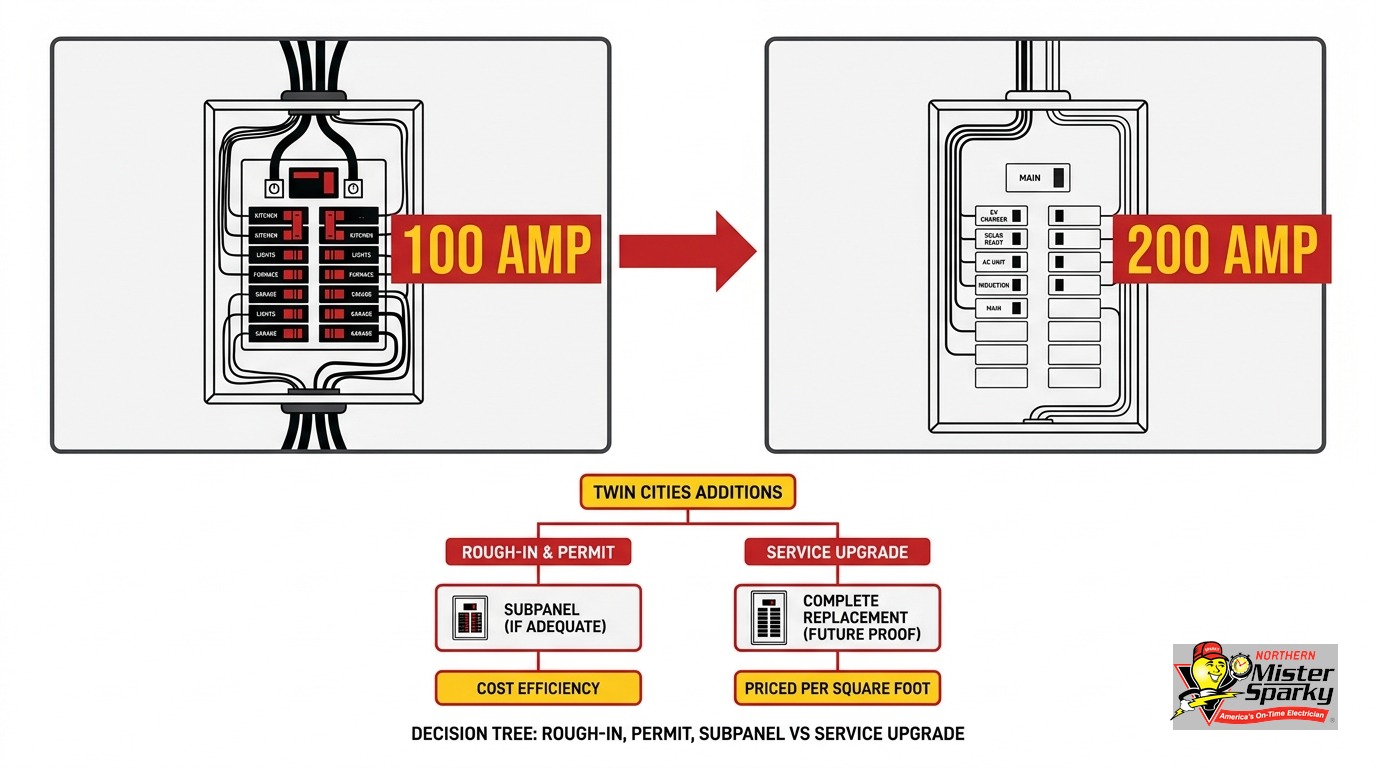
Answer capsule: A load calculation decides. A subpanel is right when your main panel has adequate total amperage but no open breaker slots, or when the addition is far from the panel. A service upgrade is necessary when your total home demand after the addition exceeds current service capacity.
This is the decision homeowners most often misunderstand. The two options solve different problems.
Choose a subpanel when:
- Your main panel has enough total amperage, but every breaker slot is occupied.
- The addition sits more than 50 to 75 feet from the main panel and needs ten or more circuits. Running one feeder cable to a subpanel is cleaner and often less expensive than pulling eight to twelve individual home runs.
- A 60A or 100A subpanel fed from the main panel covers all the circuits the addition needs.
Choose a service upgrade when:
- A load calculation shows your total home demand will exceed current service capacity after the addition is complete.
- You are adding central air conditioning, an electric dryer, an EV charger, or electric heating to a home already on 100A service. That combination almost always requires an upgrade.
- Your current panel is a known safety risk. Federal Pacific Electric (Stab-Lok) and Zinsco panels have documented breaker failure histories. Some insurers - State Farm and Farmers among them - will not renew policies on homes with these panels. An addition project is the right time to replace them.
Many Twin Cities homes built in the 1950s through 1970s still run on 100A service. A heated addition in a Minnesota winter adds real load. If your home already uses 70 to 80 amps on cold days, the addition will likely push you over capacity. A load calculation done before permits are pulled tells you exactly where you stand and avoids a costly mid-project surprise.
What Does an Electrical Panel Upgrade Cost in Minnesota?
Answer capsule: A 100A-to-200A panel upgrade in Minnesota runs $1,800 to $4,500+. The job takes four to eight hours and requires the utility to cut power for most of that window. Cost varies based on meter base condition, service entrance wiring, and utility requirements.
The wide range reflects real variables:
- Whether the meter base and service entrance conductors need replacement alongside the panel itself.
- Whether Xcel Energy or your local utility needs to run new service to the house.
- Local labor rates. Minneapolis and inner-ring suburbs run higher than outer-ring communities.
- Ampacity. A 200A panel covers most homes. Larger homes with heavy concurrent loads - electric heating, EV charging, a workshop, and a hot tub - may warrant 400A service.
If your addition is triggering the upgrade, budget panel work as a separate line item in your project estimate. It must be complete before rough-in inspection, and it cannot be skipped if the load calculation says you need it.
Our panel upgrade service page covers what the replacement process involves from site visit to final inspection.
What Does Minnesota’s 2023 NEC Mean for Your Addition?
Answer capsule: Minnesota adopted the 2023 NEC effective July 1, 2023. Any permit filed after that date must comply. The main cost driver for additions: expanded AFCI and GFCI coverage means more combination breakers at $35 to $55 each instead of $8 to $15 for a standard breaker.
Minnesota’s 2023 NEC adoption expanded protection requirements significantly from prior editions. A contractor quoting a job under the old code - or forgetting to account for these requirements - will deliver a bid that either misses compliance or hits you with change orders.
AFCI changes: Arc-fault circuit interrupter protection is now required in bedrooms, living rooms, kitchens, bathrooms, and laundry areas. An AFCI breaker detects the electrical signature of arcing faults - the type that cause fires inside walls and ceilings, out of sight.
GFCI changes: Per NEC 422.5(A), GFCI protection now covers all kitchen receptacles (including refrigerator, microwave, and garbage disposal circuits), all 250V circuits such as EV chargers and electric water heaters, and dishwashers. A kitchen addition triggers GFCI protection on nearly every circuit in that space.
Where both protections are required, the combination AFCI/GFCI breaker is mandatory. A kitchen addition with ten circuits that need combination breakers adds $350 to $550 in hardware before labor. Budget for this up front so it is not a surprise on your final invoice.
For a full breakdown of where GFCI is required under current code, see our GFCI outlet requirements guide.
What Permits Do You Need for Home Addition Electrical Work in Minnesota?
Answer capsule: Any electrical work beyond replacing outlets, switches, or fixtures requires a permit in Minnesota. Permits are filed with MN DLI or the local municipality depending on the authority having jurisdiction (AHJ). Minimum fees for panel work start around $61 through MN DLI.
Here is how the process works.
Who performs the work: Only a licensed MN electrical contractor may do this work under a contractor permit. Homeowners may file a homeowner permit for work on their own primary residence, but unlicensed helpers and family members are not permitted to assist under that permit.
State vs. local AHJ: Minneapolis and Hennepin County file electrical permits with MN DLI. Some suburban municipalities - many in Ramsey, Dakota, and Washington counties - handle permits locally under their own fee schedules. Check the DLI AHJ directory at dli.mn.gov to confirm which applies to your address before assuming.
MN DLI fee structure: The base schedule is $25 base fee + $1 surcharge + $35 amperage fee for service up to 400A, totaling roughly $61 minimum for a panel permit. Rough-in circuits are $2 per feeder for fewer than 15 circuits. Local AHJs may charge differently.
What the inspection covers: A licensed inspector visits twice - once to check rough-in before drywall closes, once to check the final trim after drywall is up. Never close a wall before the rough-in inspection is approved. A failed rough-in means opened walls.
Our electrical permit Minnesota guide covers the full filing process step by step.
What Rebates Can Twin Cities Homeowners Stack on a Panel Upgrade?
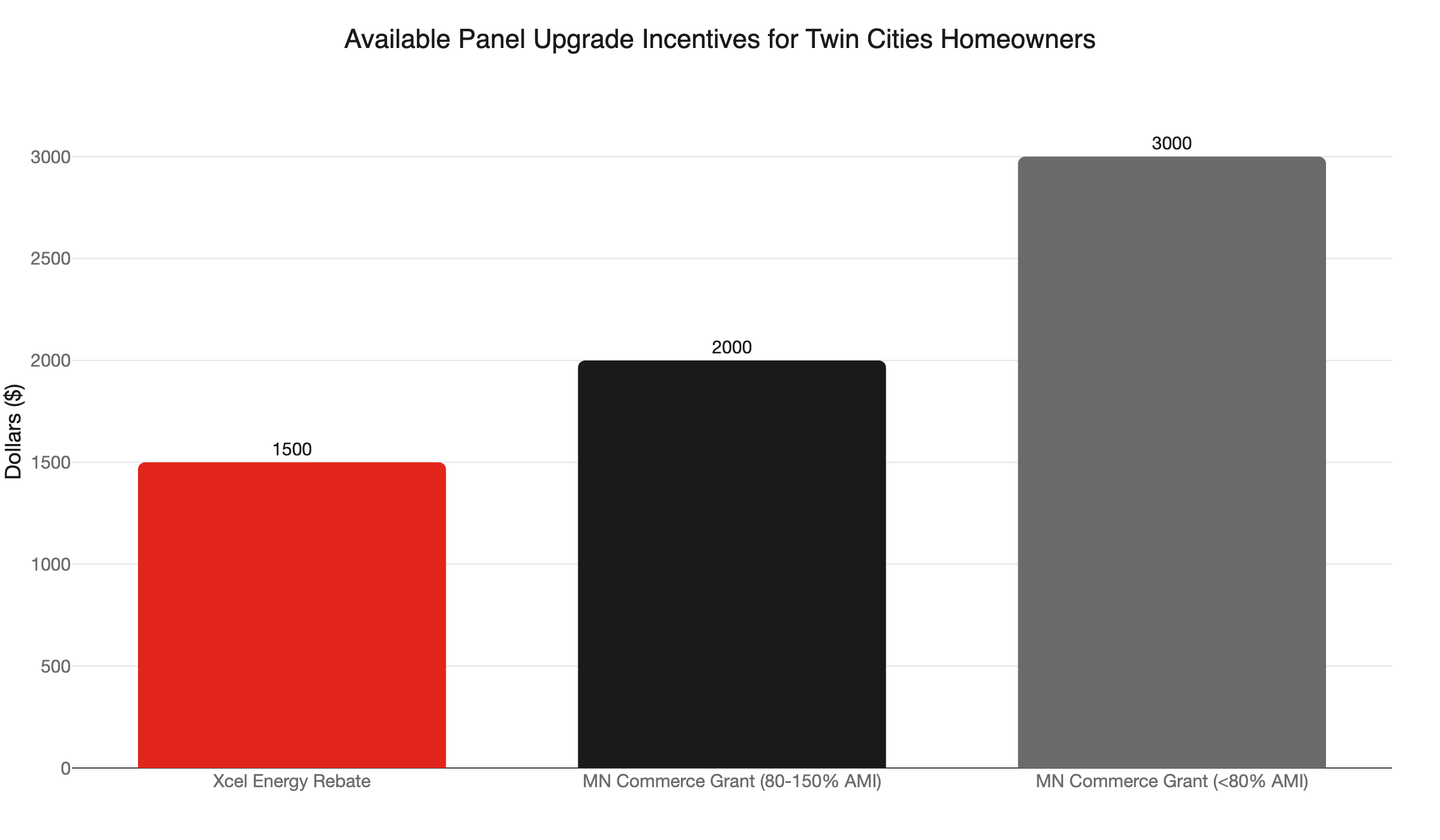
Answer capsule: Xcel Energy offers up to $1,500 for a qualifying panel upgrade to higher amperage. The MN Commerce Residential Electrical Panel Upgrade Grant offers $2,000 to $3,000 depending on income. Both may stack on the same project, with federal IRA credits potentially layering on top.
This is the part that most national home addition cost guides completely miss.
Xcel Energy Panel Rebate: Up to $1,500 for a panel upgrade to higher amperage (not a like-for-like replacement). You must use a licensed MN electrician and submit the contractor invoice with your permit approval. Xcel serves most of the Twin Cities metro. Confirm your address is eligible before filing.
MN Commerce Residential Electrical Panel Upgrade Grant: This state program offers:
- $3,000 for households under 80% of area median income (AMI)
- $2,000 for households between 80% and 150% AMI
The program’s $5.8 million statewide pool was pending DOE final approval as of early 2026. Check the MN Commerce program page for current status before counting on this grant in your budget.
Federal IRA Tax Credits: The Inflation Reduction Act includes tax credits for electrical upgrades that support whole-home electrification. These may layer on top of state and utility incentives. A tax professional can confirm your specific eligibility.
Stacking the Xcel rebate and the MN Commerce grant on a $4,000 panel upgrade could bring out-of-pocket cost to $500 or less for eligible households. If your addition is already triggering an upgrade that was coming eventually, applying for every available incentive makes the timing work in your favor.
A Practical Decision Tree: Sizing the Electrical Scope for Your Addition
Answer these four questions before your electrician visits. They define the full scope.
1. What is your current service size?
Look at the main breaker in your panel. A 100A label means 100A service. A 200A label means 200A. If you are on 100A service and adding more than a basic bedroom, order a load calculation before the bid.
2. What does the addition include?
A bedroom adds two to four circuits. A bathroom adds three to five circuits, all triggering AFCI/GFCI. A kitchen adds eight to twelve circuits with combination breakers on each. A heated addition in a Minnesota winter adds significant load. Each high-draw appliance - electric dryer, EV charger, hot tub - may require a dedicated circuit on top of the general addition wiring.
3. How far is the addition from the main panel?
If the addition is more than 50 to 75 feet away and needs ten or more circuits, a subpanel at the addition point is usually more cost-effective. One feeder cable versus ten individual home runs is a significant labor and material difference.
4. Is your current panel a safety risk?
Federal Pacific (Stab-Lok) and Zinsco panels have documented breaker failure problems and insurer pushback. If you have one, replace it as part of this project. Our signs you need an electrical panel upgrade guide explains what to look for.
Get an Accurate Electrical Cost for Your Home Addition
The ranges in this guide are real starting points. Your actual cost depends on your current service capacity, the addition’s scope, and what the 2023 NEC requires for your specific spaces. The only way to get a reliable number is a load calculation and a site visit.
We are locally owned and operated in the Twin Cities, and our team has walked through this exact scoping process with hundreds of Minnesota homeowners. We handle the load calculation, the permit filing with MN DLI or your local AHJ, and the rebate paperwork for every incentive you qualify for. Financing is available for larger panel and service upgrade projects.
Call 763-200-5956 or book online to schedule an estimate. As America’s On-Time Electrician(R), we show up when we say we will. And our UWIN(R) 100% satisfaction guarantee covers every job - no malarky.
Frequently Asked Questions
How much does electrical rough-in cost per square foot for a home addition in Minnesota? +
Do I need a subpanel or a full service upgrade for my home addition? +
Are there rebates for electrical panel upgrades in the Twin Cities? +
Do I need a permit for electrical work on a home addition in Minnesota? +
Need an electrician now?