Electrical Requirements for a Home Salon in Minnesota
Key Takeaways
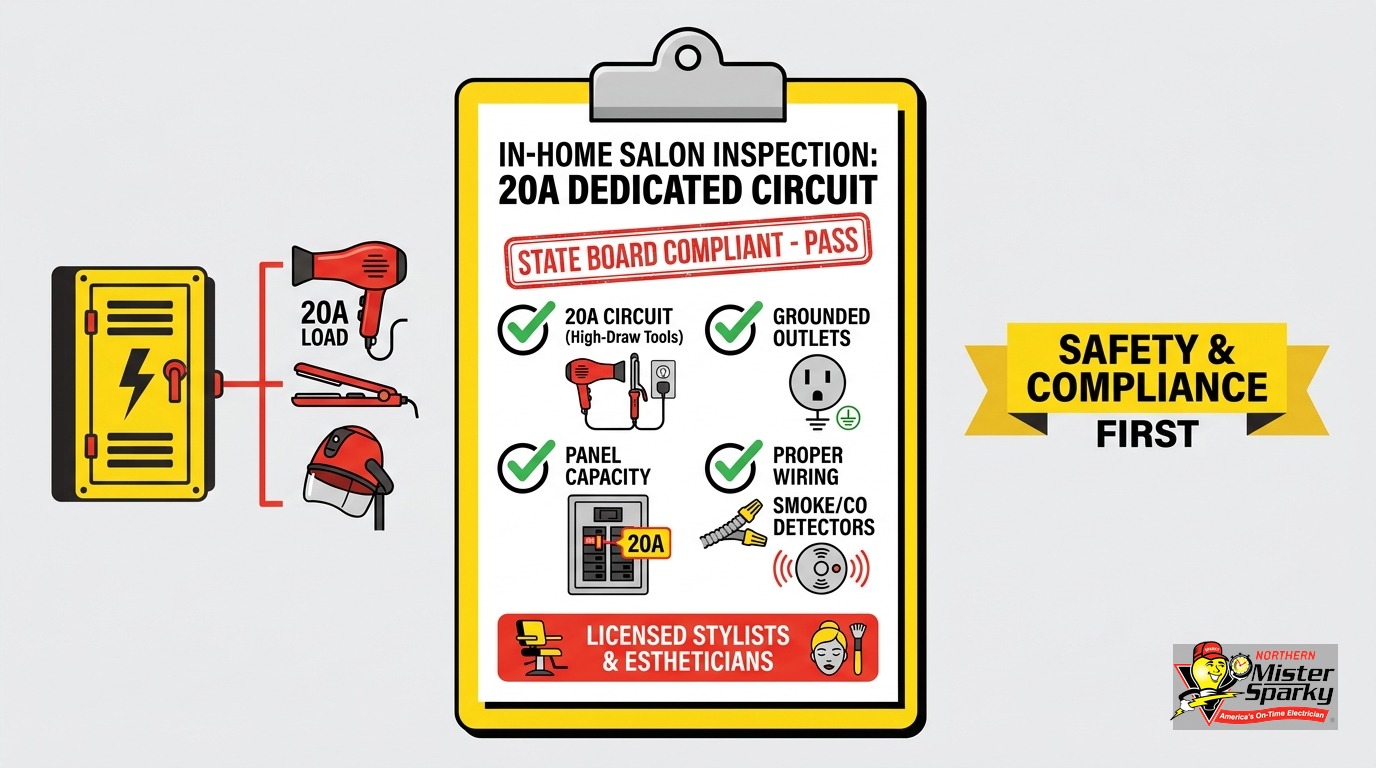
- The electrical requirements for a home salon in Minnesota involve two separate inspectors: a DLI cosmetology inspector and a state or local electrical inspector. Both must sign off before you can legally operate.
- Minnesota Rule 2105.0393 governs salons located in private residences. Minnesota Statute 155A.29 requires a physical inspection before your salon license is issued or renewed.
- Add at least one dedicated 20-ampere circuit for your styling station. A shampoo bowl with an inline water heater needs its own separate circuit.
- Every outlet within 6 feet of a shampoo bowl or rinse sink requires GFCI protection. No exceptions under the code.
- Permits filed on or after August 17, 2026 must comply with the 2026 NEC. That is the standard Minnesota adopted 16 days ago. Most online guides have not caught up.
- Older Twin Cities homes with 100-amp panels may not have room for new salon circuits without a service upgrade.
What Are the Electrical Requirements for a Home Salon in Minnesota?
At minimum: one dedicated 20-ampere circuit for your salon workspace, GFCI-protected outlets wherever water is present, and valid electrical permits filed with the Minnesota Board of Electricity or your local municipality. Your DLI cosmetology inspector and your electrical inspector must both sign off before you open.
Most national guides stop at “get a 20-amp circuit.” They skip why that circuit is necessary, they never mention the dual-inspector reality that Minnesota imposes, and none of them have caught up to the fact that Minnesota changed its governing electrical code on August 17, 2026. This post covers all three.
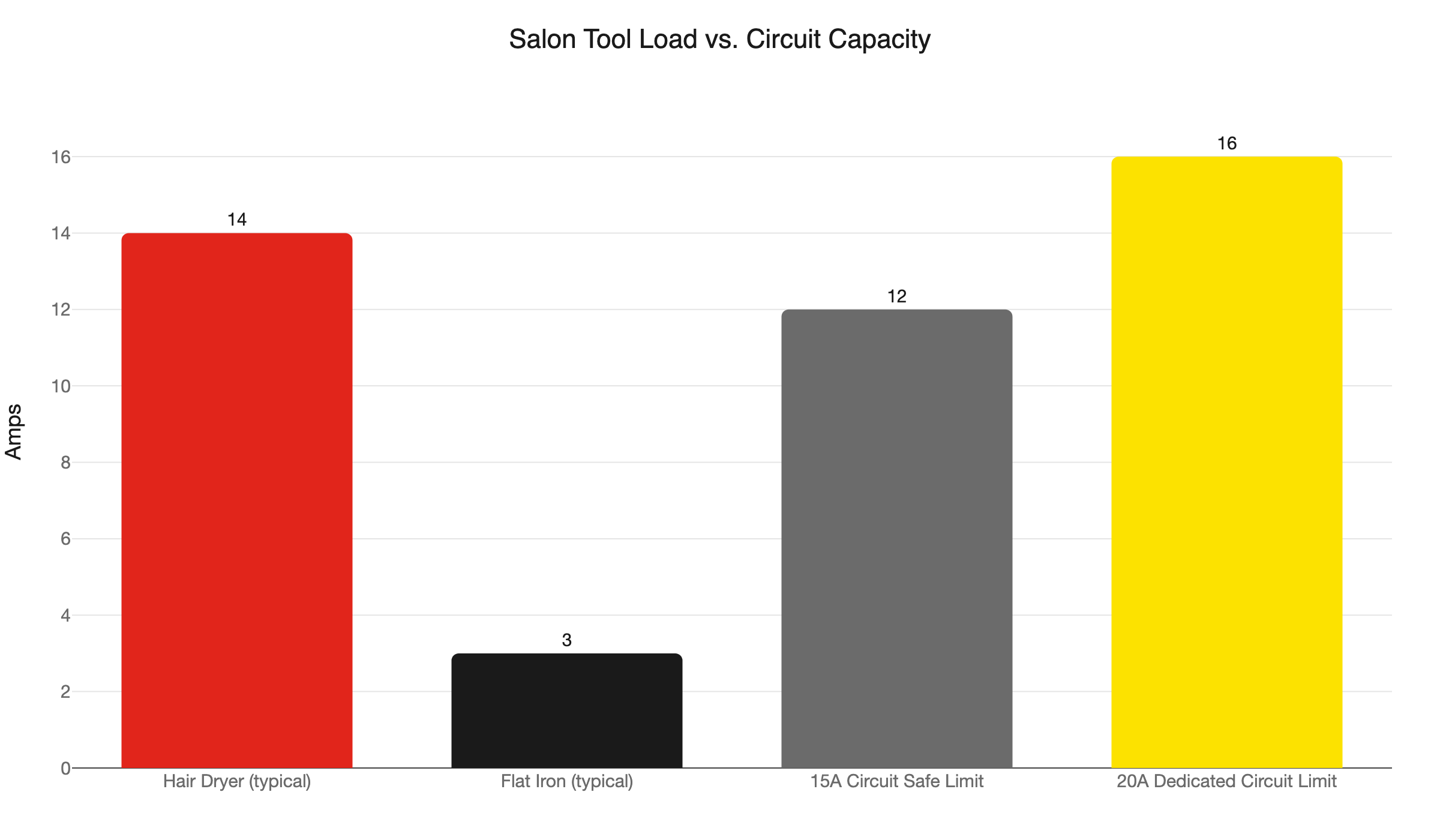
If you are a licensed stylist or esthetician working out of a dedicated room in your home, here is the baseline. A standard 15-ampere household circuit was not built for professional salon tools. A professional hair dryer draws 12.5 to 15.6 amps at 120V. A flat iron adds 200 to 450 watts on top of that. Run both on a shared 15A circuit and you will trip the breaker mid-service. Clients do not come back after that, and a pattern of overloads is also a code violation in the making.
The fix is straightforward. The process has steps. This post walks you through both.
Two Inspectors, Two Bodies of Law: How Minnesota Actually Works
Minnesota separates the licensing side of a home salon from the electrical side completely. These are two different state agencies with two different bodies of law, and each inspector only cares about their own jurisdiction.
On the licensing side, Minnesota Statute 155A.29 governs cosmetology salon licensing. Before your salon license is issued or renewed, a DLI cosmetology inspector visits your space. They are checking compliance with Minnesota Administrative Rule 2105. Rule 2105.0360 sets general physical requirements for licensed salons. Rule 2105.0393 adds requirements specifically for salons located in private residences. Those sub-requirements cover ventilation, sanitation, service area conditions, and how the space is physically arranged.
The cosmetology inspector does not review your wiring. They check the space. But the space must be finished and fully functional before that inspection happens.
On the electrical side, any new circuit added for the salon requires a permit. That permit goes to either the Minnesota Board of Electricity or your local municipality, depending on where you live. Once the work is complete, an electrical inspector signs off on the wiring. The electrical inspector does not issue your salon license. They only verify that the work meets code.
The sequence that matters: you cannot book the cosmetology inspection until the electrical work is permitted and inspected. If the room is not complete, the cosmetology inspector will not pass it. Get the wiring done and inspected first. Then schedule the DLI visit.
What Circuits Does a Licensed Home Salon Need?
At minimum, one dedicated 20-ampere branch circuit for your primary styling station. If your workspace includes a shampoo bowl with an inline water heater, that requires a second dedicated circuit. A second styling chair or a nail station with high-draw equipment may need a third. Plan for your busiest service day, not your lightest.
The word “dedicated” carries the weight here. A dedicated circuit serves only the salon. It does not share a breaker with the hallway outlets, bedroom lights, or the refrigerator two rooms over. When your hair dryer is pulling 14 amps and your flat iron is running at the same time, those amps come from a circuit that has nothing else competing for them.
The 2026 NEC is Minnesota’s governing standard as of August 17, 2026. It treats a salon workspace with a wet sink similarly to a bathroom for circuit and GFCI purposes. NEC 210.11(C)(3) requires at least one 20-ampere branch circuit for bathroom receptacle outlets. That is the floor. Your actual setup may require more.
For most home salons, two circuits cover it:
- One dedicated 20A circuit for your styling chair and tool outlets
- One dedicated circuit for the shampoo bowl, if it has an inline water heater
For estheticians running a steamer, a high-powered facial device, and a heated treatment bed, add the wattage of your three highest-draw tools and size accordingly. Our post on dedicated circuits for appliances explains the load math in plain terms.
Plan exactly where each outlet will go before the electrician arrives. Knowing the layout upfront lets the electrician price the job accurately and finish in one visit.
How Much Power Do Salon Tools Actually Draw?
A professional hair dryer draws 12.5 to 15.6 amps at 120V. A flat iron adds 1.7 to 3.75 amps. Running both on a shared 15-ampere circuit consistently trips the breaker. The continuous load limit on a 15A circuit is 12 amps. A hair dryer alone can exceed that by more than 2 amps. A dedicated 20A circuit solves this cleanly.
The numbers are confirmed by the U.S. Department of Energy appliance energy estimator. At 1,500 to 1,875 watts, a professional dryer exceeds what a shared residential circuit can supply. A flat iron adds 200 to 450 watts. At typical draw, both tools running together can reach 17 amps or more. That exceeds the continuous limit for even a dedicated 20A circuit, which is why the circuit must serve the salon only and nothing else.
This is why the code requires a dedicated circuit. It is not about equipment being fancy. It is straightforward load math. A circuit that only serves your salon has its full headroom available. A shared circuit does not.
The consequence of running professional tools on an undersized shared circuit is not limited to nuisance tripping. Repeated overloads heat the wire insulation over time. That heating is a fire hazard. The 2026 NEC’s requirements exist to prevent that outcome, not to create paperwork.
What GFCI Protection Does the Code Require Near a Shampoo Bowl?
Every outlet within 6 feet of a sink must have GFCI protection. NEC 210.8(A)(1) requires GFCI protection for all receptacles in bathrooms. In a home salon, that zone extends to every outlet near your shampoo bowl, esthetician rinse sink, or any other water source. Every receptacle in reach of a client or a tool cord needs a GFCI device.
GFCI stands for ground-fault circuit interrupter. A GFCI outlet monitors current flow in real time. The moment it detects a mismatch - current leaking to ground, which is what happens when a live tool contacts water - it cuts the circuit in about a tenth of a second. That response time is fast enough to prevent electrocution.
For a home salon, GFCI protection is not optional and not limited to the outlet closest to the water source. In a room where a shampoo bowl sits along one wall and a styling chair along another, the 6-foot zone may cover most of the room’s outlets. Every one of them needs a GFCI device.
There are two ways to meet the requirement. GFCI receptacles at each individual outlet protect that outlet only. A GFCI breaker on the entire circuit protects every outlet downstream at once. Your electrician can advise which approach fits your salon layout. Either is code-compliant when installed correctly.
Your electrical inspector will verify GFCI protection during the permit inspection. Standard receptacles with no GFCI protection will fail. The work has to be corrected and reinspected before the permit closes, which delays your cosmetology inspection and your opening date.
For a full breakdown of where GFCI outlets are required throughout a home and what the different device types mean, see our post on GFCI outlet requirements explained.
Does My Older Minneapolis Home Have Enough Panel Capacity?
Many Twin Cities homes built before 1980 have 100-amp service panels. A 100A panel already loaded by a washer, dryer, central AC, and resistive heat may not have room for one or two new 20A salon circuits. The only way to know is to calculate your current electrical load. If you are near 80% of panel capacity, a service upgrade may be required before the salon opens.
This is the step most home salon guides skip. It is also the step most likely to delay your opening if you discover it late.
Older homes in Minneapolis and Saint Paul were often built with 100-amp service. That was adequate when the home’s largest loads were a range and a few circuits of lights. Today, with central air, an electric dryer, a heat pump or resistance heat, a dishwasher, and now a professional salon drawing 14 amps during every client visit, a 100A panel can be at or near capacity before you add anything new.
Adding a dedicated 20A salon circuit to a panel that is already near its limit creates an overload risk. An overloaded panel does not just trip breakers. It can cause sustained heat in the service entrance conductors. That heat is a fire hazard. Your electrical inspector will flag this problem during the permit inspection.
A licensed electrician can calculate your current load in about an hour. If the panel is at or above 80% of capacity, the conversation shifts to whether a service upgrade to 200A is the right call, or whether consolidating lower-draw circuits can free up breaker slots. Our post on 100-amp vs. 200-amp electrical service covers that decision in plain terms.
Winter load is a wrinkle specific to the Twin Cities. Older Minneapolis and Saint Paul homes often carry electric resistance baseboard heaters for supplemental warmth. In winter, those loads run alongside the salon draw and push the panel harder. If you are opening a home salon in a pre-1980 Twin Cities home, calculate the load using winter conditions, not shoulder-season ones.
How Has the 2026 NEC Changed What You Need?
Minnesota adopted the 2026 National Electrical Code effective August 17, 2026. Any permit filed on or after that date - including a permit for new salon circuits - must comply with the 2026 code. The 2026 NEC tightens arc-fault and ground-fault requirements in residential occupancies. Most online advice is citing older editions.
If you are pulling a permit for your home salon today, you are working under the 2026 NEC. The transition is confirmed by the Minnesota Department of Labor and Industry. Permits filed before August 17 used the 2023 edition. Permits filed on or after that date use 2026. Licensing exams shift to 2026 NEC on September 8, 2026.
The 2026 NEC expands AFCI (arc-fault circuit interrupter) requirements in residential settings. AFCI breakers detect arcing faults: the type of electrical fault that can ignite wire insulation without tripping a standard breaker. Depending on your home’s construction and where the salon circuit runs, the new circuit may require an AFCI breaker, a GFCI breaker, or a combination device that provides both protections in a single unit.
Your electrician and your inspector apply the current code. What you need to know is that any “20A circuit is enough” advice written before 2026 may be missing the AFCI and other requirements that now apply to your permit. Ask your electrician which protection devices the 2026 NEC requires for your specific installation.
How Do You Get an Electrical Permit for a Home Salon in Minnesota?
Your licensed electrician files the permit. You do not navigate this yourself. File with either the Minnesota Board of Electricity or your local municipality, depending on your address. Check the inspector directory on the Minnesota DLI electrical permits page to find out which applies to your suburb.
In the Twin Cities, permit jurisdiction varies by location. Minneapolis, Saint Paul, Bloomington, and many first-ring suburbs operate their own local electrical inspection authority. Outer suburbs and parts of Hennepin and Ramsey counties route through the state board. The DLI inspector directory maps this out by address. Check it before hiring an electrician, because an electrician set up only for state-permitted work may not be configured for a city-permit project.
After the work is complete, the inspector schedules a site visit or, for eligible permit types, a virtual inspection. The inspector reviews the installation against the 2026 NEC. Once they sign off, the electrical portion of your approval is complete. Then you schedule the DLI cosmetology inspection.
The permit is not a bureaucratic hurdle. It is the document that proves your wiring was reviewed by a licensed inspector. Without it, you have no protection if a wiring issue causes damage or injury, and your homeowner’s insurance may have grounds to deny a related claim.
What Is the Correct Sequence for Getting a Minnesota Home Salon Licensed?
Plan the electrical work first. Pull the permit. Complete the wiring. Pass the electrical inspection. Then schedule the DLI cosmetology inspection. Each step depends on the one before it. The cosmetology inspector will not pass a room that is not fully finished and inspected.
Here is the sequence in order:
- Plan the electrical work. Confirm how many circuits you need and exactly where outlets will be located.
- Hire a licensed Minnesota electrician. They file the permit and complete the wiring under the 2026 NEC.
- Pass the electrical inspection. The inspector signs off and the permit closes.
- Schedule the DLI cosmetology inspection. Rule 2105.0393 governs what the inspector checks in a private residence salon. The space must be complete, clean, and functional.
- Receive your salon license or renewal.
Shortcuts in this sequence do not save time. A stylist who skips the electrical permit and fails the cosmetology inspection now has to hire an electrician, wait for the permit, wait for the electrical inspection, and then reschedule the cosmetology visit. That costs weeks. Doing it in order costs days.
What About Financing a Panel or Circuit Installation?
The total cost of salon electrical work depends on your home’s layout, your panel’s current capacity, and how far the salon room sits from the main panel. Running new wire through finished walls, installing GFCI outlets and AFCI breakers, and completing the rough-in and finish work is a real job. If a panel upgrade is also needed, costs increase.
Northern Mister Sparky offers financing options for larger electrical jobs. Ask when you call for a quote.
Xcel Energy also offers residential rebates for some electrical efficiency upgrades. The programs and dollar amounts change seasonally. Verify what is currently available before building a rebate into your budget. Do not assume a program that appeared in a search result last month is still active.
For panel upgrade services in the Twin Cities, see our electrical panel upgrade service page.
Ready to Open Your Home Salon? Start Here.
The electrical requirements for a home salon in Minnesota are real, codified, and enforced. Here is the short version: at least one dedicated 20A circuit, GFCI protection on every outlet within 6 feet of water, permits filed under the 2026 NEC, and two separate inspector sign-offs before you open. If your home has a 100-amp panel that is already carrying a heavy load, that conversation happens before anything else.
No malarky: get the electrical work done right the first time and you open on schedule. Skip a step and you are rescheduling the cosmetology inspector, losing client bookings, and spending more than a proper sequence would have cost.
Northern Mister Sparky is locally owned and operated in the Twin Cities. We serve Minneapolis, Saint Paul, Bloomington, Brooklyn Park, Woodbury, Blaine, Maple Grove, and Plymouth. We know the permit jurisdictions across the metro, we work under the 2026 NEC, and we are familiar with the older home stock that needs a candid panel conversation before salon circuits can be added.
We are America’s On-Time Electrician(R). Call us at 763-200-5956 or book online to schedule a walkthrough of your space.
Frequently Asked Questions
Do I need a permit to add circuits for a home salon in Minnesota? +
How many circuits does a home salon need? +
What GFCI protection is required near a salon shampoo bowl? +
Need an electrician now?