Home Brewing Electrical Circuit Requirements: MN Guide
Key Takeaways
- Most Twin Cities garages built before 2000 have a single 15A lighting circuit or no electrical at all. That is not enough for a modern brewing system.
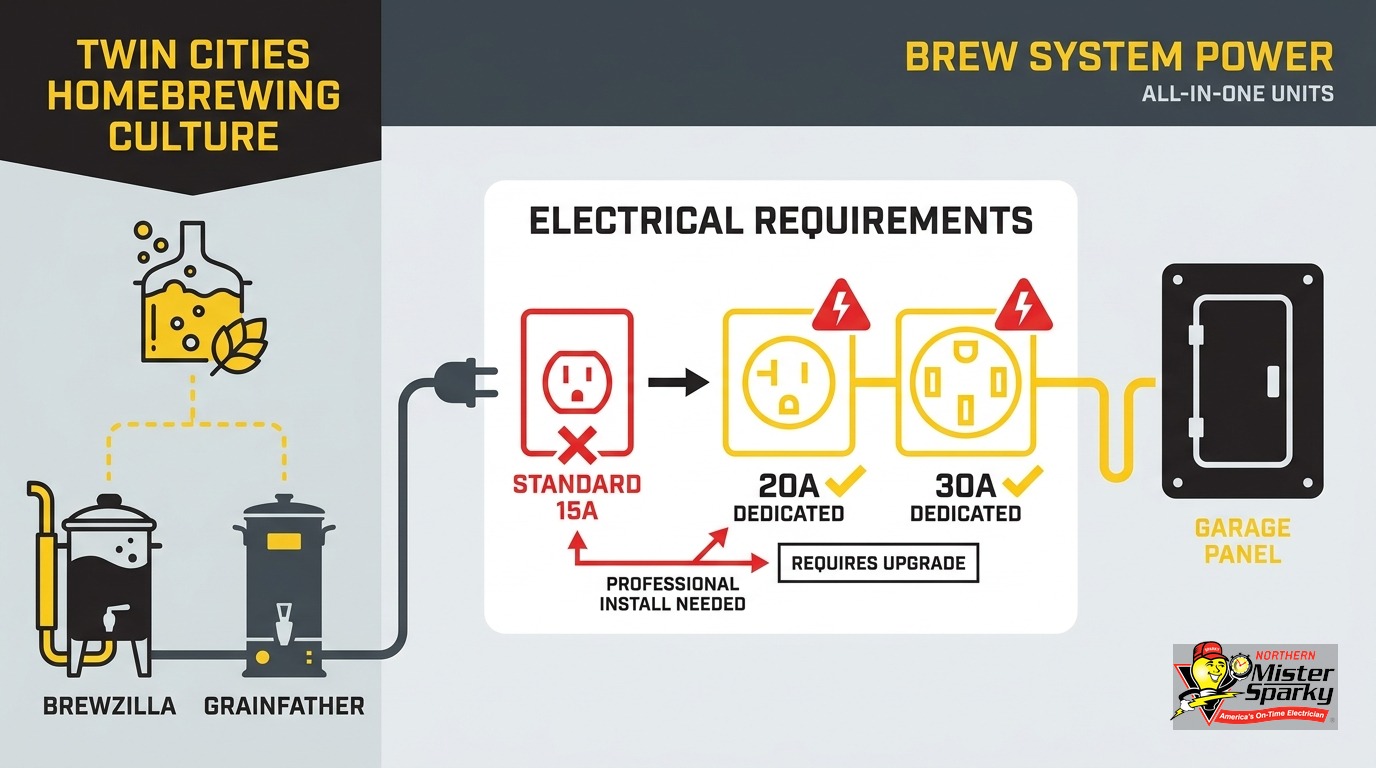
- All-in-one brewing systems at the 10-gallon tier require a dedicated 30A/240V circuit and a NEMA 6-30 outlet.
- Minnesota requires a permit for any new or modified garage circuit. Homeowners of owner-occupied single-family homes can pull their own.
- Minnesota adopted the 2026 NEC on August 17, 2026. Permits filed on or after that date must comply. The 2026 NEC requires GFCI protection on 240V garage receptacles, not just 120V outlets.
- If you also want an EV charger, Xcel Energy offers up to $500 for a Level 2 circuit installation and up to $1,500 for a qualifying panel upgrade. The work overlaps heavily. Bundling both projects saves money.
The Twin Cities Runs on Good Beer - and That Starts in the Garage
The Minnesota Home Brewers Association and the Saint Paul Homebrewers Club are two of the oldest homebrew clubs in the state. Homebrew Con - the world’s largest annual homebrewers gathering - has been held at the Minneapolis Convention Center. The Twin Cities knows how to make good beer.
A lot of that beer now starts in a garage. All-in-one electric brewing systems have replaced propane burners for thousands of home brewers across the metro. Plug it in, add water, crush your grain, and brew. No open flame. No propane tank to haul. Clean and quiet.
But “plug it in” is where the trouble begins. If you bought a BrewZilla Gen 4 or a Grainfather G40, you already know you need a dedicated circuit. What the forums and equipment guides almost never tell you is what that actually means in Minnesota: the permits required, the code changes that took effect in August 2026, and why your garage almost certainly cannot handle it right now.
We are a locally owned and operated Twin Cities electrical company. This is the post we wish someone had written before our customers started calling us.
What Are the Home Brewing Electrical Circuit Requirements for My System?
A BrewZilla Gen 4 on 220V needs a dedicated 20A or 30A/240V circuit. Every 10-gallon-tier all-in-one system requires a dedicated 30A/240V circuit and a NEMA 6-30 receptacle. Running anything less means throttled output or a tripped breaker mid-mash.
The key number is watts - and how the NEC limits what you can draw on a sustained basis.
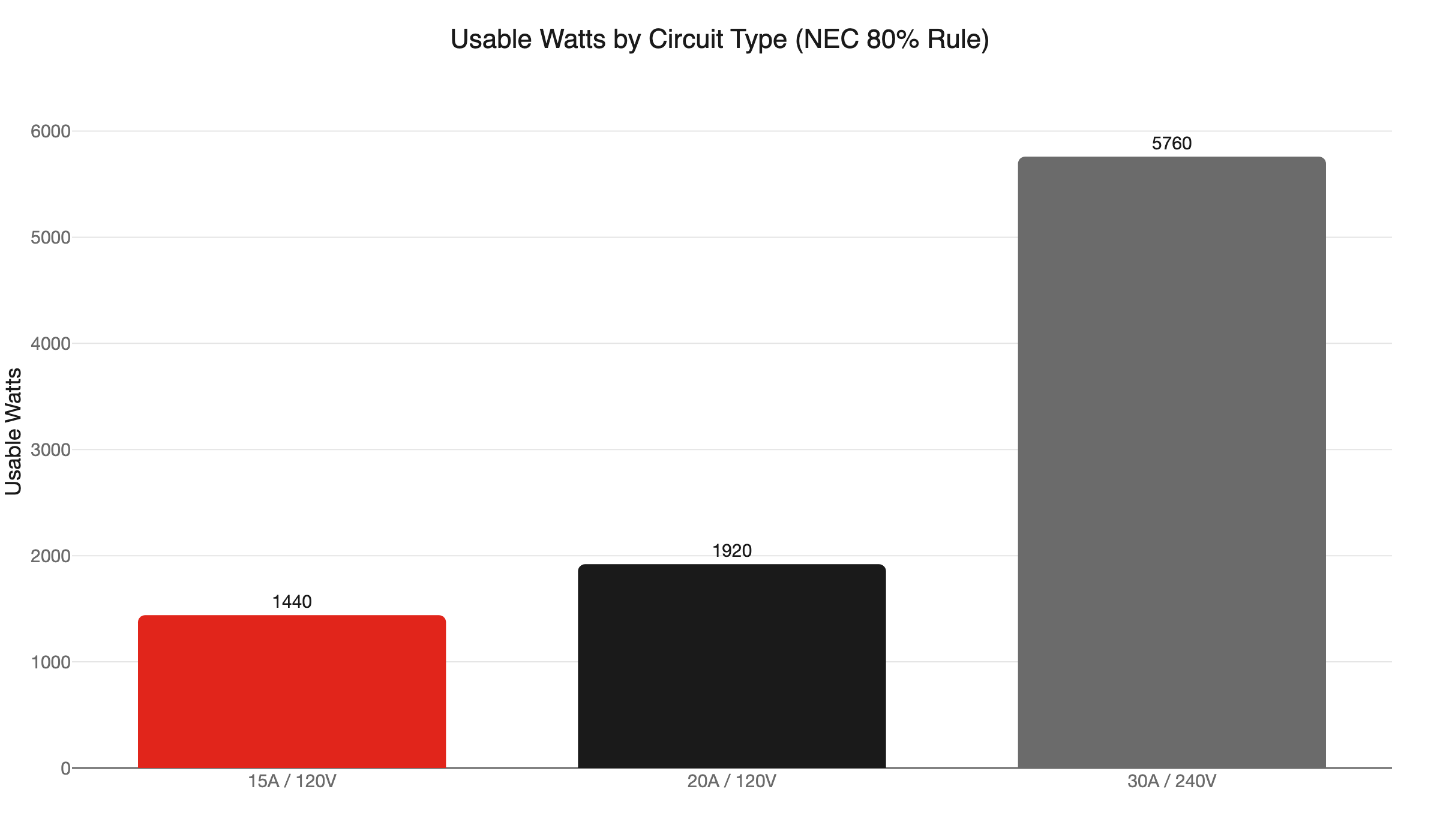
The NEC 80% continuous-load rule caps usable wattage at 80% of a circuit’s rated capacity for loads that run continuously. Heating elements are continuous loads. That rule applies directly to brewing systems.
Here is what it means by circuit type:
- 15A/120V circuit: roughly 1,440W usable
- 20A/120V circuit: roughly 1,920W usable
- 30A/240V circuit: roughly 5,760W usable
The BrewZilla Gen 4 (35L) pulls 2,200W on 220V and throttles to about 1,100W in 110V mode. At 110V on a dedicated 20A circuit, you can technically brew. But you will not hit a vigorous boil above six or seven gallons. Most home brewers want full power. That means 240V.
Every 10-gallon-tier system - the Grainfather G40, Anvil Foundry 10.5, Spike Solo - requires 220V/30A service and a NEMA 6-30 plug configuration. Getting the plug type wrong is one of the most common setup errors brewers make before they call us. A NEMA 5-20, the standard 120V outlet, looks similar to a NEMA 6-30. They are not interchangeable.
One more code detail: under NEC 210.20(A), continuous loads require a circuit breaker sized at 125% of the load. In practice, this affects how an electrician sizes the breaker, not just the wire. Let a licensed electrician do the load math before you buy hardware.
What Does a Typical Twin Cities Garage Actually Have?
Most garages built before 2000 have a single 15A lighting circuit shared with the door opener and one outlet - or no dedicated electrical at all. A 30A/240V brewing circuit almost certainly does not exist. Expect to need a new circuit run from your main panel or a subpanel.
This is the gap the forums skip. They tell you what circuit you need. They do not tell you that your garage almost certainly does not have it.
Older attached garages across Minneapolis, St. Paul, Bloomington, and the surrounding suburbs typically have:
- One 15A or 20A circuit, shared between the overhead light, the opener, and any receptacles
- A single duplex outlet near the opener on that same circuit
- No 240V service at all
Some garages have a conduit stub from the house with no wire pulled through it yet. Others have nothing. Even garages built in the early 1990s often stop at 15A.
A new 30A/240V brewing circuit means running wire from your main panel (or a subpanel) to the garage, installing the correct breaker, and adding a GFCI-protected NEMA 6-30 outlet at the brewing location. Depending on your panel’s available capacity and the distance from the panel to your brew station, this is typically a half-day job for an electrician.
If your panel is already at capacity or the garage is detached and far from the house, a detached garage subpanel is often the cleaner solution. A subpanel lets you run multiple circuits to the garage - the brewing circuit, an EV charger, better lighting - without clogging your main panel with a long run of heavy wire. It also gives you room to grow.
Do You Need a Permit to Add a Brewing Circuit in Minnesota?
Yes. Minnesota requires a permit and inspection for any new or modified garage circuit. Homeowners of owner-occupied single-family homes can pull their own permit and do the work themselves. Condo owners, rental property owners, and duplex owners need a licensed contractor to pull the permit.
No malarky on this one: skipping the permit is not worth it.
An unpermitted circuit can void your homeowner’s insurance if a fire or injury traces back to the wiring. It will surface on a pre-sale inspection and complicate your closing. And if something goes wrong, you carry full liability with no code sign-off to fall back on.
The good news: homeowner permits in Minnesota are straightforward for single-family homes. You apply at your city or county building department, an inspector comes out after the work is done, and you get a signed-off record. Permit fees are modest relative to the project cost.
One detail that matters right now: Minnesota adopted the 2026 NEC with an effective date of August 17, 2026. Permits filed on or after that date must comply with the 2026 NEC. Permits filed before that date follow the 2023 NEC. For any brewing circuit installed today, the 2026 NEC applies. That includes the GFCI requirement we cover next.
What Is the GFCI Requirement for 240V Garage Circuits?
Under the 2023 and 2026 NEC, 240V garage receptacles now require GFCI protection, not just 120V outlets. This is a recent change that most online guides have not caught up to yet. Any circuit installed or permitted after Minnesota’s August 17, 2026 adoption date must meet this requirement.
Most homeowners know that bathroom outlets and garage outlets near water need GFCI protection. What most do not know is that the NEC extended that requirement to 240V receptacles in garages. The 2023 NEC garage GFCI requirements are explicit on this point - and the 2026 NEC carries those requirements forward.
This matters directly for a brewing circuit. When you are working around water, grain, steam, and a large heating element, a GFCI-protected circuit provides an automatic shutoff if there is a ground fault. That is a meaningful safety layer. It is not just a paperwork checkbox.
The practical implication: a standard NEMA 6-30 receptacle alone is not enough. The circuit needs either a 240V-rated GFCI breaker at the panel or a GFCI-protected receptacle rated for 240V service. If you are hiring an electrician and they do not bring up this requirement on their own, ask directly whether they are meeting the current NEC garage GFCI rules for 240V circuits.
For a deeper explanation of how GFCI protection works across different circuit types and where each option makes sense, see our guide on GFCI breakers vs. GFCI outlets.
Should You Add an EV Charger at the Same Time?
If you are already pulling a 240V circuit to your garage, bundling an EV charger outlet in the same project almost always makes financial sense. Incremental cost is low, the permit work overlaps entirely, and Xcel Energy rebates apply to both the charger circuit and a qualifying panel upgrade.
Running wire through the walls, pulling the permit, and adding load to the panel - those steps happen once. Adding a second 240V run during the same job costs far less than scheduling a separate EV charger installation later. You are already opening the wall. You are already at the panel. The marginal cost of the second circuit is mostly just wire and a receptacle.
Xcel Energy’s Optimize Your Charge program offers residential customers up to $500 for a Level 2 EV charger plus 240V circuit installation. If your panel needs an upgrade to support both circuits, the program also offers up to $1,500 for a qualifying panel or subpanel upgrade. A home brewer running a 30A/240V brewing circuit is doing most of the same electrical work as an EV charger installation. Bundling both captures both rebates and reduces total out-of-pocket cost significantly.
This is a combination we put together regularly for Twin Cities homeowners. You can see what the EV charger side of the project involves on our EV charger installation page.
What Does a New Brewing Circuit Cost in the Twin Cities?
A straightforward 30A/240V circuit installation in a Twin Cities garage typically runs $300 to $600. Costs rise to $800 or more if your panel is full or the run is long. Bundling with an EV charger and claiming Xcel rebates can significantly reduce your net cost.
Electrical pricing varies by panel condition, distance, and wall access. Here is an honest range:
Best case - panel has open slots, short run (20 to 30 feet): A 30A/240V circuit installation including the breaker, wire, and GFCI-protected NEMA 6-30 outlet typically runs $300 to $600. This assumes the panel is close, has room, and the walls are accessible.
More complex routing through finished walls or older plaster: Add $150 to $300 for difficult routing. Older Twin Cities homes with plaster walls or tight attic access take more labor time.
Panel at capacity or needs upgrade: If your panel has no open slots, you may need a tandem breaker, a subpanel, or a full panel upgrade. A detached garage subpanel runs roughly $800 to $2,000 depending on distance and load requirements. A full panel upgrade at a typical Twin Cities home runs $2,500 to $5,000. Installation cost can be significant if the panel is full or far from the brew space, which is why an honest assessment before you commit matters.
With Xcel rebates: If you bundle the EV charger and your panel upgrade qualifies, the combined $500 to $1,500 in available rebates changes the math considerably.
We give firm quotes before any work starts. Call us at 763-200-5956 or book online and we will assess your garage and panel before we give you a number.
Can I Wire a Brewing Circuit Myself?
Homeowners of owner-occupied single-family homes in Minnesota can legally pull their own permit and do their own electrical work. But this is 240V wiring with specific code requirements and real hazard potential. If you have any hesitation about the scope or the requirements, hire a licensed electrician.
Minnesota allows homeowner self-permitting for owner-occupied single-family homes. The permit is yours to pull, the inspection is yours to pass, and the work is yours to do. The law permits it.
That said: this is 240V wiring. It involves a specific breaker sizing rule under NEC 210.20(A), a new GFCI requirement that most online guides have not caught up to, and the physical reality that mistakes with 240V can injure or kill. A miswired outlet can also damage expensive brewing equipment that is not cheap to replace.
If you are confident in residential electrical work and understand the current NEC requirements for 240V garage receptacles, self-permitting is a legal option for single-family homeowners. If you have any doubt, hire a licensed electrician.
For condos, rentals, and duplexes, there is no self-permit path available. A licensed contractor must pull the permit.
To verify a contractor’s license in Minnesota before you hire, use the lookup tool at the Minnesota Department of Labor and Industry. We are licensed, insured, and carry the UWIN(R) 100% satisfaction guarantee on every job. We are also America’s On-Time Electrician(R), which means we show up when we say we will - and that matters when you have brew day on the calendar.
What to Expect When You Call an Electrician
Here is what a typical brewing circuit job looks like from our end:
Assessment. We look at your panel: available slots, total load, and distance from the panel to your brew station. If the panel is near capacity or a subpanel makes more sense, we tell you before we quote.
Firm quote. You get a number before any work starts. No mid-job surprises.
Permit. We pull the permit on your behalf. For homeowners who want to pull their own, we walk you through the process.
Installation. We run the wire, install the correct breaker, and mount the GFCI-protected NEMA 6-30 outlet at your brewing location. If you are bundling an EV charger, we wire both in the same visit.
Inspection. The city or county inspector reviews the work. You receive a signed-off record of the permitted installation.
Done. You brew.
Start to finish, a typical project runs one to two weeks from first call to final inspection, depending on permit processing time in your municipality. Some cities in the Twin Cities metro turn permits around in a few days. Others take a bit longer. We will give you a realistic timeline when we quote.
Wire It Right, Then Brew
The home brewing electrical circuit requirements in Minnesota are more specific than most guides let on. Your garage probably does not have what your system needs. The permit is required. The GFCI rule for 240V garage circuits is real and current. And if you are already doing the work, bundling an EV charger captures rebates that make the whole project cheaper.
We install dedicated circuits for home appliances and hobby equipment throughout the Twin Cities every week. The brewing circuit is one of the more satisfying ones - because the homeowner actually uses it, often the same weekend the inspection clears.
Call 763-200-5956 or book online to schedule a quote. We will assess your panel, give you a firm number, and get your brew space wired right.
Frequently Asked Questions
Do I need a permit to add a brewing circuit in my Minnesota garage? +
What circuit does a BrewZilla Gen 4 need? +
Can I run an all-in-one brewing system on a 20-amp, 120-volt circuit? +
Need an electrician now?