
Home Recording Studio Electrical Requirements in Minnesota
Key Takeaways
- A home recording studio needs at least two dedicated 20A circuits: one for audio gear, one for computers and powered monitors.
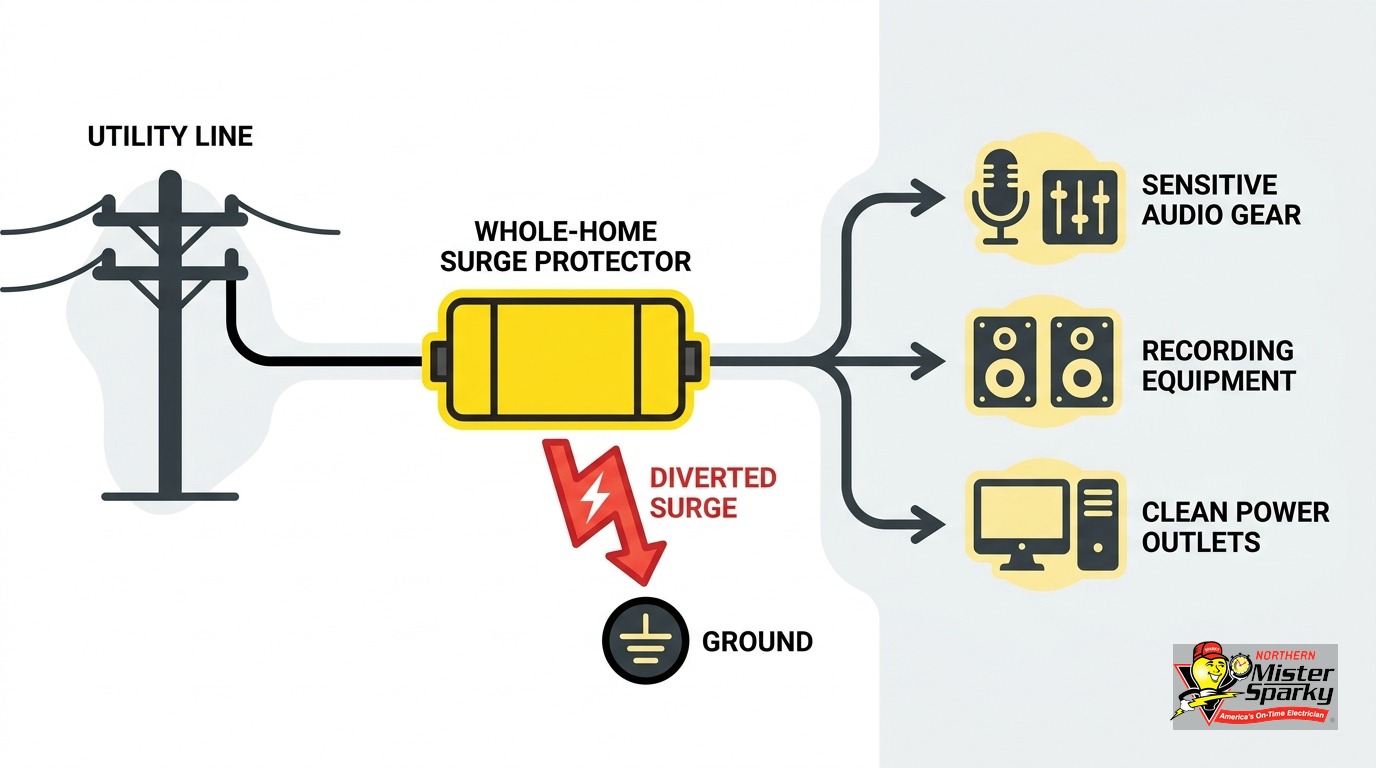
- Under NEC 230.67(A), whole-home surge protection is now required by Minnesota code - not optional. A power strip does not count.
- Isolated ground (IG) circuits reduce one specific type of electrical noise. They are frequently misapplied and can make noise worse if you mix IG and non-IG outlets on the same signal path.
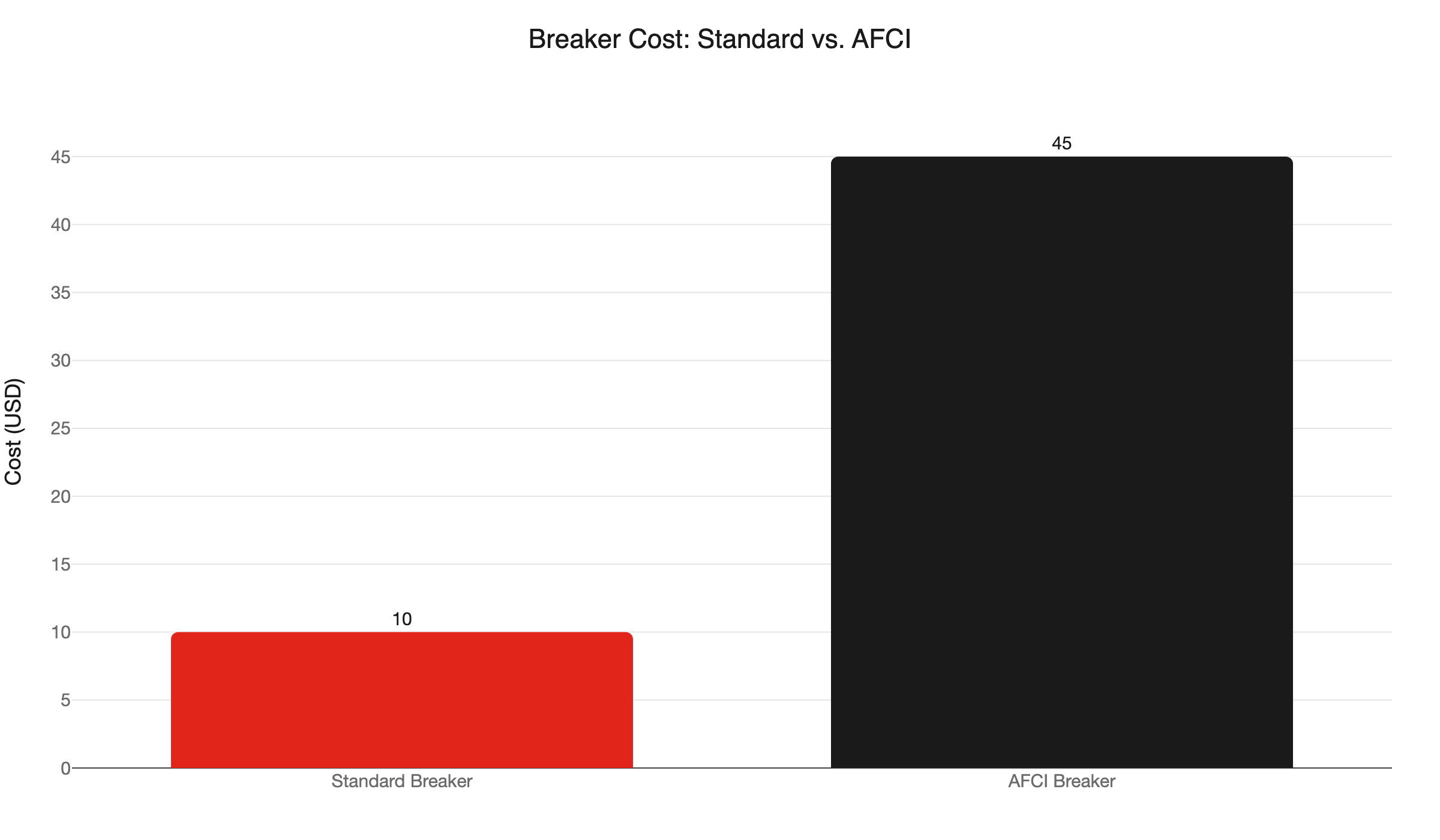
- Any finished studio room requires AFCI breakers under NEC 210.12(B). Budget $35-55 per breaker instead of $8-12 for a standard model.
- New circuits in Minnesota require an electrical permit under Minn. Stat. 326B. Permit costs range from an $85 minimum in Saint Paul to $75-$400 in Minneapolis depending on scope.
What Are the Home Recording Studio Electrical Requirements?
Short answer: A properly wired studio needs dedicated circuits sized for continuous load, whole-home surge protection at the panel, AFCI breakers in any finished room, and a permit for any new circuit work in Minnesota. Isolated ground circuits are optional but worth discussing only if noise is already a confirmed problem.
Your recording gear is among the most sensitive electrical equipment in your home. An audio interface sampling at 96kHz cannot tolerate the voltage sags and transients a refrigerator compressor or a shop vac creates. The stakes are higher than a nuisance trip during a session. Equipment that costs as much as a used car deserves wiring that treats it accordingly - and wiring that will pass inspection if you ever sell.
What follows covers what the code actually requires, what it only permits, and where most guides available online get it wrong. The biggest miss is consistent: the whole-home surge protection requirement that took effect in Minnesota in 2023 is almost never mentioned, and the isolated ground circuit is almost always oversold.
Dedicated Circuits: How Many Do You Need?
Short answer: Plan on at least two dedicated 20A circuits - one for audio gear (interface, preamps, outboard hardware), and one for computers and powered monitors. Add a third if you are also running significant lighting or a mini-split in the same room.
The reason dedicated circuits matter is not mystical. It is math. A 20A circuit provides 16A of continuous usable power after the NEC’s 80% continuous-load derating rule. A 15A circuit provides only 12A. Modern audio interfaces, studio monitors, and computers draw enough steady-state current that sharing a circuit with anything else - a space heater, a laser printer, or even a strong LED fixture - risks nuisance tripping or voltage fluctuation that shows up as noise in a recording.
Use 12 AWG wire on 20A circuits and 14 AWG on 15A circuits. A 20A circuit wired with 14 AWG is a code violation and a fire hazard. If you are not sure what gauge is already in your walls, your electrician will verify it before adding any load.
A third circuit is worth planning if your studio also functions as a finished workspace with its own lighting load, wall-mounted cooling, or a rack of gear that runs warm and needs continuous ventilation. Mixing lighting and audio on one circuit is technically acceptable. In practice, dimmer switches on the same circuit as a sensitive audio interface are a reliable source of audible noise. Many dimmers generate high-frequency switching artifacts that a nearby interface will pick up. Keeping them on separate circuits eliminates the problem entirely.
If your studio is in a room originally built for another purpose, do not assume you can tap an existing circuit. Have an electrician check both the wire gauge and the existing load. A circuit that appears idle may still be feeding outlets in an adjacent room or a closet you do not use. Adding studio gear to an already-loaded circuit defeats the purpose.
For more on how to plan dedicated circuits and what they cost, see our overview of dedicated circuits for appliances.
Does a Home Studio Need Surge Protection?
Short answer: Yes, and in Minnesota it is no longer just good practice - it is the law. Under the NEC, all residential electrical services must have a whole-home surge protective device. Minnesota adopted the 2023 NEC effective July 1, 2023.
Surge protective devices (SPDs) are classified by where they sit in the system. A Type 1 device is installed ahead of the main disconnect on the utility side of your panel. A Type 2 device is installed at the load side of the service panel. Either satisfies the NEC requirement. Most residential installations use Type 2. Both are engineered to clamp large transient voltages - from a lightning strike or a utility switching event - before they reach your branch circuits.
The NEC is explicit: point-of-use power strips do not satisfy the code requirement. A power conditioner sitting under your desk is not a substitute for panel-level protection. Type 3 devices at the equipment level are still worth having - they catch transients that slip past the panel device - but they are supplemental, not primary.
The NEC applies this requirement to service replacements and upgrades, not only new construction. If your panel was replaced in the last few years without an SPD, your installation is likely out of compliance with current Minnesota code.
NEC 215.18 adds a further layer: feeder panels serving dwelling units also require SPDs. If your studio runs off a subpanel in a finished basement or detached garage, that subpanel needs its own device.
For a studio owner, the code change is straightforwardly good news. Gear worth $10,000 or more is sitting on circuits that are now required to have the protection they probably did not have a few years ago. If your home is older and the panel has not been inspected recently, confirm the SPD is present before connecting anything you cannot easily replace. We cover the full picture in our whole-home surge protection guide.
What Is an Isolated Ground Circuit, and Do You Actually Need One?
Short answer: An isolated ground (IG) circuit runs its ground conductor directly back to the service panel without bonding to intermediate ground buses. It can reduce common-mode noise on sensitive gear. It is not required by code for audio use, and results vary widely. Ask about it only when you have a confirmed noise problem - not as a default specification.
Under the NEC, an IG receptacle’s ground terminal is electrically isolated from its metal mounting structure. The circuit carries four conductors in a single cable or conduit: line, neutral, isolated ground, and safety ground. The isolated ground conductor passes through any intermediate panels without bonding to their ground buses and terminates only at the original service panel.
IG receptacles are required by code to display an orange triangle on the face. Many manufacturers make the entire receptacle body orange. If you have seen an orange outlet in a recording studio or a server room, that is what it is.
What IG circuits can and cannot do
The physics of what IG accomplishes is specific. It reduces common-mode noise only. That is interference appearing equally on both the hot conductor and the ground conductor at the same time. It does not reduce differential-mode noise, which travels between the two signal conductors. Most audible hum in a home studio is differential-mode noise - typically ground loop noise introduced through cable shields that bridge two different grounding paths.
The NEC does not endorse any specific audio benefit from IG circuits. Results in practice range from no measurable improvement to increased noise, depending on the specific installation. Do not let anyone sell you an IG circuit as a guaranteed fix for studio noise without first identifying what type of noise you have.
The Common Mistakes That Defeat Isolated Ground
Even a correctly specified IG circuit fails if it is installed wrong. Two errors are common enough that they are worth naming explicitly before you decide whether to spec one.
Running the isolated ground to a separate ground rod. This is a code violation under NEC 250.96(B) and a shock hazard. According to ProSoundWeb, the IG conductor must terminate at the service panel - not at a rod driven into the soil next to your studio. A separate ground rod provides no low-impedance path for fault current. A wiring fault in the circuit has nowhere safe to go. This is sometimes done by installers who believe a “clean earth ground” is the goal. It is not. Safety is the goal, and the code reflects that.
Mixing IG and non-IG outlets on the same signal path. If your audio interface is plugged into an IG outlet but your monitor controller is plugged into a standard outlet, and you run a balanced cable between them, the cable shield picks up the ground potential difference between the two circuits. That difference is precisely the noise you installed the IG circuit to eliminate. Every device in a shared signal chain needs to be on the same isolated ground system, or the system does not work - and may be noisier than before.
A third failure mode: plugging a signal cable from an IG outlet to a non-IG outlet in another room re-introduces noise through the cable shield, defeating the isolation entirely. This happens constantly in real-world home studios where gear is borrowed from another room or a friend brings their laptop to the session.
These failure modes are common enough that many experienced audio engineers skip IG circuits in home studios entirely and focus on proper cable routing and balanced connections instead. We share that instinct unless a specific noise problem has been traced to common-mode interference by someone who knows the difference.
Are AFCI Breakers Required in a Finished Home Studio?
Short answer: Yes, if the studio is in a finished room. The NEC requires AFCI protection on circuits in bedrooms and similar finished spaces. A finished basement studio, a converted bedroom, or a purpose-built studio room all qualify. Budget accordingly.
AFCI stands for arc fault circuit interrupter. A standard circuit breaker responds to overcurrent: too much current flows and the breaker trips. An AFCI breaker also monitors for the electrical signature of arcing, which can occur at normal current levels when wiring is damaged, pinched behind drywall, or improperly connected at a terminal. Arcing is a leading cause of residential electrical fires. A standard breaker cannot detect it.
NEC 210.12(D) adds an important point. Extending or modifying an existing circuit in a covered area triggers the AFCI requirement regardless of the home’s age. If you are adding one outlet to an existing bedroom circuit to power a new piece of studio gear, the breaker feeding that circuit must be upgraded to an AFCI model. You cannot simply extend the run on the existing standard breaker.
AFCI breakers cost $35-55 each, compared to $8-12 for a standard breaker. That is roughly a four-to-one price difference per slot. On a studio adding three new dedicated circuits, the AFCI requirement adds $75-$130 to the breaker budget. That is not an unreasonable number given what the circuits are protecting, and it is not negotiable under current Minnesota code. See our post on AFCI breaker requirements explained for a full breakdown of where AFCI applies and where it does not.
Do You Need a Permit for Studio Electrical Work in Minnesota?
Short answer: Yes. Any new dedicated circuit in Minnesota requires an electrical permit under Minn. Stat. 326B, whether a licensed electrician pulls it or you do as a homeowner-occupant. Skipping it means the work is uninspected and potentially a liability when you sell or file an insurance claim.
Minnesota adopted the 2023 NEC effective July 1, 2023. The 2026 NEC takes effect August 17, 2026. Any circuit added under the current code must comply with 2023 NEC requirements, including the whole-home SPD requirement and AFCI protection in finished rooms.
Permit costs vary by city. Saint Paul charges $15 per circuit with an $85 minimum. Minneapolis ranges from $75 to $400 depending on scope. The state minimum per inspection is $55. When comparing bids, confirm whether the permit fee is included or ask for it as a separate line item. Some contractors bundle it; others pass it through at cost.
Owner-occupants of a single-family home in Minnesota may pull their own permit and do the work themselves. The inspection is still required. The inspection is what makes the work legal, code-compliant, and insurable. Work that fails inspection must be corrected and re-inspected before it is covered.
An unpermitted circuit that surfaces during a home sale is a real problem. The buyer’s inspector will flag it, and you will be negotiating either a retroactive permit and inspection or a credit to the buyer. The permit is inexpensive insurance. Our guide to the electrical permit process in Minnesota covers what to expect from start to inspection.
What About Panel Capacity and Rebates?
Short answer: Xcel Energy does not currently offer rebates for SPD installation or isolated ground circuits, but does offer up to $1,500 for qualifying panel upgrades. If your panel has no open slots, your studio build may require an upgrade or subpanel before new circuits can be added.
Adding two or three dedicated 20A circuits is a straightforward job on a panel with available slots. If your panel is full or close to full, the conversation changes. A panel running near capacity needs an upgrade before new circuits can be safely added. That upgrade may also trigger the whole-home SPD requirement under NEC 230.67(D) if it has not already been addressed.
Xcel does not currently offer rebates specifically for SPD installation or isolated ground circuits. The Xcel panel upgrade rebate - currently up to $1,500 for qualifying work - may apply if your studio build requires a service upgrade. See our post on Xcel Energy electrical rebates for Minnesota homeowners for current program details and eligibility.
If your studio is in a detached structure - a converted garage, a backyard outbuilding, or a standalone room off the main house - running new circuits from the main panel involves underground wiring to a subpanel in the detached space. That is a larger scope, a separate permit, and a different conversation about wire depth and conduit type. The subpanel in a detached structure also needs its own SPD under NEC 215.18, which is easy to address during the installation and expensive to add after the drywall is closed.
Ready to Wire Your Studio Right?
Home recording studio electrical requirements come down to a short list: dedicated circuits on properly sized wire, a whole-home SPD at the panel, AFCI breakers in any finished room, and a permit before work starts.
Isolated ground circuits are worth specifying only if you have a confirmed common-mode noise problem and are willing to build every device in the signal chain around the same IG system. They are not worth adding as a blanket precaution. Get your cable routing and balanced connections right first - that resolves most studio noise without touching the wiring at all.
We are locally owned and operated in the Twin Cities, and we back every job with the UWIN(R) 100% satisfaction guarantee. We have wired studios, home theaters, and equipment-heavy workspaces throughout Minneapolis, St. Paul, Bloomington, and the surrounding metro. We know what actually shows up as noise in a recording versus what sounds good in a spec sheet. No malarky.
As America’s On-Time Electrician(R), we show up when we say we will. Call us at 763-200-5956 or book online to schedule your studio electrical consultation.
Frequently Asked Questions
Do I need a dedicated circuit for a home recording studio? +
Is whole-home surge protection required by code in Minnesota? +
What is an isolated ground circuit and do I need one? +
Do home studio circuits require AFCI breakers? +
Need an electrician now?