
Home Server Rack Dedicated Circuit Requirements Guide
Key Takeaways
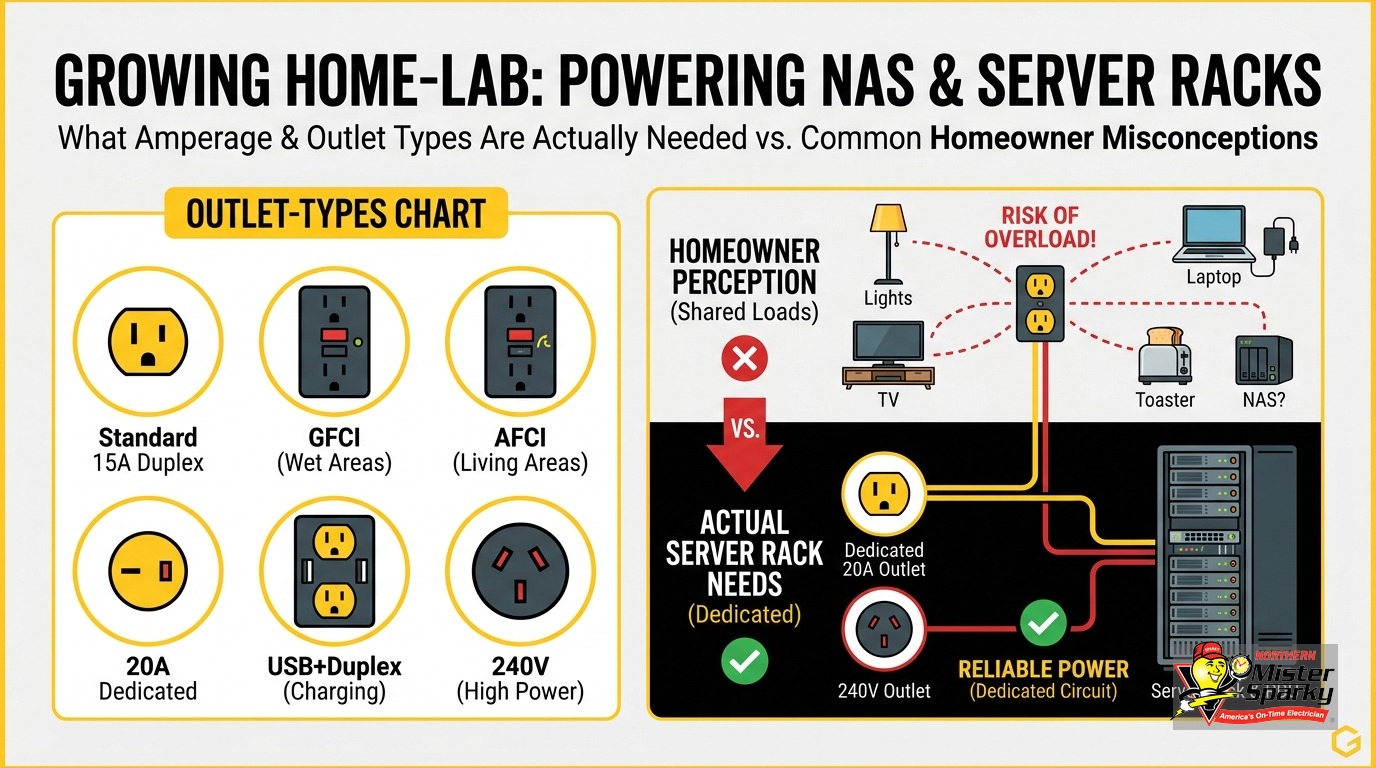
- A standalone NAS drawing 30-55W can share a circuit as long as no high-draw appliances are on the same breaker.
- The NEC defines always-on gear as a continuous load. Size the circuit and breaker at 125% of the calculated draw, not 100%.
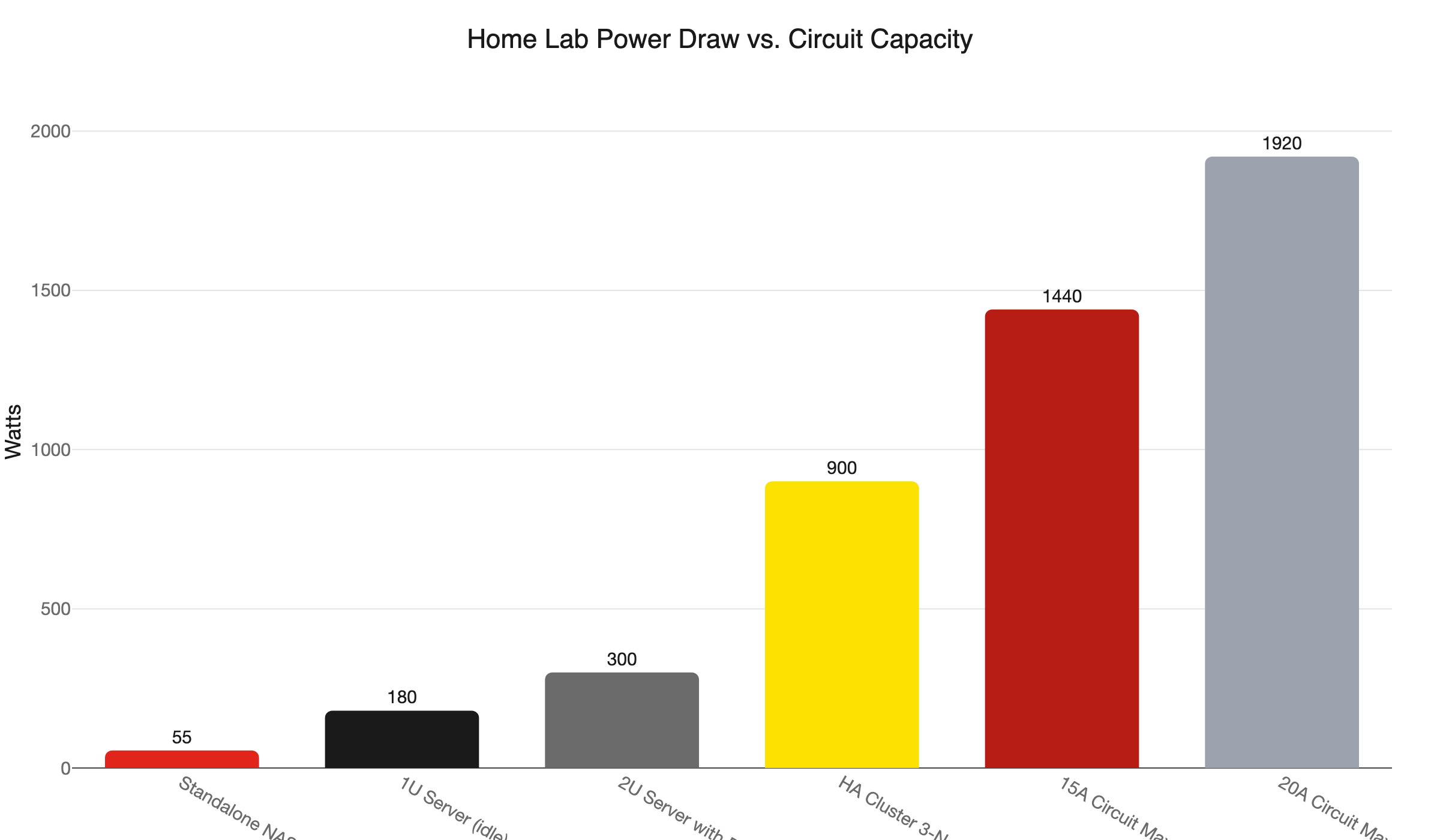
- A 15A circuit allows a maximum continuous load of 1,440W. A 20A circuit allows 1,920W. Any rack approaching those limits needs its own dedicated circuit.
- Minnesota adopted the 2026 NEC on August 17, 2026. Every new 120V branch circuit in a home now requires an AFCI breaker with no room exemptions.
- A permit is required for every new dedicated circuit in Minnesota.
- In a Minnesota winter, a 1,500W portable space heater on the same 15A circuit as a home lab is a guaranteed nuisance trip.
- Outlet type scales with load: NEMA 5-20R for a small rack, NEMA L5-20R or L6-30R for high-density builds.
Does a Home Server Rack Need Its Own Dedicated Circuit?
Yes, in most cases. If your rack draws more than roughly 1,000W at peak, or shares a circuit with any high-draw appliance, a dedicated circuit is not optional. It is the correct baseline for reliability and code compliance.
A standalone NAS averaging 16-55W active is a different animal than a full server rack. A NAS-only setup on a shared circuit is fine as long as nothing high-draw is on the same breaker. The moment you add a 1U server, a UPS, and a managed switch, your load climbs into the range where shared circuits cause real problems.
The math matters here. A 15A circuit’s continuous load is capped under the NEC’s continuous-load rule. That sounds like a lot until you factor in a portable space heater at 1,500W, a laser printer spiking to 600-800W on startup, and a UPS adding overhead on top of your server draw. Put any two of those together on the same 15A breaker and a trip is a matter of when, not if.
The more a home lab grows, the clearer the answer becomes. A dedicated circuit is the correct starting point, not a luxury upgrade.
Why Twin Cities Home Labs Trip Breakers Every Winter
This is a Minnesota-specific problem that most wiring guides miss entirely.
From October through April, portable space heaters are standard equipment in Minnesota home offices and finished basements. These are the same rooms where home-lab gear lives. A 1,500W space heater, a server running at moderate load, and a couple of monitors can sit comfortably on a shared 15A circuit during summer. Then the first cold morning arrives and the breaker trips.
A 15A circuit has a continuous-load ceiling. That is the 80% rule applied to always-on loads. A space heater draws 1,500W by itself, which exceeds the limit before your server contributes a single watt. Add even a modest 150W server load and you are well past what the circuit allows.
The fix is not a bigger breaker. A 15A breaker is correct for a 15A circuit. The fix is a dedicated circuit for the home lab, separate from the general-purpose outlets that serve the space heater and other room loads. Each load gets the headroom it needs. Neither one nuisance-trips the other.
For a broader look at which household loads are most likely to land on shared circuits and why that creates problems, our guide on dedicated circuits for common household appliances covers the full picture.
What Appliances Need a Dedicated Circuit Under the NEC?
The NEC does not list “home server rack” by name. But the continuous-load sizing rules in NEC 210.19 and 210.20 effectively require a dedicated or correctly sized circuit for any always-on equipment that draws enough amperage to push a shared circuit over its limits.
The NEC defines a continuous load as one expected to operate at maximum current for three or more hours. Under NEC 210.20(A), the overcurrent device must be rated at not less than 125% of that continuous load. A NAS or server running 24 hours a day qualifies by definition. A load calculated at 12A continuous needs a 15A breaker at minimum (12 x 1.25 = 15A). A 16A continuous load needs a 20A breaker.
The practical rule: do not size the circuit for the average draw. Size it for the rated draw multiplied by 1.25.
Named appliances the NEC explicitly calls out for dedicated circuits include electric ranges, dryers, dishwashers, refrigerators, and HVAC equipment. Home servers are not in that list, but the load math pushes any serious rack toward a dedicated circuit regardless.
For the distinction between 15A and 20A circuits and what that means at the outlet and breaker, our guide on 20A vs. 15A outlets and circuits explains the hardware differences clearly.
How Do You Size the Circuit for a Home Lab?
Add up the wattage of every device in the rack. Multiply by 1.25 for the continuous-load rule. Choose the next standard breaker size up. For most home labs, the answer is a 20A dedicated circuit.
Here is the math at three common scales:
Standalone NAS only: Synology NAS models like the DS225+ and DS925+ differ notably in active power draw. Even a 4-bay NAS rarely exceeds 55W continuous.
- 55W x 1.25 = 69W required circuit rating.
- 69W / 120V = 0.58A. A 15A circuit covers this with enormous headroom.
Small rack (1U server + NAS + switch + UPS):
- 1U server idle: 150W
- 4-bay NAS: 55W
- 8-port managed switch: 20W
- UPS overhead: 35W
- Total: approximately 260W continuous, with 400-500W bursts on spin-up.
- 260W x 1.25 = 325W required. At 120V: 2.7A continuous.
- A 15A circuit technically covers the steady-state draw. But hard-drive spin-up creates inrush current that can be 4-5x the idle draw for a fraction of a second. A 20A circuit is the right call for any setup with spinning drives.
Full rack (3-node HA cluster + NAS + switch + UPS): A 3-node cluster with NAS and networking draws considerably more at peak than at idle.
- At 900W peak: 900W x 1.25 = 1,125W required.
- 1,125W / 120V = 9.4A continuous. A 20A circuit’s 16A continuous allowance (1,920W) covers it.
- But a fully populated rack can draw heavily enough to max out a standard circuit and leave nothing for inrush.
- At that scale, a 240V circuit is the correct answer.
Design for the rack you will have in two years, not the rack you have today. Running a heavier circuit once costs less than adding a second circuit later.
What Outlet Type Does Your Home Server Need?
A standalone NAS needs nothing exotic. A NEMA 5-20R (20A T-slot) outlet is the correct minimum for a small rack. High-density builds and dual-PSU servers benefit from a 240V NEMA L6-30R twist-lock circuit for efficiency and long-term stability.
Outlet types by use case, based on NEMA outlet standards for rack equipment:
- NEMA 5-15R (standard 120V, 15A): Fine for a standalone NAS at 16-55W. Not the right outlet for a full rack.
- NEMA 5-20R (120V, 20A T-slot): The minimum for a small rack. Requires 12 AWG wire and a 20A breaker. The T-slot shape accepts both 15A and 20A plugs.
- NEMA L5-20R (120V, 20A twist-lock): PDU and rack-mount UPS grade. The locking blade keeps the cord seated through vibration and maintenance.
- NEMA L6-30R (240V, 30A twist-lock): The right choice for a high-density rack or any setup with dual-PSU servers. Higher voltage delivers the same wattage at lower current, which means less heat in the wire and a smaller ampacity requirement relative to the load.
The twist-lock formats are worth the upgrade when your rack uses a proper PDU with a locking inlet. A cord that seats positively is one fewer failure point in an always-on system.
The installation process for a 240V outlet for a home lab follows the same general approach we cover in our 240V outlet installation guide.
What Components Does a Home Server Need?
A home server build has a few standard pieces: compute hardware, a network switch, a UPS for protection and runtime, and a PDU to route power from the wall to multiple rack devices. From an electrical standpoint, the PDU determines your outlet type, so plan the electrical supply starting from the PDU, not the server.
The compute hardware is the server or NAS itself. CPU, RAM, and storage drives are the core. Consumer NAS units from Synology or QNAP are self-contained. DIY builds use a desktop or rack chassis that you configure yourself.
The network switch connects all your gear to your router. An 8-port or 24-port managed switch is typical for a home lab.
The UPS protects against power surges and short outages. It is not optional if the server holds data you cannot afford to lose. Size the UPS for at least 1.25x your total connected load and choose a runtime appropriate for your needs.
The PDU routes power from the wall outlet to multiple rack devices. A basic PDU is a rack-mount power strip using a NEMA 5-20R inlet. A managed or metered PDU uses a twist-lock L5 or L6 inlet for a positive-lock, monitored connection to the dedicated circuit. That inlet type is what drives the outlet choice at the wall.
How Big of a Network Rack Do I Need?
Rack size is measured in rack units (U), where 1U equals 1.75 inches of vertical space. A starter home lab typically fits in a 6U to 12U rack. A serious multi-server build runs 18U to 24U. From a circuit perspective, wattage drives the breaker size, not rack height.
A 12U rack with a single server, NAS, and switch may draw under 300W and run comfortably on one 20A circuit. A 24U rack fully populated can exceed 1,500W and needs a 240V circuit or two separate 20A runs fed through a dual-circuit PDU.
The practical rule: count the watts in your rack, add 25%, and pick the circuit size that covers it. Then size up one step to account for growth. A 12U rack you plan to expand to 24U in two years is worth running a 240V circuit from the start.
At the larger scale, weight matters as much as electricity. A fully loaded 24U rack can weigh 500-700 pounds. Plan the rack location with your floor structure in mind.
What Minnesota Requires for a New Dedicated Circuit
Minnesota adopted the 2026 NEC on August 17, 2026. The permit date governs which code applies. Permits pulled on or after that date must comply with the 2026 NEC.
The change that most directly affects home-lab installs: AFCI protection is now required on every 120V, 15A/20A branch circuit in a dwelling unit. There are no room exemptions remaining. A new dedicated circuit for a home lab requires an AFCI breaker regardless of where in the house the equipment room is located. If you have an older panel and AFCI retrofit costs are a concern, our guide on AFCI breaker retrofit cost for older homes covers the options.
Permits are required, no exceptions based on complexity or scope. A permit is required for any new branch circuit in Minnesota. Homeowners in an owner-occupied single-family home may self-permit and do the work themselves. Two inspections follow: rough-in before walls close, and final after energization. Starting without a permit triggers an investigation fee from the Minnesota Department of Labor and Industry. Unpermitted work can also complicate a home sale or void coverage on an insurance claim tied to an electrical incident. The full permit walkthrough is in our Minnesota electrical permit guide.
This is what most online guides skip entirely. Recommending a 20A dedicated circuit without mentioning permits, the continuous-load rule, or AFCI requirements is not harmless advice. It leads to failed inspections and coverage gaps.
Does a Home Lab Affect the Rest of Your Electrical System?
It can. Every new circuit draws from your panel’s available capacity. A 100A or 150A service, common in Twin Cities homes built before 2000, has finite breaker slots and finite total ampacity. Adding a home lab alongside other large loads may require a service upgrade before the circuit run.
A 3-node home lab, an EV charger, and an electric water heater added to a 100A panel is a load calculation conversation, not a simple circuit-run job. If your panel is already carrying significant load, a service upgrade or a dedicated subpanel may be the right first move. Our guide on 100-amp vs. 200-amp electrical service covers the breakeven point and what drives the upgrade decision.
We are locally owned and operated in the Twin Cities, and we assess your existing panel before recommending any new circuit run. No guesswork about what your service can absorb.
Ready to Run a Dedicated Circuit for Your Home Lab?
Our team handles every step: permit application, circuit run, AFCI breaker installation, and both inspections. The sizing decision below narrows down the right circuit for your specific setup.
Here is the summary:
- Standalone NAS under 100W: An existing 15A or 20A circuit works if no high-draw appliances share it. A dedicated circuit adds reliability but is not a code requirement at this load size.
- Small rack under 500W peak: A 20A dedicated circuit with a NEMA 5-20R outlet. 12 AWG wire, 20A AFCI breaker, permit required in Minnesota.
- Medium rack 500-900W peak: A 20A circuit covers it now, but a 30A or 240V circuit gives real headroom for growth. Discuss with an electrician before committing to the lighter run.
- Full rack above 900W or dual-PSU servers: A 240V L6-30R circuit. Lower current at higher voltage means less heat and better efficiency for always-on gear.
Call 763-200-5956 or book online to schedule your home lab circuit install.
For more on related always-on loads, our guide on home theater dedicated circuit planning covers a comparable AV setup with similar sizing questions. Our post on sump pump dedicated circuit requirements covers another always-on load with its own Minnesota code specifics worth knowing before you start pulling permits.
Frequently Asked Questions
Can I plug my NAS directly into a standard wall outlet? +
Does a server running 24/7 count as a continuous load under the NEC? +
What happens if I add a circuit without a permit in Minnesota? +
Need an electrician now?