
Home Theater Electrical Requirements: Dedicated Circuit
Key Takeaways
- A serious home theater needs two to three 20-amp dedicated circuits, not one.
- NEC Article 210.19(A)(1) limits a 20-amp circuit to 1,920 watts continuous. A full AV system can reach or exceed that limit before lighting is added.
- Minnesota adopts the 2026 NEC on August 17, 2026. Permits filed on or after that date fall under the new code, including the panel-level surge protection requirement.
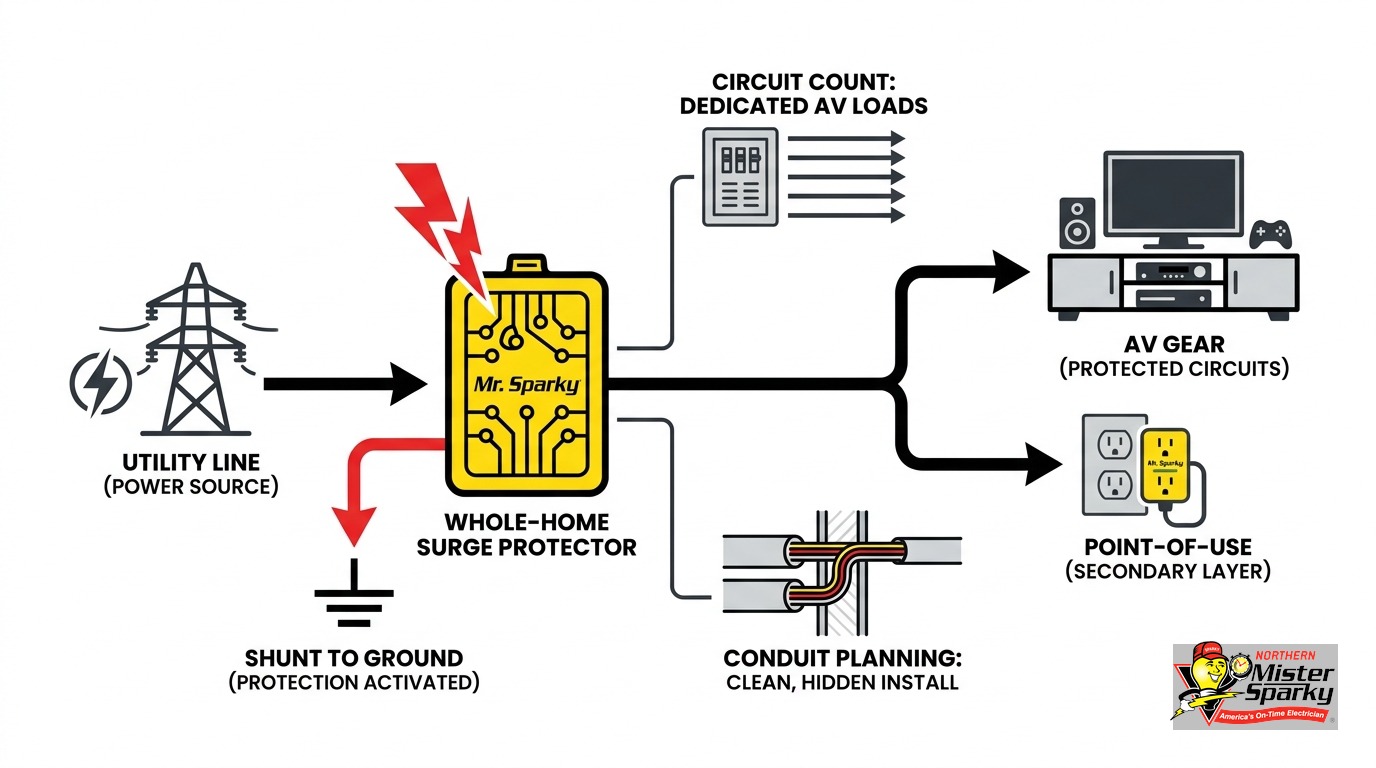
- Layer your surge protection: a Type 2 whole-panel SPD at the breaker box, plus a quality point-of-use strip at the AV rack.
- Twin Cities basement theaters can trigger GFCI requirements under NEC 210.8 if moisture is present.
- Long panel-to-room runs over 80 to 100 feet may need 10 AWG wire to stay within the 3 percent voltage drop recommendation.
- In the Twin Cities, most electrical permits go to the city or suburb, not the state DLI.
Home Theater Electrical Requirements: Planning the Dedicated Circuit
Building a home theater is one of the higher-stakes electrical projects in a residential home. The home theater electrical requirements for a dedicated circuit go well beyond adding an outlet. Circuit count, wire gauge, surge protection layers, conduit planning, and Minnesota permit rules all factor into a clean, code-compliant install.
This guide is written for Twin Cities homeowners planning a serious AV room: basement theaters, dedicated media rooms, and whole-room AV builds. We will cover the electrical side from panel to rack in plain language, with the Minnesota-specific details that out-of-state sources consistently miss.
What Are the Home Theater Electrical Requirements for a Dedicated Circuit?
A dedicated circuit isolates your AV equipment from the rest of the home’s wiring. At minimum, a home theater needs one 20-amp, 120-volt dedicated circuit on 12 AWG copper. Most complete builds need two to three circuits to keep amplification, display components, and motorized gear on separate breakers.
The word “dedicated” does a lot of work here. A dedicated circuit serves one location or equipment group only: no other outlets, no other loads share the breaker. That isolation keeps voltage stable under heavy draw and eliminates the interference that shared circuits introduce into audio and video equipment.
For a modest setup - one receiver, one display, and a streaming box - a single 20-amp circuit often covers it. Once you add a powered subwoofer, a gaming console, motorized blackout shades, or dimmable theater lighting, you are looking at a multi-circuit rough-in. Plan those circuits while the walls are open. Doing it after drywall costs significantly more in labor and patching.
How Many Dedicated Circuits Does a Home Theater Need?
Start at two 20-amp circuits for any serious build. One handles amplification. The second handles display and source components. A third is worth running if you plan a motorized screen, lighting control, or powered seating. Running a single circuit is possible for a minimal setup, but leaves almost no headroom.
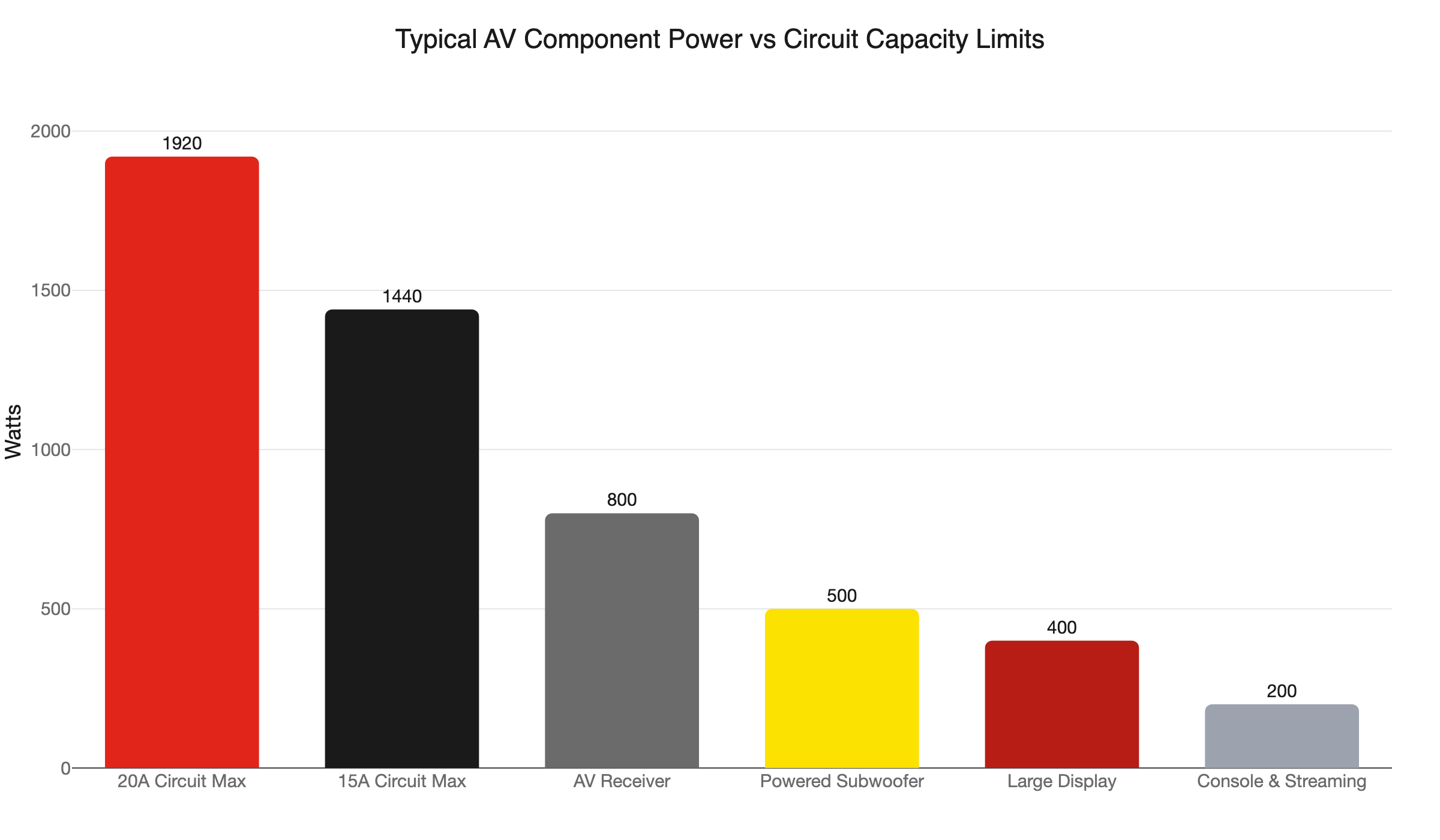
Here is why the math pushes toward two circuits. NEC Article 210.19(A)(1) sets the 80 percent continuous load rule: a 20-amp circuit maxes out at 1,920 watts for loads that run continuously.
Typical AV power benchmarks:
- AV receiver: 500 to 800 watts
- Powered subwoofer: 200 to 500 watts
- Large display (75-inch or larger): 150 to 400 watts
- Streaming devices and gaming console combined: 50 to 200 watts
A receiver drawing near its peak, a large subwoofer, and a 75-inch display can push past 1,500 watts before the console is counted. Add the console and you are at or past the 1,920-watt continuous limit on a single circuit. A full AV build can easily exceed 1,920 watts before lighting or motorized gear is included.
A professional three-circuit layout separates loads this way:
- Circuit 1: AV receiver and any standalone amplifiers
- Circuit 2: Display, Blu-ray player, streaming devices, gaming consoles
- Circuit 3 (if needed): Motorized screen, lighting control, powered seating, additional subwoofers
Splitting loads also makes troubleshooting faster. If the receiver and display share a circuit and the breaker trips, you lose everything in the room. Separate circuits mean a fault on one breaker does not take down the full space.
For more context on load isolation across the home, see the dedicated circuits for high-draw appliances post.
Should All Home Theater Circuits Be on the Same Panel Leg?
Yes. Keep all home theater power circuits on the same panel leg. Circuits on the same leg share a voltage reference, which reduces ground-loop noise between audio and video components. Move dimmers and lighting controls to the opposite panel leg to keep switching transients away from the signal path.
Your main panel alternates between two legs, Line 1 and Line 2. Each breaker slot connects to one leg. When multiple AV circuits share the same leg, their chassis grounds sit at the same electrical potential. That eliminates the tiny voltage differences between component grounds that cause hum in audio systems.
This does not happen automatically when circuits are added piecemeal over the years - which is one reason older homes with several retrofitted circuits can develop persistent hum. A licensed electrician plans breaker positions intentionally as part of the theater rough-in.
A related question is whether your panel has room for two or three additional 20-amp breakers. Older Twin Cities homes may have panels already at capacity. If your electrician finds the panel is full, the leg-assignment goal and circuit count need to factor into whatever solution comes next: a tandem breaker arrangement, a subpanel, or a full panel upgrade. That conversation needs to happen before rough-in begins, not after the circuits are partially planned.
Does Minnesota Now Require Whole-Panel Surge Protection?
If you are pulling a permit for a panel upgrade or new service, yes. NEC Article 230.67 requires a Type 1 or Type 2 SPD as part of or adjacent to any service equipment serving a dwelling unit. Minnesota moves to the 2026 NEC on August 17, 2026. Any permit filed on or after that date must comply with the new code.
That timing is live. If you are scheduling a home theater project with any panel work planned for late August 2026 or beyond, your permit falls under the 2026 NEC. The panel-level SPD requirement was already in the 2023 NEC under Article 230.67, and the 2026 version does not soften it.
Even if your project does not touch the panel directly, it is worth asking your electrician to install a whole-panel SPD while they are already on-site for the theater circuits. Combining the work on one trip avoids a second service call later. A whole-panel SPD typically runs $300 to $600 installed - a modest number against a $2,000-plus AV receiver or a $3,000-plus display.
For a full look at what whole-panel protection covers, read the whole-home surge protection guide.
How Many Surge Protection Layers Does a Home Theater System Need?
Two layers minimum: a Type 2 whole-panel SPD at the breaker box and a quality point-of-use strip at the AV rack. A cheap power strip is not surge protection. It will fail silently after the first significant transient and leave your equipment exposed.
NEC Article 242 defines the three SPD tiers:
- Type 1: Installed on the line side of the service disconnect. Typical in commercial settings. Rare in residential.
- Type 2: Installed on the load side of the service equipment. This is the whole-panel unit mounted inside your main breaker box. Required under NEC 230.67 for any new or upgraded service.
- Type 3: Point-of-use protection at the outlet or rack strip. Code requires at least 30 feet of conductor distance between the panel and a Type 3 device before it can be used.
Type 2 catches the large transients entering from the utility: lightning strikes on the grid, transformer switching events, and utility restoration surges. Type 3 handles the smaller transients generated inside the home by HVAC compressors, motor loads, and dimmer switches.
For the point-of-use strip, look for at least a 2,000-joule rating and a clamping voltage of 330V or 400V. Cheap strips often carry inadequate clamping specs and fail silently - the protection status indicator goes dark when surge capacity is spent, and most homeowners never notice until after the next weather event.
Conduit Planning: Future-Proofing Your Low-Voltage Runs
Low-voltage cable - HDMI, speaker wire, ethernet, subwoofer cable, and control wiring - does not require a licensed electrician to install in most jurisdictions. The conduit pathway for those runs, however, should be planned and roughed-in while the licensed electrician is already on the job doing the power circuits.
The reason is cost. Pulling cable through closed walls after drywall is time-consuming and requires patching. Running ENT - Electrical Nonmetallic Tubing, often called smurf tube for its blue color - during rough-in costs almost nothing in materials and saves significant demolition work the next time you need to swap cables.
Three rules govern how to do this correctly:
Separation from line-voltage wiring. NEC prohibits mixing low-voltage data and signal cable with 120-volt conductors in the same conduit without a permanent physical barrier. Industry standard is a minimum of six inches of physical separation between low-voltage and 120-volt runs through framing bays.
ENT sizing. Use 3/4-inch ENT at minimum and 1-inch for any conduit pull carrying multiple cables. Always use sweep elbows, not tight 90-degree bends. A tight 90-degree bend on ENT makes future cable pulls significantly harder and risks kinking stiff HDMI cables.
EMT for EMI-sensitive runs. If low-voltage signal runs must travel parallel to 120-volt power in tight framing bays with no room for separation, EMT (steel conduit) provides EMI shielding. A grounded steel conduit acts as a Faraday cage around the signal cables inside. This is worth specifying in a dedicated theater room with high-end equipment.
Support conduit per code: every three feet on horizontal runs, every 10 feet on vertical runs.
The long-term benefit is straightforward. When you need to upgrade from an HDMI 2.0 cable to 2.1 in three years, or run a fiber optic HDMI for a very long pull, you feed the new cable through the ENT without touching drywall.
Do Basement Home Theaters Need GFCI Protection?
It depends on moisture history and how fully the space is finished. NEC 210.8 requires GFCI protection in unfinished basement areas. A fully finished, dry, climate-controlled theater room is generally treated as a habitable space and may fall outside that requirement. If moisture has ever been an issue, or the room shares a wall with an unfinished utility area, your inspector may require GFCI receptacles.
Most Twin Cities homes put the theater room in the basement. That is practical for light control, sound isolation, and thermal stability. It also creates a code question that out-of-state articles consistently skip.
Before rough-in, tell your electrician about any moisture history in the space. A dry, fully enclosed theater is different from a basement that had water intrusion two years ago. The inspector makes the final call, but your electrician needs to know before the circuit design is locked.
One practical note: GFCI protection can interact poorly with certain AV gear. Some power amplifiers have a small leakage current that nuisance-trips GFCI breakers - not a safety hazard, but an annoyance in the middle of a movie. If your inspector requires GFCI on the theater circuits, let your AV installer know before the rack is mounted and dressed so they can test the equipment with protection in place.
For a broader look at what basement electrical work involves and what it costs, see the basement finishing electrical cost guide.
What About Voltage Drop on Long Panel Runs?
For conductor runs over 80 to 100 feet, step up from 12 AWG to 10 AWG. NEC 210.19(A) recommends a maximum 3 percent voltage drop on branch circuits. Standard 12 AWG copper holds that limit to approximately 100 feet. Larger Twin Cities homes, particularly in outer-ring suburbs, often have panel-to-basement-room runs that approach or exceed that distance.
Voltage drop at 3 percent is a recommendation, not a hard code violation. It is, however, a real performance problem for AV equipment. A receiver designed for 120 volts that consistently sees 110 to 112 volts runs hotter, clips audio output sooner under load, and stresses its internal power supply over time.
The fix during rough-in is inexpensive: swap from 12 AWG to 10 AWG. The difference in wire cost per circuit is modest. After drywall goes up, rewiring a long run costs hours of labor and significant drywall repair.
One practical note: 10 AWG wire is stiffer and slightly harder to pull than 12 AWG, especially through tight framing bays or conduit with bends. Plan for it at rough-in when access is open. Asking the installer to swap back to 12 AWG to ease the pull is not the right trade on a long run to high-end AV equipment - the voltage stability is worth the extra effort.
Measure the actual conductor route before wire is ordered. The straight-line distance from utility room to theater room does not reflect the real wire path: from the panel, up to the ceiling, across the basement span, and down to the outlet box. In a larger Twin Cities home with a full basement, 90 to 110 feet of actual conductor is common on that route.
Do You Need a Permit for a Home Theater Dedicated Circuit in the Twin Cities?
Yes. Any new circuit from the panel requires an electrical permit. In the Twin Cities, most permits are pulled with the city or suburb, not the state DLI. Minneapolis, St. Paul, Bloomington, Brooklyn Park, Woodbury, Maple Grove, Blaine, and Plymouth each operate as their own AHJ (authority having jurisdiction) with their own permit process and inspection schedule.
A few jurisdiction specifics worth knowing:
- St. Paul requires a permit through DSI for any dedicated circuit installation. Low-voltage-only runs such as speaker cable, HDMI, and ethernet do not require a permit in St. Paul.
- Deephaven and Woodland residents: Minnetonka stopped serving as your AHJ on January 1, 2026. Verify your correct permit jurisdiction before scheduling any electrical work.
- Homeowners can pull their own electrical permit on a single-family homesteaded home in Minnesota. Condos, rentals, and duplexes require a licensed contractor.
When your inspector reviews the completed work, NEC Article 640 covers audio signal processing and amplification equipment. That is the governing code section for a dedicated AV circuit if the inspector asks for a reference.
For the full jurisdiction breakdown and how to find your city’s permit office, see the Minnesota electrical permit guide.
What Northern Mister Sparky Specs for a Full Home Theater Build
We are locally owned and operated in the Twin Cities. When a homeowner calls us for a home theater electrical build, a typical scope of work includes:
- Two to three 20-amp dedicated circuits on 12 AWG or 10 AWG wire, gauge determined by measuring the actual conductor route, all placed on the same panel leg
- Breaker positions planned to keep AV circuits on one leg and lighting dimmers on the opposite
- A Type 2 whole-panel SPD added if one is not already installed, pulled under permit with the correct local AHJ
- ENT low-voltage conduit in 3/4-inch or 1-inch with sweep elbows, run alongside the power circuits during rough-in
- A site walkthrough to measure actual run lengths before wire is ordered
- Permit pulled and inspection scheduled before drywall closes up
We show up when we say we will. If the panel leg assignment or run length creates a complication, we flag it before the walls are closed - not after. Every job comes with the UWIN(R) 100% satisfaction guarantee. We are America’s On-Time Electrician(R).
Call 763-200-5956 or book online to schedule service. We serve Minneapolis, St. Paul, Bloomington, Brooklyn Park, Woodbury, Blaine, Maple Grove, Plymouth, and the surrounding Twin Cities communities.
Frequently Asked Questions
Do I need a permit to add a home theater circuit in the Twin Cities? +
How many dedicated circuits does a home theater need? +
What wire gauge does a home theater circuit need? +
Will a whole-panel surge protector protect my AV equipment? +
Need an electrician now?